
The Back Bar
November 2026 24 notes
Never Turn Your Back on the Ocean
November 24, 2026 · Day 270 · 1003 words
Never Turn Your Back on the Ocean
Never Turn Your Back on the Ocean, read aloud · 5 minutes.
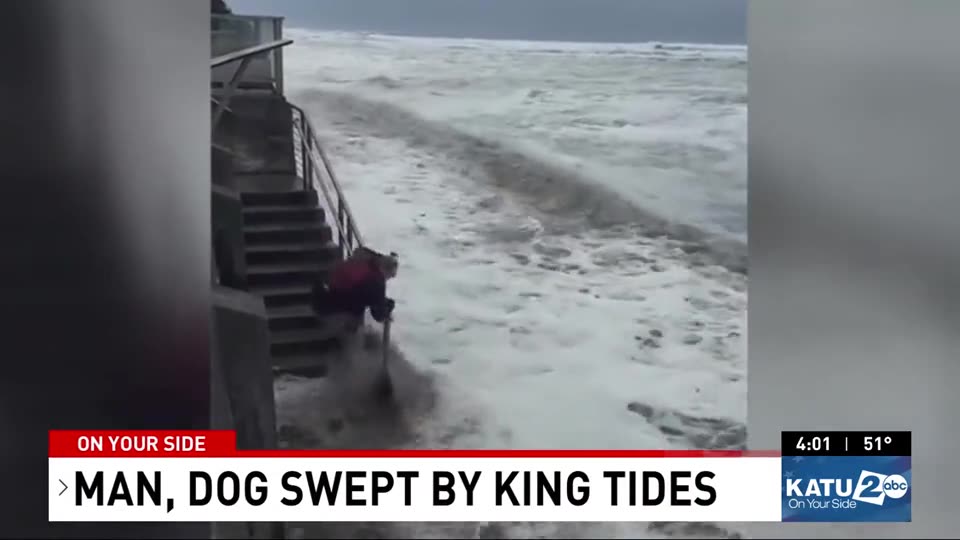
At half past ten this morning a man stood on the stairs at the Second Street beach access in Cannon Beach, Oregon, with his dog on a leash on the sand below him. The police had already told him once that day to watch the water from a distance. In the video that went around this afternoon the ocean comes up the beach without a wave in front of it, takes the dog, knocks him off the stairs and carries them both about a hundred yards along the seawall to the next set of steps. Both got out. The police used the word the whole coast is using this week: king tide.
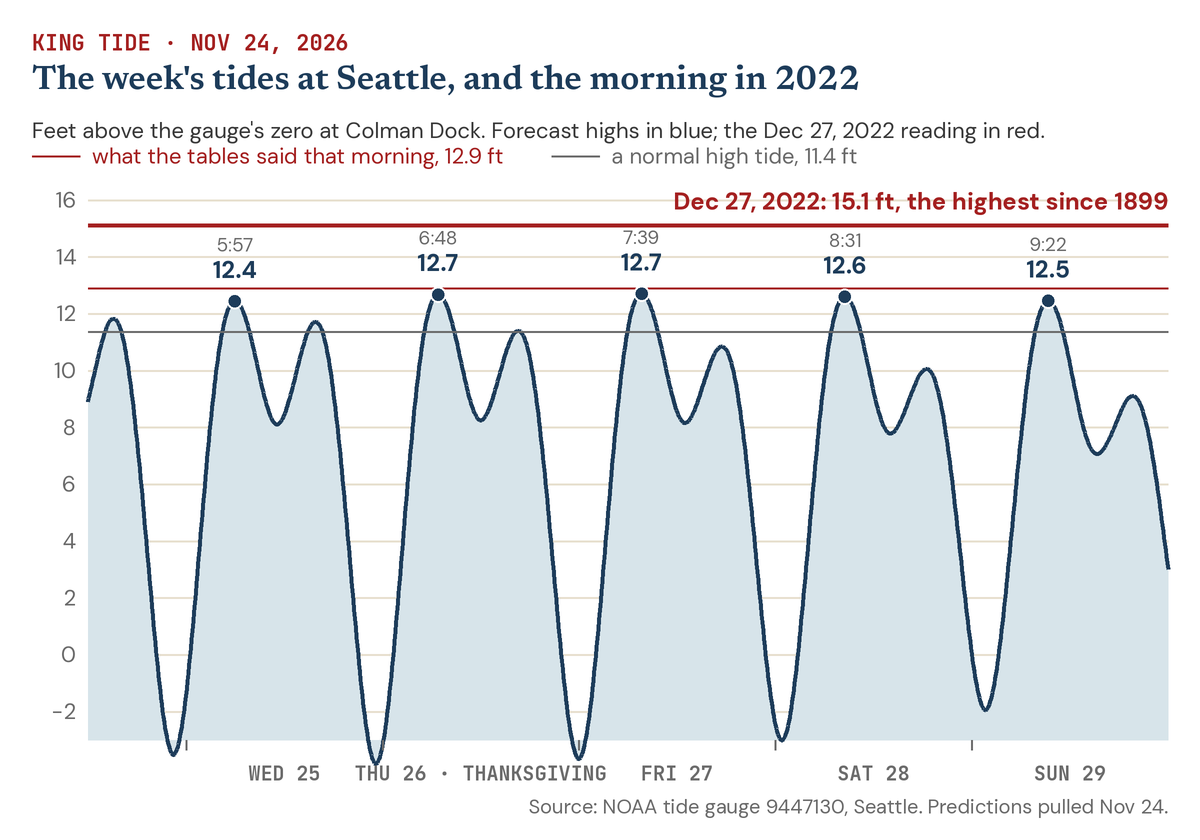
At three minutes to six tomorrow morning, while most of the city is still asleep, the water in Elliott Bay will reach twelve and a half feet on the gauge at Colman Dock, about a foot higher than a normal high tide. Thursday morning, while the turkey’s going in, it’ll be a little higher, and Friday morning higher still. The city is closing the flood wall in South Park tonight, opening a base camp at 8th and Monroe in the morning, stacking sandbags at five corners and putting extra crews on the street. That’s a king tide: the few mornings a year when the ocean comes as far up the beach as it can, and a neighborhood on the Duwamish gets ready for it like a storm.
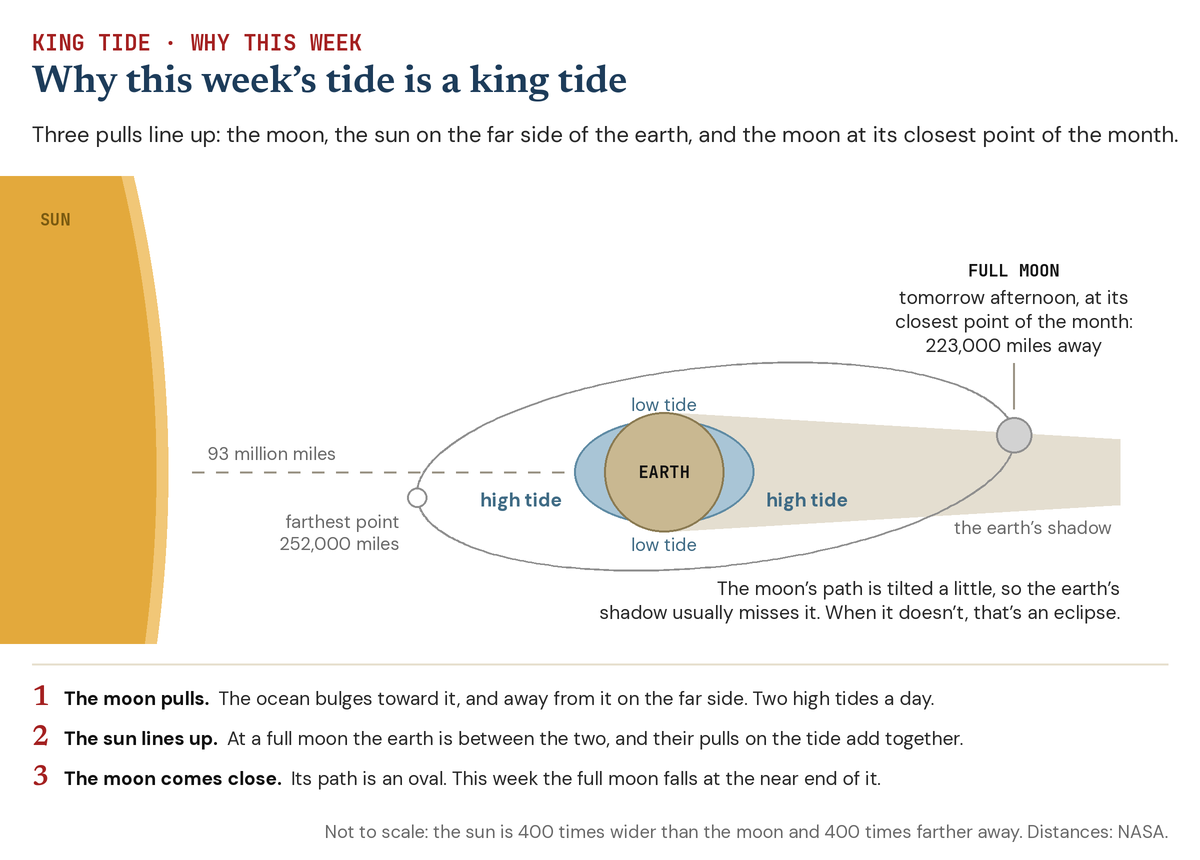
It’s one of the few things in the news this week that’s fully understood. The moon pulls on the ocean. That’s what a tide is. At a full moon the earth sits between the sun and the moon, and their pulls on the tide add together, so it runs bigger. And when the full moon comes around while the moon is also near its closest point to us for the month, it pulls harder still. That’s this week. The moon was full this morning, and tomorrow afternoon it’s at its closest point of the month. That tide is a king tide. It isn’t a storm and it isn’t climate. It’s the moon, and the tables have it worked out years ahead.
Around here the biggest ones come in winter, and they come in threes: this week, the week of Christmas, and the last week of January. Each is a little higher than the one before. The chart below is the whole year, one bar a day, and you can see the winter in it.
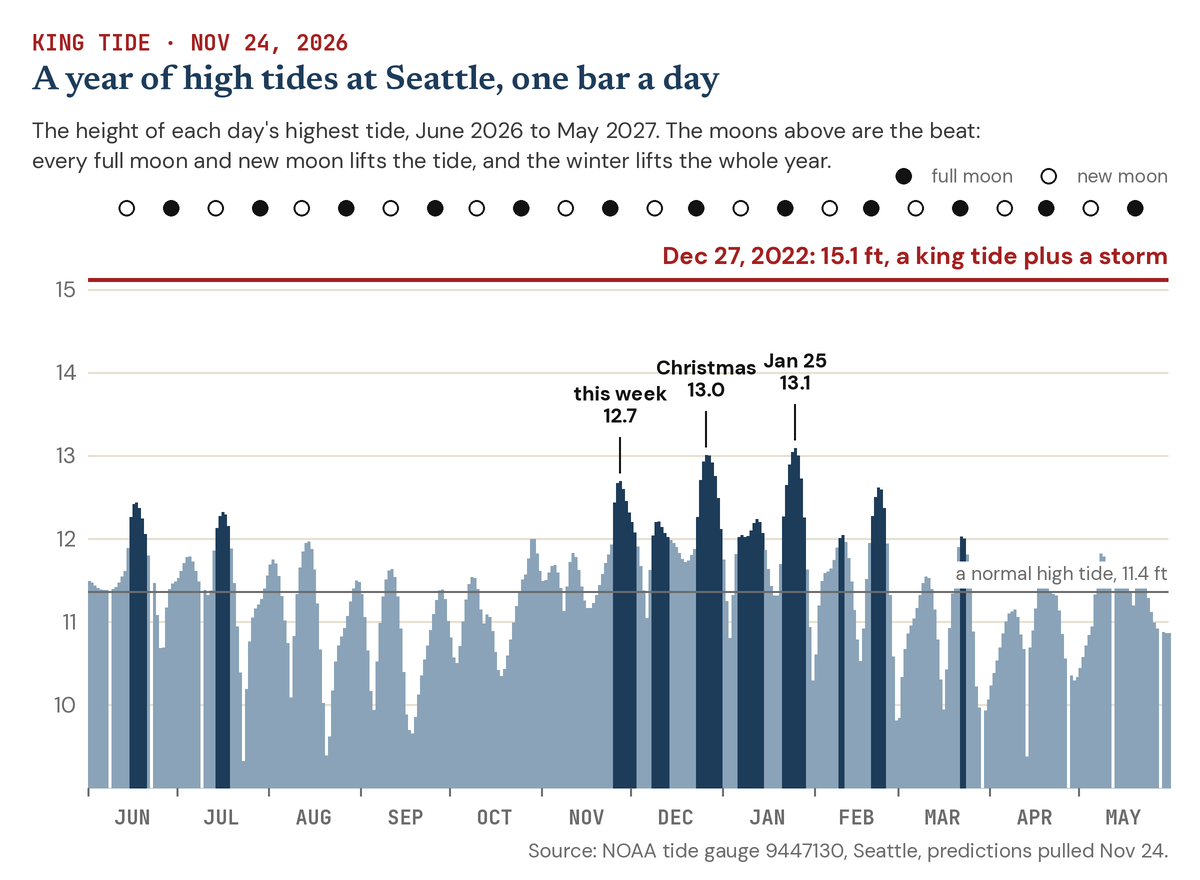
The tables can’t see the weather. On the morning of December 27, 2022, the tables said about thirteen feet at Seattle. The gauge read fifteen. That was the highest water it had measured since 1899, two feet above the forecast, and a storm did it. A storm piles the sea up under it and the wind pushes it up the Sound, and that week days of rain had filled the Duwamish River, which has nowhere to go when the bay it empties into is already full. “There’s often a lot of players involved,” Kai Parker, an oceanographer with the state Department of Ecology, told KUOW this week. Extreme water “often needs a combination of things to occur.”
This year there’s one more player. The Pacific is in a strong El Niño, which means the ocean off our coast is warmer than usual, and warm water takes up more room than cold water. So the whole sea sits a little higher this winter. KUOW’s John Ryan says the tides in the San Juan Islands this month have been running about a foot above the tables, and that this winter could break records. A foot is roughly what the ocean has risen from climate change since 1880. El Niño is adding another one on top, for a season.
South Park sits on a bend of the Duwamish, the industrial river south of downtown, on some of the lowest ground in the city. It’s a working neighborhood with a main street of taquerias and auto shops and a river so polluted the federal government has been cleaning it up since 2001. On the morning after Christmas in 2022 the river came over the bank with almost no warning and went into about twenty-five homes and a row of businesses, then did it again the next morning. The city has been sandbagging it every winter since. Paulina Lopez, who runs the Duwamish River Community Coalition, told KUOW the neighborhood has been told the sandbags are the plan until 2032.
A king tide is a preview. The water that reaches the sandbags in South Park on three or four mornings a year is roughly the water that will be there on an ordinary high tide once the sea has come up another foot, and the city’s own projection for Seattle is about a foot by 2050. That’s not a prediction about the end of the century. It’s a mortgage. The line the sandbags make along the Duwamish this week is a line on a map of what the shoreline looks like in twenty-five years, drawn by the water itself, and the people living on the wrong side of it already know.
So if you’re up early Friday, go look, from somewhere high and dry. The man at Cannon Beach was on a staircase. The rule is an old Hawaiian saying that Oregon’s park rangers made the first line of their beach safety advice, and this week it reads like scripture: never turn your back on the ocean. Alki at 7:39, or the Duwamish at the South Park bridge, or the ferry dock downtown, where the water will be lapping at the bottom of the ramp. The Sound doesn’t throw waves the way the open coast does, but it doesn’t need to; it just keeps coming. It’ll be gone by lunch. It comes back at Christmas, and again at the end of January, and every year after that a little higher than the last. The water knows the date. It always has. We’re just starting to.
Sources (16), on the site.
Routes and Resources
November 23, 2026 · Day 269 · 1491 words
Routes and Resources
Routes and Resources, read aloud · 9 minutes.
A Russian warship, the Merkury, blew up at its pier in Benghazi, Libya, on Sunday. What was it doing there? Guarding cargo ships, and the cargo was weapons for Russia’s other war, the one it’s fighting in the middle of Africa. That war isn’t a sideshow to the war in Ukraine, and the war in Ukraine isn’t really Ukraine’s alone. The countries that care about what happens in that harbor are the ones paying for Ukraine’s side: the United States, Britain, France, Germany, the rest of NATO. Ukraine can’t run a drone base on the far side of the Mediterranean by itself. Somebody lets it. The map below shows the road the weapons take. This note is about what’s at the other end of it, and why Russia cares.
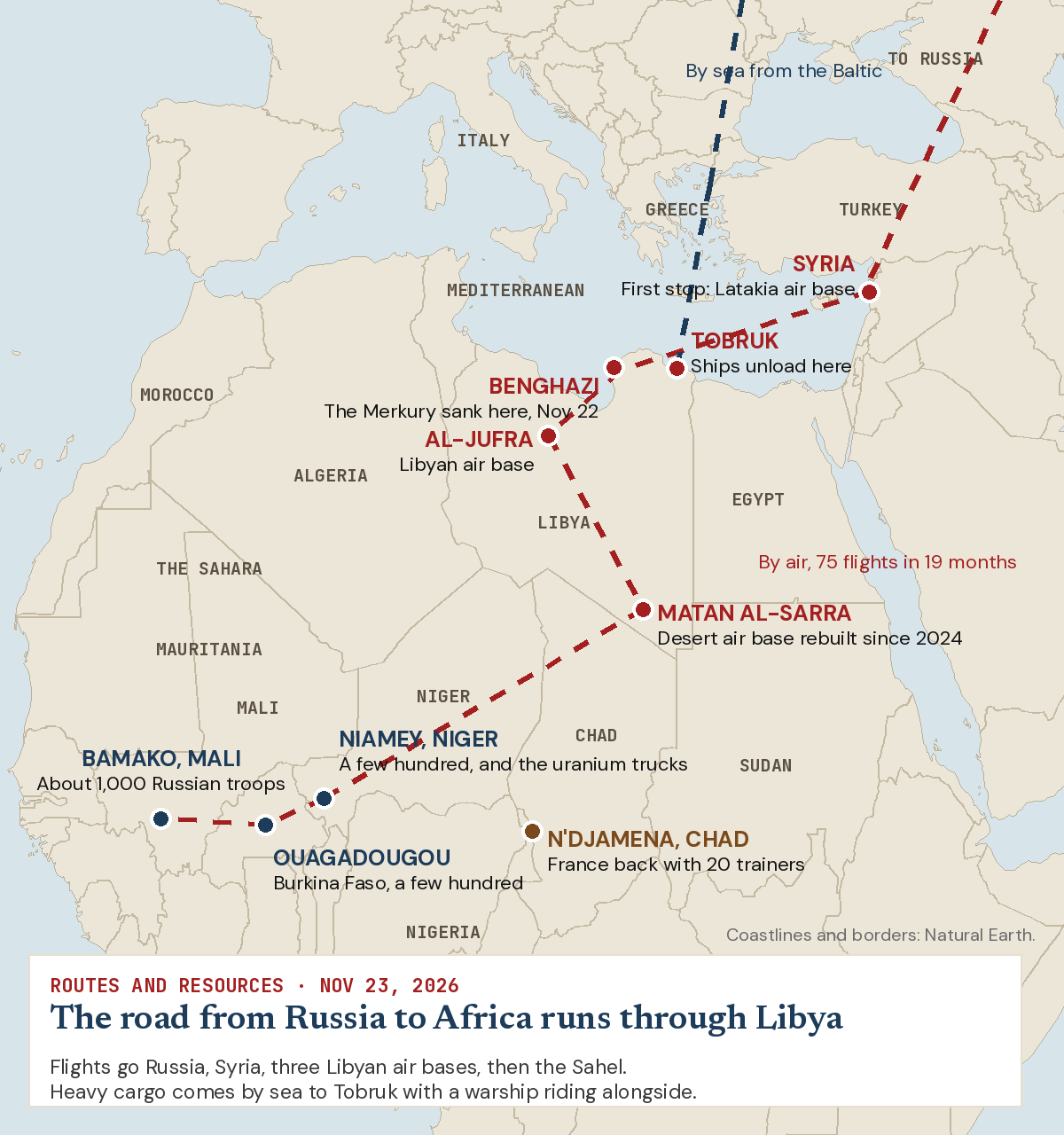
Start with why. The first reason is money that sanctions can’t reach. Russia is cut off from Western banks, and gold doesn’t need one. In Mali, Sudan and the Central African Republic, Russian mercenaries guard the gold mines, take a cut, and fly the gold out to the Emirates, where it turns into money Moscow can spend on anything. One investigation put it at about two and a half billion dollars in the first two years of the Ukraine war. That’s the first thing Russia wants from Africa. The second is uranium: Niger has a thousand tons of it sitting on trucks at an air base, seized from the French company that mined it for fifty years, and Russia has been trying to buy it. The third is votes: fifty-four African countries sit at the United Nations, and a third of them abstained when the world voted to condemn the invasion. A few thousand mercenaries protecting a general is a cheap way to keep those votes. And the fourth is Libya itself: whoever holds its coast holds the migrant route to Italy, which Russia can open or close, and a foothold on the Mediterranean to replace the one it lost when Syria fell. Gold, uranium, votes and a coast. That’s why.
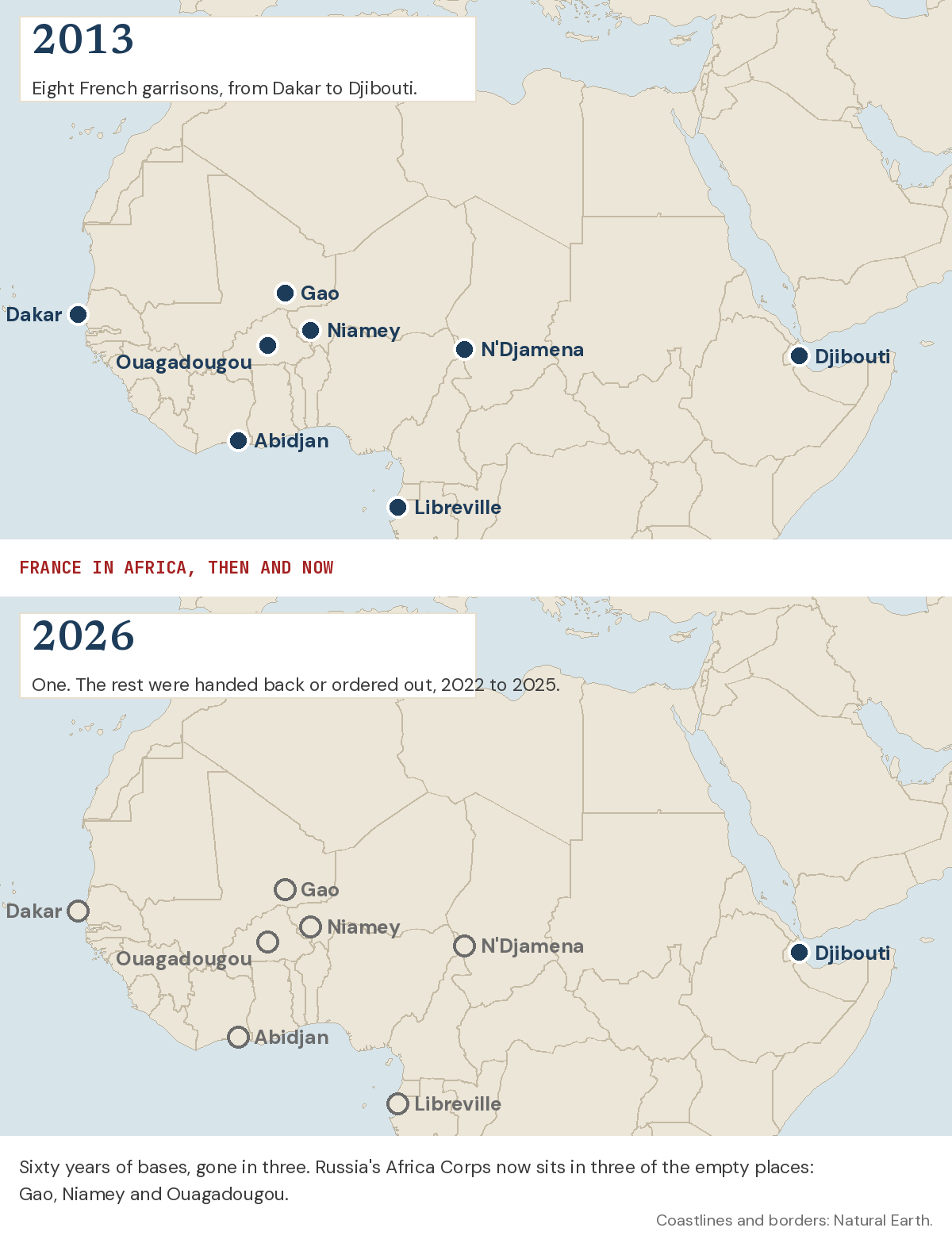
Now how Russia got in, because it didn’t walk into an empty room. The strip of dry country south of the Sahara is called the Sahel, and the countries there, Mali, Niger, Burkina Faso and Chad, were French colonies until 1960. Their governments, their courts and their schools run in French, because France built all three, and sixty years after independence France never really left. It kept soldiers and air bases there, ran their money through a currency printed in Paris, and sent in troops whenever a friendly government was in trouble. The French call that arrangement Françafrique, and in France the word is an accusation, not a boast. In 2013 France sent its army into Mali to drive out the jihadists who had taken the north, and it did. But it made a choice Malians never forgave: it let the Tuareg rebels who had marched in alongside the jihadists keep the northern town of Kidal, and kept Mali’s own army out. From then on, to a lot of people there, France looked less like a protector than like a foreign power deciding who won.
Then, between 2020 and 2023, soldiers took over the governments one after another, and every one of them told the French to leave, saying out loud that France had been in league with the jihadists all along. France denies it and nothing has ever proved it. But it’s what people there believe, and the crowds that cheered the coups waved Russian flags. Within three years France was out of all of them. For the first time since 1960 it has no base of its own anywhere in West or Central Africa.
Russia took the job, and it took it for the gold. The outfit it sent is worth a minute, because it’s the strangest army in this story. Wagner began as a private company, a mercenary army owned by a man named Yevgeny Prigozhin, who’d made his fortune cooking for the Kremlin. For years Russia could send Wagner anywhere and say it hadn’t sent anyone. Wagner guarded presidents, fought rebels, took its pay in gold and mining rights, and did things an army with a flag can’t: in 2022 the UN found that Mali’s soldiers and “foreign military personnel,” meaning Wagner, killed about five hundred people in one village in five days. Then in 2023 Prigozhin marched his men on Moscow, called it off, and died two months later when his plane fell out of the sky. The Defense Ministry kept the business. The same men work the same countries under a new name, the Africa Corps, and now they answer to the Russian state directly. About a thousand of them are in Mali, a few hundred each in Burkina Faso and Niger, and about a thousand in Libya. Getting men and weapons to the middle of Africa is the hard part, and that’s where Libya comes in. The flights run from Russia to Syria, then to Libyan air bases, including one deep in the desert that Russia has been rebuilding, then on to the Sahel. The heavy cargo comes by sea to the eastern Libyan port of Tobruk, with a warship riding alongside. That was the Merkury’s job, until Sunday.
And here’s the bridge back to the war you know. In the summer of 2024, Tuareg rebels ambushed a Russian column in the far north of Mali and killed dozens of Wagner men, the worst loss the mercenaries have ever taken in Africa, and Ukraine’s military intelligence said afterward that it had given the rebels what they needed. Mali broke off relations with Kyiv. Since last year Ukraine has had sea-drone crews in western Libya, hitting the Russian ships that feed the other side of the country. Be clear about what that means. A country fighting for its life at home doesn’t send drone crews to Africa on its own account. It gets there because the people paying for its war want Russia’s gold line cut too. The Associated Press has described the Libya arrangement as one with Western backing, the United States included, and the satellites, the intelligence and the money behind those boats are NATO’s. So Sunday wasn’t the war wandering into a strange new place. It was NATO’s side cutting the line that pays for Russia’s shells, with Ukrainian hands, at the one spot where the line touches the sea.
It isn’t going well for the Russians either. The jihadists they were hired to beat have taken a major northern town this year, killed Mali’s defense minister, and kept the capital under a fuel blockade on and off for more than a year, burning the tanker trucks that try to get through. The security the generals bought isn’t working.
Which is where France comes back in, quietly. I write a lot about the CIA. France has one too. It’s called the DGSE, and inside it sits a unit called the Service Action, the part that doesn’t collect information but does things: sabotage, rescues, snatches, the training of friendly armies and the quiet removal of unfriendly people. It’s the unit that sank the Greenpeace ship Rainbow Warrior in a New Zealand harbor in 1985. French-speaking Africa is where it’s always done most of its work, and the three juntas know it, which is why every Frenchman they catch is a spy. This year Mali convicted a Frenchman from the embassy as a spy, sentenced him to twenty years, and then pardoned him and put him on a plane after the king of Morocco intervened. Burkina Faso did the same with four French “computer technicians” a year earlier. And Chad, which threw France out two years ago, has let about twenty French soldiers back in to train its army and signed a new defense agreement in Paris last month. No bases. A foot in the door.
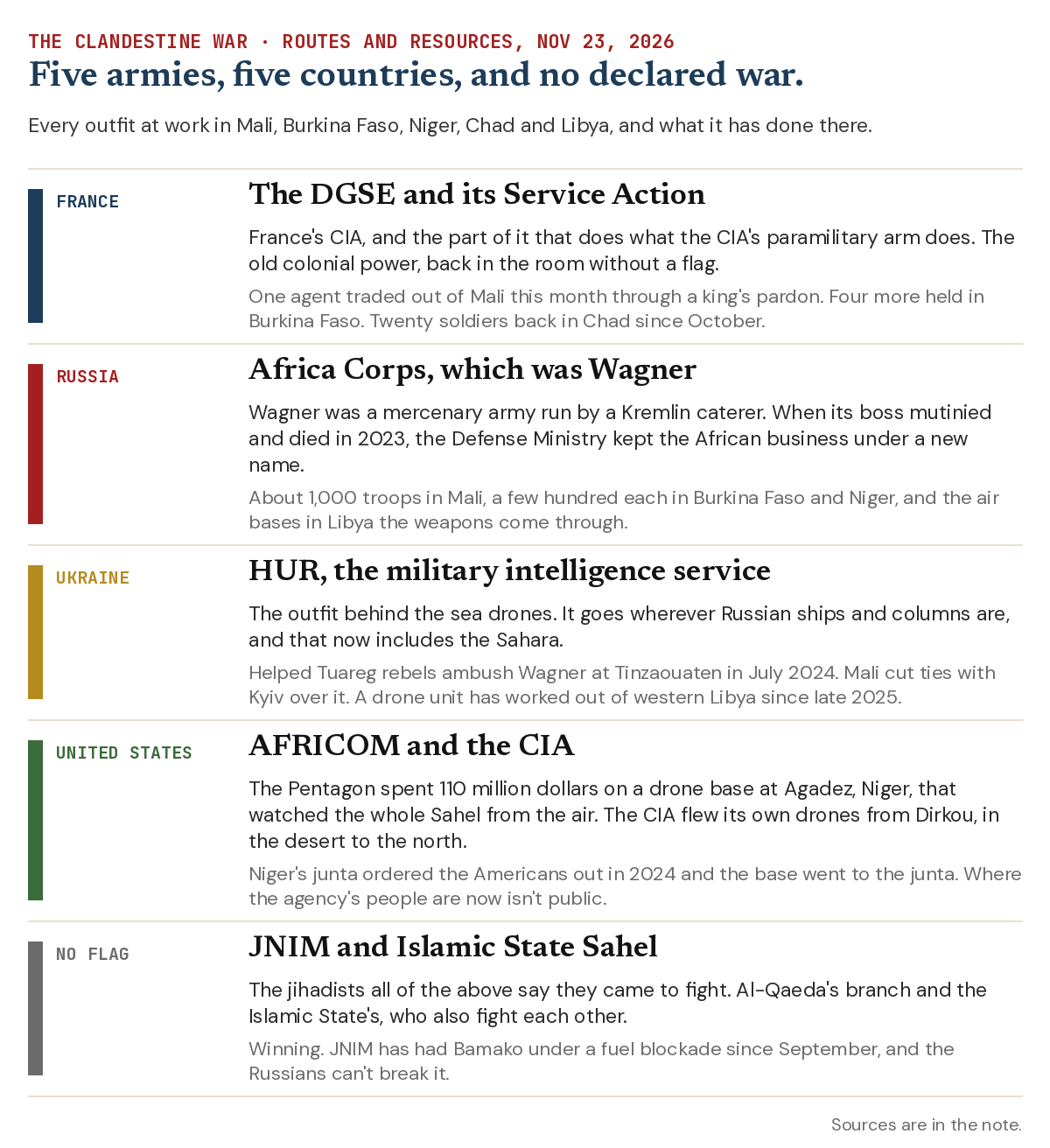
So here’s the shape of it. A region France ran for sixty years and lost in three. Generals who threw France out and hired Russia. Russia, there for gold, uranium, votes and a coast, supplying its men through Libya. Jihadists beating the Russians the way they beat the French. Ukraine reaching in to cut the supply line because the gold pays for the shells falling on Kyiv, and NATO behind Ukraine, because the line is Russia’s. And France, the whole time, working its way back in through the side door. We hear “Russia in Africa” the way we heard “Russia attacks a democracy” about Ukraine, as if the story started the day the Russians arrived. It didn’t. There was already a war in that room. Russia joined it, and NATO followed, with Ukraine out front.
That’s the route, and those are the resources. And that’s why a warship in a Libyan harbor is part of the war between Russia and NATO. Ukraine is where that war is fought. Africa is one of the places it’s paid for.
Sources (28), on the site.
Two Libyas
November 22, 2026 · Day 268 · 1098 words
Two Libyas
Two Libyas, read aloud · 7 minutes.
Before dawn on Sunday a Russian warship blew up at its pier in Benghazi, a port city in Libya, on the north coast of Africa, and by afternoon it was lying on its side with only the bow out of the water. The day before, a Russian cargo ship caught fire off the coast of Finland, up at the top of Europe, and drifted into Finnish waters with its crew in the lifeboats. The two ships were nearly two thousand miles apart. Neither was anywhere near Ukraine, where the war is. Nobody has officially said who did it, but every account points the same way: Ukrainian sea drones. The map below shows where all of this happened.
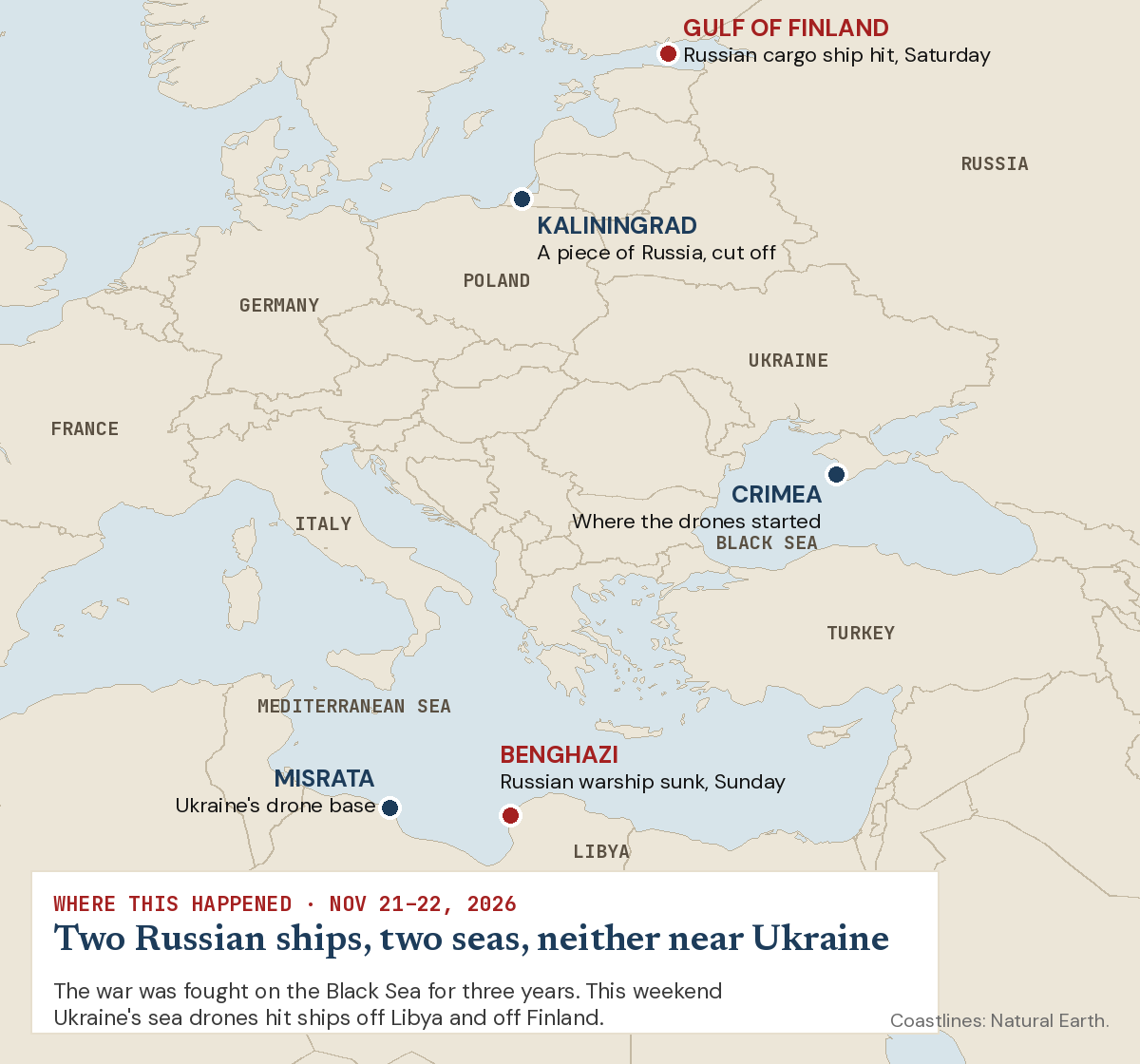
Here’s what a sea drone is, because the whole weekend turns on it. It’s a boat with nobody aboard: a hull about the size of a bass boat, a motor, a camera, a satellite link, and a few hundred pounds of explosives in the nose. Someone steers it from a screen, sometimes from hundreds of miles away, and runs it into the side of a ship. It costs a few hundred thousand dollars. The warship it sank on Sunday was three years old and worth a couple of hundred million. Ukraine built these boats because it has almost no navy and Russia has a big one. For three years it used them on one body of water, the Black Sea, the sea on Ukraine’s own south coast, and it used them well enough to drive Russia’s fleet out of its home port there. Until this weekend that was the story: a weapon for one sea. What changed is where they turned up.
Start with Libya, because the answer is there. Libya is the big country on the Mediterranean coast of Africa, directly south of Italy. It’s had two governments since 2014, and they don’t speak to each other. One sits in Tripoli, on the west side of the country, and it’s the one the United Nations recognizes. The other sits in Benghazi, on the east side, under a general named Khalifa Haftar, who spent twenty years living in Virginia before he went home to fight. Russia backs the general. Russia used to keep its Mediterranean ships at a base in Syria, but Syria’s government fell and the ships had to leave. So Russia moved its business to the general’s side of Libya. Russian freighters now unload weapons at the eastern port of Tobruk, with warships standing by, and the cargo goes by truck across the Sahara to Russia’s mercenary army in Africa. That’s what the warship, the Merkury, was doing in Benghazi: it had escorted cargo ships down from Russia and was tied up at the pier.
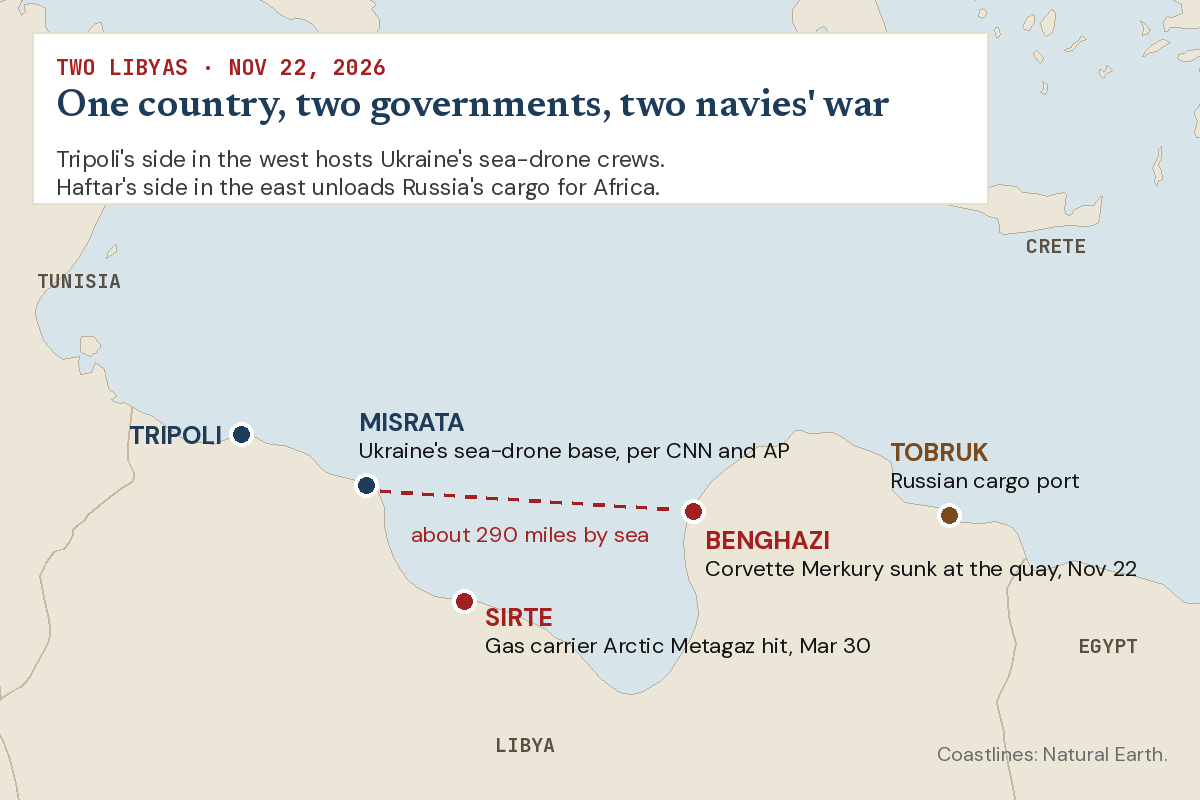
Now the other half of the country. In September a Ukrainian drone operator told CNN that his unit had been working since late 2025 out of a base at Misrata, a city on the western coast, on the Tripoli government’s side. His unit launches drones at Russian ships, and in return it trains the local forces. The Associated Press has described a quiet deal between Ukraine and the western government, with Western backing that included the United States. The western government says there’s “no agreement, arrangement or coordination” allowing any base to be used for attacks on anyone. But Russian ships have been getting hit off Libya since last December, and on Sunday officials on the general’s side told the AP that the drones “were launched at the ship from a base run by Ukrainian forces in western Libya.” Look at the map: Misrata to Benghazi is about 290 miles by sea. At least four drones were shot down before two got through. The warship had a crew of about 90. Nobody has said how many died. As of tonight neither Moscow nor Kyiv has said a word.
The ship off Finland needs one more piece of geography, and it’s the strangest piece on the map. Kaliningrad is a chunk of Russia that isn’t attached to Russia. It sits on the Baltic Sea between Poland and Lithuania, two countries that are in NATO, and about a million Russians live there. There’s no road from Russia to Kaliningrad that doesn’t cross a NATO country, so Russia supplies it by ship: out of St. Petersburg, west along the Gulf of Finland, which is the narrow arm of the Baltic between Finland and Russia, then south down the open sea. The Sparta II was on that run on Saturday morning, a freighter owned by a shipping company the Russian Defense Ministry set up for itself, when two drones hit it in the gulf. It lost its steering, drifted into Finnish waters, and burned into Sunday while a Russian rescue ship and Finnish boats fought the fire together. Finland’s military said Ukraine was the likely attacker.
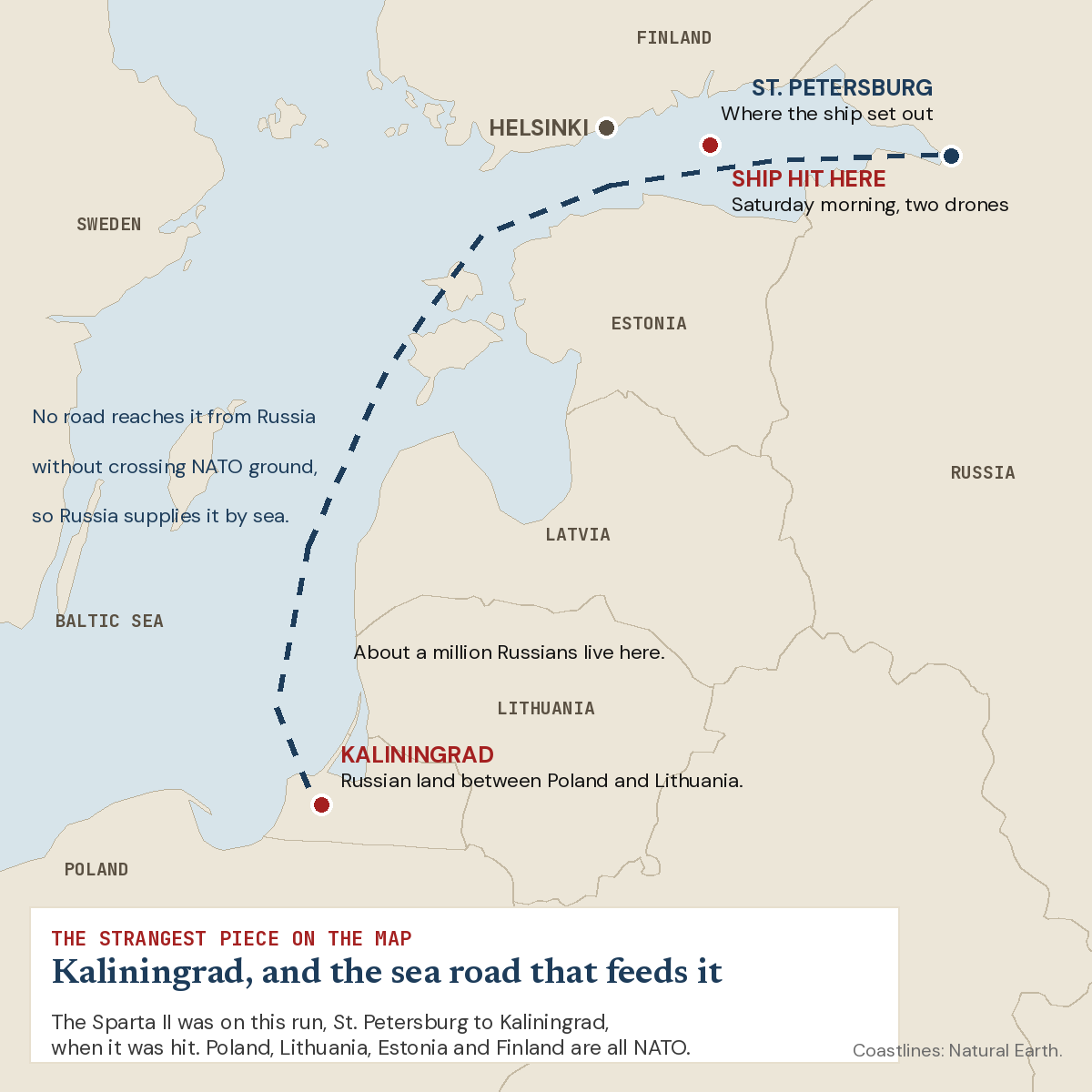
Finland matters here because it joined NATO in 2023, and NATO is the alliance of the United States and 31 other countries in which an attack on one is supposed to be treated as an attack on all. Finland shares an 800-mile border with Russia. Its prime minister, Petteri Orpo, said: “War is spilling over into our immediate vicinity. Ukraine has the right to fight back against the aggressor.” That’s a NATO head of government saying both things at once: this is close to us, and we aren’t going to stop it.
Here’s why it matters more than one sunk ship. For three years the fighting at sea happened in one place, the Black Sea, right next to Ukraine, and Russia could treat every other sea as its own. Ukraine couldn’t reach the ships that carry Russian weapons to Africa, or the ones that keep Kaliningrad fed and armed, or the tankers that sell the oil that pays for the war. Now it can, from a friend’s harbor, with a weapon that costs a tiny fraction of what it sinks. Russia will answer somewhere, and the places it has to choose from are a Libyan port, a Finnish gulf and the sea lanes off a NATO coast. None of them is Ukraine. That’s the part Finland heard.
This is how wars grow. Not with a declaration, but with one side finding a harbor to launch from and the other side’s ships being wherever they are. Libya has had two governments for twelve years, and most of the world stopped paying attention. This weekend each of them had a foreign navy’s war in its harbor, and the water between them is the newest front in a war that began a thousand miles away.
Sources (19), on the site.
The Island
November 21, 2026 · Day 267 · 1807 words
The Island
The Island, read aloud · 11 minutes.
There’s an island in the Persian Gulf, 124 miles from Iran, whose people have been asked only once, in the spring of 1970, what country they wanted to belong to. Everything that happened to it this week comes back to that.
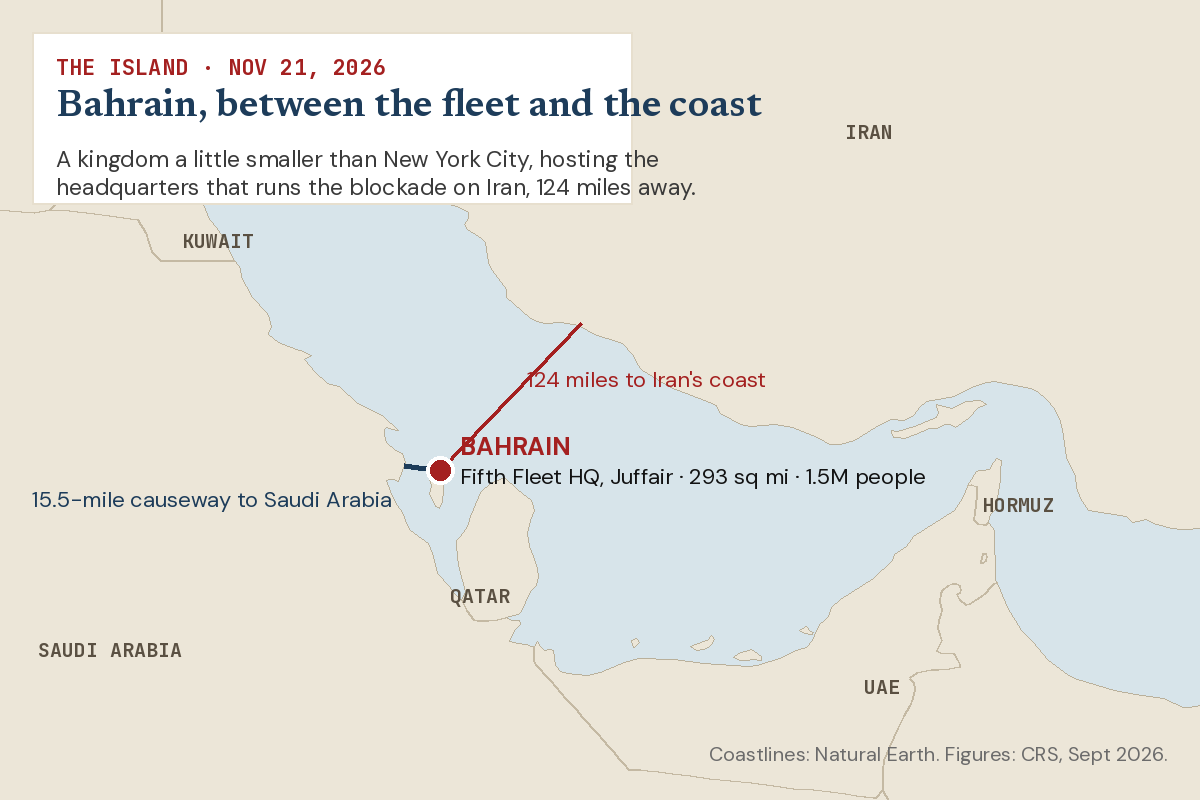
The island is Bahrain. It’s small, a little smaller than New York City, with 1.5 million people, about half of them citizens. Most of those citizens are Shia Muslims. That matters because Shia and Sunni are the two main branches of Islam, Iran is run by Shia clerics, and the family that rules Bahrain, the Al Khalifa, is Sunni. The king is Hamad bin Isa Al Khalifa, 76, who has ruled since 1999. His son Salman, the crown prince, runs the government day to day as prime minister. A Sunni family has ruled a Shia island since 1783, when it took the place from Persia, which is what Iran was called then. A family that rules over a majority of a different faith needs a protector. For a century that was Britain. When Britain ran out of money and empire and announced in 1968 that it was leaving the Gulf, the family needed a new one. The Americans were already there. The US Navy had kept a small command on the British base at Juffair, on the capital’s waterfront, since 1949. In 1971 the new country leased them part of it. The base is small, about 268 acres. What the Navy wanted was the spot, a deep harbor in the middle of the Gulf, next door to Saudi Arabia’s oil fields, in a country whose rulers would always say yes. What the rulers wanted was a guarantee. After the 1991 Gulf War the two signed a defense pact, and in 1995 the Navy named its command there the Fifth Fleet. That’s the bargain the island has lived under for 77 years: the family gets protection, the Americans get the harbor, and the people who live there weren’t asked. It only works with a ruler who needs the protection more than he needs his own people’s consent. A government that answered to the island’s majority might have said no to the harbor in 1971, or to the blockade this year. The Navy has never had to find out.
Iran never fully accepted that the island was gone. In 1957 the Shah, Iran’s king, declared Bahrain Iran’s fourteenth province and kept seats for it in his parliament. But by 1970 Britain was leaving the Gulf, and the Shah wanted two things more than Bahrain. He wanted to be the strongest power in the Gulf after the British left, without a quarrel with every Arab state over an island he didn’t hold. And he wanted three small islands at the mouth of the Gulf, Abu Musa and the two Tunbs, which his troops took in November 1971 as the British left. Many in the region believe the two were a trade; no document says so. So he agreed to let the United Nations ask Bahrainis what they wanted. The UN’s envoy spent three weeks on the island asking. The answer was that they wanted their own country. On May 11, 1970, the UN Security Council approved it with no vote against, Iran’s parliament accepted it, and on Aug 15, 1971, Bahrain became a country. It’s the only time in the island’s history that anyone asked its people a question and then did what they said.
The claim came back with the revolution. In 1979 the clerics took power in Iran. One of them said the Shah had no right to give Bahrain away, and the idea has stayed alive in Iran ever since. This year it came back in print. Kayhan is a hardline newspaper in Tehran. Its editor, Hossein Shariatmadari, is chosen by the office of Iran’s supreme leader, the cleric who has the final say in Iran, so what he writes is a fair guide to what the hardliners near the top are thinking. In April he wrote that Bahrain belongs to Iran and that its people want to join. In June he wrote that “our Bahraini compatriots” shouldn’t be kept waiting. On Oct 24 he wrote: “When the time comes, we will take it back.”
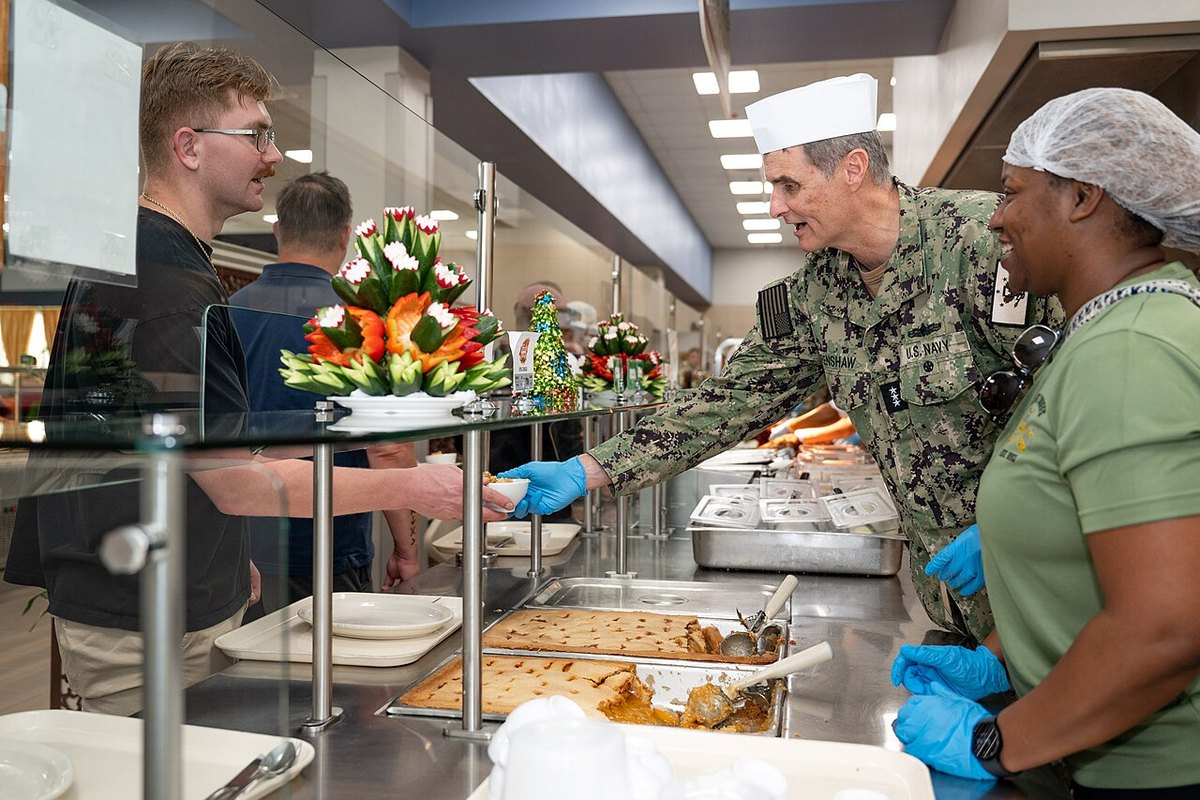
Then the war came to the island, because the island is where the fleet lives. On Feb 28, the first day, Iranian missiles and drones got through to Juffair and hit the fleet’s command building, two satellite dishes, the warehouses and a dozen other buildings. An official told Congress’s own researchers the base “was nearly destroyed.” The Navy’s acting secretary, Hung Cao, said in September that Iran “blew the hell out of Bahrain.” The Navy’s top admiral, Daryl Caudle, told sailors on Aug 31: “We’re not getting back in there anytime soon.” Repairs will cost at least $400 million. Here’s what that means. The base was the fleet’s home port and its warehouse, the place ships came to refuel, rearm and fix what broke. Now carriers and supply ships can’t use it, and the Navy runs its supplies through Diego Garcia, an island 2,200 miles away in the Indian Ocean. The sailors who ran the headquarters were flown out to Florida. Before the war about 8,300 American sailors, civilians and their families lived on the island. On Mar 2 the State Department ordered the families out, and about 1,300 wives, husbands and children left for hotels and short-term rentals in Europe and then America, where most of them still are, without their furniture. By law an order like that can last only 180 days, so it ran out on Aug 25 with the war still on and the base still broken, and nobody could tell the families what came next. Vice Adm. Curt Renshaw, who commands the Fifth Fleet, told them the Navy was “making it up as we go because nothing is conceived to go on this length of time.” The Pentagon has given them until Nov 30, nine days from tonight, to pick a new home base or take an allowance for living apart. So what America has on the island right now is a wrecked base, a flag, and a blockade run from ships at sea. The blockade is the one job the fleet still does from Bahrain: since April it has stopped Iran’s oil from leaving by sea. The protector can’t protect its own headquarters, and it’s still using the island to cut off the neighbor’s oil. Iran’s answer has been to make the island pay: the oil refinery hit, the aluminum smelter hit, a water plant hit, Amazon’s data center hit, a tanker in dry dock hit and a worker on it killed, and its Formula 1 race, the same series that raced on the Las Vegas Strip tonight, taken away. Bahrain has hosted a Grand Prix every year since 2004; this year it ran in Malaysia, under Bahrain’s name, because nobody would race on an island under fire. Iran’s foreign ministry says Bahrain bears “direct and clear responsibility” for American attacks launched from its soil. Bahrain’s government says it “rejects the use of its territory to settle accounts,” and it went to the UN Security Council and won a resolution condemning the strikes. Both are describing the same fact. The island lends its harbor to a war on its neighbor, and its neighbor has told it what that costs.
Here’s where the royal family’s oldest fear comes in. When a Shia power is bombing the island, a Sunni king worries that his Shia majority might side with it. He has reason to remember 2011. That spring, crowds, most of them Shia, camped for a month at the Pearl Roundabout, a traffic circle in the capital with a monument in the middle, and asked for a say in how they were governed. On Mar 14, 2011, about 1,000 Saudi soldiers drove across the 15-mile bridge from Saudi Arabia, whose own oil province next door has a large Shia population, and whose rulers didn’t want a Shia uprising to succeed 15 miles from it. Four days later the government bulldozed the monument. The king then appointed a panel of international judges to look into what his forces had done, and in November 2011 it reported that they had used torture, systematically, and that people had died in custody. He accepted the report, and the crackdown went on. Washington’s answer was to keep the fleet where it was, and in 2017 to drop the human rights conditions on selling him 19 F-16 fighter jets. That’s the kind of ruler the bargain needs, and both sides know it. In 2016 a court shut down the main Shia opposition party. And on Monday of this week, with the island under fire, a Bahraini court sentenced 64 people, most of them Shia clerics, to life in prison, and five more to 15 years, for plotting with Iran’s Revolutionary Guards, the most powerful part of Iran’s military, to overthrow the government. Prosecutors said the men had used the mosques to spread Iran’s idea that clerics should run the state. One of the 64 is Sheikh Isa Qassim, the most senior Shia cleric on the island, who was stripped of his citizenship in 2016, has lived in Qom, a holy city in Iran, since 2018, and was tried without being there. Human rights groups say some of the confessions were forced by torture. That’s the royal family’s answer to the general: the clerics he says it’s pushing around are in prison.
Two days later Iran answered. On Wednesday, Nov 18, 2026, a Revolutionary Guards general, Hossein Mohebbi, said that the survival of Bahrain’s royal family “under the new regional security order will be in doubt” if it kept on as it has. He named three things: helping the attacks on Iran, living inside America’s protection, and pushing around its own Shia clergy. Three days after that, on Saturday night, the Guards hit the island for the fourth time in nine days. He wasn’t talking about a radar. He was talking about whether Bahrain keeps existing as a country.
So the question is the one from 1970, back again. Is this island a country or a province of Iran? That year the people who live there gave the answer, and Iran accepted it. This year Iran’s newspaper says the island will be taken back when the time comes, Iran’s general says the royal family may not survive, the royal family has put its own clergy in prison, and the American fleet that’s supposed to protect the island has been bombed off its own base and runs the war from the sea. Nobody has asked the people of Bahrain, and nobody will, because the whole arrangement depends on not asking. The one time anybody did, they said they wanted a country, and they got one.
Sources (31), on the site.
The Excuse
November 20, 2026 · Day 266 · 1095 words
The Excuse
The Excuse, read aloud · 7 minutes.
Jensen Huang ran Nvidia for 33 years and made it the most valuable company on earth, and last week he lost it over an affair. Affairs aren’t illegal. Nvidia doesn’t sell anything to you or me; it sells chips by the billion to other companies, and companies don’t care about a supplier’s private life. Donald Trump, the day the story broke, said he’d always found Huang “very above board.” On Nov 8, 2026, the day Huang admitted the affair to his employees, Trump called him “an honorable guy.” And today, Friday, Nov 20, 2026, a day after sitting with Xi Jinping, he said Nvidia should “accept an apology and let him go back to work.” So the question isn’t what Huang did. It’s who wanted him out, and what they got once he was gone.
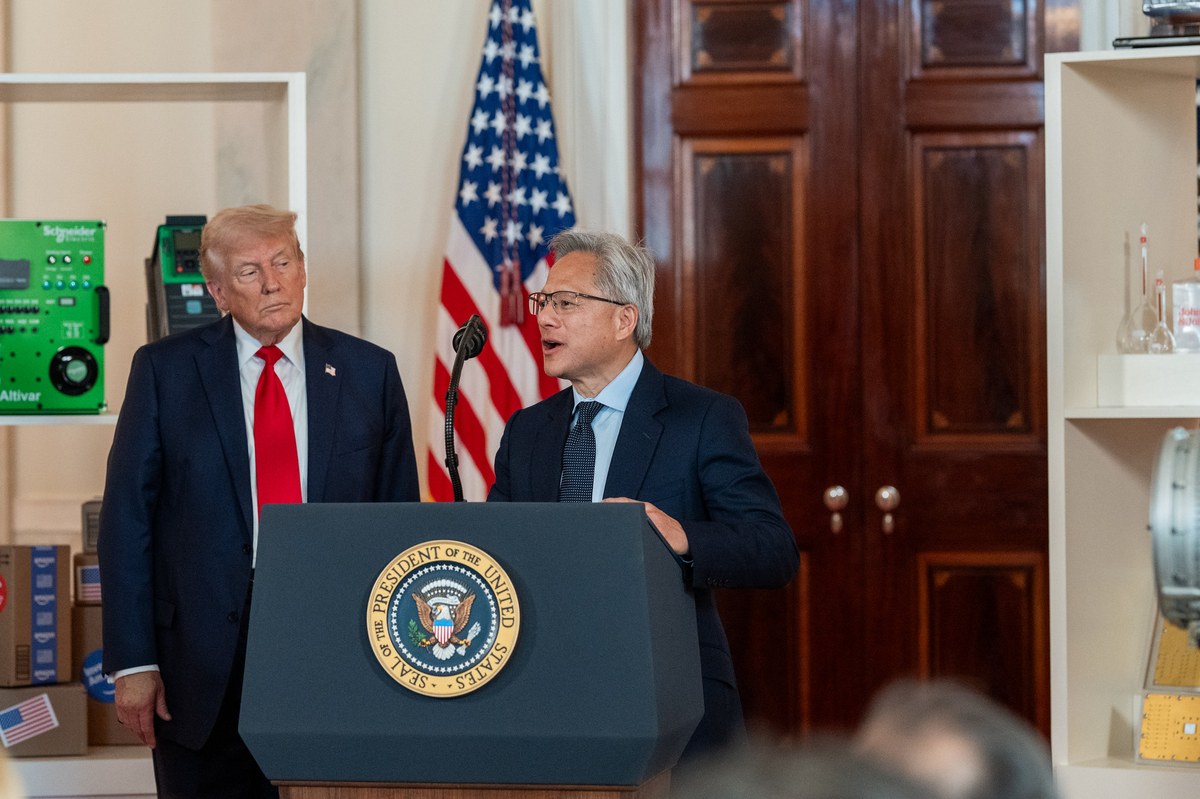
What Huang did that mattered was this: he was the one man who could get Trump to let Nvidia sell chips to China. Howard Lutnick, before he was even confirmed as commerce secretary, called Huang’s company “a national treasure” and told him “whenever you need the president, call us.” In December 2025 Trump let Nvidia sell its H200 chips to China in exchange for a quarter of the money. That put Huang against two sets of people. The first are the China hawks in Trump’s own cabinet, Marco Rubio and Scott Bessent, who say the chips end up in China’s military. The second are Nvidia’s own biggest customers, the American companies that build AI with its chips, whose whole lead over China’s labs is that China can’t buy what they can. Dario Amodei, who runs Anthropic, said at Davos in January 2026 that letting the H200 go to China was like selling nuclear weapons to North Korea. Anthropic listed on the Nasdaq on Thursday at $1.76 trillion. That’s what the lead is worth. Not every customer. Elon Musk, whose xAI buys Nvidia’s chips by the hundred thousand, signed the petition to bring Huang back and said the deals Nvidia would lose without him were handshakes, not contracts. He needs Jensen for his own supply. Anthropic needs China not to have one.
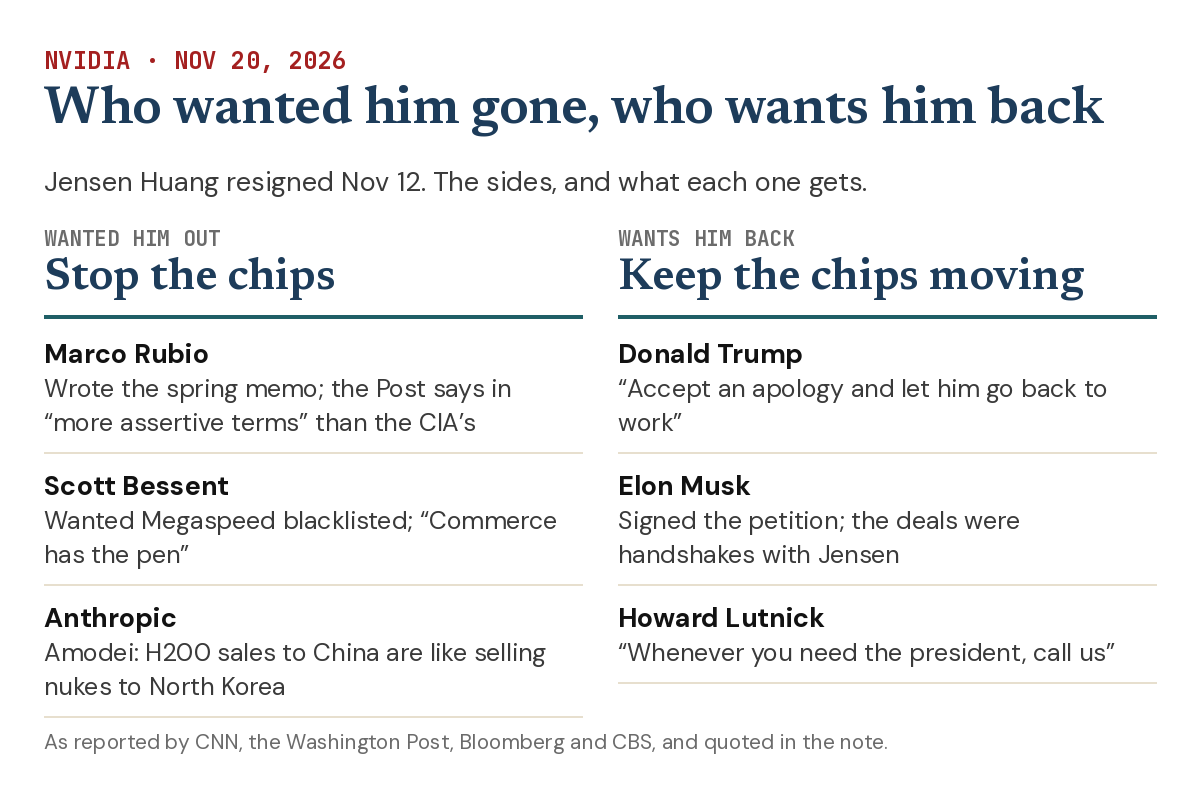
Here’s how it went. In August 2025 someone in the tech industry told the New York Times to look at Megaspeed, the Singapore company that bought Nvidia’s chips and employed Alice Huang, no relation. The Times’ reporter said so himself on the paper’s podcast; he didn’t name the tipster. In October 2025 the Times reported that Commerce was investigating Megaspeed and that Alice Huang socialized with Jensen. On March 30, 2026 Rubio wrote a classified memo about the two of them, and in May he briefed Trump about it on Air Force One, on the way to China, with Huang on the plane. Trump did nothing. Then the memo leaked, and on Oct 29, 2026 the affair came out in the Times as a Chinese spy plot. That one word did the work. An affair is a private matter. An affair with a Chinese spy is a national security story, and it’s the story Washington already tells itself, that China is coming for us. And the chips make anyone who moves them look like a spy. Washington bans selling the best ones, and Beijing has held back buying the ones Washington allows, so the business only exists in the dark, and a Chinese businesswoman working in the dark looks like a spy whether she’s one or not. Inside the government the evidence is still argued over: officials near the director of national intelligence told CNN the spy label was “not entirely accurate and over-torqued,” the CIA isn’t convinced she knowingly passed anything, the attorney general says the Justice Department has reached no conclusion, and Singapore says it never investigated her for spying. The Washington Post reported that Rubio took the CIA’s report and wrote it up “in his own more assertive terms.” A former official told the Post what the point was: “They wanted to destroy the influence Jensen had over the president.”
The man who kept the pen in his pocket was Howard Lutnick. His Commerce Department decides which companies American firms may sell to, and it had been investigating Megaspeed since 2024 without ever putting it on the blacklist. Senator Tom Cotton asked him to. Treasury, State, the Pentagon and the trade representative all wanted it done; Bessent said so on CNBC: “Commerce has the pen.” Lutnick’s own export chief told colleagues it was “a decision for the secretary.” Lutnick was Huang’s man in the cabinet from the first week, the one who got him into a million-dollar-a-plate dinner at Mar-a-Lago and who explained the China sales on television as a way to get Chinese developers “addicted to the American technology stack.” On Monday the administration put out new chip rules for Southeast Asia, written by Treasury and the White House, not by Commerce. His colleagues are now writing the rules his department exists to write. Lutnick testifies to the Senate on Dec 10, 2026.
What finished Huang was a second affair, with a vice president who reported to him, reported Nov 11, 2026. The board met that night. Now look at the eight days since. On Tuesday Nvidia’s interim chief executive said the company will stop selling H200s to China. Bessent said the next chief executive should come from outside the company. Trump’s advisers are discussing whether Lutnick should go. Congress is writing tighter chip rules. The policy the hawks and the customers couldn’t win in a year of arguing, they got in a week, and the president never had to decide anything.
Trump is the one person in this who hasn’t moved. He never cared about the spy. He cared about the sales and he liked the man, and he wants him back. Today he also said he hasn’t lost confidence in Lutnick. So he’s defending the two men who were selling China the chips, against his own secretary of state and his own treasury secretary. That’s the fight. Huang is the first man it’s cost. He isn’t why it’s happening.
When a scandal in Washington looks like it’s about sex, ask who got what they wanted once the man was gone. Here it wasn’t China. Chinese AI companies wanted the chips; the Chinese government wants to build its own, and it held back most of the H200 orders Washington had approved. It was the people in Trump’s cabinet who wanted them stopped, and the companies that get richer every month China goes without them. The affair was true. It was also the excuse.
Sources (16), on the site.
48 to 51
November 19, 2026 · Day 265 · 673 words
48 to 51
48 to 51, read aloud · 5 minutes.
The Senate voted this afternoon, Thursday, Nov 19, 2026, on a resolution telling President Trump to pull American forces out of the war with Iran. It failed, 48 to 51. Three Republicans voted for it: Susan Collins, Lisa Murkowski and Rand Paul. One Democrat voted against it: John Fetterman. Chris Murphy, who had a stroke last month, wasn’t there. It’s Day 265 of the war. By Reuters’ count, Congress has voted on resolutions like this one 21 times since the war started on Feb 28, 2026. This was the first vote since the election on Nov 3, 2026, when Republicans lost the House and the Senate, and it came out the way every vote before it did.
The reason is the kind of vote it was. A resolution like this one is a statement. It never goes to the president, so he doesn’t sign it, he can’t veto it, and he doesn’t have to obey it. Congress passed one over the summer, the House and the Senate both, and the White House said it wasn’t binding and the war went on. Thom Tillis, a Republican from North Carolina who’s retiring in January, voted yes in September and no today, and he said why: “This one doesn’t go to the president, so it’s just a statement from Congress. I’ve made that statement.”
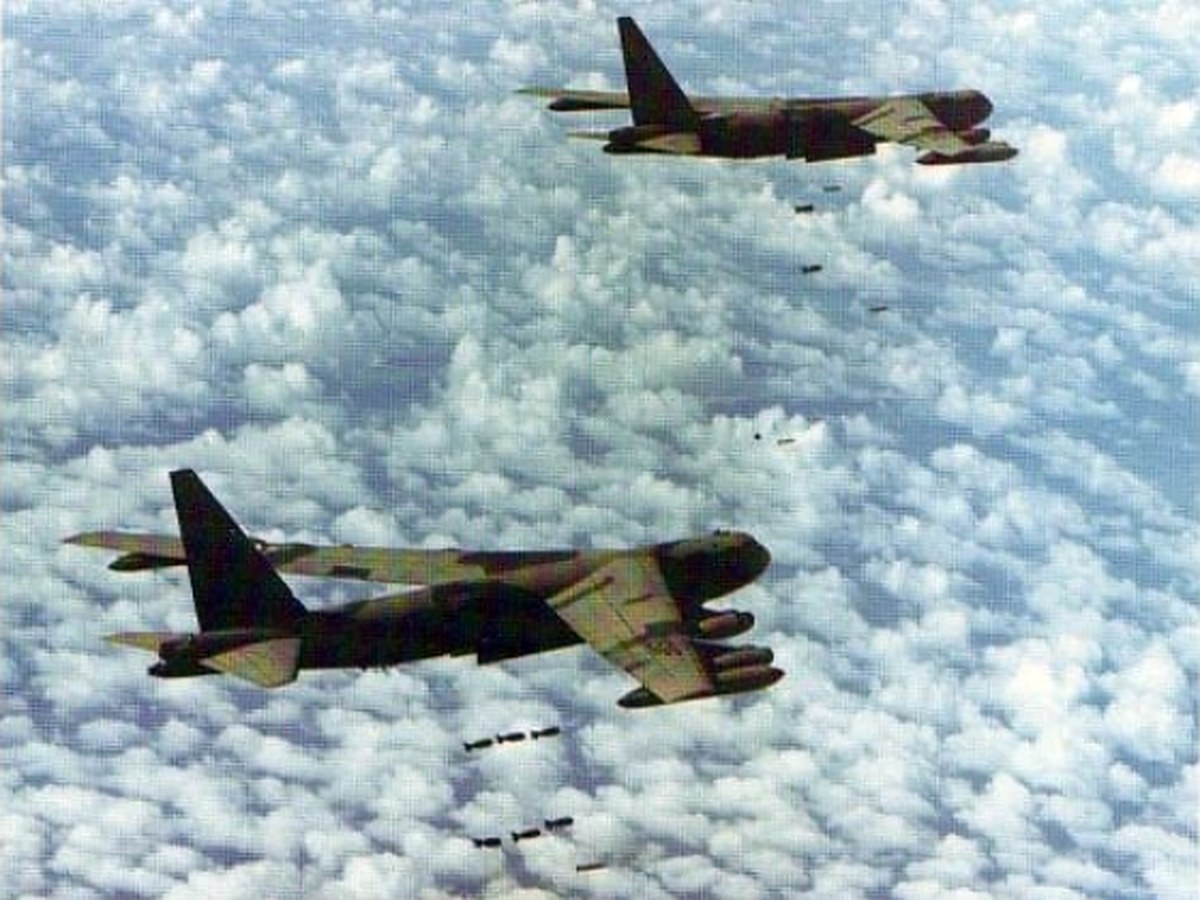
Congress has one tool that does work on a war, and it’s the checkbook. The military can’t spend a dollar Congress hasn’t given it. Congress has used that tool to end a war exactly once. In 1973 the last American troops had come home from Vietnam, and President Richard Nixon kept bombing Cambodia next door. Congress didn’t tell him to stop. It wrote one sentence into the bill that paid the government’s bills: no money for combat “in or over Cambodia.” Nixon vetoed it on June 27, 1973, and Congress didn’t have the votes to overrule him. So they tried again with a date. The money would stop on Aug 15, 1973. Nixon signed it on July 1, 1973, because the rest of the bill kept the government open and he needed that. On Aug 15 the bombing stopped.
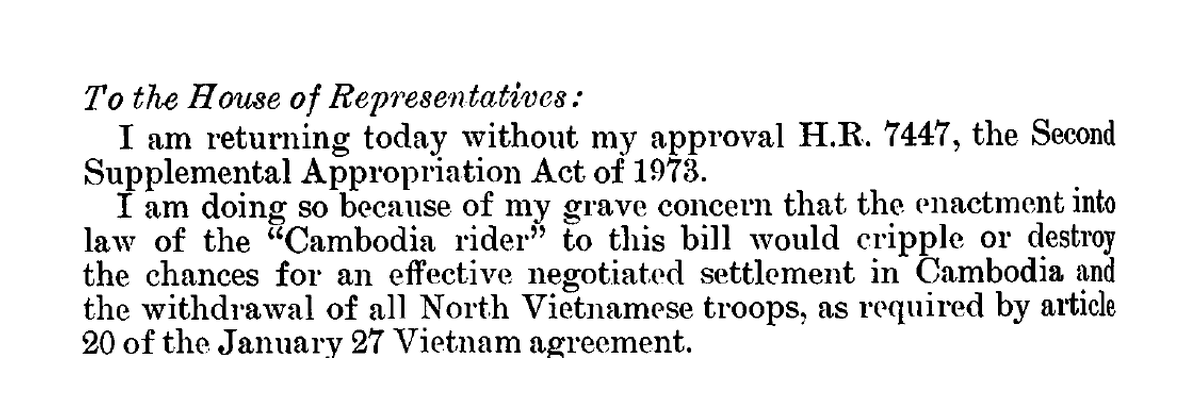
That sentence from 1973 is back. Michael Bennet, a Democratic senator from Colorado, released his version of it today: no money for combat “in or over Iran,” with exceptions for defending the troops, sharing intelligence and escorting ships through the Strait of Hormuz. Tammy Duckworth of Illinois, Elizabeth Warren and Kirsten Gillibrand have their own version, and Duckworth says she’ll vote against any bill that doesn’t include it: “Nine months in, defunding the war is the only way to force Trump to end it.” The government’s money runs out on Dec 11, 2026, three weeks from tomorrow. The bill to keep it open has to pass by then, and that’s the bill they want the sentence in. Democrats take over both houses on Jan 3, 2027, and Tim Kaine of Virginia, who’s led every one of the 21 votes, told reporters after this one: “When we have the gavels, we are contemplating other things.”
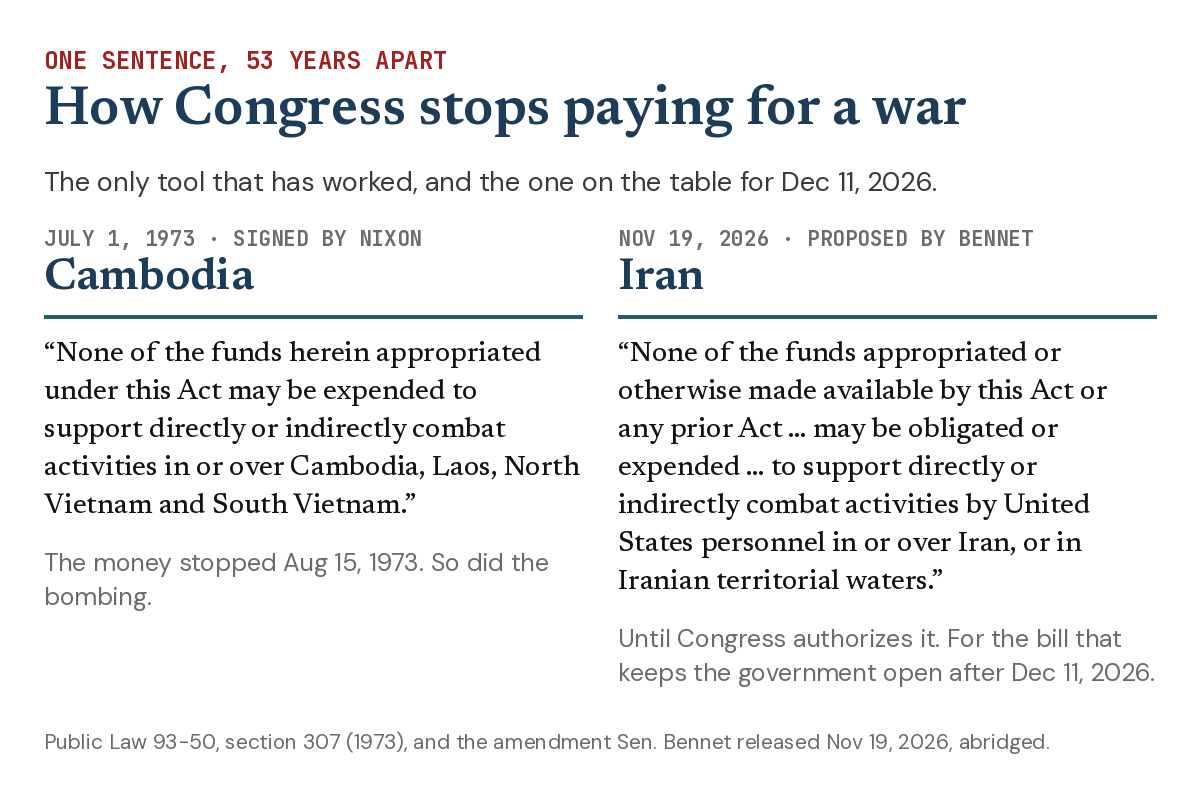
It’s a lot of money to stop. The same morning, a Pentagon budget official, Arthur Miller, told senators the war has cost $48.3 billion through Nov 13, 2026, not counting the repairs to the bases Iran has hit, which he couldn’t put a number on. The Republicans who run the House want a separate $100 billion bill to pay for more of it.
So today’s vote didn’t change anything, and everyone in the room knew it. The one that matters comes in three weeks. The bill that keeps the government open after Dec 11 needs 60 votes to pass the Senate, and Republicans have 53, so it doesn’t pass without Democrats. Some of them, Duckworth and Bennet among them, say they won’t vote for it unless the 1973 sentence is in it. If they hold out, Trump gets the choice Nixon got: sign a bill that stops the money for the war, or let the government close. Nixon signed.
Sources (13), on the site.
Airport’s for Guests
November 18, 2026 · Day 264 · 622 words
Airport’s for Guests
Airport’s for Guests, read aloud · 4 minutes.
China rolled out the red carpet for Donald Trump this morning at the airport in Shenzhen, the factory-and-tech city across the border from Hong Kong, and Xi Jinping himself was standing at the foot of the stairs of Air Force One. There was an anthem, troops, dancers, a crowd chanting a welcome in Mandarin, and a five-jet flyover trailing smoke. The press pool didn’t expect him. Xi doesn’t usually do airports; when Trump landed in Beijing in May 2026, he got the vice president.
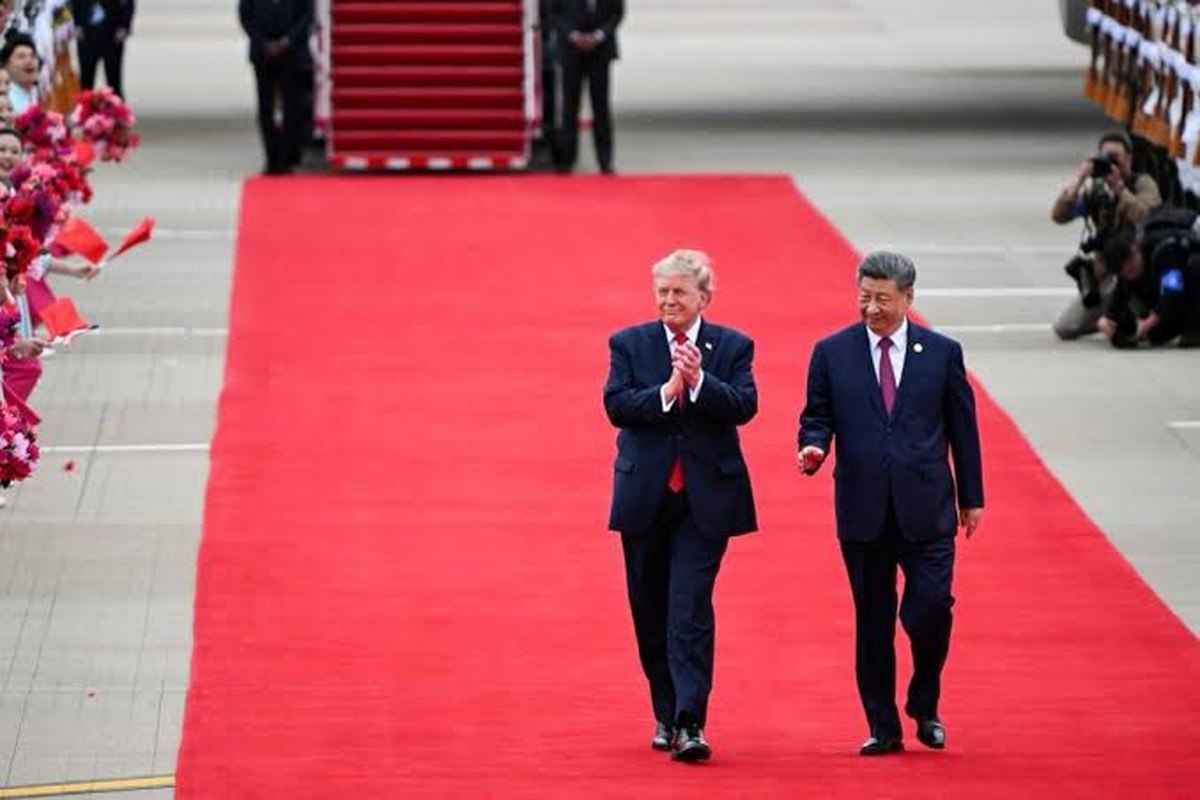
Vladimir Putin landed in the same city the same day and got Cai Qi, Xi’s chief of staff and the fifth-ranking man in China’s Communist Party, for about 40 seconds of pleasantries through interpreters.
I don’t roll out the red carpet for my brother. That’s for out-of-town guests. You don’t meet your brother at the airport, but you still set the table for him, and that’s what happened once Putin got into town: a full sit-down with both delegations, then a working breakfast, the two of them calling each other “dear friend” the way they’ve done for a decade, and Xi saying China and Russia should “lead and advance the trend toward a multipolar world.” Trump got the tarmac and Putin got the kitchen.
The occasion is APEC, the 21-economy Pacific Rim trade forum that China’s hosting this year in Shenzhen. Tomorrow, Thursday, Nov 19, 2026, Trump, Xi and Putin sit down together, which has never happened. The White House says the agenda is nuclear arsenals and the Iran war, with Ukraine kept on a separate track. A US official told ABC News today that Trump and Putin will also meet one on one, which is a change; a week ago the line from both governments was that no one-on-one was planned. The three shook hands in the receiving line before tonight’s banquet, with Xi looking on, and nobody’s reported what was said.
Putin spoke second at the business summit this morning, right after Xi opened it, and he used the slot. His figures, not mine: the dollar and euro were 85% of Russia’s export payments in 2021 and are 9% now, and Russia “did not turn our backs on the dollar or the euro,” it was shown the door, and the ones who shut it “only punished themselves.” The Asia-Pacific went from a quarter of Russia’s trade in 2014 to 53%. The European Union, he said, is losing its industry because it gave up cheap Russian energy. He asked the room to back Russia hosting APEC in 2035. Russia last hosted in 2012 and Putin hasn’t shown up in person since 2017, and in a forum that runs on consensus, that ask means the Americans, Japanese, Canadians and Australians either say yes or get to be the ones who said no.
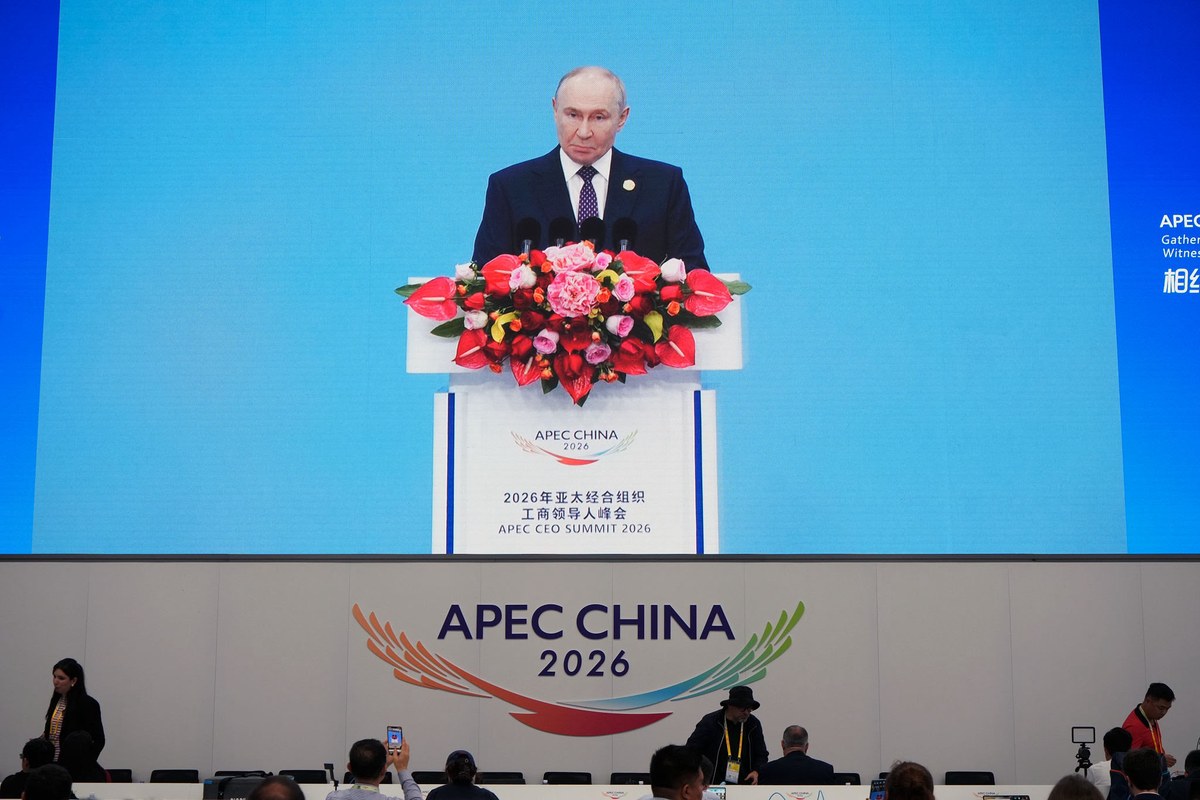
What he didn’t do is name the United States while swinging. “Former hegemonic powers” got the knife, the EU got it by name, and the Americans got “dialogue rather than ultimatums” and “substantial potential benefit” from tomorrow’s meeting. Xi, an hour earlier on the same stage, said “unilateralism and protectionism are rampant” and named no country at all. So Xi named nobody, Putin named everybody except the man he’s meeting tomorrow, and Trump got the flyover.
The question going into today was whether Xi would meet Trump’s plane, and he did. I don’t read it as a verdict on Trump so much as a bill paid: Trump met Xi’s plane at Joint Base Andrews outside Washington DC in September 2026, the first president to do that for a foreign leader in decades, and China settles its accounts. Putin didn’t need the airport because the house was always his, and tomorrow all three of them are sitting in it.
Sources (14), on the site.
Three Chairs
November 17, 2026 · Day 263 · 1,529 words
Three Chairs
Three Chairs, read aloud · 10 minutes.
This coming Thursday, Nov 19, 2026, Donald Trump is expected to sit down at one table with Xi Jinping, the president of China, and Vladimir Putin, the president of Russia. No American president has ever met with the presidents of China and Russia together. The White House calls it a first-ever trilateral sit-down between the leaders of the three countries.
The meeting is set for Shenzhen, the Chinese city across the river from Hong Kong. The reason everyone is in town is APEC, a yearly trade summit of 21 Pacific countries. The three-way meeting itself is about optics, and each of the three men gets something out of the picture.
Trump gets his photo with Xi and Putin and makes history. Made for TV. A senior administration official said, “We do not expect to get to any kind of agreement.” Who cares? That’s not the point.
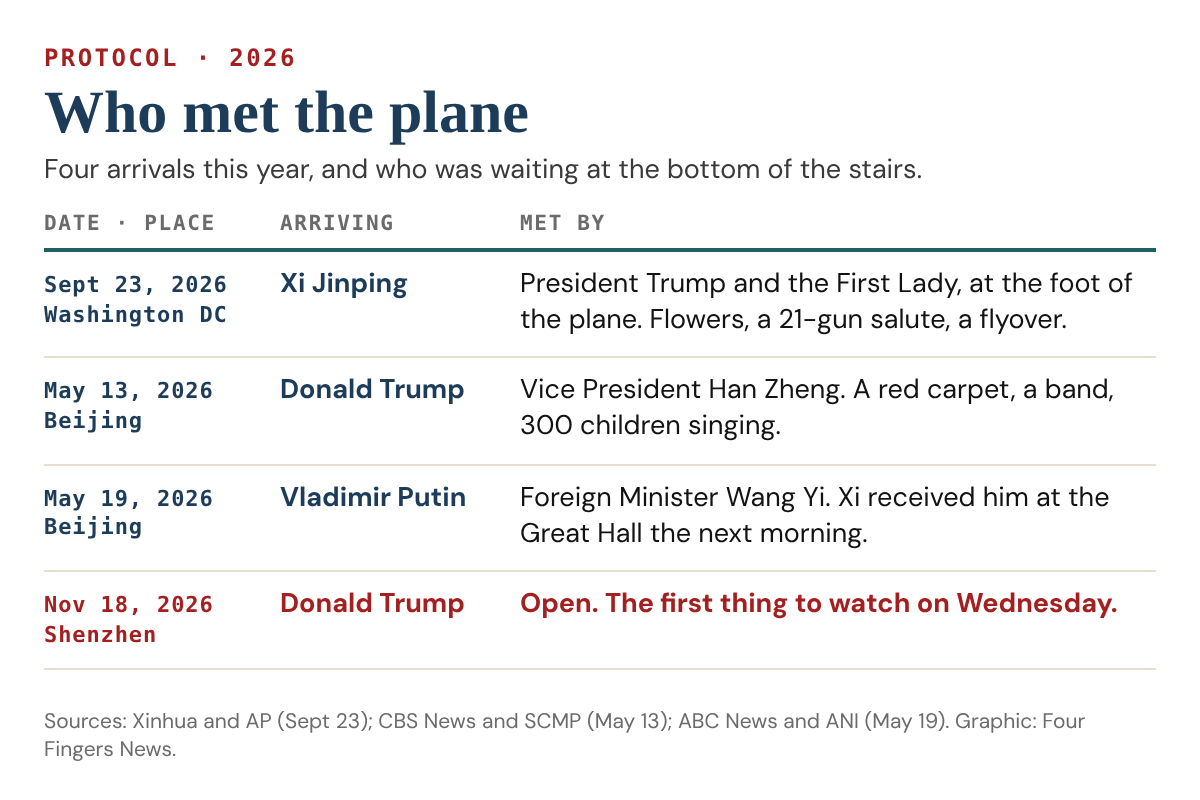
What’s worth watching is how Xi and Putin receive Trump. When Xi flew to Washington DC on Sept 23, 2026, Trump and his wife met him and his wife at the foot of the plane, a rare planeside welcome. Two American children handed over flowers, and there was a 21-gun salute, both national anthems and a military flyover. When Trump landed in Beijing on May 13, 2026, Xi didn’t come to the airport. Trump was met on the tarmac by Xi’s vice president, Han Zheng, with a red carpet and about 300 children singing a welcome and waving American and Chinese flags. It was a bigger show than Trump got in 2017, and it still wasn’t Xi.
Every diplomatic event is staged down to the shape of the table, the drinks, and whether anything is offered at all. The language counts too, and so does how it’s interpreted.
On Thursday, Nov 12, 2026, Putin hosted Jared Kushner and Steve Witkoff at the Kremlin. Kushner is Trump’s son-in-law and runs a private equity fund that took $2 billion from Saudi Arabia’s sovereign wealth fund in 2021. Witkoff is a real estate developer and Trump’s envoy. They came from Abu Dhabi, the capital of the United Arab Emirates, where two days of talks between Russia and Ukraine, run by the United States, had ended with a prisoner exchange and nothing else. Putin spoke through an interpreter. Watch the footage and the timing stands out. A speaker working through an interpreter normally waits for a cue that the translation is done. Putin didn’t wait. He started his next point as the interpreter landed the last word of his previous one, every time. A real estate developer and a private equity manager got a modern history lesson in who sets the pace in that room.
The warmth runs the other way with China. When Putin landed in Beijing on May 19, 2026, the foreign minister, Wang Yi, met him at the airport, and Xi received him at the Great Hall of the People the next morning. Both Trump and Putin got the red carpet in Beijing this spring. Putin’s visit came with a far more open show of friendship. These are small details in the production of a summit, and the message they send is clear to anyone paying attention. How Trump is received in Shenzhen won’t say anything about Trump. It’ll be a window into what Xi and Putin are thinking.
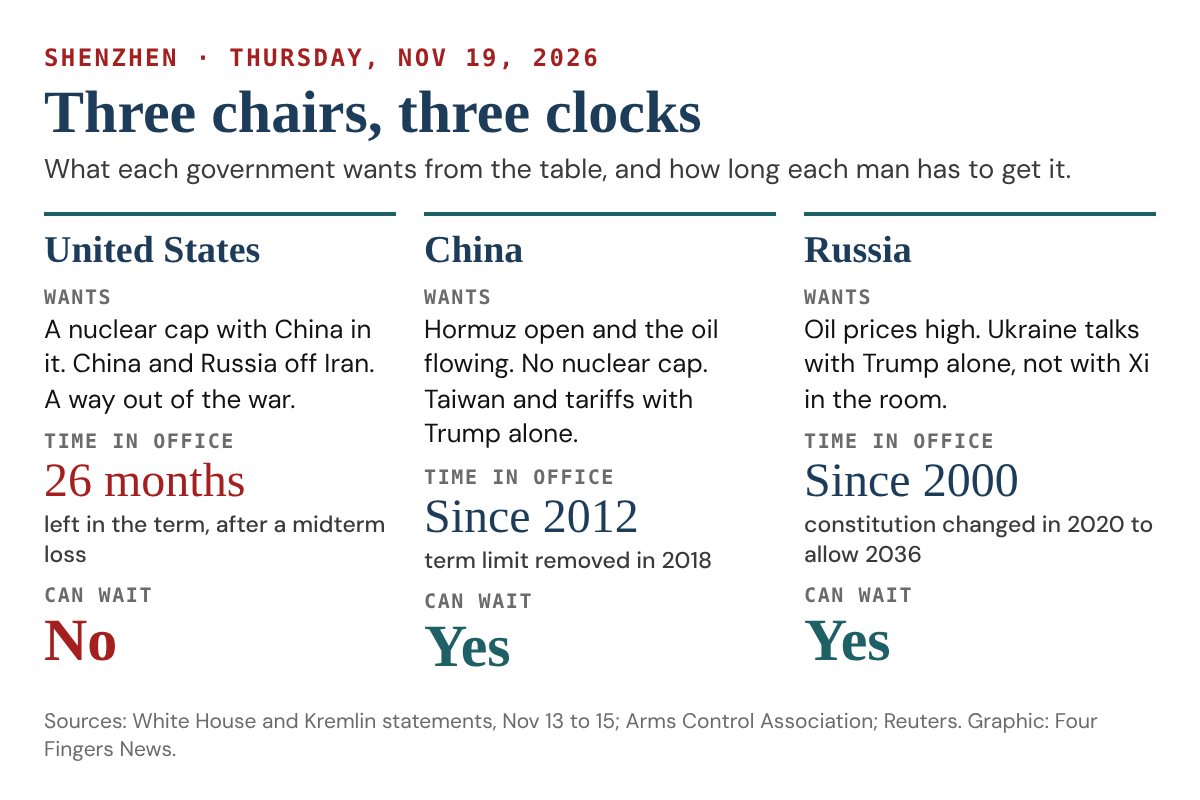
Each of the three wants something from Thursday. The stated American agenda is nuclear weapons. New START, short for the New Strategic Arms Reduction Treaty, was the last agreement that capped how many long-range nuclear weapons the United States and Russia could keep ready to fire, 1,550 warheads each. It ran out on Feb 5, 2026, after Trump rejected Russia’s offer to extend it for another year and demanded a “new, improved and modernised” deal that includes China. The real American ask is Iran. China buys most of the oil that pays for Iran’s war. On Aug 24, 2026, Treasury Secretary Scott Bessent announced what he called Operation Economic Outcast and said any bank or company that launders money for Iran “will be removed from the US dollar system.” Three months on, nothing has been done to China. Russia’s part is the targeting. Since the war began, Russia has passed Iran the locations of American warships and aircraft, three officials told the Washington Post on March 6, 2026, and the White House didn’t deny it. So Trump sits down with the government that buys Iran’s oil and the government that tells Iran where the American ships are, and asks them to stop. He also wants out of the war itself. JD Vance went on Fox News on Monday, Nov 16, 2026, and pledged the administration won’t allow the Iran war to be “even a two-year commitment.” The USS Theodore Roosevelt carrier strike group entered the US Central Command’s area of operations on Sunday, Nov 15, 2026, joining two other carrier strike groups already operating in the region.
China wants the oil flowing again. China has been Iran’s largest oil buyer for years, and it imports about a third of its oil through the Strait of Hormuz, the channel between Iran and Oman that the US Navy has blockaded since April 13, 2026. China’s seaborne crude imports in August 2026 ran about 7.14 million barrels a day, nearly 40% below the prewar average. On the nuclear question its answer is already on the record: “China will not take part in nuclear disarmament negotiations at this stage,” Shen Jian, China’s ambassador for disarmament affairs, said in February. China has about a tenth as many warheads as either of the other two and won’t sign a treaty that locks that in.
Russia is in no hurry. The war keeps oil prices high, Russia sells oil, and every month the fighting goes on the Russian government collects more tax from it. Reuters calculated that Russia’s tax on oil extraction would rise from 327 billion roubles in March 2026 to around 700 billion roubles in April 2026, about $9 billion, because of the Iran war. The United States sells oil too, and the difference is who gets the money. Russia’s biggest oil company, Rosneft, is owned by the state, and taxes on oil and gas paid for 23 percent of Russia’s federal budget last year, before this war pushed prices up, so a high price goes straight into the Kremlin’s accounts. American oil belongs to private companies and their shareholders. The federal government gets a corporate tax bill and some royalties, and everyone else gets the price at the pump. High oil pays for Russia’s war. In America it comes out of your wallet.
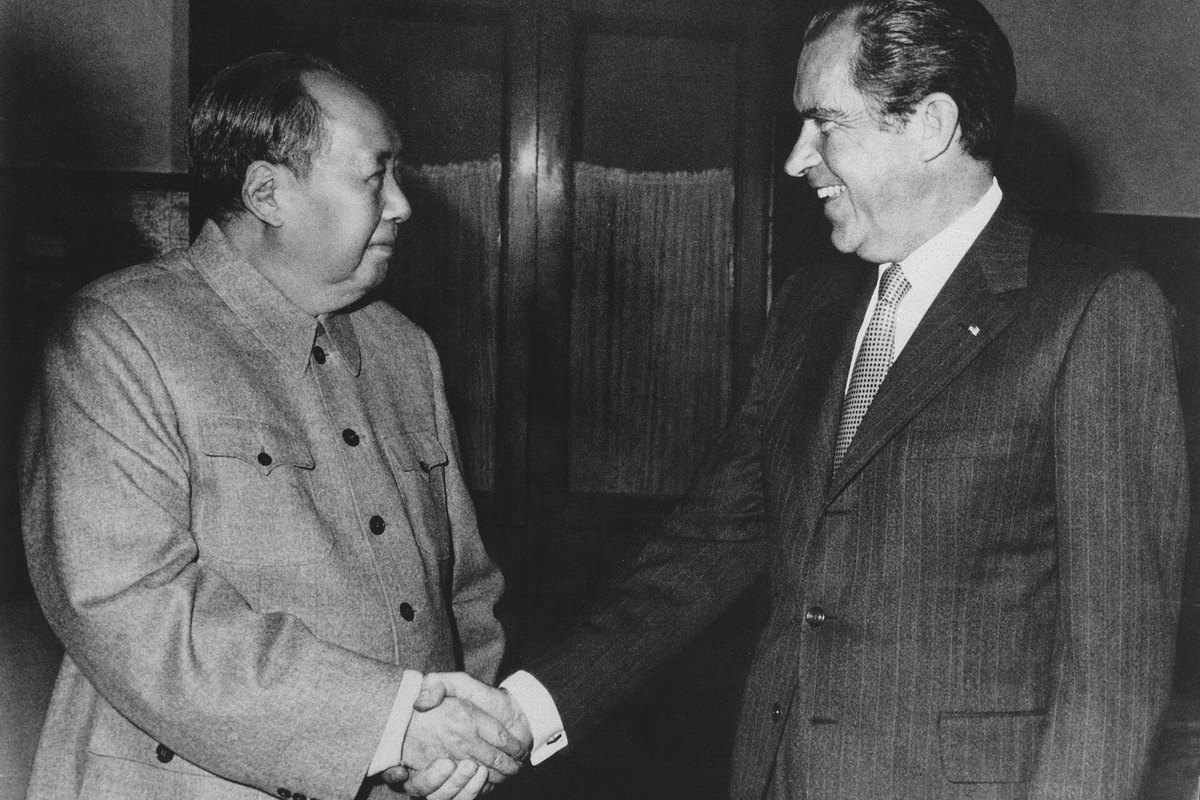
For fifty years the one fixed rule of American strategy toward these two countries was to keep them apart. In February 1972 Richard Nixon flew to Beijing and shook hands with Mao Zedong, the leader of Communist China, a government the United States had refused to recognize for 23 years. He became the first US president to visit mainland China while in office. The reason was the Soviet Union. China and the Soviets had fallen out in the late 1950s, and in 1969 their soldiers shot at each other along the border. Nixon saw two enemies who feared each other more than they feared him, and he made friends with the weaker one. Three months later he flew to Moscow and signed SALT I, the Strategic Arms Limitation Treaty, the first agreement that put a ceiling on the two countries’ nuclear missiles, with Soviet leaders who now worried about China and America getting close. For the next fifty years the United States could count on China and Russia distrusting each other more than they distrusted Washington DC.
That advantage is gone. Xi and Putin declared a partnership with “no limits” in Beijing on Feb 4, 2022, 20 days before Russia invaded Ukraine, and they’ve grown closer since. Trump has 26 months left in office and a midterm behind him that his own vice president called a shellacking. Xi has led China since 2012 and removed the term limit on his office in 2018. Putin has led Russia since 2000 and changed the constitution in 2020 so he can stay until 2036. Two of the three men at that table can wait. Russia is waiting. China is waiting for a better price on the blockade, and it won’t pay for it with a nuclear cap. The meeting costs them nothing. It gives them a photograph of the American president as one of three men at their table, nine months into a war they both opposed and he can’t close.
Nixon went to China to split the two. Trump is going to China because he can’t.
My expectation for Thursday is the same as the White House’s: no treaty, and no announcement that ends anything. The first thing I’ll watch is who’s standing at the bottom of the stairs when Air Force One opens its door in Shenzhen. The second is what the ships do in the week after. Whether any of the three strike groups turns for home. Whether tankers start loading at Iran’s ports again. Whether the statement out of Shenzhen uses the word Hormuz.
Sources (24), on the site.
Dusted Off
November 16, 2026 · Day 262 · 751 words
Dusted Off

Photo: Paul Morse / White House · Archive source
Day 262. The weapons of mass destruction are back. On Monday, Nov 16, CNN reported that Iran is drawing up plans to set off a dirty bomb in Washington DC, on the word of seven American officials who wouldn’t give their names. It’s a fabrication, and a lazy one. There’s nothing in it to be afraid of, and a good deal to recognize.
Take the weapon first. A dirty bomb isn’t nuclear. It’s a regular bomb with radioactive material packed around it, built to frighten far more than to kill, and nobody has ever set one off anywhere. Its natural habitat is the headline. CNN’s own story, read to the end, takes most of itself back. The officials are split on whether Iran could do it, Iran is no more capable than it was, and there’s no sign anyone in Tehran approved anything. The fear is at the top and the retraction is at the bottom, which is how these stories are built.
Americans have been sold this before, by people who described it as selling. In September 2002 the White House chief of staff, Andrew Card, explained why the case for invading Iraq had waited until after Labor Day: “From a marketing point of view, you don’t introduce new products in August.” The product arrived that Sunday on the front page of the New York Times, where unnamed officials said Saddam Hussein was buying aluminum tubes for an atom bomb. Dick Cheney went on television the same morning and cited the Times as his evidence. Condoleezza Rice supplied the slogan: “We don’t want the smoking gun to be a mushroom cloud.” The officials had fed the paper the story and then quoted the paper. The invasion came six months later. The government’s own inspector eventually reported that there were no weapons and that the tubes were for ordinary rockets.

Photo: David Bohrer / White House · Archive source

Photo: Tina Hager / White House · Archive source
The dirty bomb has had a turn too. In June 2002 the attorney general, John Ashcroft, interrupted a trip to Moscow to announce on live television that an attack on America had been stopped. His suspect, José Padilla, had been in custody for a month already. Padilla was held three and a half years without charges, and when he was finally tried, the dirty bomb wasn’t in the case. It had served its purpose the morning it was announced.

Photo: U.S. Department of Justice · Archive source
The White House says there’s no credible threat, and that changes nothing. A story like this doesn’t need the podium. It needs a handful of officials and a reporter’s phone number, and it’s more useful to its authors if the president’s spokesman can deny it.
As for who wanted it out, Benjamin Netanyahu has spent weeks pushing the United States to resume bombing Iran. On Friday the head of the Mossad, Israel’s foreign intelligence service, was in Washington DC briefing the CIA on Israel’s latest intelligence about Iran. He was home by Sunday, and the dirty bomb was on CNN by Monday.
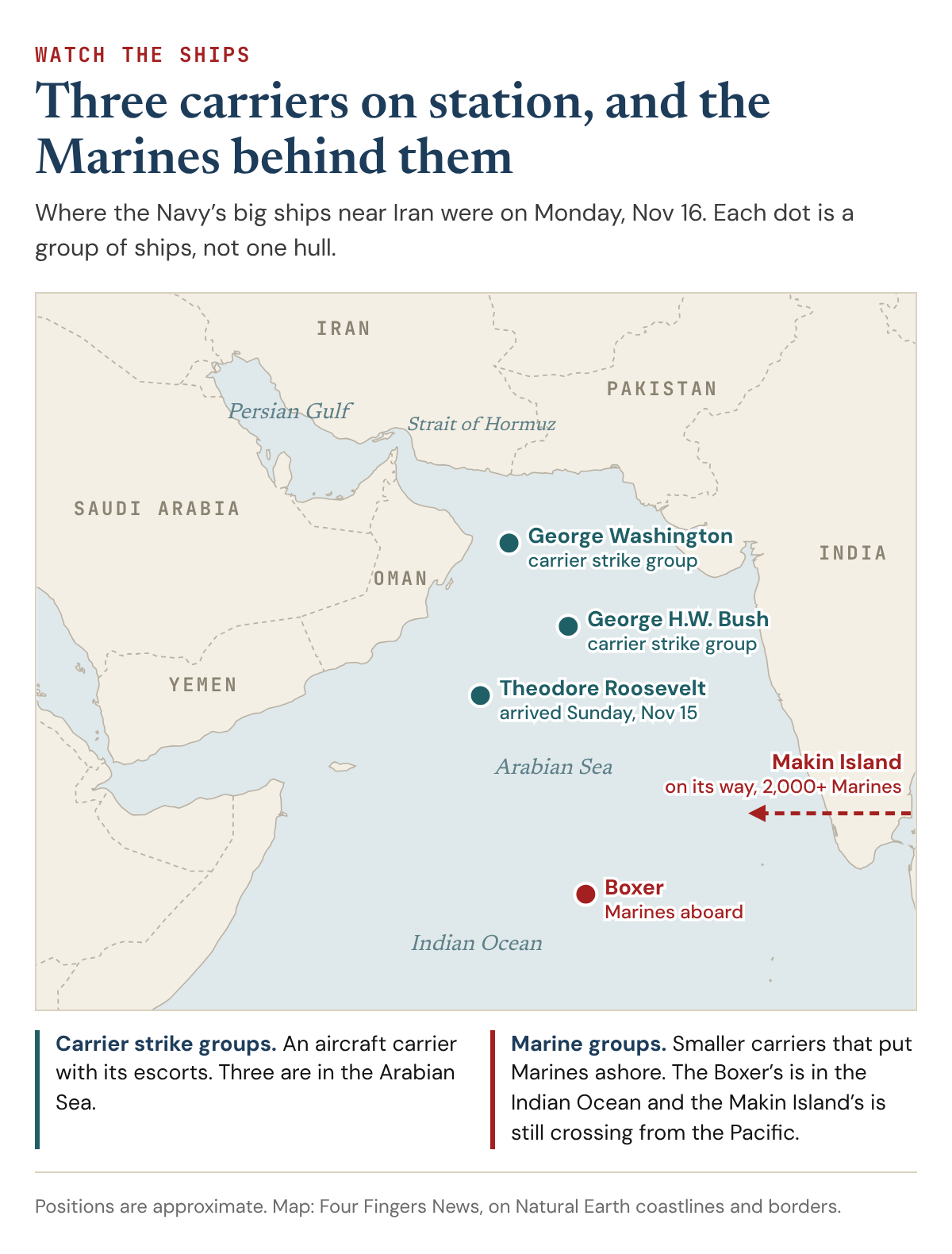
The ships tell the same story. Three American carrier strike groups are now in the region, led by the USS George Washington, USS George H.W. Bush and USS Theodore Roosevelt. The Roosevelt arrived on Sunday. The Boxer and its group are already there with a Marine landing force aboard, and the Makin Island’s group is on its way with more than 2,000 more Marines, due by the end of the month. Those two are smaller carriers built to put Marines ashore, and they carry helicopters and a version of the F-35 that doesn’t need a runway. It gets airborne in the length of the ship’s deck and comes back down vertically, the way a helicopter does. Ships are expensive to move and statements are free, so it’s the ships worth watching, and they’re being put in place for another round. Monday’s story is there to make that round easier to accept.
Iran has no use for any of it. Its terms for ending the war are public: the fighting stopped on every front, the blockade lifted, the sanctions eased and its frozen money released. A bomb in Washington DC wouldn’t free one frozen dollar. It’d deliver the opposite of every item on that list, along with everything Netanyahu has asked for. The headline’s beneficiaries are the people who want the bombing to resume.
The last time this worked it cost a war, thousands of American lives and many more Iraqi ones, and the weapons were never there. The script hasn’t changed since, and neither has the reason for using it.
Named After the Owners
November 15, 2026 · Day 261 · 630 words
Named After the Owners
Named After the Owners, read aloud · 4 minutes.
The war with Iran is still the main story. Tonight’s note is about a related but separate war south of the Strait of Hormuz, where Saudi Arabia is fighting Ansarallah, the Yemeni movement most news reports call the Houthis.
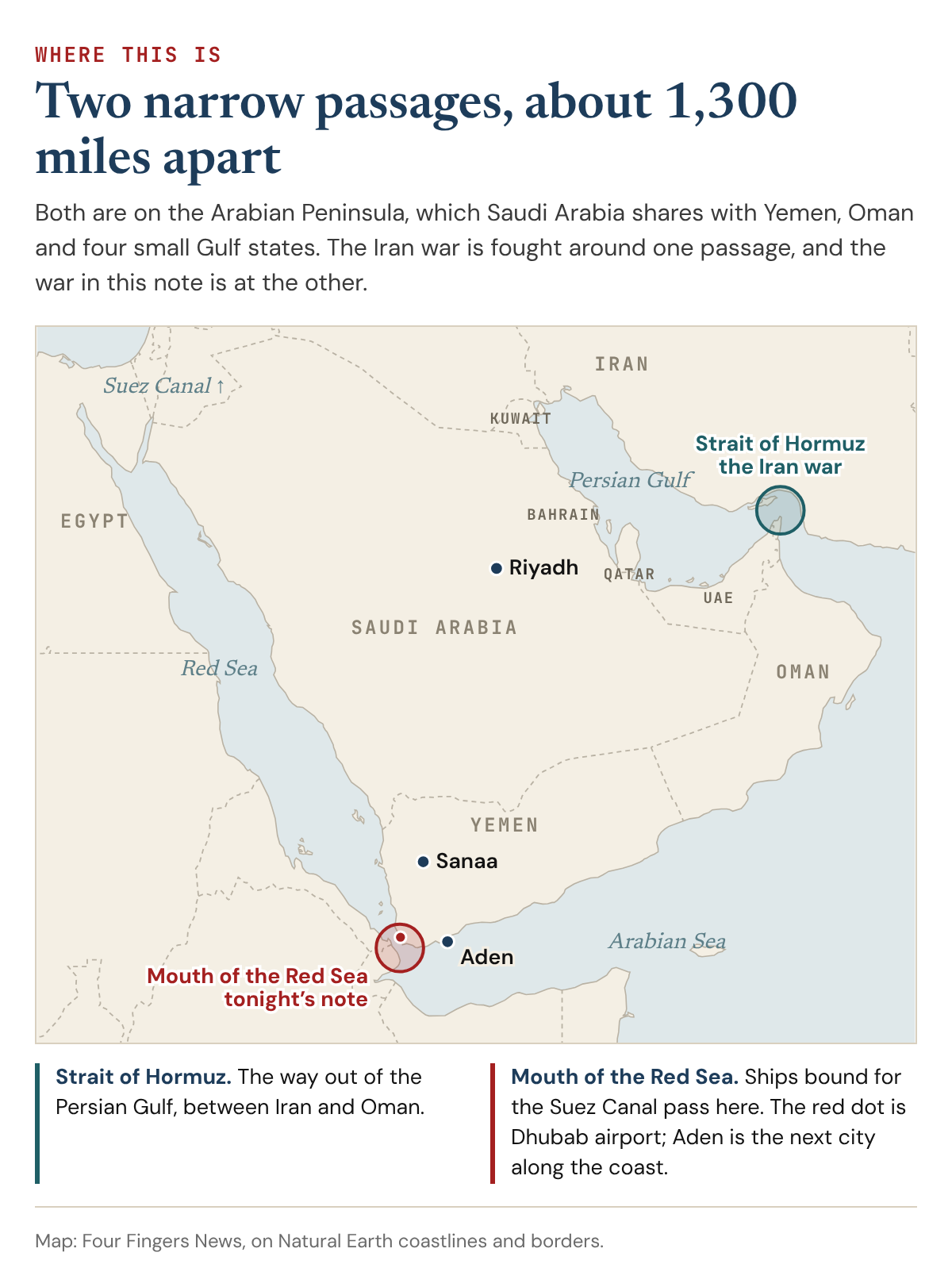
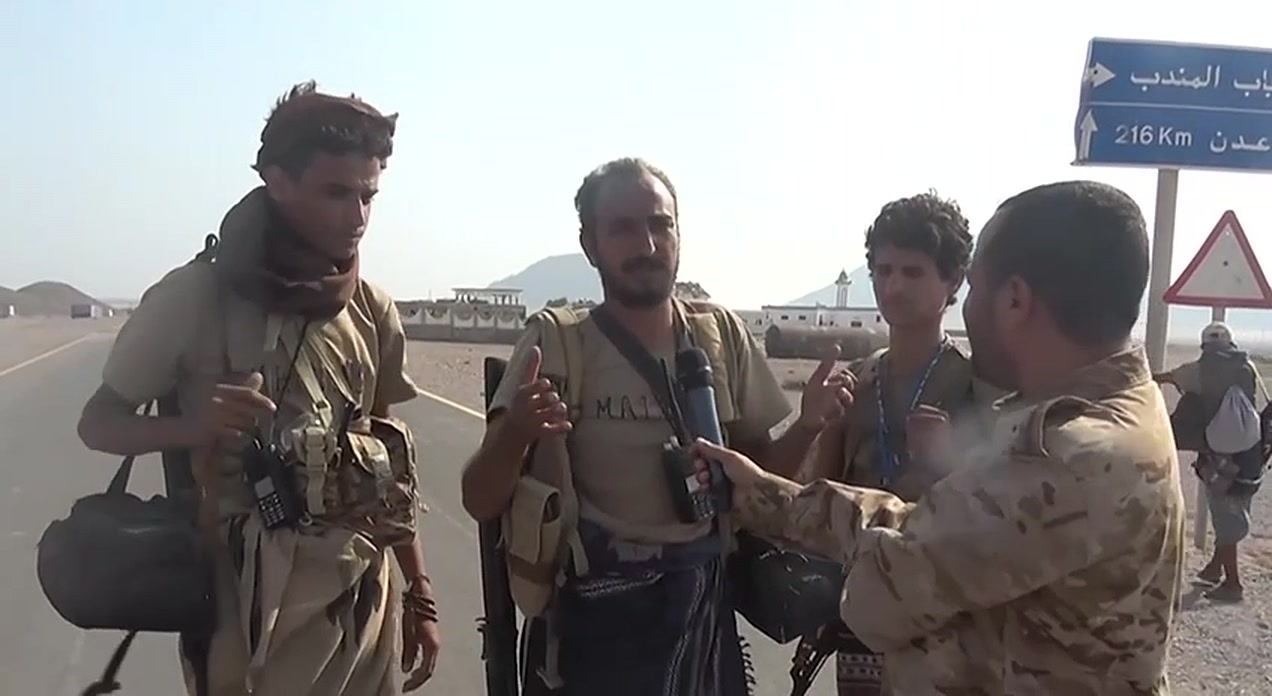
A road sign in today’s footage from Yemen points straight ahead for the port city of Aden, 216 km away, about 134 miles. The armed men being interviewed under it are Ansarallah’s, and Aden is where they’re headed.
Yemen has had two governments for 12 years. Ansarallah holds the capital, Sanaa, and the part of the country where most Yemenis live. The other government is the one the United Nations recognizes, and it’s paid and armed by Saudi Arabia and based in Aden. On Sunday, Nov 15, that second government pulled its troops off the coast at the southern mouth of the Red Sea, the narrow passage every ship using the Suez Canal has to squeeze through, and Ansarallah’s fighters moved in behind them. The same film shows a man in camouflage talking to the camera in front of the empty control tower at Dhubab airport, which was built with Emirati money and handed over only this May. By Sunday night Ansarallah’s fighters were about 37 miles from Aden, where the government was stacking sandbags and digging tunnels.
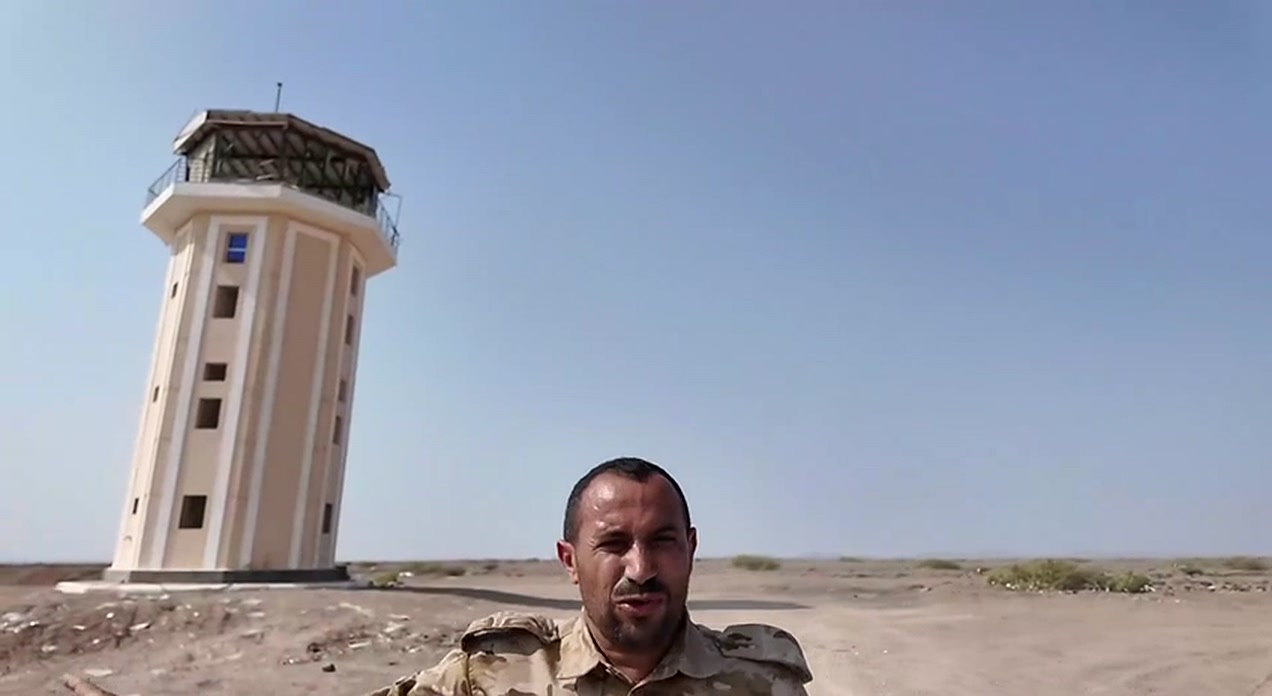
The same day, Ansarallah said it fired two ballistic missiles at the airport and the financial district in Riyadh, the Saudi capital, and Saudi Arabia said it shot two down. Whichever account is closer, one of the world’s biggest military spenders is arguing about whether missiles from the poorest country in Arabia reached its capital.
The country’s name explains more of this than the map does. Most countries are named for a place or a people, which is why nobody ever called Russia Stalinistan and why Russia was still there the morning after Stalin. Saudi Arabia is named for the family that owns it, so a lost war there doesn’t land on a nation so much as on whoever’s running the family firm. That’s Mohammed bin Salman, the crown prince who runs the kingdom. He was 29 and newly made defense minister when he sent the Saudi air force into Yemen in 2015 for what was sold as a short campaign, and he’s 41 now.
Ansarallah wants to be treated as Yemen’s government, and it doesn’t have to conquer anything Saudi to get there. It only has to stay in the field longer than one man can stay in his job.
He’s short on ways to stretch that out. Sending his own army in real numbers risks funerals that could turn the country on him. His family has always leaned on an outside partner in a year like this, and in 1929, when the founder’s own tribal army rose against him, British planes helped finish it. When the grandson asked the United States for its planes this fall, he came home with shared intelligence and no planes.
So it comes back to the family, and owners in this spot usually change the manager before they lose the business. This manager, though, locked a good part of the family in the Riyadh Ritz-Carlton in 2017 and made them sign over fortunes to get out, so there’s no friendly board left to offer him a pension and a villa, and plenty of people with reasons to want worse. Aden looks likely to go the way of the coast, and that’s no longer the open question. Strongmen look permanent until the afternoon they don’t, and my read is that this one doesn’t finish the war in charge and that it ends for him in revolutionary execution or exile, though nobody can say when and men like him have hung on for years.
Sources (6), on the site.
The Safest House in Tehran
November 14, 2026 · Day 260 · 680 words
The Safest House in Tehran
The Safest House in Tehran, read aloud · 5 minutes.
On Friday, Nov 13, 2026, the US Treasury secretary, Scott Bessent, said on television that he’d moved onto a military base on Secret Service instructions, citing Iranian death threats that he didn’t describe and that no one in the government has documented publicly. On Saturday, Israel Today (Israel Hayom), the free Israeli daily founded by the late casino billionaire Sheldon Adelson and long known for its friendly coverage of Benjamin Netanyahu, reported that Mossad had passed the CIA intelligence about an Iranian plan to target the president and senior officials with explosive drones. Neither the CIA nor the White House has confirmed the report, and the officials the paper quotes call the threats a major reason the president has cooled on negotiating with Iran.
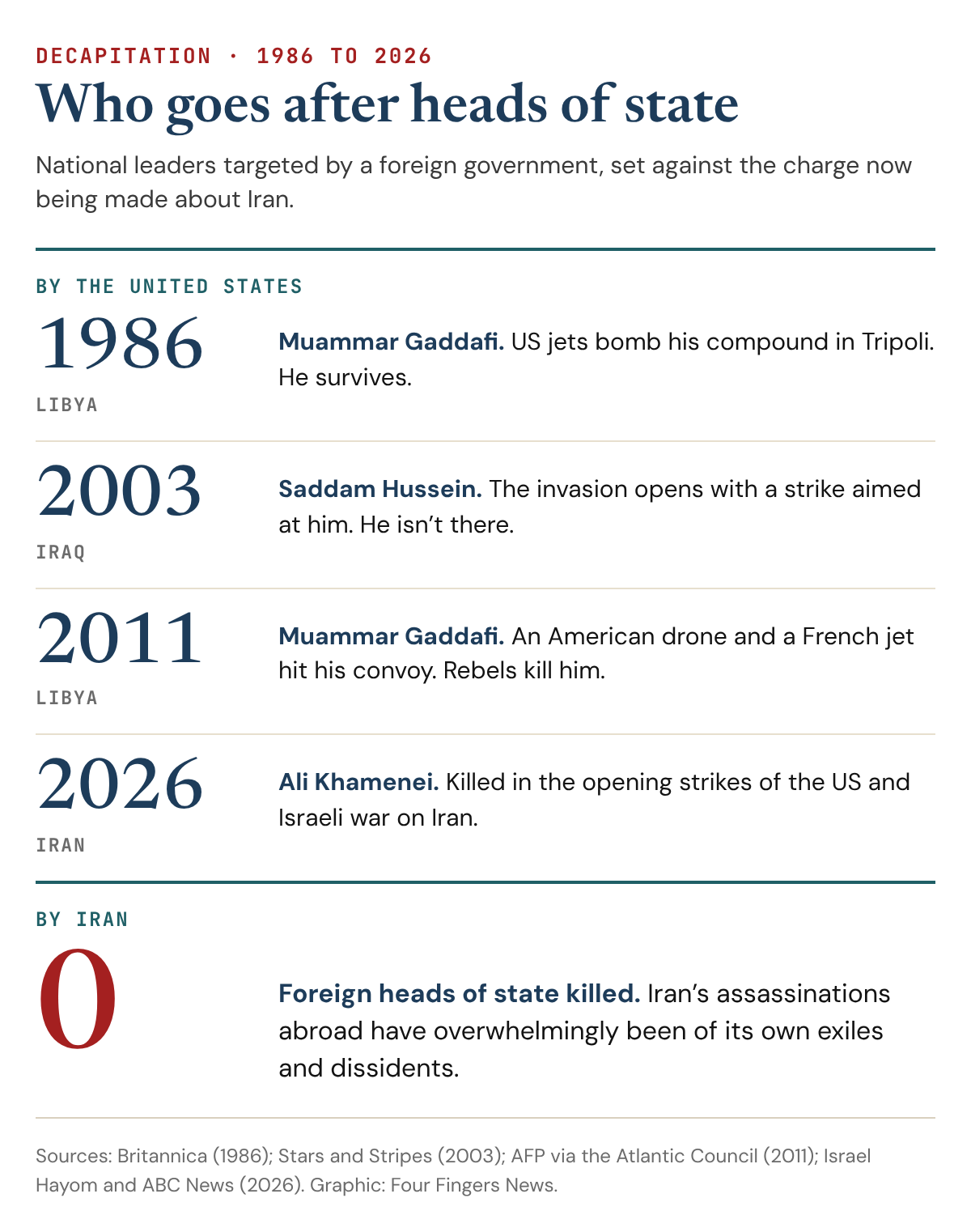
No public evidence backs the plot beyond the word of unnamed officials. Iran’s assassinations abroad have overwhelmingly been of its own exiles and dissidents, which is to say Iranians, and it’s never killed a foreign head of state. The United States and Israel have done it often enough that there’s a word for it, decapitation. The US bombed Muammar Gaddafi’s compound in 1986, and in 2011 an American drone and a French jet hit his convoy and left him to the rebels who killed him. The 2003 invasion of Iraq opened with a strike aimed at Saddam Hussein, and this war opened with the one that killed Iran’s supreme leader.
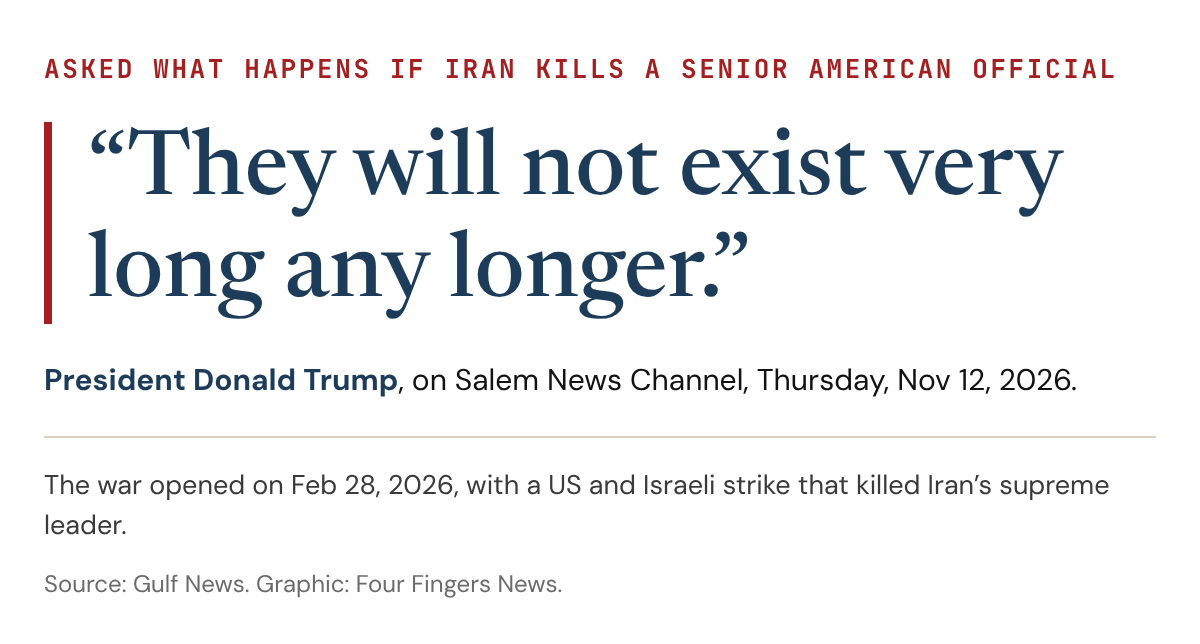
Asked on Thursday what would happen if Iran killed a senior American official, the president said Iran would “not exist very long.” Killing a foreign leader is a tool of policy when the US does it and grounds for erasing a country when the US is the target, and the method it now fears is its own. The warning has already cooled the talks with Iran, which is the outcome Israel’s government has been pressing the White House for.
The same thing happened to Franklin Roosevelt in 1943, when a Soviet warning about German assassins moved him into a house Stalin had bugged. Roosevelt arrived in Tehran, Iran’s capital, on Nov 27 expecting to stay at the American legation. Around midnight, Vyacheslav Molotov, the Soviet foreign minister, called in the American and British ambassadors to tell them German agents knew the president was in the city, and that a house inside the Soviet embassy walls was already being prepared. By the next day, the president of the United States was living as Stalin’s guest, in rooms wired for listening.
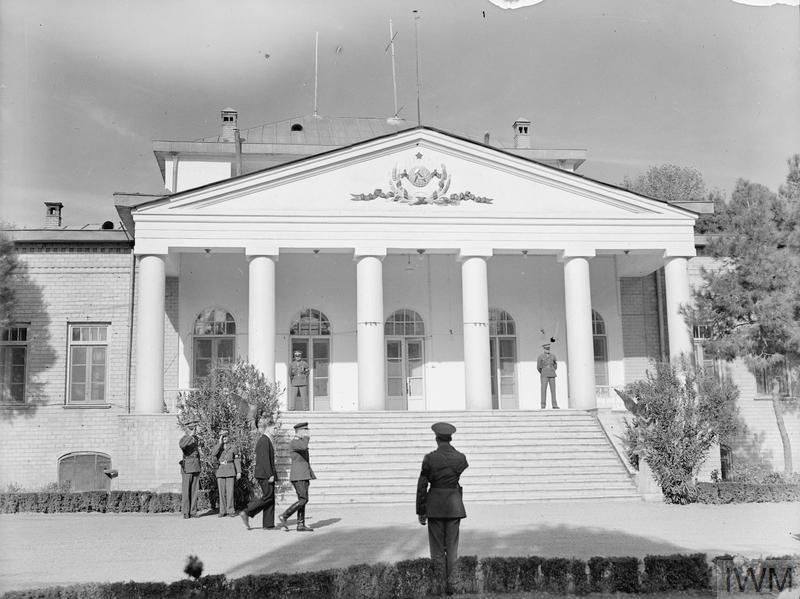
Historians still can’t say whether the German plot existed. Nearly everything known about it traces back to Soviet sources, the German commando said to have led it insisted after the war that there’d been no such operation, and Britain’s ambassador in Tehran suspected Molotov had invented the story to win Roosevelt over. There really were German agents in Iran, though, and Mike Reilly, the Secret Service chief whose only job was to keep Roosevelt alive, had been told six parachutists were still at large and believed what he was shown. The most persuasive reading is that both things were true, that the Soviets feared an attack and Stalin also wanted Roosevelt where he could listen to him.
Both governments have a motive this week too. Iran lost its supreme leader to an American and Israeli strike and has every reason to want revenge. Israel’s government wants to keep the US and Iran from reaching a deal, and the warning reached the public through a paper that’s been close to its prime minister since the day it launched. Motive isn’t evidence in either direction.
Whether the 1943 threat was real turned out to matter less than where the warning put Roosevelt. He may well have been safer inside the Soviet compound, and he was also sleeping exactly where Stalin wanted him.
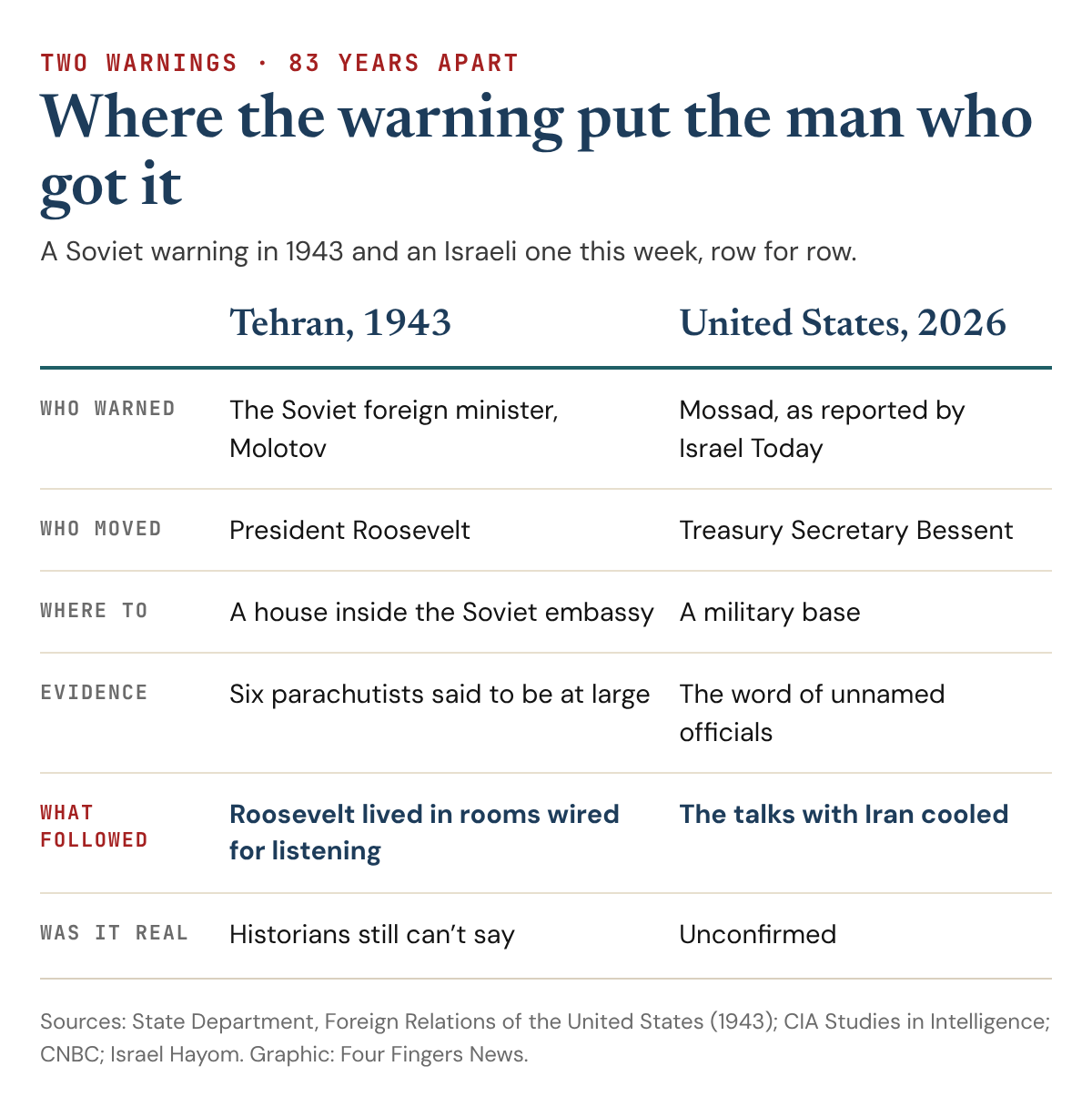
This week’s warning has already put the White House where Israel’s government wanted it. A Cabinet secretary is living on a base, the president is reportedly keeping a lighter public schedule, and the talks with Iran have cooled, and all of that holds whether or not a single drone exists.
Sources (10), on the site.
Home by Christmas
November 13, 2026 · Day 259 · 790 words
Home by Christmas
Home by Christmas, read aloud · 6 minutes.
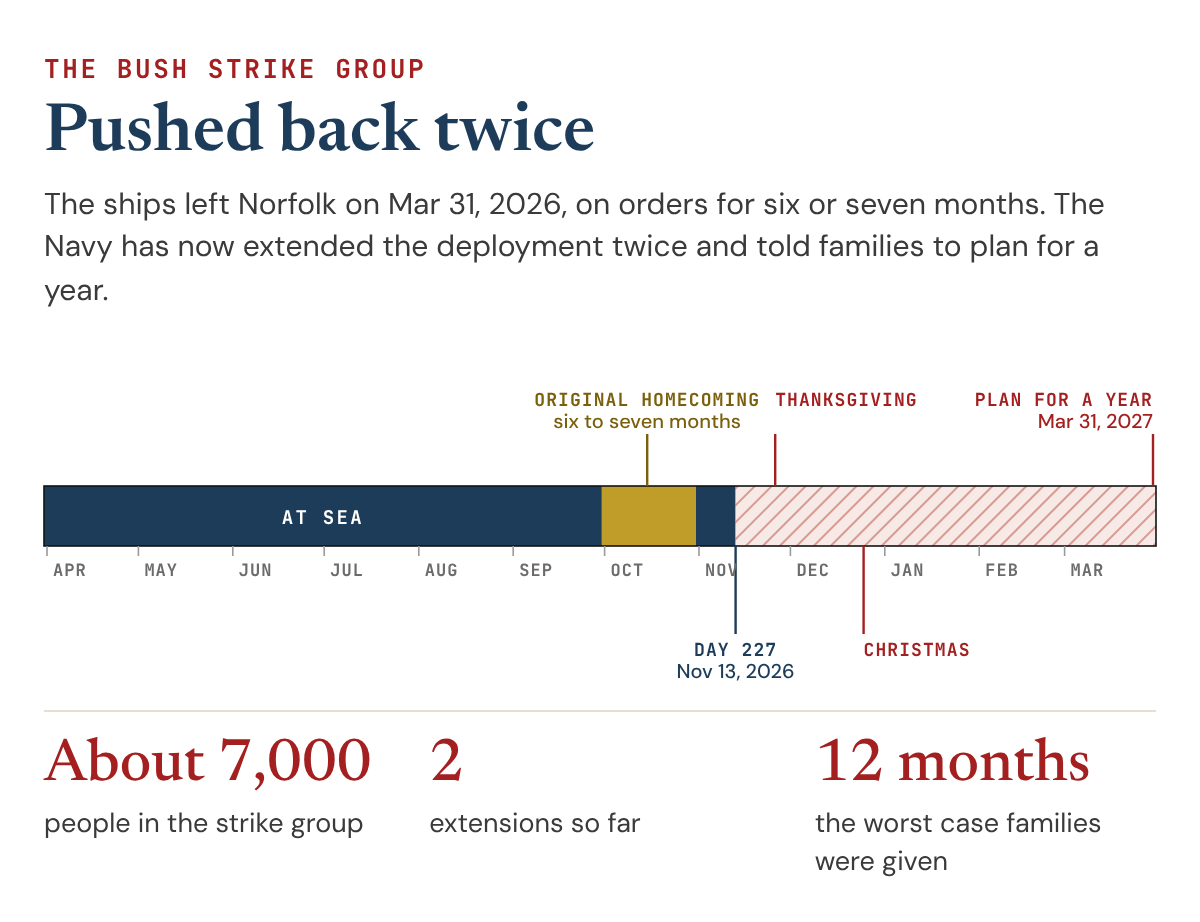
It’s Day 259 of the war with Iran, and about 7,000 American sailors just found out they won’t be home for Christmas. Their families heard it first. On Monday, Nov 9, 2026, a town hall at the Navy base in Norfolk, Virginia drew about 500 relatives of sailors, and the news they got was no Thanksgiving and no Christmas. The sailors weren’t told until the next day.
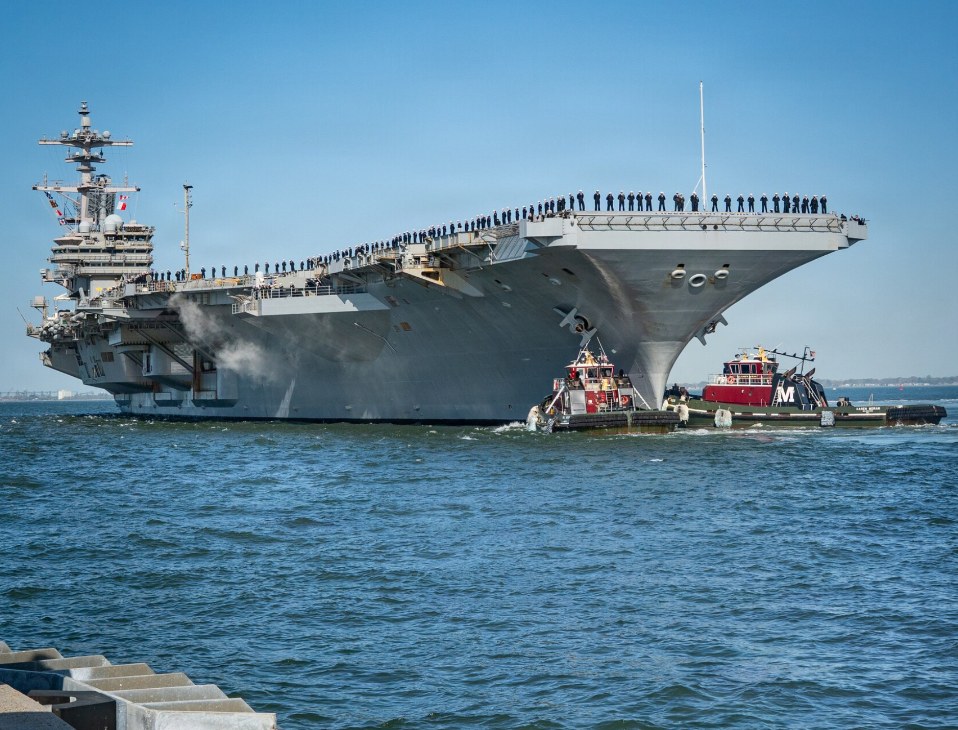
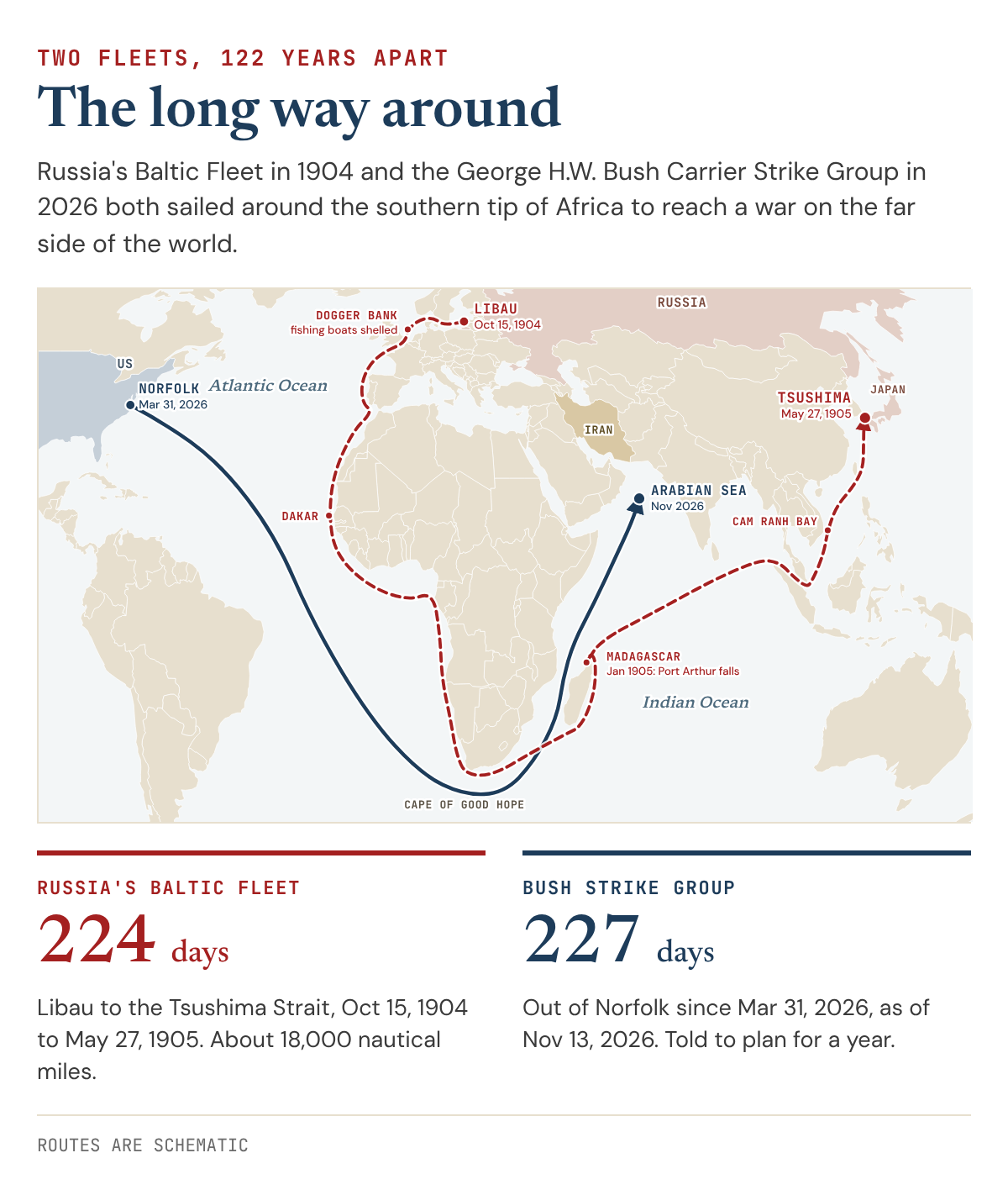
Those sailors belong to the George H.W. Bush Carrier Strike Group. It left Norfolk as five ships: the carrier, three destroyers (the USS Ross, the USS Donald Cook and the USS Mason), and a supply ship, the USNS Arctic, hauling fuel and ammunition for all of them. Add the air wing and it’s about 7,000 people from Virginia and Florida. They left on Mar 31, 2026, on orders that were supposed to run six or seven months. They took the long way, around the southern tip of Africa. That return date has now been pushed back twice, and the Navy says to plan for a year. One family member called it “unsustainable and unaffordable.”
The war with Iran is being fought half a world from home, and distance has a price. It gets paid in people and in worn-out ships, and there’s a 120-year-old story that shows how the bill adds up.
In 1904 Russia was losing a war with Japan over who would control Korea and Manchuria, the northeast corner of China. Russia’s Pacific fleet was trapped in its base at Port Arthur, on the Chinese coast. So Tsar Nicholas II ordered his other fleet, the one in the Baltic Sea near St. Petersburg, to go rescue it. On Oct 15, 1904, about 40 warships carrying 12,000 men steamed out of Libau, a port in present-day Latvia. The trip ahead of Admiral Zinovy Rozhestvensky was 18,000 nautical miles: around Europe, around the southern tip of Africa just like the Bush group, and across the Indian Ocean.
It went wrong in the first week. The crews had heard rumors that Japanese torpedo boats, small fast attack ships, were waiting for them in the North Sea, 18,000 miles from Japan. On the night of Oct 21, 1904, jumpy Russian gunners took a group of British fishing boats for the enemy and shelled them, killing at least two fishermen. Some of the Russian shells landed on other Russian ships. Britain, the strongest navy on earth, nearly declared war.
Then there was fuel. Warships burned coal, and the rules of war barred neutral countries from sheltering a fleet on its way to a fight. A German shipping company, the Hamburg-America Line, kept the fleet moving with 60 coal ships, and the sailors shoveled it aboard themselves 30 to 40 times, half a million tons of it. They did it in African heat above 100 degrees, with coal dust in every cabin.
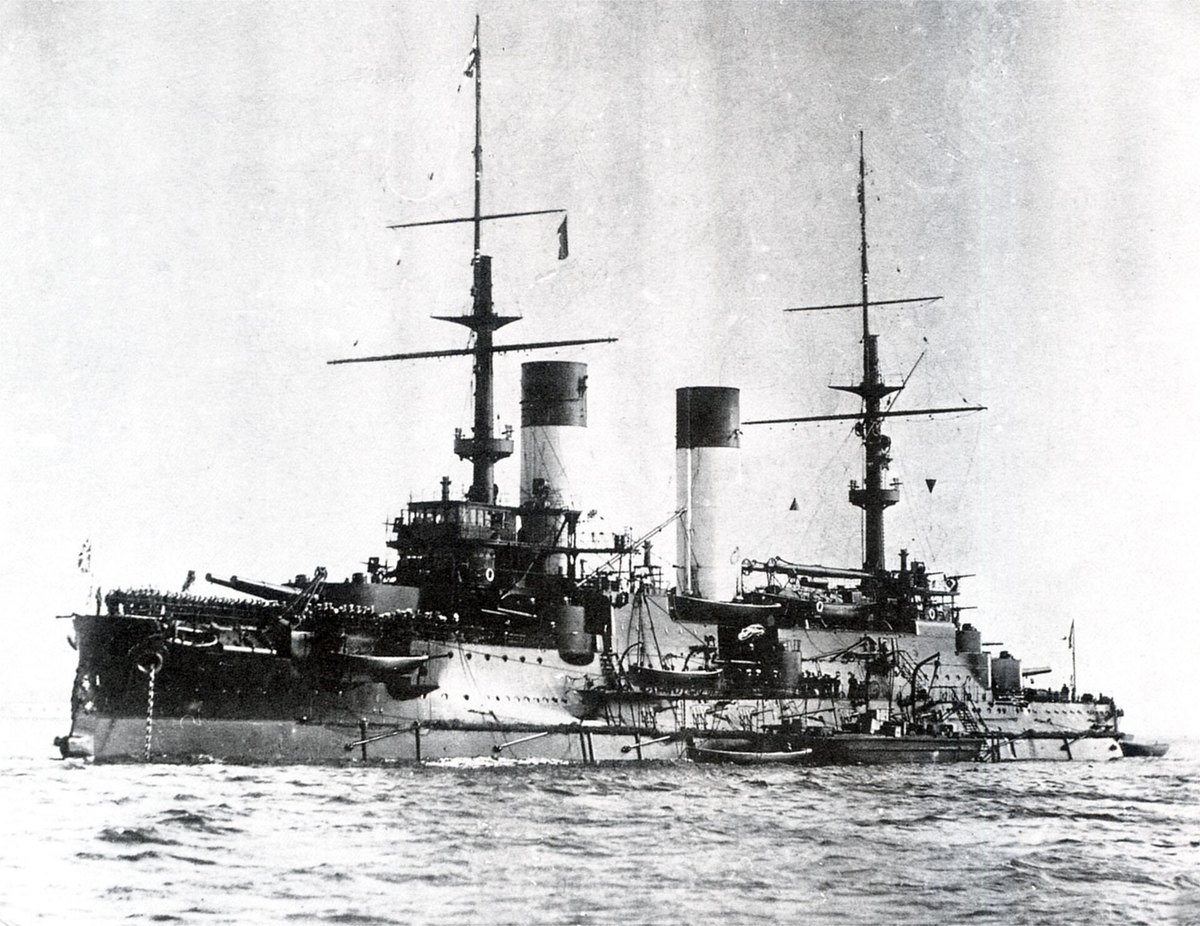
While they sat off Madagascar in January 1905, Port Arthur surrendered. The fleet they’d been sent to save was gone. They were ordered to keep going anyway.
On May 27, 1905, in the Tsushima Strait between Korea and Japan, they finally met the Japanese fleet under Admiral Tōgō Heihachirō. Tōgō had been waiting for them at a base in Korea, a short sail away. By the next day Russia had lost most of its fleet and more than 4,000 men. Japan lost three torpedo boats.
Rozhestvensky’s men had been gone 224 days.
There’s a name for what happened to that fleet. In 1962 an economist named Kenneth Boulding called it the loss-of-strength gradient. Chas Freeman, a retired US ambassador, said the same thing in plainer words this week: “Distance degrades power, and great distance degrades it greatly.” Fuel, food, spare parts and rest all have to come from home, and the longer the trip, the less of each arrives.
Boulding thought modern technology was fixing that problem, and for machines it mostly has. A nuclear carrier doesn’t need coal and can stay at sea for years. The people on it can’t. Navy leaders said so themselves in Norfolk. They told families the strike group can stay only as long as the ships and the jets hold up. The carrier that’s supposed to replace the Bush, the USS Dwight D. Eisenhower, is still being readied in Virginia.
As of tonight the strike group has been gone 227 days. The Russian fleet’s entire voyage took 224.
The lesson of 1904 isn’t about one battle. It’s that a war fought this far from home wears down the ships and the people sent to fight it, a little more every day. The sailors in the Bush strike group have now been told twice that they aren’t coming home yet. Nobody in Norfolk on Monday could promise there won’t be a third time.
Sources (7), on the site.
Receipts Kept
November 12, 2026 · Day 258 · 1,000 words
Receipts Kept
Receipts Kept, read aloud · 7 minutes.
Day 258. The US has pulled ships and planes away from China and Russia to load up on Iran, which isn’t something a country does for a war that’s ending. The oil market is priced as if it’s ending anyway, and I think the market has it wrong.
On Tuesday, Nov 10, 2026, the price of Brent crude, the benchmark most of the world’s oil is priced against, fell to its lowest in two months, and it sat near $91 a barrel this morning. Traders gave Reuters the reasoning: talks are said to be happening out of sight, a summit between the US and China is on the calendar for next week, and nobody expects fighting before then.
On Monday, Nov 9, 2026, the day before that low, somebody filmed crude oil washing onto a beach in Oman, on the south side of the Strait of Hormuz, the narrow exit from the Persian Gulf that this war is being fought over. Iran says it’s stopping tankers that use a route it hasn’t approved, the one along Oman’s coast that the US military opened. The fuel tanker Navig8 Messi burned off Oman on Saturday, Nov 7, 2026, and two more tankers, the Dominica Prosperity and the NCC Fajr, were hit on Wednesday, Nov 11, 2026. The Washington Institute, a think tank that keeps a running count, logged 37 attacks on ships in October 2026, the worst month of the war, and November 2026 is running at about one a day. A price that falls while the ships carrying the oil are burning is a price built on what people are saying.
What’s being moved tells a different story, and the largest piece is the Theodore Roosevelt carrier strike group. An aircraft carrier never travels alone. The USS Theodore Roosevelt is a floating airfield with close to 50 strike fighters aboard, the jets that drop the bombs, and it sails with three escorts: the cruiser USS Chosin and the destroyers USS Paul Hamilton and USS Decatur. A destroyer is a warship built to protect the carrier. It shoots down incoming missiles and aircraft, hunts submarines, and carries cruise missiles of its own that can hit targets on land. A cruiser is a larger version of the same ship with more missiles, and it runs the air defense for the whole group. All told it’s more than 5,000 people. When it reaches the Arabian Sea, the water south of Iran, it’ll be the third such group there, and three is about as many as the US Navy can hold in one place. There isn’t a fourth it can realistically send.
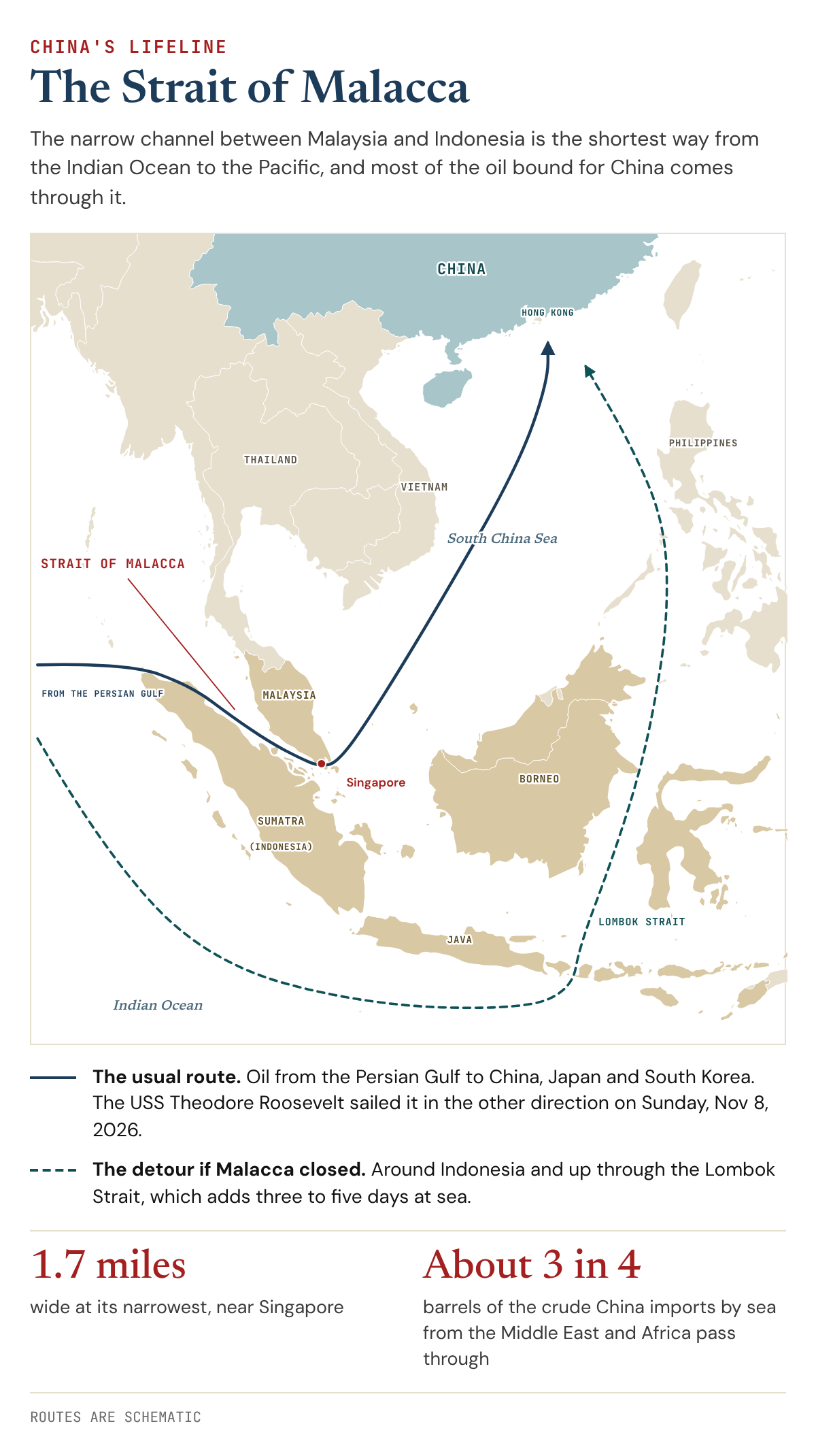
To get there Roosevelt sailed through the Strait of Malacca on Sunday, Nov 8, 2026. Malacca is the narrow channel between Malaysia and Indonesia, 1.7 miles wide at its tightest, and it’s the shortest way from the Pacific Ocean to the Indian Ocean. More oil passes through it than through Hormuz, and roughly three-quarters of the crude China imports by sea from the Middle East and Africa comes that way, which makes it China’s lifeline the way Hormuz is the Persian Gulf’s. Roosevelt had been in the South China Sea, at the Pacific end of it. The US took a carrier off the waterway that matters most to China and sent it to the one that matters most to Iran.
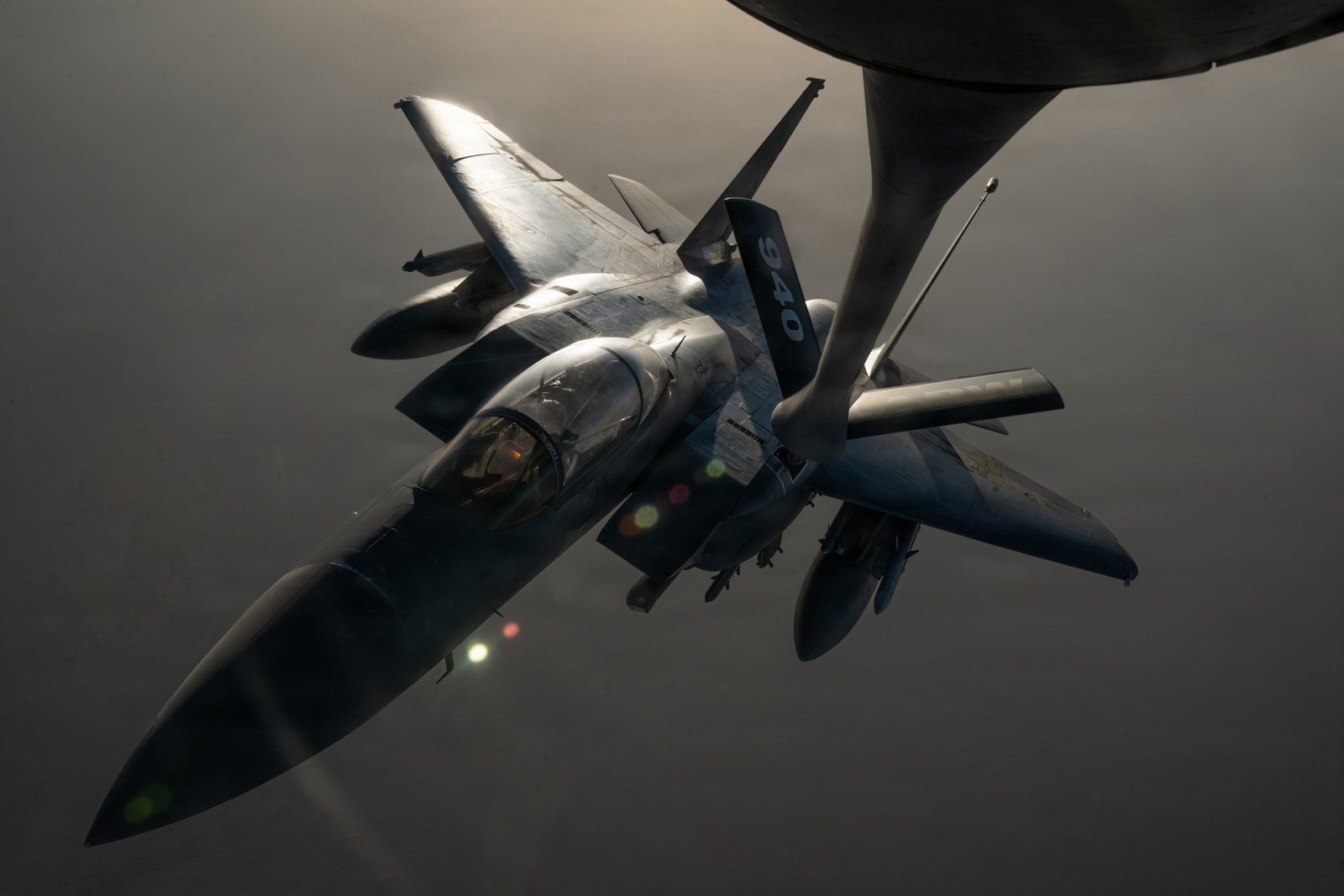
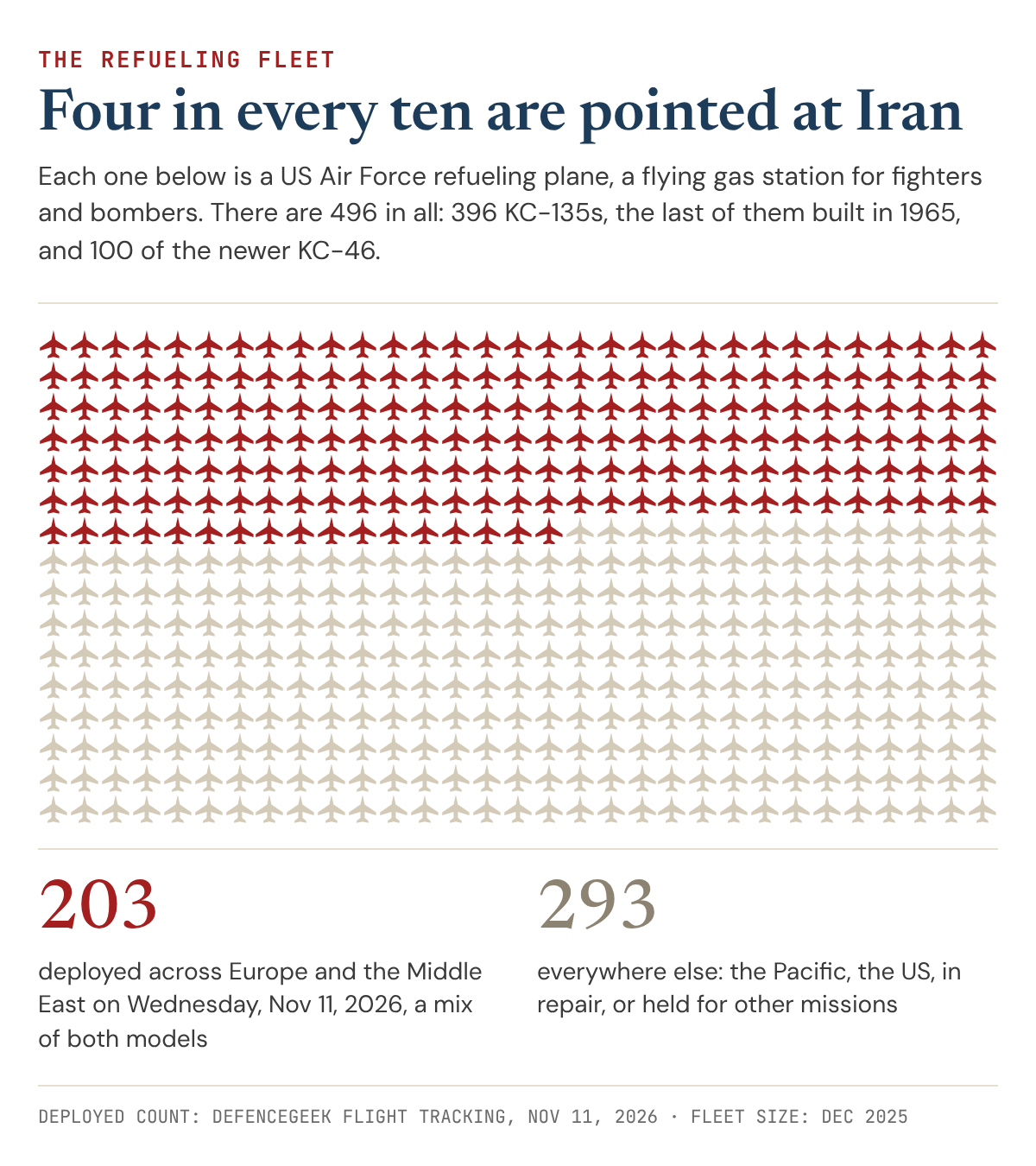
The refueling planes make the same case in bigger numbers. The main one is the KC-135, a flying gas station, and a fighter or bomber can’t reach deep into Iran and get home without meeting one in the air. An analyst who logs military flights from public tracking data counted 203 of them, a mix of the KC-135 and the newer KC-46, across Europe and the Middle East on Wednesday night, Nov 11, 2026. The US Air Force owns 496 in all, 396 KC-135s and 100 KC-46s, so about 40% of every refueling plane it has is now between England and the Persian Gulf. The US can’t make more of them in a hurry, either. The last KC-135 was built in 1965, so those 396 are about 60 years old, and at least one has crashed in this war while others were destroyed on the ground by Iranian strikes. When a threat emptied part of the American tanker base in England on Monday, Nov 9, 2026, the planes weren’t flown home but moved to Germany, Spain and Scotland. A country winding a war down sends those planes home.
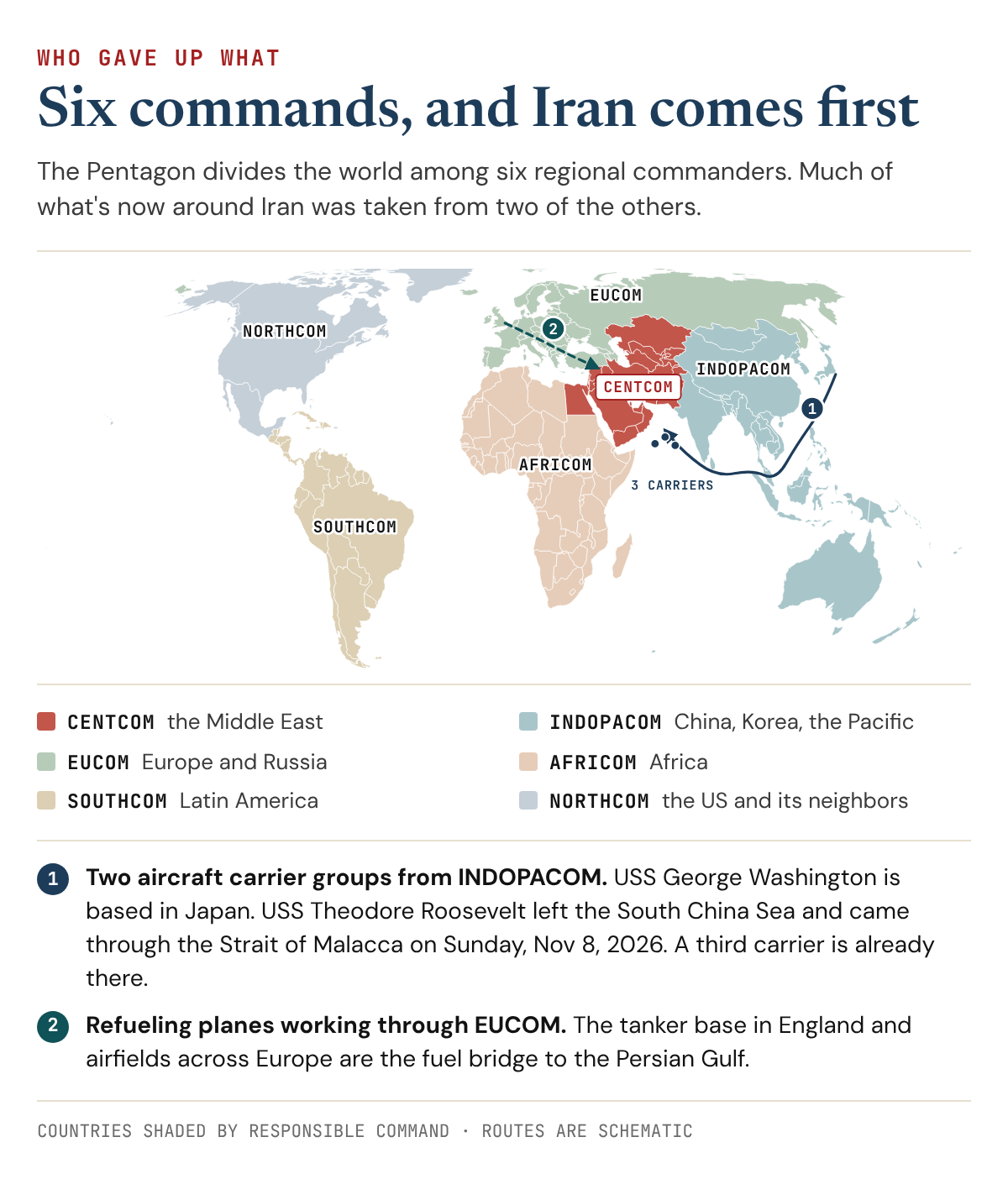
All of it was taken from somewhere. The Pentagon splits the world into six regions and gives each one a four-star commander. Central Command, or CENTCOM, has the Middle East. Indo-Pacific Command, INDOPACOM, has China, Korea and the Pacific. European Command, EUCOM, has Europe and Russia. Africa Command is AFRICOM, Southern Command, or SOUTHCOM, has Latin America, and Northern Command, NORTHCOM, has the United States itself.
CENTCOM runs the war but owns almost none of the forces, so nearly everything it’s using was borrowed. Roosevelt and the USS George Washington, the carrier that’s based in Japan, both came from INDOPACOM, whose job is China, and they’re gone a week before the summit with China. The tanker base in England belongs to EUCOM, whose job is Russia. Every ship and plane sent to the Persian Gulf is one that another commander now has to do without, and that only happens when someone above all six of them has decided Iran comes first.
Nobody leaves the Pacific short of carriers for a war they think is over.
The last time the talk and the traffic split this far was February 2026. Iranian officials called a round of talks in Oman a good start, oil dipped on the relief, and 120 aircraft were crossing toward the region while everyone was reading the quotes. The bombing started on Feb 28, 2026.
I’d love to be wrong about where this is heading, and if the carriers turn around I’ll say so here, but until they do I’m keeping the receipts.
Sources (9), on the site.
The Forty-Year File
November 11, 2026 · Day 257 · 1,180 words
The Forty-Year File
The Forty-Year File, read aloud · 8 minutes.
The CIA spent 42 years, from 1948 to 1990, secretly paying for a Ukrainian nationalist movement. The goal was to weaken the Soviet Union by encouraging Ukraine to break away from it. The man the CIA chose to run the effort had worked with the Nazis during World War II, and the CIA protected him from American investigators for decades. None of this is a theory. It’s in the CIA’s own files, which Congress ordered released, and the National Archives published a report on them in 2010. It matters now because the United States is acting as the neutral mediator in talks to end the war between Russia and Ukraine. Russia has known this history all along, and most Americans have never heard of it.
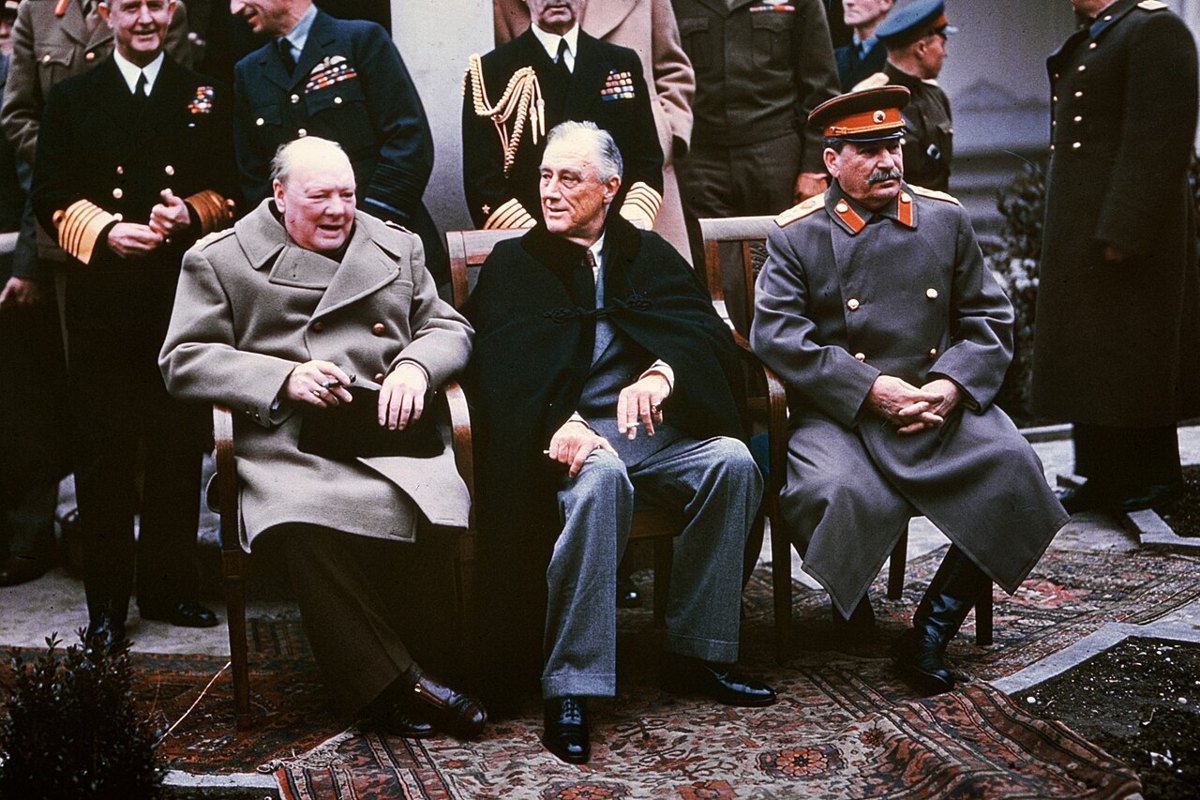
Those talks were held on Nov 10 and Nov 11, 2026 in Abu Dhabi, the capital of the United Arab Emirates, and they were the first in nine months. The two sides agreed in principle to a large exchange of prisoners and didn’t agree on territory or a ceasefire. Vladimir Medinsky, who led Russia’s delegation, said the main subject was how Europe’s security gets arranged after the war. He said the order set up at Yalta and Potsdam, the two 1945 meetings where the United States, Britain and the Soviet Union divided up Europe at the end of World War II, works very badly, and that “Ukraine is merely where the abscess burst open.” Jared Kushner, one of the two American envoys, said Russia’s security concerns were discussed and that he’d told the Russians to bring different proposals if they want Europe to accept them. He and the other envoy, Steve Witkoff, are due in Moscow on Nov 12, 2026 to meet Vladimir Putin, Russia’s president.
In the United States, Russia’s security concerns are usually described as an excuse. The common view is that the US got involved in Ukraine only recently, to help a country that was attacked in 2022. Americans are also told the US is defending a democracy, in the same language used during the Cold War, as if Russia were still communist. The Soviet Union broke up in 1991, and Russia hasn’t been a communist country since. The record shows the US has been involved in Ukraine since 1948.
In 1948 Ukraine was part of the Soviet Union, the communist state that also included Russia. World War II had ended three years earlier, and in western Ukraine a guerrilla force called the Ukrainian Insurgent Army was still fighting Soviet troops. The CIA had been founded the year before. It wanted contacts inside Ukraine, and it picked a group of Ukrainian exiles led by Mykola Lebed.
Lebed’s record was known to the US government. During the war he led the most militant Ukrainian nationalist faction inside German-occupied Ukraine. He’d trained at a school run by the Gestapo, Nazi Germany’s secret police, and fighters under his command killed thousands of Poles and Jews. A US Army intelligence report from 1947 called him a “well-known sadist and collaborator of the Germans.” The CIA hired him and named the project AERODYNAMIC.
The project started with agents. Between 1949 and 1953 the CIA’s base in Munich, in West Germany, dropped 12 Ukrainian agents by parachute into western Ukraine to join the guerrillas. Soviet security forces captured or killed 11 of the 12. By 1954 the Soviet Union had defeated the guerrillas, and the CIA stopped the airdrops.
The CIA then switched to propaganda and kept at it for another 36 years. It moved Lebed to New York. In 1952 the US immigration service was investigating his wartime record, and Allen Dulles, a senior CIA official who became the agency’s director the next year, stepped in on his behalf and called him “of inestimable value” to the agency. Lebed became a permanent resident and later a US citizen.
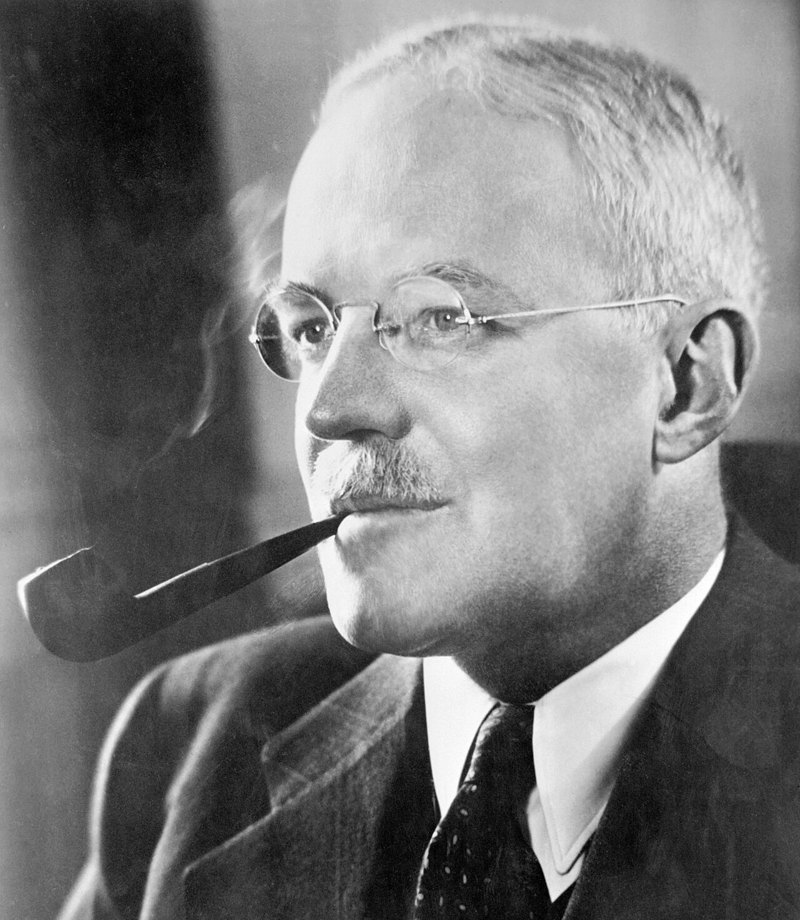
The CIA set up a publishing company for him in New York called Prolog, with an office in Munich. Prolog hired Ukrainian writers living outside the Soviet Union, and most of them didn’t know the CIA was paying them. Only six people at the company knew. People inside the CIA have long called the agency “the Company.” Prolog was a real one, secretly run and paid for by the agency, and the CIA’s files call businesses like it proprietaries. In 1957 alone Prolog produced 1,200 radio programs, 200,000 newspapers and 5,000 pamphlets, all meant for people in Soviet Ukraine. A CIA analyst wrote that Ukrainian nationalism was a “cold war weapon” and that the agency had an obligation to support it.
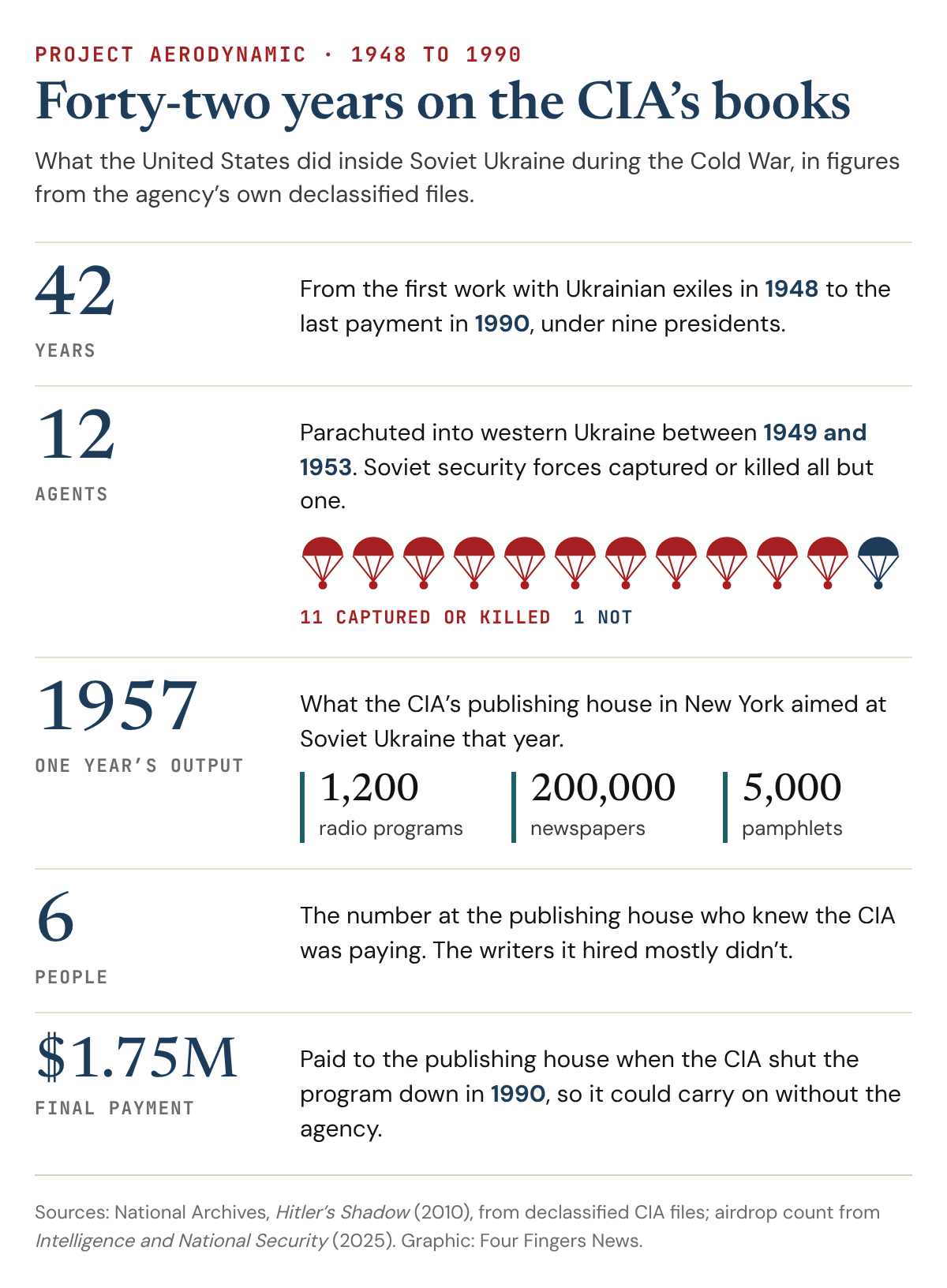
Nine presidents were in office while the program ran, from Harry Truman to George H.W. Bush. In 1977 Zbigniew Brzezinski, President Jimmy Carter’s national security adviser, helped expand it. In 1985 the Justice Department office that investigated Nazi collaborators living in the US opened a case on Lebed, and the CIA told the investigators he’d had no connection to the Nazis. As late as 1991 the CIA was still trying to keep them from requesting his records from German, Polish and Soviet archives, and the investigators dropped the case. The CIA ended the program in 1990, when the Soviet Union was close to collapse. It gave Prolog, the publishing company, a final payment of $1.75M so the company could keep going without the agency. Lebed died in 1998 and is buried in New Jersey.
Lebed wasn’t the only case like this. After World War II a program called Operation Paperclip brought more than 1,600 German scientists and engineers to the United States to work on rockets and weapons, and some of them had been Nazi Party members and SS officers. In both programs the US government decided that a man’s usefulness against the Soviet Union mattered more than what he’d done in the war.
There are limits to what the file proves. The released records end in 1990. They don’t show who did what in the 2014 uprising in Kyiv, Ukraine’s capital, that removed a president friendly to Russia, and they don’t change the fact that Russia invaded Ukraine in February 2022. The CIA also didn’t create Ukrainians’ wish for a country of their own. What the CIA did was pay for the nationalist movement, train its people and use it against the Soviet Union, in secret, for 42 years.
The historians who wrote the National Archives report concluded that the program helped destabilize the Soviet Union. The Soviet government knew about it while it was happening and said publicly that Lebed’s group worked for the Americans, which was true. Americans didn’t get the full account until 2010, and most still haven’t heard it.
That’s the history behind the talks in Abu Dhabi. When Russia raises its security concerns about Ukraine, it has a record to point to that goes back 78 years. Most Americans don’t know that record exists, so the Russian position sounds like paranoia to them. The United States can help end this war, but it’ll be doing that as a country that’s been involved in Ukraine since 1948, not as a neutral outsider.
Sources (8), on the site.
Functionally Destroyed
November 10, 2026 · Day 256 · 1,070 words
Functionally Destroyed
Functionally Destroyed, read aloud · 7 minutes.
Day 256. Iran’s military put a six-minute film on state television on Nov 10, 2026 that shows two generals riding a jeep through a tunnel lined with missiles, and by the Pentagon’s own account those missiles shouldn’t be there. The war began on Feb 28, 2026, a US blockade of Iran’s ports is still in place, and Qatar is carrying proposals between two governments that won’t sit in the same room. Seven months ago the Pentagon said Iran’s missile stockpile was nearly gone and that Iran couldn’t build any more. The film answers the first of those claims, and three days before it aired Iran made a bigger one about the second, saying its missile factories have moved underground. What it means is that the bombing didn’t do what Americans were told it did, and that this war ends when the two governments make a deal, not when Iran runs out of missiles.
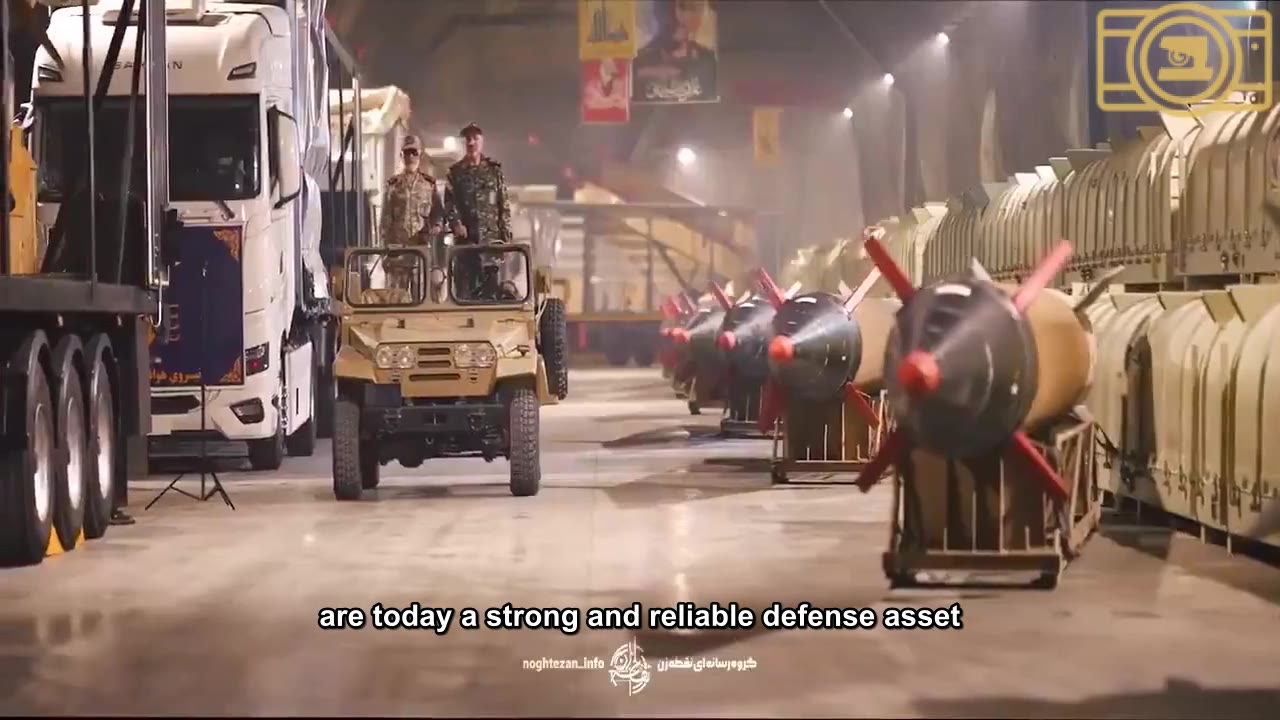
The American claims came on Apr 8, 2026, and they’re worth taking one at a time. Pete Hegseth, who runs the Pentagon, told reporters that day: “Their missile program is functionally destroyed, launchers, production facilities and existing stockpiles depleted and decimated and almost completely ineffective.” That was a statement about what Iran had left. He then made one about the future, saying a wave of more than 800 strikes the night before meant “we finished completely destroying Iran’s defense industrial base.” A country’s defense industrial base is the factories, workshops and suppliers that make its weapons, so he was saying Iran couldn’t replace whatever it fired. Gen. Dan Caine, the top US military officer, stood next to him and described something smaller, saying more than 80% of Iran’s missile facilities were gone, which covers one part of that industry and leaves as much as a fifth of it standing.
The film settles the first claim. Iran calls a base like this a “missile city,” its name for a military complex dug into a mountain, and the one on screen holds rows of ballistic missiles, the kind that fly a high arc to targets hundreds of miles away, including the long-range Khorramshahr, one of the most powerful weapons Iran has. Maj. Gen. Ali Abdollahi, the chief of staff of Iran’s armed forces, toured it and warned that if Iran is attacked again, “our response will extend beyond the region.” None of it should’ve surprised the Pentagon. The Wall Street Journal reported in April 2026 that American and Israeli officials believed Iran still had thousands of missiles hidden or buried, and at a Senate hearing in July 2026, after a Democratic senator read Hegseth’s April words back to him, he said Iran’s weapons industry was “effectively gone” and then added: “But they do have underground facilities.”
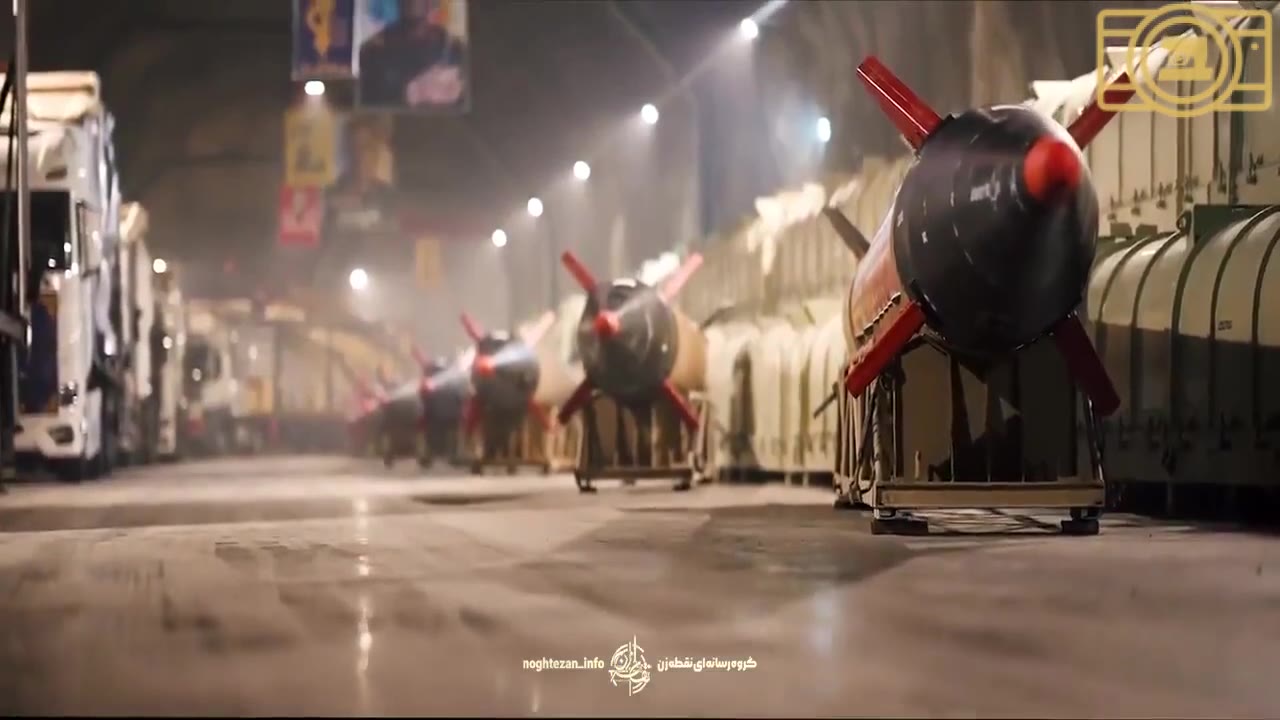
The second claim matters more, because it’s about what Iran can keep doing. On Nov 7, 2026, Hossein Mohebbi, the spokesman for the Islamic Revolutionary Guard Corps (“IRGC”), the branch of Iran’s military that controls its missiles, said production lines for missiles and drones had been moved out of surface factories and into underground sites he called “missile production cities.” A stockpile gets used up and an assembly line doesn’t, so if he’s telling the truth, Iran can replace what it fires. The film doesn’t show that. It shows finished missiles in a tunnel, it doesn’t say where the tunnel is or when it was filmed, and the camera never goes outside, so the factories are Iran’s word and nothing more yet.
Satellites add something. Photos taken in November 2026 and reviewed for the BBC by outside analysts show fresh digging and new buildings at two of Iran’s major missile sites, one at Karaj, near Tehran, and one at Shahroud, in the north, along with repairs at bases that were bombed. Neither site is known to be the one in the film, and a satellite can’t see inside a mountain, but the photos show Iran building at its missile sites seven months after it was said to have nothing left to build with. A separate set of images from March 2026 showed what the bombing did reach. A missile has to leave the mountain to be fired, riding out on a launcher, which is the heavy truck that carries it and sets it upright, and those images showed wrecked launchers outside tunnel doors that American and Israeli planners had spent years mapping. The bombing reached the doors and the trucks parked outside them, and this week’s film shows what it didn’t reach.
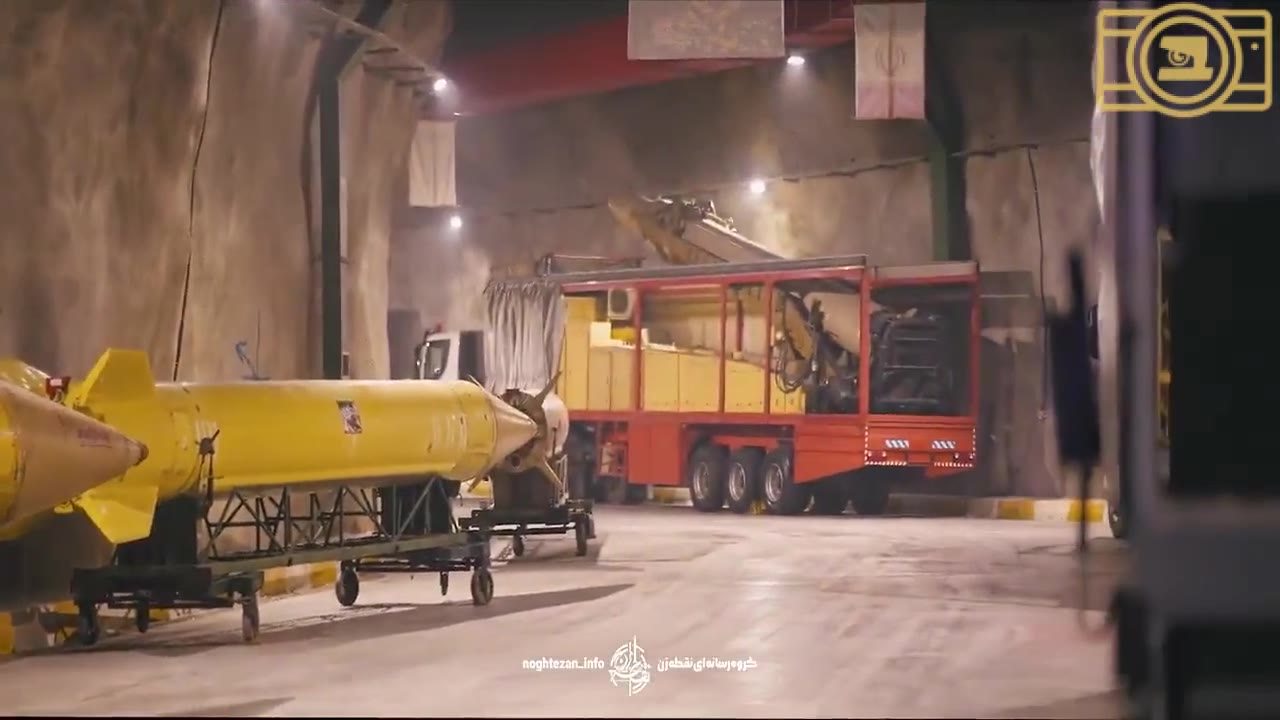
Iran has been at this for a long time. Amir Ali Hajizadeh, who commanded the IRGC’s missile force for years, said the digging began in 1984, in the middle of the Iran-Iraq War, which ran from 1980 to 1988 and saw Iraqi missiles fall on Iranian cities. Iran aired the first footage from inside one of these bases on Oct 14, 2015, three months after it signed the nuclear deal with the US and five other powers, and claimed the base sat 500 meters down, about 1,600 feet. A portrait of Hassan Tehrani Moghaddam, the officer who built the missile program and died in an explosion at a base near Tehran in 2011, hangs in the tunnel in this week’s film. By Iran’s own account, the bombing that began in February 2026 was up against 42 years of tunneling.
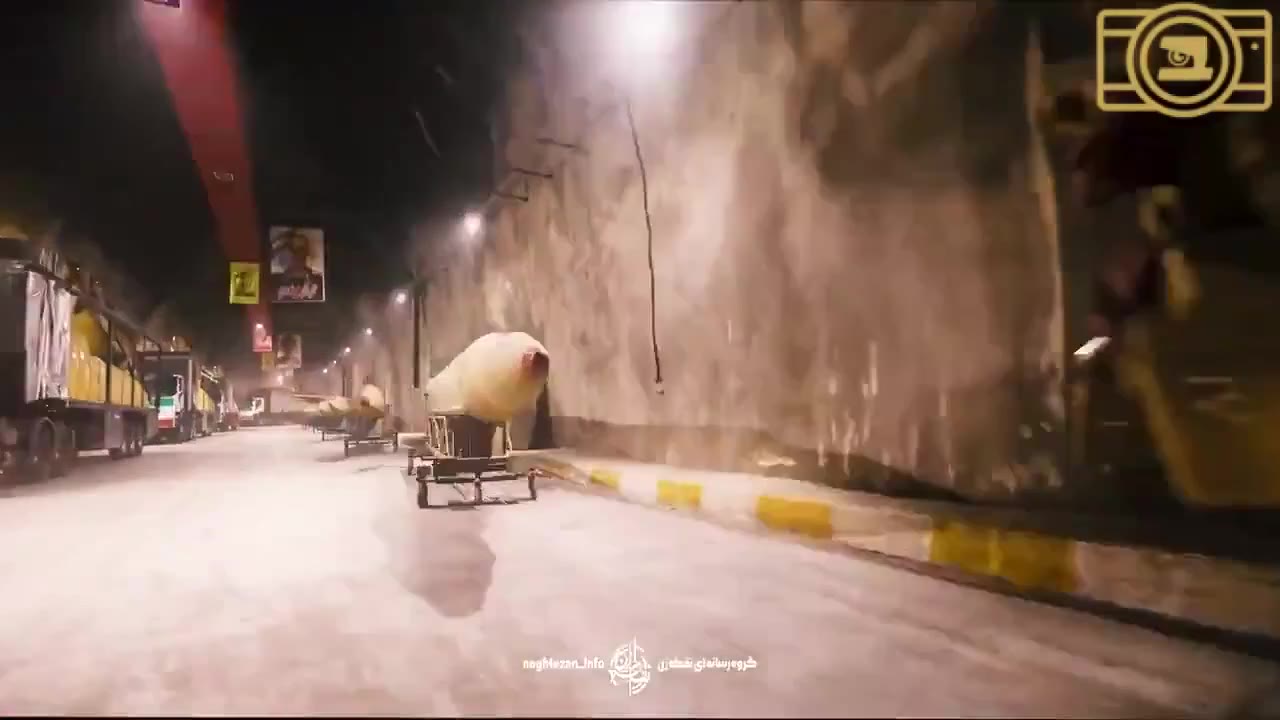
The timing echoes 2015, when the tunnels went on television while the nuclear deal was still waiting to take effect, and it’s why this film is a message to the American negotiators more than a threat to fire. On the day it aired, Marco Rubio, the Secretary of State, said in Paris that there was no need for major combat operations against Iran because economic pressure was doing the job. Hegseth’s version of the war ends with an Iran that has nothing left. Iran’s version is an arsenal that survived and a factory that can refill it, and the first half of that is now on film. The bombing was supposed to leave Iran with nothing to bargain with, and the missiles declared “functionally destroyed” seven months ago are on television, so that plan is finished. The only way left for this war to end is a deal, Qatar is carrying one between the two governments right now, and every week the US spends without one is another week of a war the bombing has already failed to win.
Sources (13), on the site.
Finite Fleet
November 9, 2026 · Day 255 · 1,450 words
Finite Fleet
Finite Fleet, read aloud · 9 minutes.
Day 255. When you see a clip of an oil tanker burning in the Persian Gulf, you’re watching something that can’t be replaced for years. A ship that size ordered today won’t leave the shipyard until 2029 or 2030, and a damaged one has to be repaired, inspected and insured again before it sails, so every tanker that burns means less oil gets moved for a long time. Many more ships drop out without a scratch, because their owners, crews and insurers decide that a trip through the Strait of Hormuz, the only way out of the Persian Gulf by sea, isn’t worth the danger. The ships still willing to go can name their price: a supertanker carrying oil from the Persian Gulf to China earned about $55,540 a day on Jan 9, 2026, seven weeks before the war began, and on Nov 6, 2026 the same trip paid $1.30 million a day, 23 times as much for the same ship doing the same work.
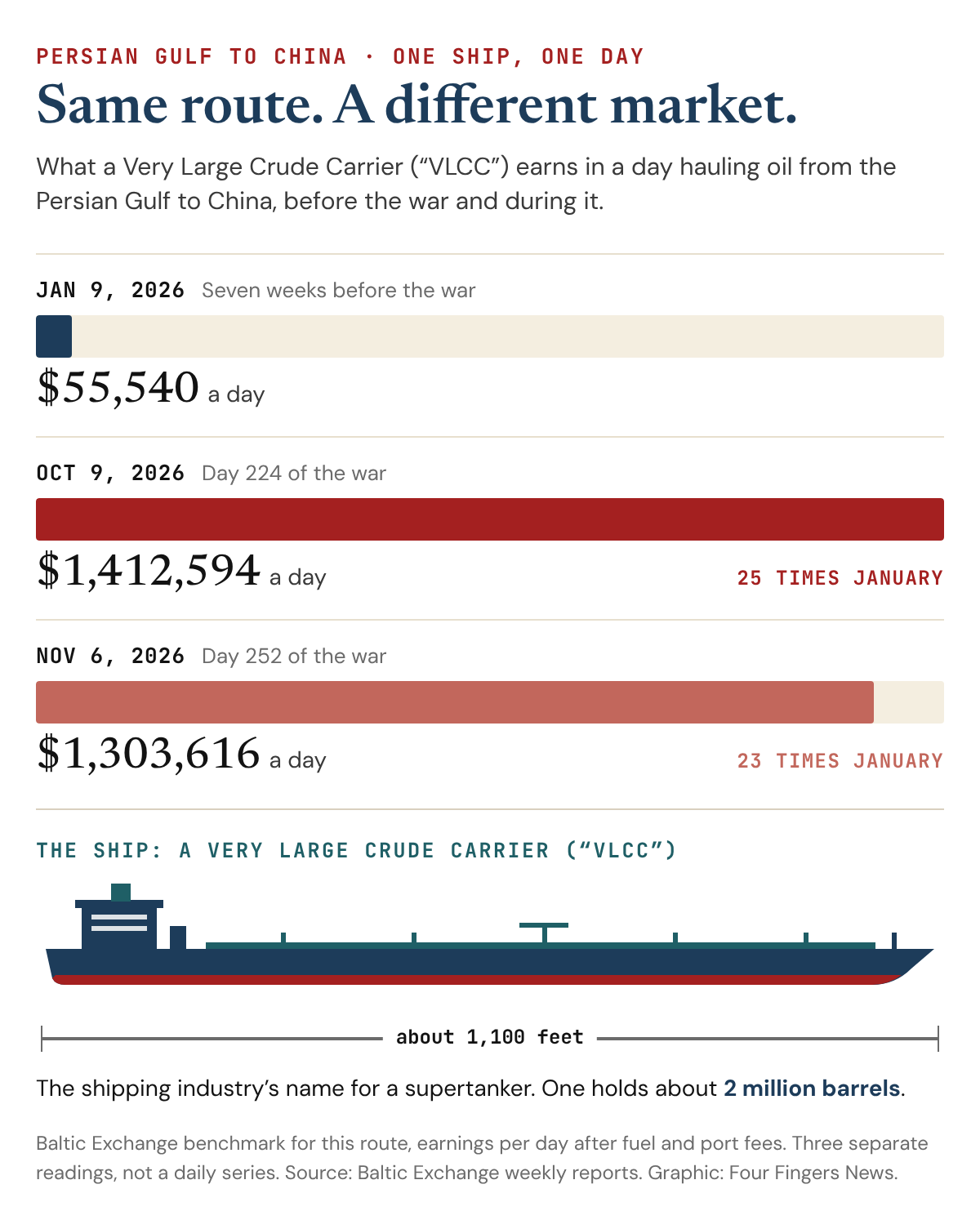
A day is a small slice of the job, because ships move slowly. A loaded supertanker makes about 15 miles an hour, so the trip to China takes about three weeks and the empty run home takes three more, and with time in port one cargo ties up the ship for about 46 days. At November’s rate that single round trip earns the owner about $60 million, which is about $30 for every barrel on board before fuel is counted, against a little over $1 in January 2026. That money is added to the price of the oil, which is why this is bad news for anyone who buys fuel and why it won’t end the day a peace deal is signed.
That supertanker is what the shipping industry calls a Very Large Crude Carrier (“VLCC”), a ship about 1,100 feet long that holds 2 million barrels of oil. What a ship earns per day, after paying for fuel and port fees, is called its time charter equivalent (“TCE”), and the figures here are the benchmark TCE that the Baltic Exchange in London publishes for that route from the rates shipbrokers report. Very little of the increase is the cost of running the ship. Frontline, one of the world’s largest tanker companies, told investors in August 2026 that each of its supertankers needs about $23,800 a day to cover running costs and debt payments, so nearly everything above that is what the market pays an owner to accept the danger, and the buyer of the oil ends up covering it.
The danger itself has a price, and the same Nov 6, 2026 report shows it. A VLCC that loads in the Gulf of Oman, just outside the strait, earned about $620,000 a day for the trip to China, less than half of what the same kind of ship earned for loading inside the Persian Gulf. The ships are the same and so is the destination, so about half of what an owner earns inside the Gulf is payment for taking a ship through Hormuz and back. The shortage reaches every ocean, because a ship tied up near the Persian Gulf is a ship missing somewhere else: VLCCs loading in West Africa and on the US Gulf Coast earned about eight to ten times what they did in January 2026.
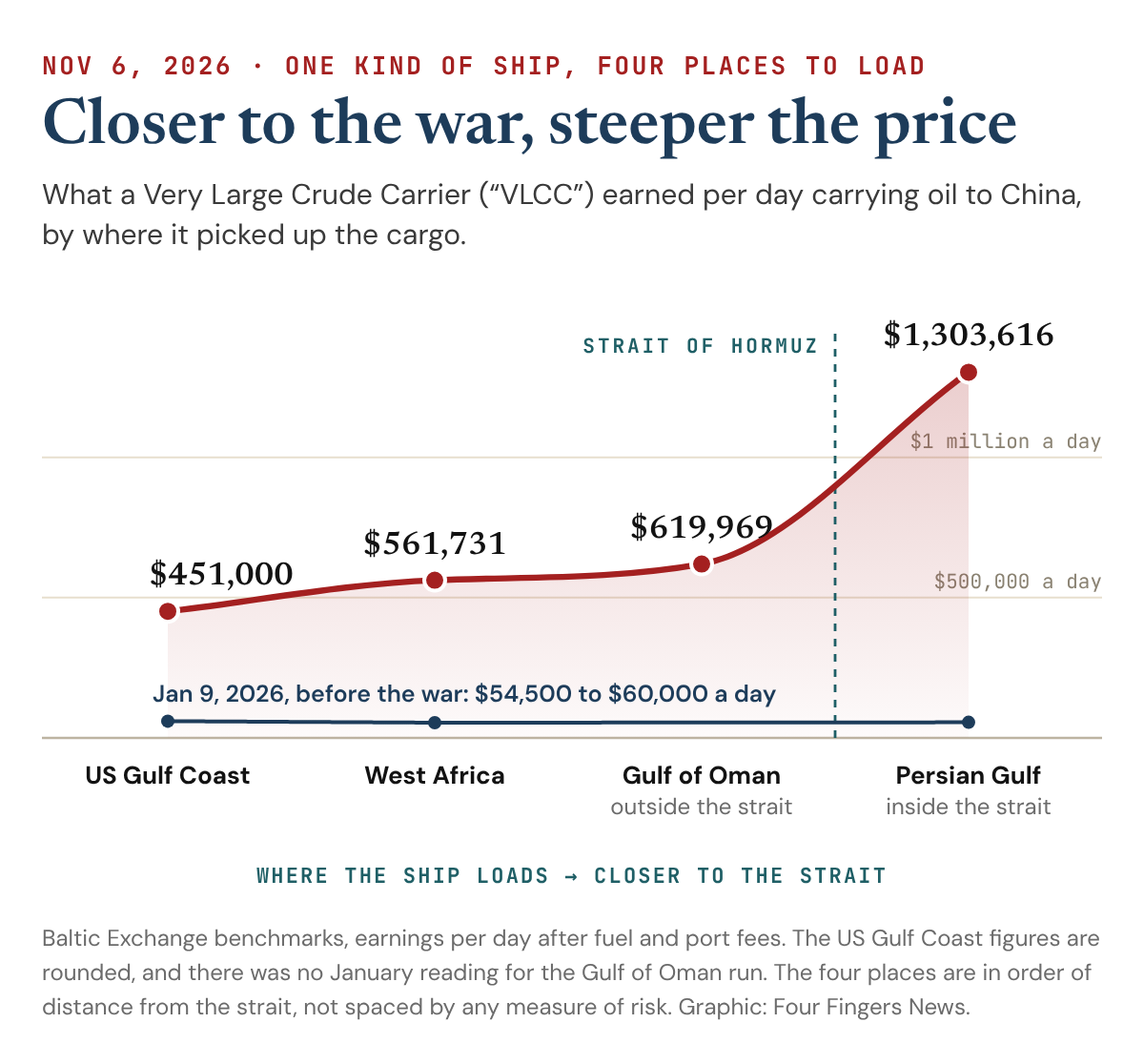
On paper the world has plenty of tankers. The Congressional Research Service, the research office that works for Congress, counted almost 7,500 oil tankers in the global fleet in 2023. But a ship on a list isn’t a ship that a seller in the Persian Gulf can hire tonight. It has to be the right size and close enough to arrive on time, with tanks clean enough for the cargo, inspection papers in order, a crew that’ll go, an owner that’ll send it and an insurer that’ll cover the trip. A tanker anchored on the far side of the Atlantic still counts in the fleet, and it does nothing for a cargo waiting at a Saudi terminal.
The war has shown how far apart the list and the working fleet can get. As of Oct 16, 2026, United Kingdom Maritime Trade Operations (“UKMTO”), the British naval office that takes incident reports from merchant ships, had logged 114 reports of damage to commercial ships of all kinds in and around the Persian Gulf since the start of the year, and six ships confirmed as total losses, meaning sunk or damaged beyond repair. Most ships that get hit don’t sink: of the 12 attacked in one week that October, six kept sailing or reached port and one was lost. But a ship doesn’t have to sink to come off the route, and every strike is studied by the owners, crews and insurers of the ships that weren’t hit.
There was a small rehearsal for this in 2019. Between May 12 and June 13, 2019, six tankers were attacked in the waters just outside the Strait of Hormuz, and none of them sank. The extra insurance an owner buys for each trip into a danger zone is called a war-risk premium, and for a supertanker headed into the Persian Gulf it went to $50,000 after the first attacks and to at least $185,000 after the second. Owners and the companies that hire their ships stopped booking for a time while they worked out the danger. The world had as many tankers after those 32 days as it had before, but fewer of them were on offer in the Persian Gulf.
This year’s numbers are of another size. War-risk cover for a single trip through Hormuz has been reported at 3% to 10% of the value of the ship, up from a fraction of 1% before the war. A nine-year-old supertanker is worth about $135 million, going by two that Frontline agreed to sell in July 2026, so the insurance on one voyage can run from about $4 million to $13.5 million, against about $185,000 in 2019. An owner with a perfectly good ship can look at that bill and decide the trip isn’t worth it, a company hiring the ship can find a willing owner and then watch the insurance wreck the economics of the cargo, and a crew can read the latest attack report and turn down the contract. None of those decisions takes a ship off anyone’s list, and every one of them takes a ship out of the market.
The fleet does grow, but slowly, because the yards that can build a ship this size, most of them in South Korea, China and Japan, are booked through 2028. Two VLCCs ordered from a South Korean yard on Oct 29, 2026, at about $133.5 million apiece, are due in the second half of 2030, and ten that China’s COSCO Shipping Energy ordered on Nov 9, 2026 are due between August 2029 and November 2030. A ship that burns this month can’t be replaced before 2029, a damaged one comes back only after repairs, inspections and an insurer’s sign-off, and even an undamaged one can sit idle while its owner waits to see whether the next trip looks worse than the last.
That’s why an announcement of peace and a working oil trade are two separate events. A ceasefire changes expectations at once, and oil futures, the contracts traders use to bet on where prices are headed, can fall on the hope of one. The physical trade waits for proof: insurers want to see ships get through safely before they cut their prices, owners want to believe their ships will come home, crews have to agree to go, and ships that were damaged or sent elsewhere have to be repaired, brought back and matched with cargoes again.
The White House has been describing a war that’s nearly over while keeping its blockade of Iran’s ports in place. Both can be true as negotiating positions, but to a tanker owner they add up to a risk that still has to be priced, and the freight market isn’t judging who won so much as estimating the odds that the next loaded ship gets out. Nov 9, 2026 was a new moon, the darkest night of the month and the kind long favored for a surprise attack, and it passed without the large strike many had feared, which is a relief and still isn’t something an insurer can count as peace.
A ceasefire can be signed in an afternoon, but the ships come back one repair, one crew and one insurance policy at a time, and until they do, the price of a ride out of the Persian Gulf will say more about whether this war is over than any announcement will.
Sources (11), on the site.
The Kitchen Table
November 8, 2026 · Day 254 · 720 words
The Kitchen Table
The Kitchen Table, read aloud · 5 minutes.
Veterans Day is Wednesday, and it’s for the ones who came home: the people who got off the boat, found a job and never said much about it. Edward Younger is the picture of it. In 1921 the Army sergeant chose America’s Unknown Soldier in a French town hall, then went home to Chicago, sorted mail at the post office and raised a son. For nine years almost nobody asked him about it, and he didn’t mind.
He was 23 when he walked into the town hall of Châlons-sur-Marne, in northeastern France, on Oct 24, 1921. Four identical caskets were waiting. Each held an American killed in the First World War whose body couldn’t be identified, taken from four different American military cemeteries in France. Before he came in, they’d been shuffled, one squad of soldiers after another, so nobody could trace a casket back to a particular cemetery. The Army had planned to let an officer choose. At the last minute it followed the French, who’d given their own choice to an enlisted man. The job went to Younger, who’d been knocked unconscious by a shell in July 1918 and shot through the left thigh that October.
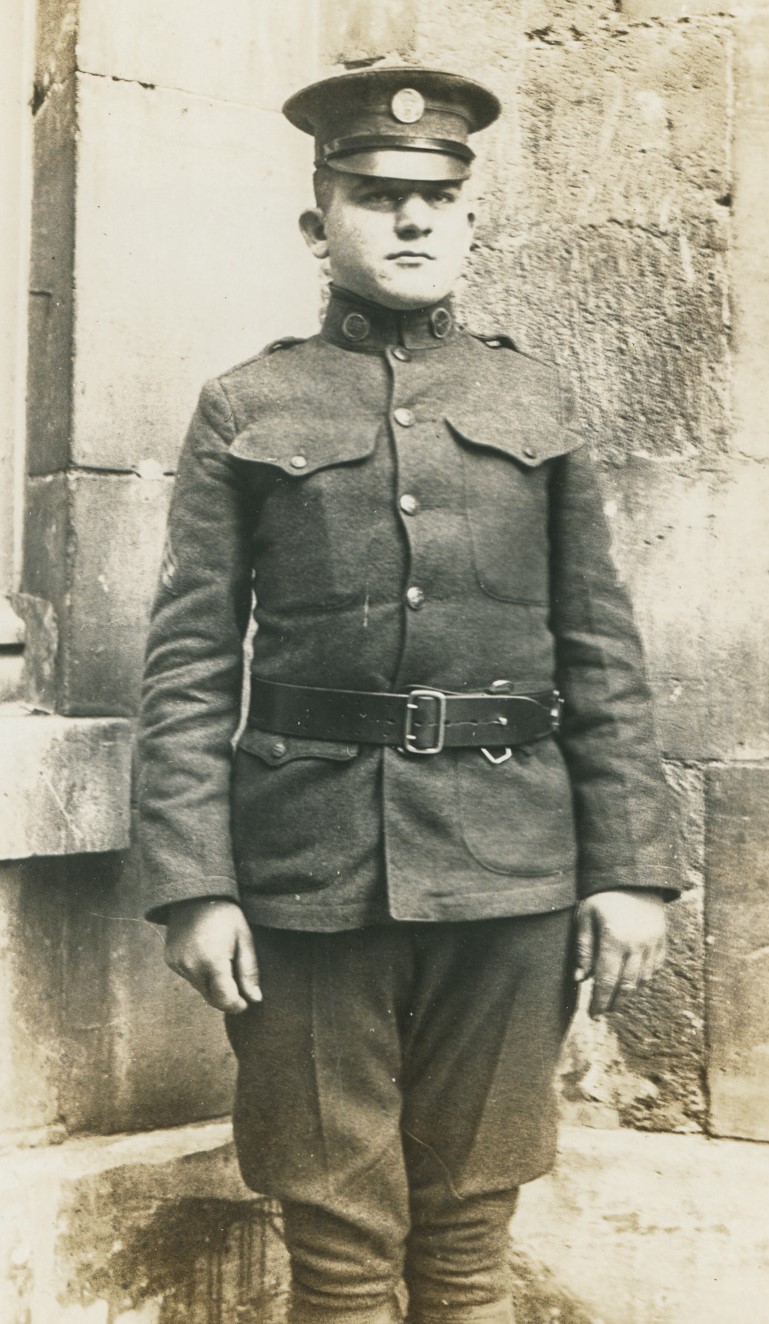
He described the moment himself in a Sunday magazine on Nov 8, 1936, 90 years ago today. Standing among the caskets, he’d wondered whether he’d known any of the men inside. “Maybe these buddies had once been my pals,” he wrote. He walked around them three times before something drew him to one. He laid roses on that casket and saluted.
The casket crossed the Atlantic on the cruiser USS Olympia and lay in state in the Capitol in Washington DC, where more than 90,000 people filed past on Nov 10, 1921. The next day, the third anniversary of the armistice that ended the fighting, it was buried at Arlington. President Warren Harding laid the Medal of Honor on it, and Americans across the country observed two minutes of silence. The tomb worked because nobody knew the name, so any family whose son, husband or brother had never been found could stand in front of it and think of their own.
Younger went home, and before long his own name faded too. When Alan MacDonald of the Washington Post tracked him down through the Veterans’ Bureau in 1930, no reporter had ever come looking. He found a small frame house on Chicago’s Bingham Street, long unpainted, with a laundry on one side and the streetcar barns on the other, and a man in a hurry: a shift at noon, and a five-year-old to drop at his father-in-law’s first. They talked at the kitchen table while the boy, Jack, played on the floor, now and then standing at the table with his eyes just above the edge, holding out toys. Younger was a clerk sorting mail bound for Wisconsin, and he explained that he could go in an hour late and work an hour longer.
Some people might call his life dull, he said, but he liked it: his family, the Legion post, St. Sylvester’s church, summers in Minnesota, a card game with the boys now and then. He didn’t talk about France. In all those years it had come up at work exactly once, when a Frenchman hired on at the post office figured out what Younger had done and went around telling everyone. The boys nodded and went back to the mail. He’d never seen the tomb, either. On post-office pay, the trip to Washington DC was out of reach.
The Post paid his way, and on Memorial Day 1930 he stood in front of the tomb and laid down roses again. He said it was “real nice to get a chance to visit him again,” and that the man inside might have “eaten, slept, and fought next to him.” He couldn’t know that, but he knew which casket he’d saluted. When Younger died in 1942, at 43, he was buried at Arlington too.
The Unknown was buried on Armistice Day, and in 1954 Congress renamed the holiday Veterans Day, to honor American veterans of all wars. Memorial Day belongs to the man in that casket. Wednesday belongs to Younger at his kitchen table, and to the millions like him who came back to work, family and the rest of a life.
Sources (4), on the site.
Awaiting Orders
November 7, 2026 · Day 253 · 520 words
Awaiting Orders
Awaiting Orders, read aloud · 4 minutes.
A tanker full of Russian diesel was supposed to arrive in New York today. It didn’t. The Agioi Fanendes left the Russian port of Primorsk on Oct 22, 2026 with 40,000 tons of diesel, the first shipment under the deal President Donald Trump made with Vladimir Putin by phone on Oct 9, 2026. Right now it’s sitting in the North Atlantic with no port to go to. The Greek company that runs it says it doesn’t know yet where the fuel will be unloaded.
The deal was announced as a way to lower diesel prices before the midterms, and it was never going to do that. The four tankers together carried about a third of one day’s American diesel use, and traders said from the start that the cargoes were Russian diesel that would have gone to Brazil anyway, not new supply. Diesel was $6.30 a gallon when the deal was announced and it’s $6.21 today, and that nine cents came from oil falling after Tuesday’s vote, when traders bet the Iran war ends sooner, not from a drop of Russian fuel. A year ago diesel was $3.71.
The Treasury Department gave the deal a license the day it was announced, which means buying and unloading Russian diesel in the United States no longer breaks sanctions. Four tankers loaded. Two of them were already under sanctions the license doesn’t cover, so they turned around. The Agioi Fanendes isn’t sanctioned, and it still can’t find anyone to take the cargo.
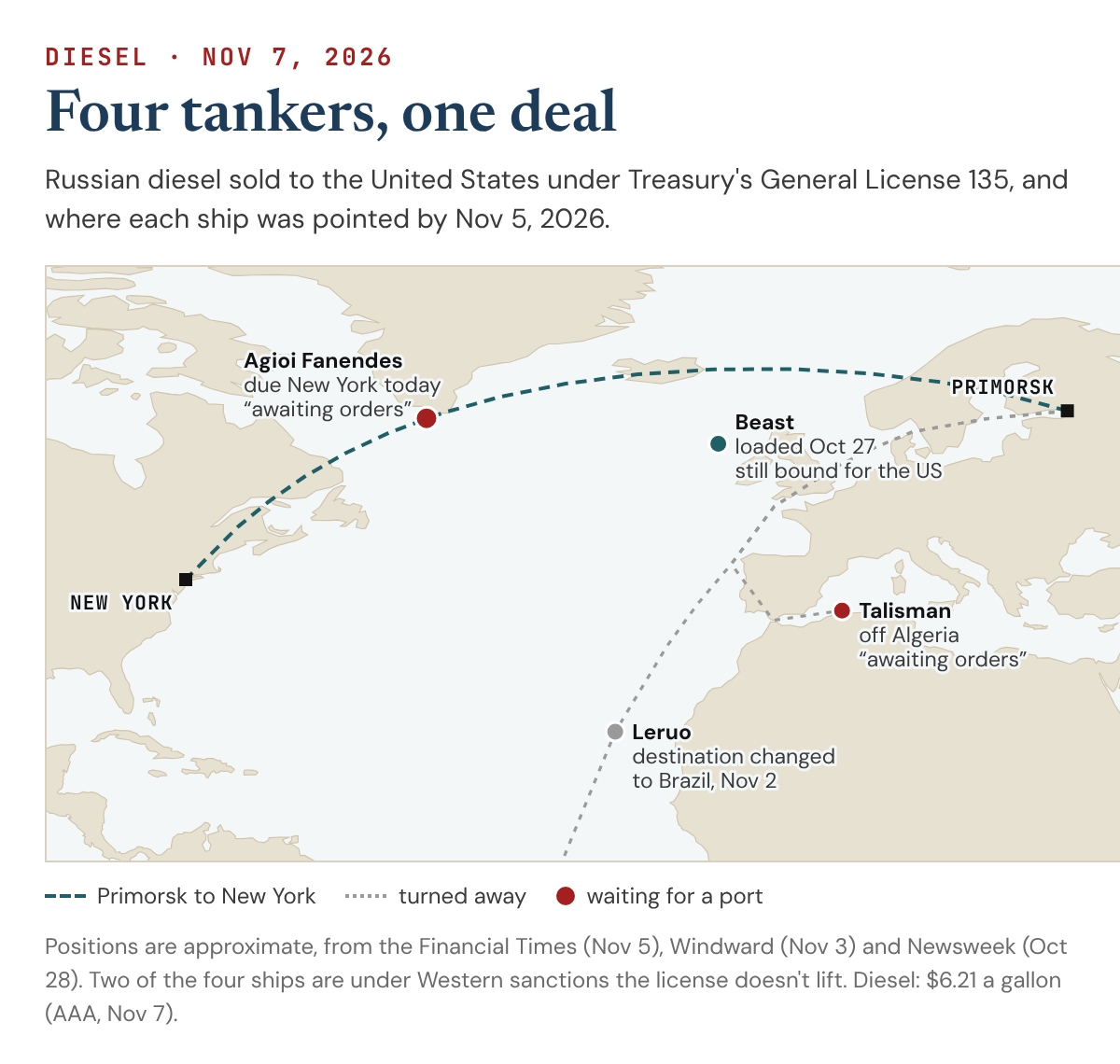
That’s because a license from the Treasury isn’t the same as a law from Congress. In April 2022 Congress banned Russian oil and fuel until the president certifies that Russia has stopped the war. Senator Richard Blumenthal of Connecticut wrote to the shipping company on Oct 28, 2026 to say that unloading the fuel would be illegal. New Jersey’s governor, Mikie Sherrill, wrote to every fuel terminal in her state on Nov 4, 2026 and told them not to take it. The White House says the shipment is legal. No terminal owner wants to be the test case, so nobody has agreed to take the fuel, and the ship waits.
There’s one more piece. Most diesel that moves between American ports has to travel on American-built, American-crewed ships, under a 1920 law called the Jones Act, and only 54 tankers in the world qualify. Back in March the government waived that law so foreign ships could carry Texas diesel to the East Coast. The waiver expires on Nov 15, 2026. The American shipping companies want it to expire, and the White House hasn’t said what it will do.
Here’s where that leaves things. The president announced a diesel deal four weeks before an election, the Treasury licensed it the same day, and the first ship was due four days after the vote. The election came and went. The diesel didn’t come at all. Meanwhile the workaround that’s been bringing Texas diesel to the East Coast on foreign ships ends in eight days unless the White House extends it. The headline arrived on time. Nothing else did.
Sources (8), on the site.
Plus Fees
November 6, 2026 · Day 252 · 390 words
Plus Fees
Plus Fees, read aloud · 3 minutes.
Tonight the Smashing Pumpkins play Climate Pledge Arena, which, like most big arenas, sells its tickets through Ticketmaster, and business has never been better. On Thursday Ticketmaster’s owner, Live Nation, the world’s biggest concert promoter, reported $10.1 billion in revenue for July through September 2026, a record, and said Ticketmaster had processed 98 million tickets with a fee attached in those three months. It did all that while losing in court: on Apr 15, 2026, a federal jury in Manhattan found the two had illegally monopolized the concert business, and the states that won are asking the judge to split them apart.
Seattle’s own Pearl Jam picked this fight in 1994. The band wanted fans to pay no more than $20, $18 for the ticket and $1.80 for Ticketmaster, which was charging $3.25. That April the band went to the Oval Office and asked President Bill Clinton whether it could play shows on closed military bases to get around Ticketmaster; he didn’t go for it, and the talk turned to Arkansas, his home state, beating Duke for the college basketball title.
In May the band asked the Justice Department to investigate, guitarist Stone Gossard testified before a House subcommittee, and bassist Jeff Ament explained what was at stake for him: “I don’t want to become something I despised as a kid.” Ticketmaster’s president, Fred Rosen, said the company had competition and offered an example: the Home Shopping Network. Pearl Jam canceled its summer tour, and in 1995 the Justice Department closed its investigation without taking action.
In 2010 Ticketmaster merged with Live Nation, and by this year’s trial it was handling about 86% of the tickets sold at major concert venues. The Justice Department sued in 2024 and then settled in March 2026, in the middle of the trial, without breaking the company up. Its deal caps Ticketmaster’s fee at 15% of the ticket price, half again what Pearl Jam asked for, and only at the amphitheaters Live Nation runs. More than 30 states turned the deal down, kept going and won.
So 32 years after Pearl Jam took on Ticketmaster, a jury finally agreed with the band. As for the competition Rosen had in mind, the company that owns the Home Shopping Network filed for bankruptcy on Apr 16, 2026, the day after the verdict.
Sources (9), on the site.
The Bid
November 5, 2026 · Day 251 · 1,600 words
The Bid
The Bid, read aloud · 10 minutes.
Roman Sopin was 43 when recruiters grabbed him off a street in Kyiv on Oct 18, 2025. That afternoon he called his mother and asked her to bring him some clothes, a little cash and his contact lenses. The next day he was in a hospital with his skull fractured and blood in his brain, and five days after that he was dead. The army says he fainted and hit his head on the floor. His lawyer says people don’t fall like that, that it was “a powerful, professional blow.” A week after he died, his mother said no one had contacted her at all. The government that took her son off the street never picked up a phone.
Every Ukrainian man between 25 and 60 can be sent to the front, and he isn’t allowed to leave the country. So the men who won’t go hide. They stay off the streets, dodge checkpoints and hope a recruiters’ minibus doesn’t pull up beside them on the way to the store. When the recruiters find one, they drag him in, sometimes in front of his family, while people film it on their phones. Ukrainians have a word for it now, busification, from busyk, their slang for those minibuses. Some men try the river instead. By May 2024 at least 31 had drowned in the Tisza trying to swim out to Romania or Hungary. Europe’s own human rights watchdog has collected reports of beatings, torture and men who died in custody, and Volodymyr Zelensky has admitted it happens.
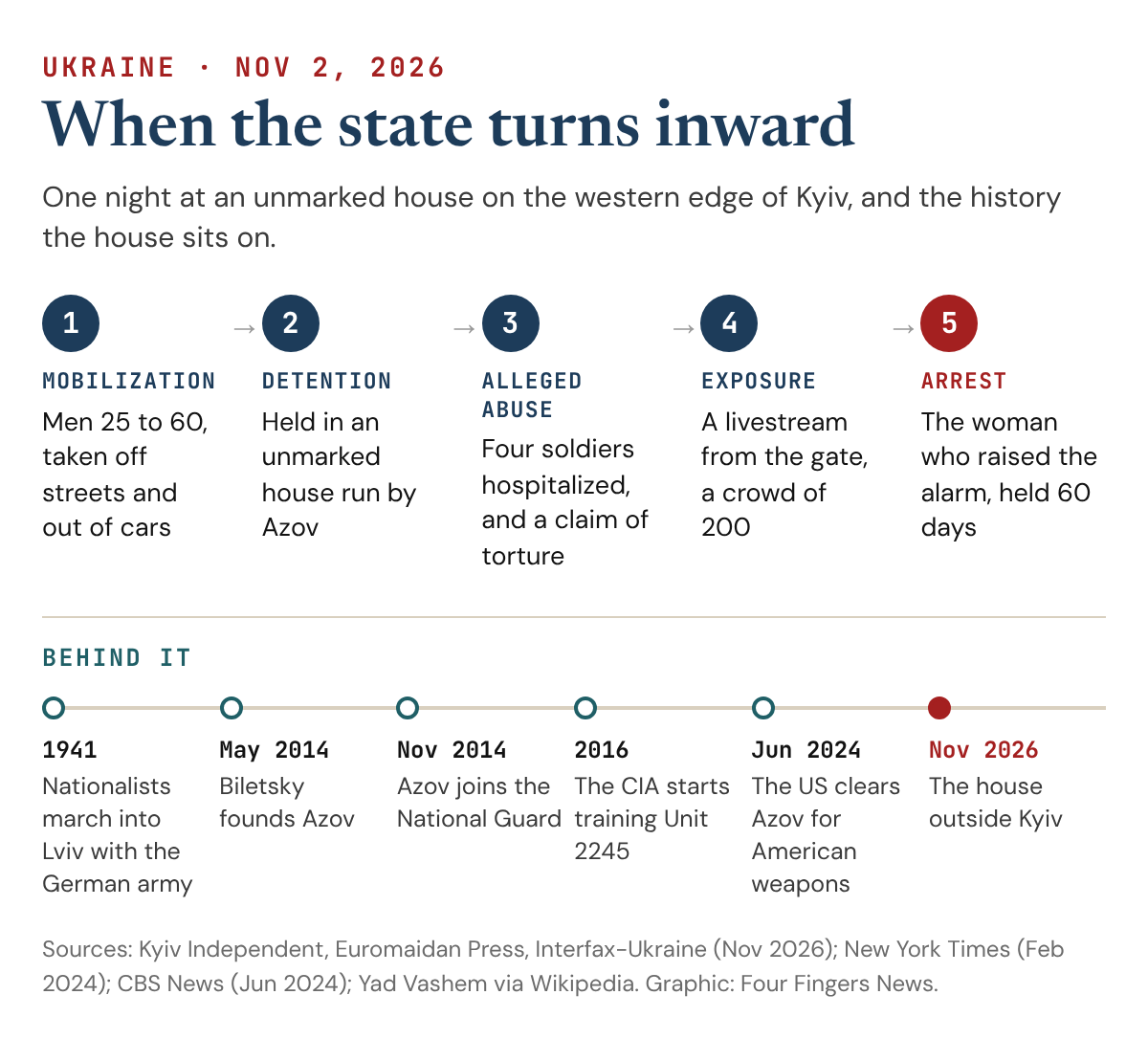
At a recruitment office near Odesa, investigators say, men were dragged in off the street to make the office’s numbers, locked up, beaten and raped, and when police raided the place they took rubber clubs and hammers off the staff.
Once they’ve got a man, he has a price. In Kyiv this spring, a man and a woman called the partner of a man being processed at a recruitment office and offered to get him out for $20,000. She had a few hours to pay, they told her, or the army would take him. They were arrested taking the money. Near Chernivtsi, investigators say, the recruiters ran the business themselves. They grabbed men off the street, tortured them at the office to make them agree to serve, and took 5,500 euros from one man to let him go. Another man they’d shot in the leg with a nonlethal gun got no doctor and was made to pull the bullet out himself. It isn’t a few bad offices. In August 2023 Zelensky fired the head of every regional recruitment office in the country over bribes. “Bribery during war is treason,” he said. That’s the bid. A family bids for its man, and if nobody can pay, the front gets him for free.
A man nobody buys back gets shipped to training and then to the front, and the front in this war belongs to drones, cheap flying cameras with explosives strapped on that chase men across open ground until they catch them. Ukraine’s government pays its drone teams in points for kills, six for a dead Russian soldier, proven by the drone’s own video, and the points buy more drones from a government catalog. The teams compete on a leaderboard. “A kill is a kill,” the minister who built it said, and when he raised the price, the kill count doubled in a month. On the other side, Russian drones have hunted ordinary people on the streets of Kherson so often that Ukrainians call it the human safari, and the United Nations calls it a crime against humanity. The last thing those men know is the buzz getting louder and the camera on the nose recording, and by tonight their death is online with a soundtrack and a slow-motion replay.
Ukraine’s security service picked the soundtrack for one of those videos itself. It cut its drones hunting Russian soldiers to the music from Squid Game, bragged that 468 of them had been knocked out of the game that week, and closed the post with a sign-up link for anyone who wanted to fly with them. Squid Game is the show where people drowning in debt are killed in children’s games for prize money while rich men in masks watch and bet on who dies. The show was gentler than this. Its players signed up, and when most of them voted to go home, the guards let them go. The men Ukraine grabs off the street never signed up, they don’t get a vote, and the border’s closed. And our VIPs don’t bother with masks. As long as we kept sending the weapons and the money, Lindsey Graham said in 2022, the Ukrainians “will fight to the last person.” The next year in Kyiv, when Zelensky thanked America for more than $38 billion in aid, Graham called it “the best money we’ve ever spent.” A Democrat, Richard Blumenthal, wrote that summer that we were “getting our money’s worth”: Russia’s military strength cut in half, and not one American hurt or killed.
Here’s where I stand. There will always be wars, but I don’t want my money paying for foreign ones, and this is why. A war that runs long enough eats its volunteers, and then the state starts hunting its own people. Close to 2 million soldiers on both sides have been killed, wounded or lost in this one.
In the summer of 1941, Ukrainian nationalists sided with Hitler against Stalin, and they had their reasons. Stalin had starved millions of Ukrainians to death in the famine of 1932 and 1933, when hunger got so bad that police opened more than a thousand cases of cannibalism, and as his army fled that June, his secret police shot thousands of prisoners in their cells. When the Germans took Lviv, Jews were made to drag the bodies out of the prisons. Jewish women were stripped naked and beaten in the street while a German film crew rolled, and a militia raised by the nationalists joined in. Thousands were murdered that summer.
In 2014 a man who’d reportedly said that Ukraine’s mission was to lead “the white races of the world” against “Semite-led Untermenschen,” words he now denies, founded a militia called Azov. Within months it was part of Ukraine’s National Guard. In 2024 the US cleared it for American weapons. This week it was Azov holding men in an unmarked house outside Kyiv.
On Monday night a woman in a medic’s uniform livestreamed from that house’s gate that the men inside were being tortured. About 200 people came and tore at the wall, and soldiers answered with tear gas and warning shots. Four soldiers who’d been held inside were taken to a hospital, injured. The man who showed up to take charge that night was Kyrylo Budanov, the head of Zelensky’s office, who’d been an officer in a commando unit the CIA trained. Two days later the woman was the one in a cell, held without bail for 60 days for obstructing the military. Prosecutors say she was selling escapes from recruitment offices, so even in the government’s version of the story, men are for sale. She says a wife begged her to help a husband who was being tortured inside. She’s raising an 11-year-old daughter.
This is our war too, and we’ve paid for it from the start. Ukraine’s government says that this year 100% of the money it raises goes to the war. Everything else, from the hospitals to the pensions, runs on money from the West, and Zelensky said himself in 2024 that without American aid, Ukraine would lose. Our spies spent a decade building Ukraine’s, with a dozen secret bases along the Russian border and an underground command bunker a Ukrainian general said the CIA pays for “one hundred and ten percent.” And the party that just won Congress promising to end one war voted in June to keep paying for this one.
Plenty of Americans are horrified by what Israel has done in Gaza, and they’re horrified because they’ve watched it and they know it’s evil. Many of the same people cheer this war on, and they don’t know any of this. They hear Russia, think Soviet Union and stop listening.
We tell ourselves we’re helping Ukrainians defend their country, and we don’t live a second of it. No American has been drafted since 1973. Nobody’s dragging our sons into vans on the way to work. We get the clips and the bill. We’re paying for a war their own government can only keep fighting by hunting them in the streets. That isn’t helping them. It’s using them.
So that’s the bid. We’ve got your son. Pay, and you can have him back. Can’t pay? Then he belongs to the front, where a flying camera hunts him across a field and his last seconds get filmed for points and cut to music. If he runs, we’ll lock him in a house with no sign on it, and if a woman screams at the gate, she’s the one who goes to jail. The men still at home listen for boots on the stairs. And we’re paying for all of it.
Tonight, somewhere in Ukraine, a man is lying awake in his apartment listening for those boots. Somewhere along the front, another one is lying in a hole in the dirt listening for the buzz. One of them won’t see the morning, and by the time you wake up, somebody will have posted it. I don’t want another dollar of mine paying for that.
Sources (33), on the site.
Not on the Ballot
November 4, 2026 · Day 250 · 630 words
Not on the Ballot
Not on the Ballot, read aloud · 4 minutes.
Day 250. Oil fell 8.7% on Wednesday, to $94.62 a barrel for Brent crude, the global oil benchmark, largely on bets that Tuesday’s vote will help end the war in Iran. But Tuesday wasn’t a mandate for the Democrats. It was a rebuke to the party in power, and the war was at the center of it. Americans have cast that kind of vote before, against whichever party was running a war, and the party they put in has kept finding a war of its own.
The people who lost know it. On Wednesday morning JD Vance posted that “the reason we lost is the war,” and dared anyone who disagreed to argue “that losing the Senate for the next 6 years was worth it.” He listed four things a Republican pollster said would win voters back, and ending the war came first. In NBC’s exit poll, 62% of voters said starting the war was the wrong decision. Donald Trump said Vance’s explanation was “probably true,” and in the same breath said he’d do it again.
The pattern doesn’t care which party is in charge. In 2006, more than three years into the war in Iraq, voters took Congress away from the Republicans, the party that started it. In 2008 they elected Barack Obama, who’d called Iraq “a dumb war,” and less than a year later he sent 30,000 more troops to Afghanistan, the war he’d said America should be fighting instead. In 2016 and again in 2024 they elected Trump, who’d said “we should have never been in Iraq” and promised at least 53 times, by CNN’s count, to end the war in Ukraine within 24 hours or before he took office. The war in Ukraine is still going, and on Feb 28, 2026 he started a war with Iran. Each of them ran against somebody else’s war, not against war itself.
Throwing out the party at war doesn’t end the war. The day after the 2006 vote, George W. Bush announced that his defense secretary, Donald Rumsfeld, was leaving, and two months later he sent more than 20,000 more troops to Iraq. The new Democratic Congress passed war funding with a date to start bringing troops home, Bush vetoed it, and Congress paid for the war anyway. The last American troops left in December 2011, five years after the vote, on a deadline Bush had agreed to with Iraq in 2008.
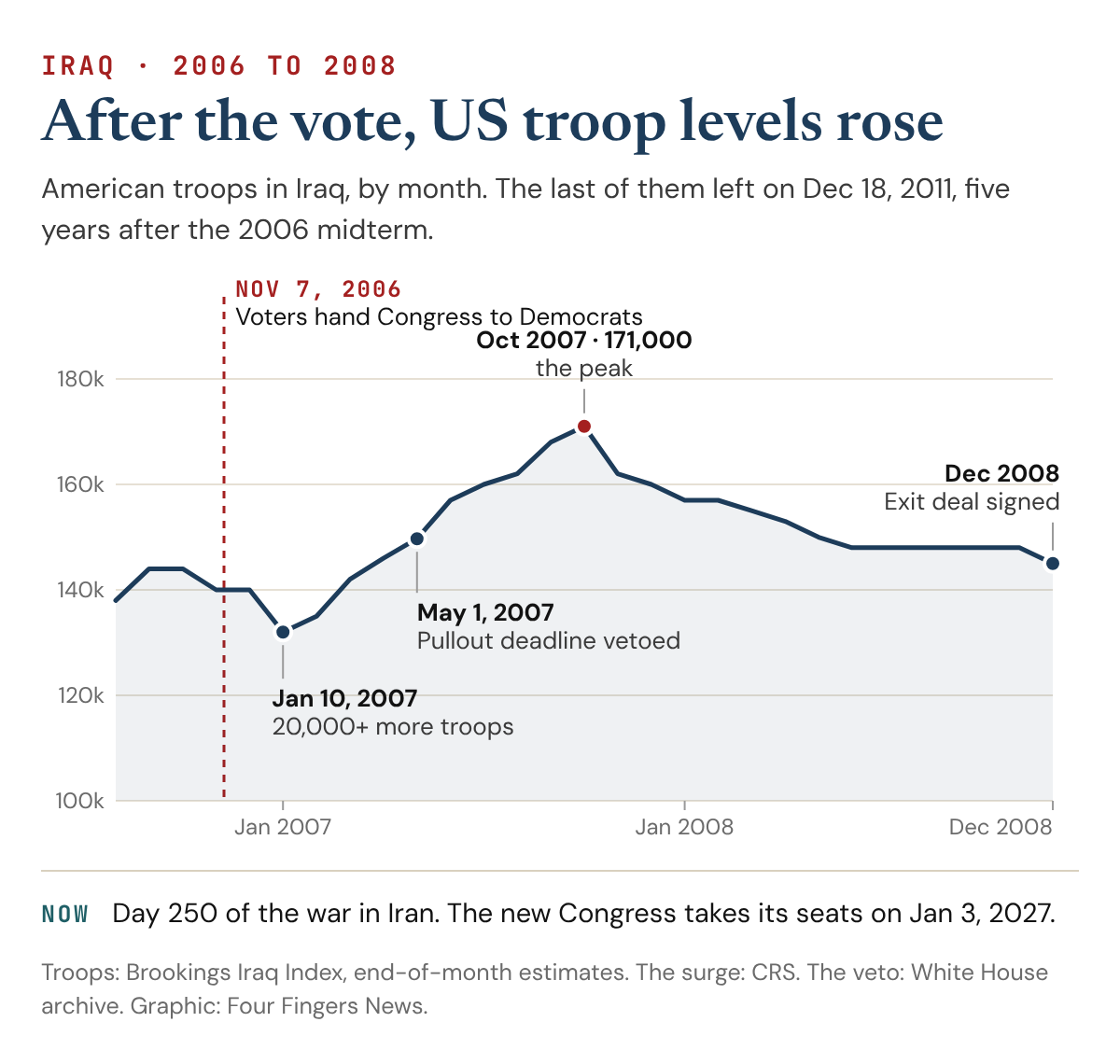
So the test of Tuesday comes after Jan 3, 2027, when the new Congress takes its seats. It holds the same power the 2007 Congress had, the money, and it can vote to cut off funding for the war in Iran, though a veto still takes two-thirds of both chambers to override. If it doesn’t use that power, Tuesday changed who’s in charge, not the war.
And the party taking over isn’t a peace party. The Republicans are fighting Iran directly, a country the president says can’t be allowed to build a nuclear bomb. The Democrats back the war in Ukraine, and in June 2026 every House Democrat present voted to advance more than $1 billion in new military aid for Ukraine over the Speaker’s objections. Arming a country that was invaded isn’t the same as bombing one, and Democrats would say so. But for a voter who wants America out of foreign wars, it’s still a war America helps pay for, and the other side of it is Russia, which has more nuclear weapons than any country on earth, so the risk if it escalates is the biggest there is. Neither party offered to stop both.
Voters keep asking for the same thing, and every few years they get a different war. The no-war party wasn’t on the ballot. You just get to pick which war.
Sources (18), on the site.
Three Hours Early
November 3, 2026 · Day 249 · 540 words
Three Hours Early
Three Hours Early, read aloud · 3 minutes.
On election night the House was called for Democrats a little after 6 PM Pacific, almost two hours before Washington State’s drop boxes closed at 8 PM Pacific. In Washington State the last day is drop-box day: the Postal Service no longer guarantees a same-day postmark, so a ballot still at home on election day had to be walked or driven to a box by 8 PM, and by election eve about half the ballots King County expects were still out. For years in Ballard I’d walk mine to the Ballard library just before 8 PM, and in Redmond I’ve watched the line of cars at City Hall. The point of this note is simple: when the East calls an election before the West has finished voting, some of the West stops voting. It happened in 1980, and we know who stayed home.
On Nov 4, 1980, NBC put “REAGAN WINS” on the screen at 5:15 PM Pacific. At 6:54 PM Pacific, with polls in Washington State, Oregon and California open until 8 PM, President Jimmy Carter went on national television and conceded to Ronald Reagan. In Olympia, a poll worker named Mina Bowker remembered close to a dozen people asking “What’s the use of me voting?” and walking out. California’s secretary of state said turnout in the last hours “dropped to practically nothing.”
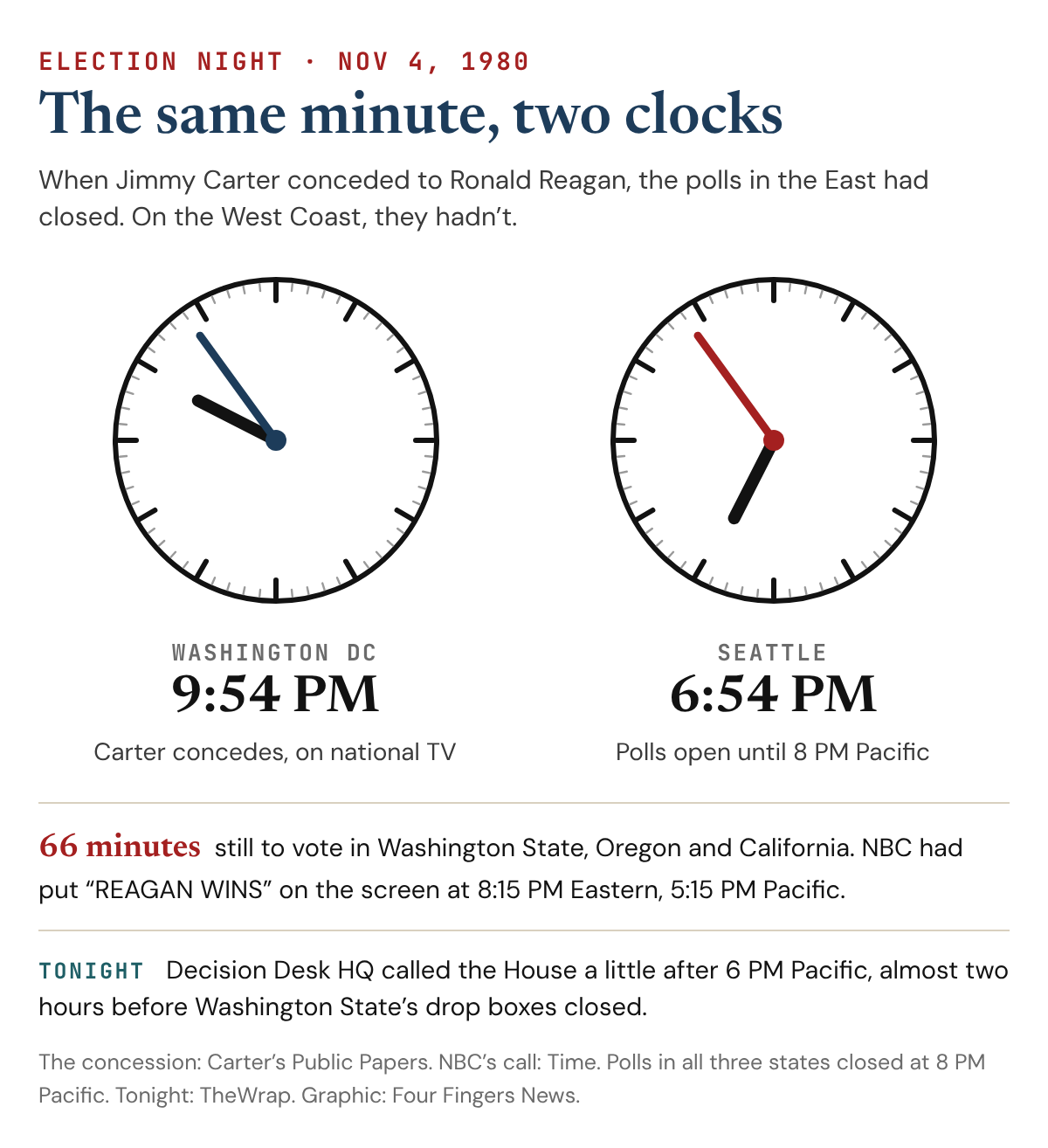
None of it changed who became president. Reagan won 44 states that night, Washington State by 12 points, so the people who turned around in Olympia weren’t going to save Carter. What they left behind was the rest of the ballot. A University of Michigan study found that about a quarter of the people who’d planned to vote late that day stayed home once they heard, most of them Carter’s voters, and the races that paid for it were the close ones further down: Oregon’s Al Ullman, who chaired the House committee that writes the tax laws, lost by 3,765 votes, and a California congressman by fewer than 800. That’s where an early call does its damage: the race at the top is already settled, and the races at the bottom aren’t.
Congress held a hearing in Seattle in July 1981, and in 1985 Al Swift, a congressman from Washington State, announced that ABC, CBS and NBC had agreed not to call a state before its polls closed, a promise NBC and AP still make. But the promise covers states, not the country, and nothing in it stops anyone from calling the House while Washington State is still voting.
Back to this week. On Tuesday night the House was settled by 6 PM Pacific, and Washington State’s own ballot wasn’t: five seats on the state Supreme Court, the repeal of the income tax on high earners, a congressional race in the 3rd District and every legislative seat on it. The news reached everyone still holding one of those ballots, and this time it may have hurt Republicans most. In September, at a rally for Senator Darline Graham of South Carolina, President Donald Trump asked his supporters to “pretend please, that I am on the ballot.” His supporters didn’t. Graham lost her seat on Tuesday. The rest of the country pretended he was.
Sources (17), on the site.
Golden Handcuffs
November 2, 2026 · Day 248 · 890 words
Golden Handcuffs
Golden Handcuffs, read aloud · 7 minutes.
On Oct 26, 2026, Microsoft offered about 60,000 of its employees, roughly a quarter of the company, a severance package to leave. The offer reaches everyone up to level 70 in the United States, Canada, the UK and India, which at Microsoft goes as high as general managers and some vice presidents. They have until the first week of December to decide, and anyone who accepts leaves on Dec 31, 2026. Microsoft had about 53,000 people at its Redmond campus last year, which made it the third-largest employer in Washington State.

The offer came in a memo from Amy Coleman, Microsoft’s chief people officer, who called it new for the company and said each part of the business would decide whether to take part. It’s open in the groups behind Copilot, Windows, Xbox, finance and human resources, and closed to sales, security and the teams that run Microsoft’s data centers. A company spokesperson said AI isn’t driving it. Two days after the memo, Microsoft reported $92.3 billion in revenue for its quarter, up 19% from a year earlier, and $39.4 billion spent on buildings and equipment in those three months, about twice as much as a year earlier, much of it on data centers. Microsoft has pointed to other tech companies where 3% to 5% of the people offered a deal like this took it, which here would be 1,800 to 3,000 people.
In tech, golden handcuffs are pay that makes it expensive to quit, usually stock that vests over several years, and a severance package like Microsoft’s is meant to make leaving worth it instead. A cheap mortgage holds people in a house the same way. In the second quarter of 2026, 19.2% of the mortgages outstanding in the US carried a rate below 3% and 49.1% a rate below 4%, according to Realtor.com’s reading of a federal mortgage database. Last week the average rate on a new 30-year loan was 7.24%, in the weekly survey of lenders by Freddie Mac, the government-chartered company that backs a big share of American mortgages. On the median single-family house in King County, which sold for $949,975 in September 2026 according to the Northwest Multiple Listing Service, a loan for 80% of the price costs about $3,200 a month at 3% and about $5,180 at 7.24%, before property taxes and insurance. The same loan on the same house costs about $2,000 a month more at today’s rate.
Economists at the Federal Housing Finance Agency, the regulator over Freddie Mac and its sister company, Fannie Mae, found that for every percentage point today’s rate sits above the rate an owner already has, the chance that owner sells drops by about 18%. They estimated that the gap kept about 1.33 million homes from selling between April 2022 and December 2023, and that the missing supply pushed prices up about 5.7%, more than higher rates pulled them down. Across the country, the typical seller in the year to June 2025 had stayed 11 years, the longest the National Association of Realtors has recorded, and first-time buyers were 21% of buyers, the smallest share on record, at a typical age of 40.
In January 2023 Microsoft announced 10,000 job cuts, and Amazon announced 18,000 that month and 9,000 more in March. Seattle-area home prices had already fallen about 12% from their April 2022 peak by March 2023, according to the S&P Case-Shiller index, which tracks the same houses as they sell again over time, and through the layoffs they climbed back about 13% by February 2025. One reason was how few homes were for sale: in September 2023 there were 4,774 across the whole Seattle metro, by Realtor.com’s count, with many owners holding mortgages around 3%. The handcuffs slow sales without stopping them, and this September there were 13,078 homes for sale across the same metro, about 2.7 times as many. Between January and August of this year, prices fell about 3%. The median household in King County earned about $126,000 in 2025, by Washington State’s estimate, and the $5,180 payment would take about half of it.

Boeing, then the region’s biggest employer, had 100,800 people on the payroll in 1967 and 38,690 by April 1971, in what Seattle still calls the Boeing Bust, after a recession, a slump in airline orders and Congress’s vote in March 1971 to stop paying for the supersonic airliner Boeing was building. On Apr 16, 1971, two real estate agents with Henry Broderick, Inc., Bob McDonald and Jim Youngren, paid $160 to rent a billboard near Sea-Tac Airport for two weeks. They meant it as a joke to lift the gloom, and it read, “Will the last person leaving SEATTLE,” and on the line beneath it, “Turn out the lights.” By October 1971 Boeing was back up to 53,300 people. In January 1979 a small software company moved from Albuquerque to Bellevue, and in 1986 Microsoft moved to its campus in Redmond.
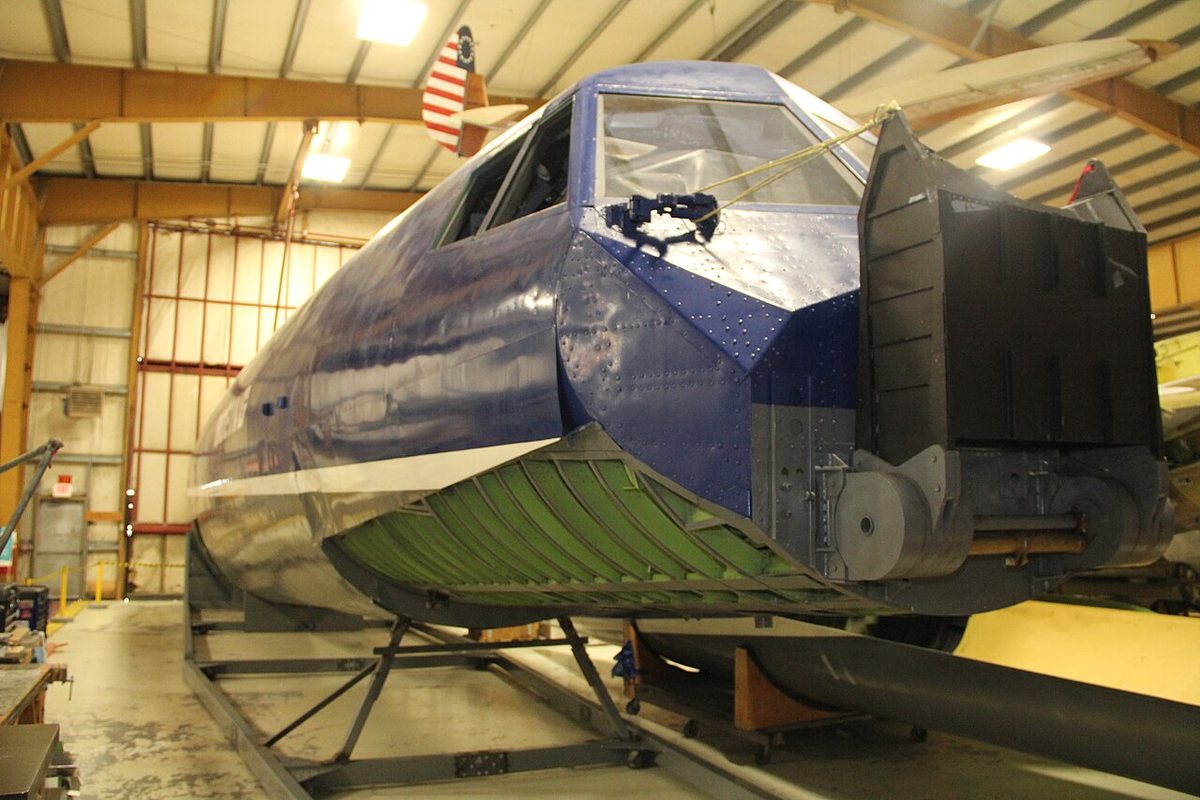
I grew up on the advice that owning beats renting, because a house is a commitment to a community and to a life, and it’s smart because you earn equity. For most of the 1990s a 30-year mortgage cost about 7% to 8%, close to last week’s 7.24%. What’s different now is how much the houses cost, and how many owners are sitting on a rate they’d be giving up to move.
Sources (12), on the site.
The Parade That Wasn't
November 1, 2026 · Day 247 · 890 words
The Parade That Wasn't
The Parade That Wasn't, read aloud · 6 minutes.
Friday’s note ended with three days for the dead: Halloween, All Saints’ Day and All Souls’ Day. Tonight is the second, and in Mexico these are the big ones. Yesterday afternoon in Mexico City more than a million people, by the city’s count, lined Paseo de la Reforma for the Gran Desfile de Día de Muertos, the Day of the Dead parade: 12 floats, bands, dancers and thousands of people in skeleton face paint moving five miles to the main square. Clara Brugada, the city’s head of government, put the crowd at 1.6 million. It’s one of the holiday’s biggest public events now. It turned ten this weekend, and a James Bond movie invented it.

In March 2015 the Bond production Spectre shut down the Zócalo, Mexico City’s central square, to film its opening sequence: Bond in a skull mask moving through an enormous Day of the Dead parade, giant skeleton puppets on floats. Mexico helped pay for the scene. Emails leaked in the Sony hack that year showed the government offering up to $20 million in incentives and the studio attaching conditions to the deal, a non-Mexican villain among them, and Amy Pascal, then running Sony Pictures, wrote, “We should insist they add whatever travelogue footage we need in Mexico to get the extra money.” There was a catch, though: Mexico City had never held a Day of the Dead parade. For many families the holiday’s center was private, the cemetery, candles, marigolds and a dead person’s favorite food, and the parade was a screenwriter’s idea.
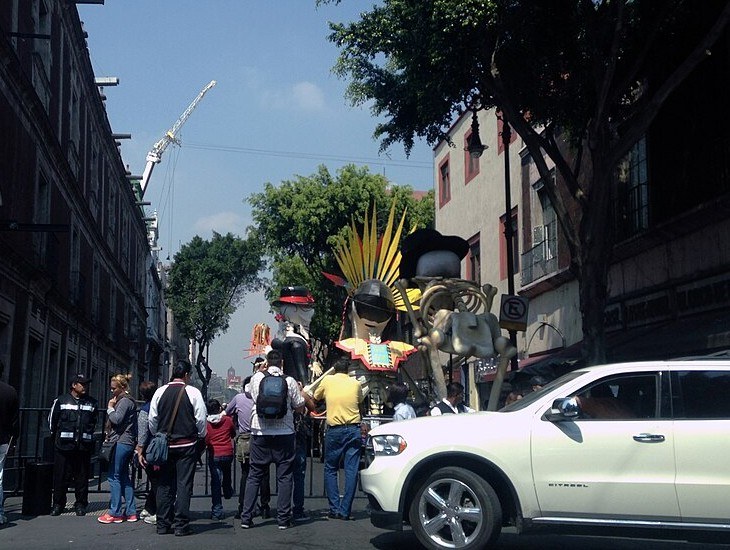
Tourists came anyway, asking where it was, so in 2016 the Mexico Tourism Board built one. The first Gran Desfile moved along Reforma on Oct 29, 2016, with more than a thousand performers and some of the film’s own props, and the board’s chief executive, Lourdes Berho, said the quiet part out loud: the movie “was seen by millions and millions of people in 67 countries,” and “we knew that this was going to generate a desire.” The estimates afterward put the crowd around 250,000. A year later Pixar’s Coco carried an animated version of the holiday to the whole world, and the parade grew into the million-plus event it was yesterday.

The holiday underneath is old, though how old is a real argument. The version Mexican schools teach is that the Aztecs kept festivals for their dead and the Spanish friars moved them onto the church’s two days: Nov 1 for the children who died, the angelitos, and Nov 2 for the adults. The ofrenda, the altar at home, carries their photographs, their food and drink, and the orange marigold called cempasúchil, whose scent is supposed to lead the souls back from the cemetery. Elsa Malvido, a historian at Mexico’s national anthropology institute, argued the opposite: that the holiday is Spanish, colonial and Christian, and that intellectuals in the 1930s “rescued and recreated” colonial Catholic customs and gave them “a pre-Hispanic meaning,” for a government that wanted a national holiday that wasn’t the church’s. Whatever its exact ancestry, UNESCO listed it as intangible heritage of humanity in 2008.
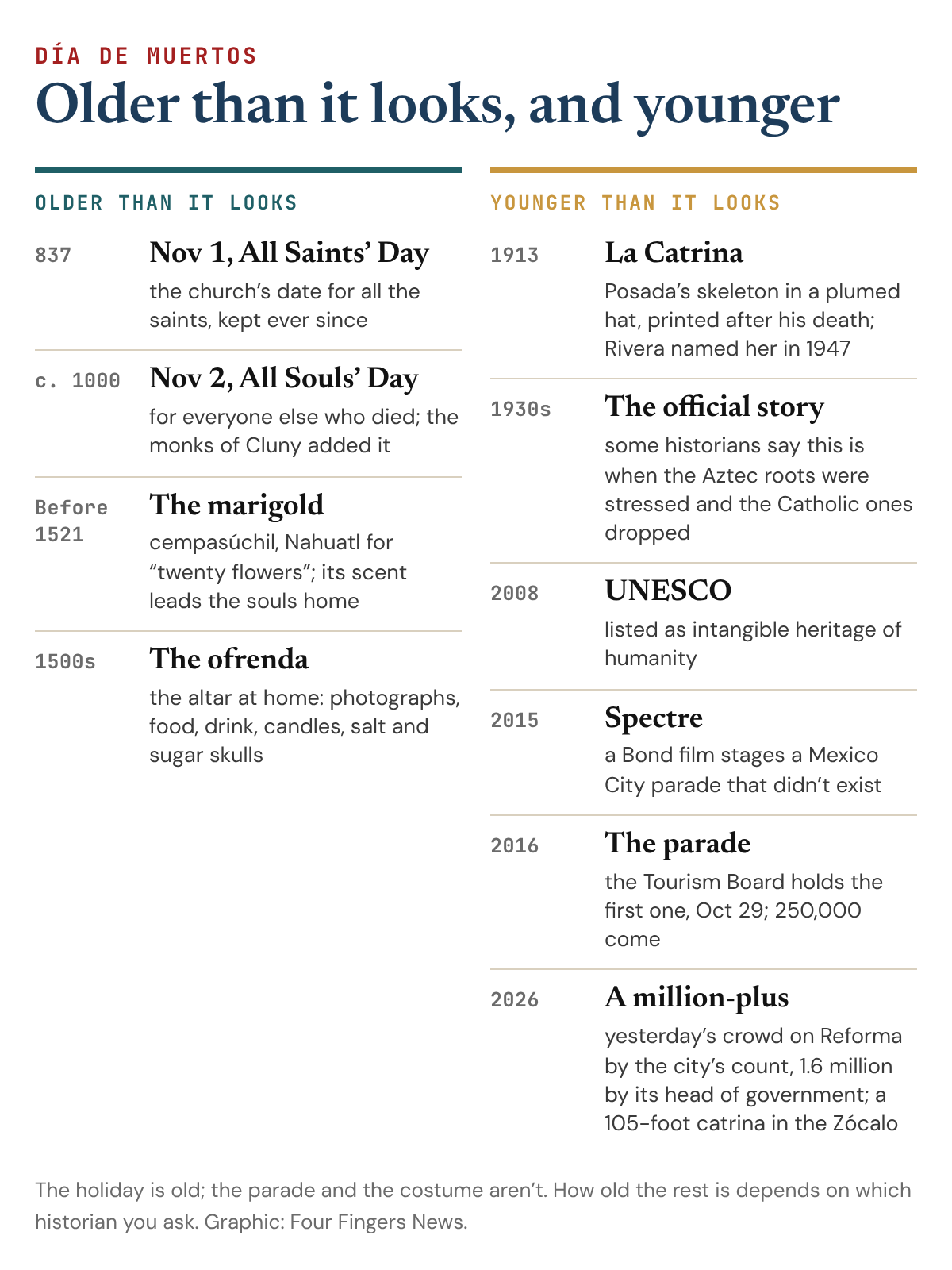
Even the holiday’s face is younger than it looks. La Catrina, the grinning skeleton in the plumed hat, started as a newspaper cartoon. José Guadalupe Posada drew her around 1910, and she was printed after his death, in 1913, as “La Calavera Garbancera,” his satire of the garbanzo sellers of Mexico City who powdered their faces and dressed in European fashion, the joke being that under the hat and the powder everyone is bones. Diego Rivera gave her the name, the dress and the fame in 1947, painting her full length at the center of his mural Dream of a Sunday Afternoon in Alameda Park, with Posada on one arm, Rivera himself as a boy on the other, and Frida Kahlo behind them. She’s been the holiday’s costume for a generation or two, and the painted skull faces on the sidewalk yesterday are younger than that.

I don’t think any of it makes the parade fake. Traditions get made by somebody, usually for a reason that looks small at the time: a friar with a calendar, a cartoonist with a grudge, a muralist, a tourism board with a Bond film. “Trick or treat” was first printed in a Calgary newspaper in 1927, and nobody at the door on Saturday was worse off for it. What matters is the thing underneath, and the thing underneath is still there. The parade ended at the Zócalo, where the city builds a monumental ofrenda every year, this year with a catrina more than 32 meters (105 feet) tall, and tonight, with the floats parked, families across Mexico are at the graves with candles and marigolds.
For the Montreal readers, this is the day the church calls All Souls’ and Quebec once kept as the Jour des Morts; Mexico makes room for both the parade and the vigil. And for my kids, who asked last week what Halloween’s name meant: the third day is tomorrow. In Mexico the weekend gave it a parade a spy movie dreamed up and a lady in a hat a cartoonist drew, and the part I’d want them to remember is the plate on the ofrenda, somebody’s favorite dish, set out by someone who still knows exactly what they liked.
Sources (7), on the site.
October 2026 31 notes
Pacific Time
October 31, 2026 · Day 246 · 1,230 words
Pacific Time
Pacific Time, read aloud · 8 minutes.
At 2 AM tonight the clocks in Washington State go back an hour, and across the line in British Columbia, they won’t. B.C. changed its clocks for the last time on Mar 8, 2026, named its new year-round zone plain “Pacific Time,” and from tomorrow until March, Vancouver and Seattle, 140 miles apart on the same coast, will disagree about what time it is. Whether that’s good or bad depends on whether you’d rather have light at 8 in the morning or at 5 in the afternoon, but how it happened is the better story: the whole West Coast spent seven years waiting on one vote in Washington DC, and the one government on the coast that didn’t need the vote stopped waiting.
The waiting started in 2019, when the Washington State legislature passed a bill from Marcus Riccelli, a Democrat from Spokane, putting the state on daylight time all year, and Governor Jay Inslee signed it in May 2019. Oregon passed its own version, and California’s voters had approved a 2018 ballot measure letting their legislature do the same. B.C. did the same after asking its residents first: 223,000 people answered and 93% wanted daylight time all year. Then B.C. said it wouldn’t flip the switch until Washington State, Oregon and California did, so the coast would move together. A federal law from 1966, the Uniform Time Act, lets a state opt out of daylight time altogether, which is why Arizona and Hawaii never touch their clocks, but it doesn’t let a state stay on daylight time through the winter without Congress changing the law. Washington State’s bill even says so: it takes effect “on the first Sunday in November following the effective date of federal authorization.” Tonight is the eighth first Sunday in November since Inslee signed it.
The latest push came on Jul 14, 2026, when the House passed the Sunshine Protection Act 308 to 117 and the bill went to the Senate and stopped. In 2022 it went the other way: the Senate passed a version and the House never took it up. John Thune, the Senate majority leader, said in October there’s “no clear path forward or consensus on it yet.” The loudest objector is Tom Cotton of Arkansas: “Arkansans don’t want their kids going to school in the pitch dark, and I’ll always put Arkansas first.”
B.C. had watched six winters of that. On Mar 2, 2026 Premier David Eby announced the province would change its clocks one more time, on Mar 8, and then never again. “We are done waiting,” he said. The news release explained why in a sentence that didn’t need to be there: “Recent actions from the U.S. have shifted how B.C. approaches decisions that merit alignment, including on time zones.” Eby said he was “hopeful that our American neighbours will soon join us.” Instead, the rest of western Canada did. Alberta followed in May with what it’s calling Alberta Time, the Northwest Territories followed Alberta, and Manitoba’s premier Wab Kinew signed his province’s proclamation on Sep 25, 2026. Ontario, which has refused for years to move without Quebec and New York, announced on Oct 13 that its northwest corner would follow suit, so Kenora, near the Manitoba border, wouldn’t end up an hour off Winnipeg; the minister announcing it called the result “Wab Kinew time.” So the map tomorrow morning has a line down it, at the 90th meridian, a line of longitude in northwestern Ontario a short drive west of Thunder Bay. In B.C., Alberta, Saskatchewan, Manitoba, Yukon and the Northwest Territories, almost nobody changed a clock tonight. East of it, from Toronto to Montreal to Halifax, everyone did, along with every American state but Arizona and Hawaii. For the Montreal readers: Vancouver is two hours behind you this winter instead of three, and Winnipeg is on your clock exactly.
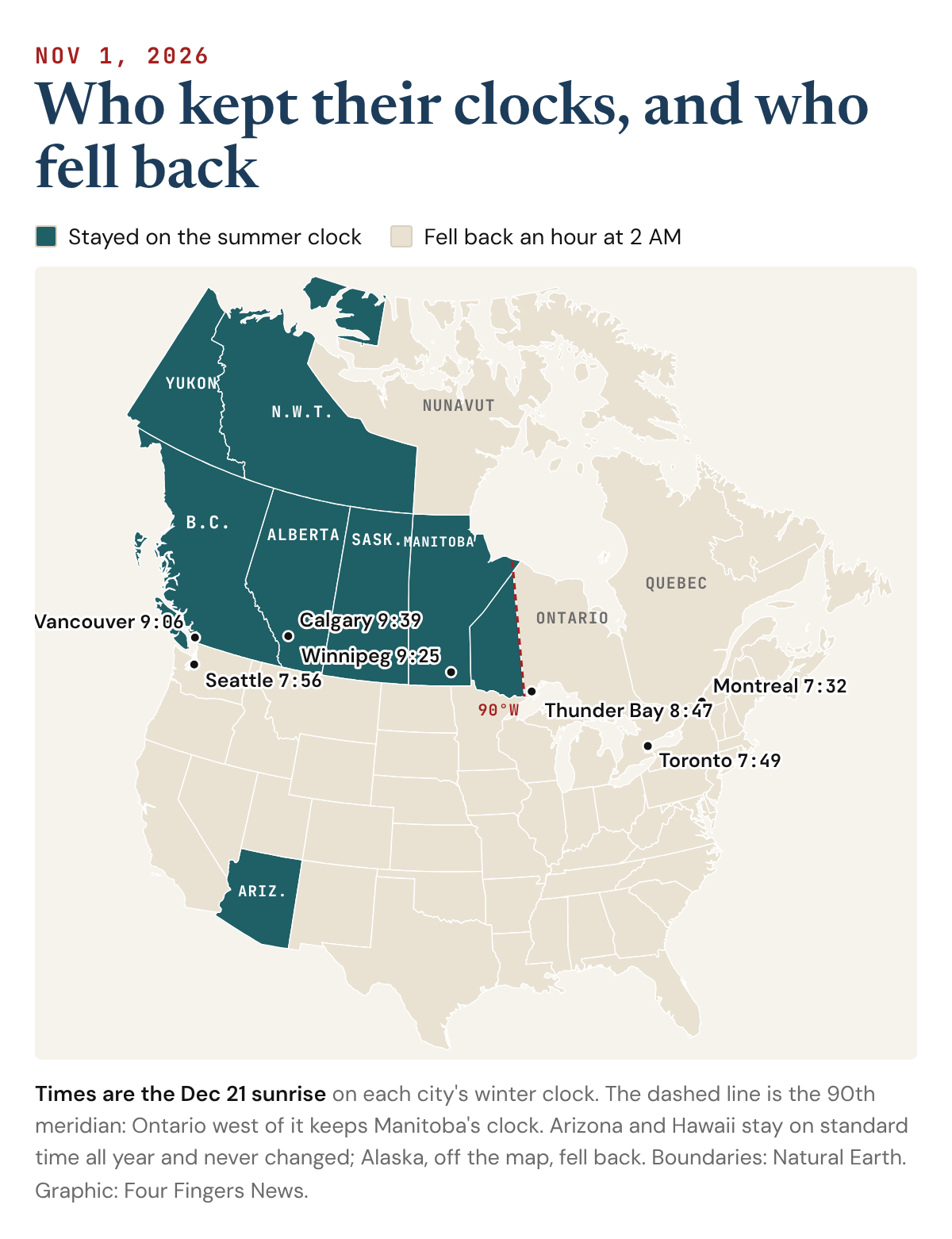
Nearly everyone in this story says the switch itself is miserable; in Manitoba and northwestern Ontario, around 90% of the people who answered said stop, and in B.C., 93% chose permanent daylight time. The fight is over which clock to keep, and that’s the part the “lock the clock” slogans leave out. Standard time is the one where noon is roughly when the sun is highest; daylight time moves every clock an hour ahead of it. Keep standard time all year and you get the Arizona deal: in Vancouver and Seattle, light in the morning and the sun down a little after 4 in the afternoon in December. Keep daylight time all year and those cities get light until after 5, with a sunrise an hour later all winter. Sleep doctors have been clear which one they’d pick: the American Academy of Sleep Medicine has asked for permanent standard time, because morning light is what sets the body’s clock. Every government in this story picked the other one, though not always for the same reason: Manitobans who answered their survey preferred daylight time 58% to 34%, northwestern Ontario just wanted to stay on Winnipeg’s clock, and Alberta’s voters actually turned permanent daylight time down in a 2021 referendum, 50.2% to 49.8%, before the government did it anyway this year. Washington State could have ended its clock changes any year since 2019 by taking Arizona’s option, which needs no permission from Congress, but it wanted the evening.
The United States last tried year-round daylight time in the 1970s. In December 1973, in the middle of the Arab oil embargo, President Nixon signed a law putting the whole country on daylight time year-round to save fuel, and it took effect on Jan 6, 1974. Support fell from 79% in December 1973 to 42% by February 1974. Florida reported eight children killed in traffic in the dark mornings of those first weeks, against two in the same stretch the year before. Congress gave up that fall and President Ford signed the repeal on Oct 5, 1974, less than ten months in. That’s the history behind Cotton’s objection, and one reason other senators are hesitant: a mid-January sunrise in Indianapolis would come up after 9 AM.
So B.C. is running the 1974 experiment again. By the shortest days of December the sun will come up in Vancouver a few minutes after 9 AM, in Prince George around 9:30, and in Calgary, on Alberta Time, closer to 9:40. In Seattle, on standard time, it rises at 7:56 and sets at 4:21. And there’s Point Roberts, the 1,200 or so Americans on a peninsula that hangs off the B.C. coast with no road out except through Canada, who will spend the winter an hour behind the only road out.
The first town anywhere to try daylight time was Port Arthur, Ontario, in 1908. It’s part of Thunder Bay now, just east of the new line, so it changed its clocks tonight along with Toronto. I don’t have a strong opinion on which clock is right; the sleep doctors make a good case, and so does anyone who’s left an office at 4:30 into the dark. What I noticed is that B.C. settled its side of this long-running argument only when it stopped waiting on Washington DC. Tomorrow morning the sun will come up over Bellingham and over Vancouver within about five minutes of each other, 50 miles apart, and the two cities will disagree by an hour about what to call it.
Sources (11), on the site.
Holy Evening
October 30, 2026 · Day 245 · 590 words
Holy Evening
Holy Evening, read aloud · 4 minutes.
My kids asked this week what “Hallows Eve” means, and the answer is hiding in the word. “Hallow” is an old English word for a holy person, a saint, and “e’en” is just “evening.” Halloween is the evening before All Hallows’ Day, which the church calls All Saints’ Day and keeps on Nov 1, followed on Nov 2 by All Souls’ Day, for everyone else who ever died. Three days for the dead, and over about a thousand years the first night turned into the one where kids in costumes collect candy from the neighbors.
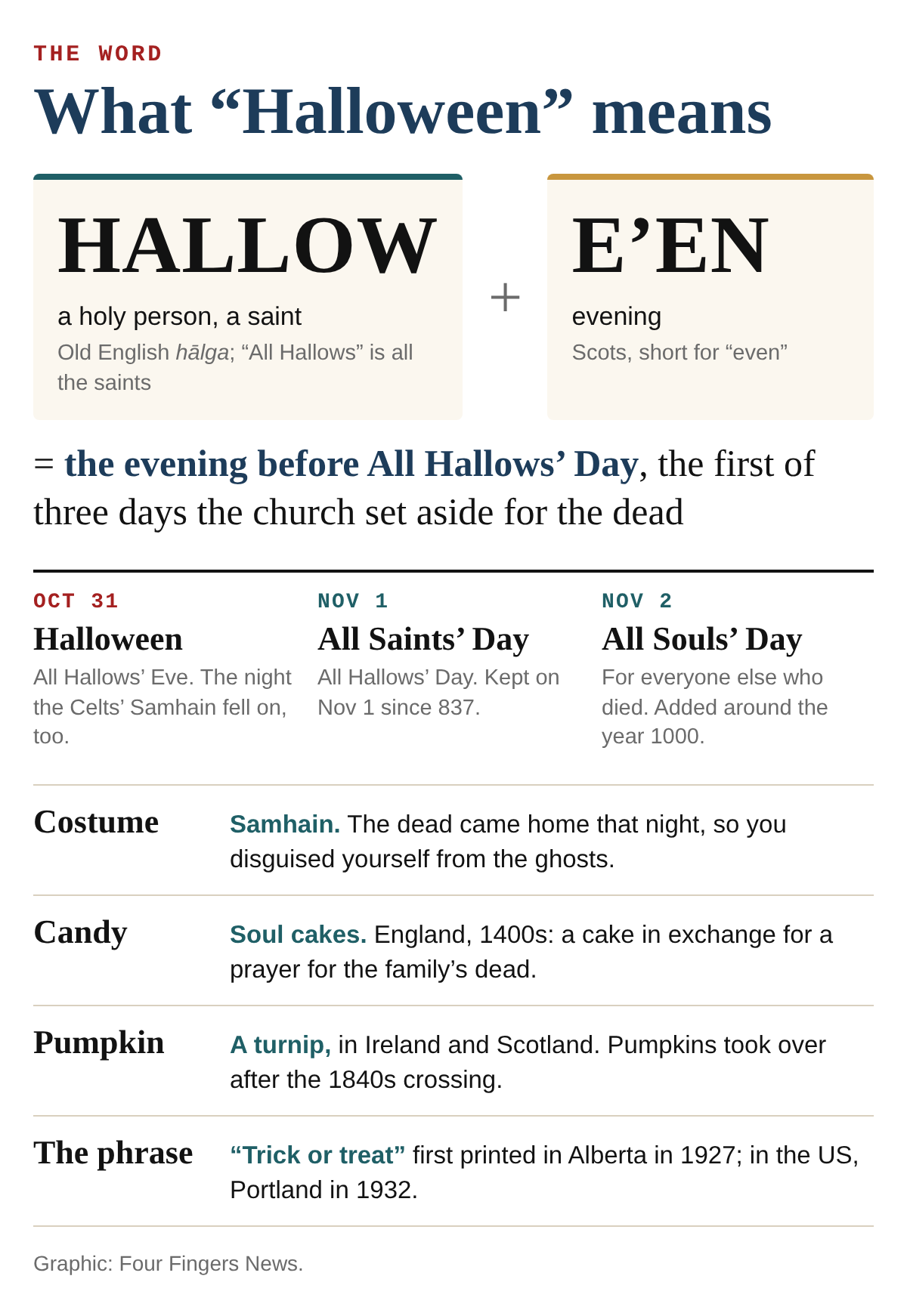
The oldest layer is Irish and Scottish. Long before the church arrived, the Celts marked the end of summer with a festival called Samhain (pronounced “sow-in”), on the night before Nov 1, the start of winter and their new year. People lit bonfires on hilltops, the dead were thought to come home for a visit that night, and you wore a disguise, the story goes, so the ghosts wouldn’t recognize you. Historians argue about how much of today’s Halloween really descends from Samhain and how much the church built on its own, but nobody disputes the dates line up.
The church’s layer came in stages. In 609 Pope Boniface IV made a feast day for all the martyrs, in May. In the 700s Pope Gregory III dedicated a chapel in St. Peter’s in Rome to all the saints on Nov 1, and in 837 Pope Gregory IV ordered the whole church to keep that date. Around the year 1000 the monks of Cluny, in France, added Nov 2 for all souls. In England in the 1400s, the poor went door to door on those days offering to pray for a family’s dead in exchange for small spiced “soul cakes.” Children took it over, trading songs for nuts and coins. The first Halloween treat was payment for a prayer.
The reason Halloween is Irish and Scottish rather than English is the Reformation. Protestant England dropped the saints’ days, and after the Gunpowder Plot of 1605 its autumn bonfires moved to Nov 5, Guy Fawkes Night. Ireland and Scotland kept the older night. Robert Burns published a poem called “Hallowe’en” in 1786, full of the night’s fortune-telling games, and by the 1800s children in both countries were “guising,” going out in disguise. The lantern was a hollowed-out turnip with a candle in it, named for Stingy Jack, a miser in a 17th-century tale turned away from both heaven and hell and left to wander with an ember in a turnip.
The famine of the 1840s sent about a million Irish across the Atlantic, and the holiday came with them. North America had pumpkins, native here and far easier to carve than a turnip, and the first newspaper report of a pumpkin jack-o’-lantern here was in Kingston, Ontario, in 1886. The first recorded children in costume were in Vancouver in 1898. “Trick or treat” is a Canadian phrase: the Calgary and Lethbridge newspapers both printed it in November 1927, and the earliest American printing anyone has found is the Oregonian in Portland on Oct 31, 1932. Sugar rationing paused it during the Second World War; the suburbs brought it back in the 1950s.
This year Americans will spend about $13.5 billion on it, $4.1 billion of that on candy. So for the kids: the costume was to fool the ghosts, the candy was payment for a prayer, the pumpkin used to be a turnip, and tomorrow night they’ll be carrying about 1,200 years of history around the neighborhood in a pillowcase.
Sources (5), on the site.
The Letter
October 29, 2026 · Day 244 · 1,140 words
The Letter
The Letter, read aloud · 7 minutes.
Day 244, and the most hopeful thing to happen in this war in weeks is a letter. On Sunday, mediators from Qatar handed it to Mohsen Rezaei, who runs Iran’s Supreme National Security Council, the body where the country’s president, generals and top ministers settle questions of war and peace, subject to the Supreme Leader’s approval. It came from Vice President JD Vance, and according to The New York Times it proposes direct talks as soon as next week, in Qatar or Türkiye, with Vance leading the American side and Iran’s nuclear program on the table from the start. The Wall Street Journal described the aim as a framework for negotiations, not a set of peace terms. On Thursday Iranian state media confirmed the letter had arrived and said no answer had been sent yet.
Is it an opening or a deadline? It’s both, an opening because someone is writing letters instead of drawing up target lists and this one went to a man who could help deliver a yes, and a deadline because a source told The Wall Street Journal that the point is to find out whether there’s enough common ground to talk the president out of ordering a short, intense attack after next Tuesday’s midterms. Gulf governments have already been told to prepare for one. The man reading the letter has said Iran won’t return to negotiations or reopen the Strait of Hormuz until seven conditions it’s sent through the mediators are met, among them an end to the US blockade of its ports and to the fighting on every front.
There’s also a contradiction at the center of the outreach: Trump publicly downplayed the letter on Wednesday, saying it concerned medical supplies rather than a restart of peace negotiations, and on Thursday, the Journal reported, the admiral who commands US forces in the Middle East briefed him at the White House on military options. Vance may be opening a door, but only Trump can decide whether to walk through it, or to order another round of strikes. Gas prices have moved with that strait since March, so whether the next month brings talks or bombs also runs partly through the man holding the letter, and he’s worth knowing.
Rezaei was born in 1954 in Khuzestan, the oil province on Iran’s border with Iraq, and as a young man he was jailed by the Shah’s secret police. After the 1979 revolution, the new leader, Ayatollah Ruhollah Khomeini, created the Islamic Revolutionary Guard Corps, known as the IRGC, as a force loyal to the revolution itself, separate from the old army, and in 1981, at 27, Rezaei became its commander. He ran it for 16 years, through all eight years of the war that began when Saddam Hussein’s Iraq invaded Khuzestan in 1980 and that killed hundreds of thousands of people on both sides. He was one of the hawks: after Iran pushed Iraq’s army back out in 1982, he was among those who wanted to keep going.
By the summer of 1988 Iran was losing the war: Iraq was firing missiles into Tehran and using chemical weapons on Iranian troops, and the US Navy was fighting Iran’s navy in the Gulf; on July 3 an American warship in the Strait of Hormuz shot down an Iranian airliner it mistook for a fighter jet, killing all 290 people aboard. That summer Rezaei, still the IRGC’s commander, wrote to Khomeini to say what it would take to win: five more years, 350 infantry brigades, 2,500 tanks, 300 warplanes, and laser and nuclear weapons. Iran had nothing close to that, nuclear weapons least of all, so in plain terms one of the war’s leading hawks was telling his leader it couldn’t be won. Khomeini quoted Rezaei’s list in a letter to his top officials explaining why he’d decided to stop, a letter that stayed secret until 2006. On July 17 Iran told the United Nations it would accept a ceasefire, Khomeini told the country the decision was “more deadly than drinking from a poisoned chalice,” and the guns stopped on Aug 20, 1988.
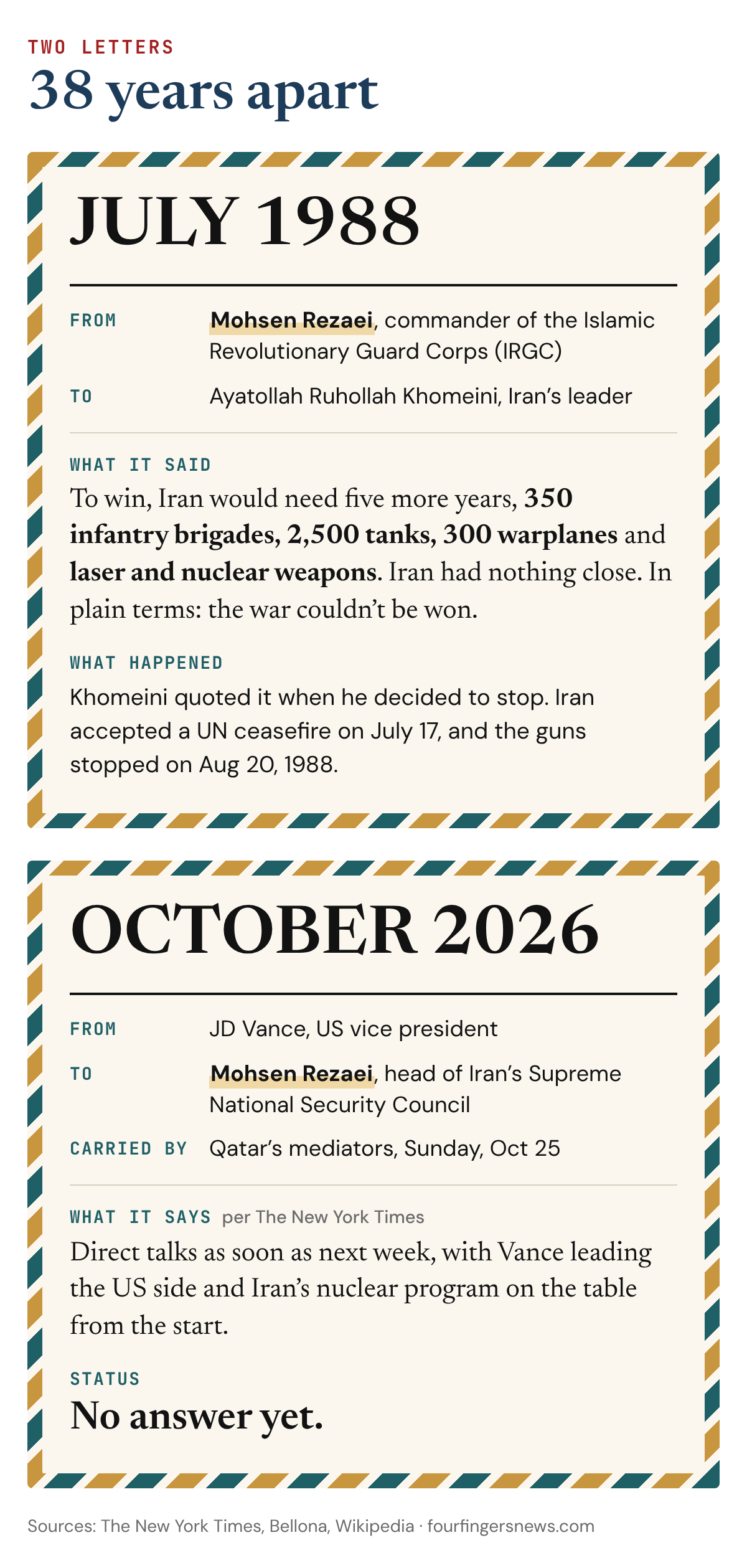
His record also runs through Buenos Aires, where on July 18, 1994, a bomb destroyed the AMIA, the city’s main Jewish community center, and killed 85 people. Argentine prosecutors concluded that Iran’s leadership ordered the attack and that Hezbollah, the Lebanese armed group Iran backs, carried it out. In 2006 an Argentine judge ordered Rezaei’s arrest along with other Iranian officials, and since 2007 Interpol has carried a red notice for him, a request to police in its member countries to find him and hold him for extradition. Iran and Rezaei have always denied it, and Argentina has protested when he’s traveled abroad; it once asked Qatar, the same country that just delivered Vance’s letter, to arrest him, which Qatar didn’t do.
He’s also run for president four times and lost every time, and in 2021 he got 3.4 million votes, fewer than the number of ballots that were spoiled or left blank. Voters have never wanted him, but the system always has.
The war is why he’s the one holding the letter: the first American and Israeli strikes on Feb 28 killed the Supreme Leader, Ayatollah Ali Khamenei, along with about 40 senior commanders, and in March the clerics who choose Iran’s Supreme Leader picked his son, Mojtaba Khamenei. The security council’s secretary, Ali Larijani, was killed in a later Israeli strike, and his replacement quit after about four months. In August the new Supreme Leader made Rezaei his personal representative on the council, and hours later the president named him its secretary. Hamidreza Azizi, an analyst at the International Crisis Group, said addressing the letter to Rezaei may signal a shift in the US government’s view of who holds influence in Tehran.
There’s an old line in American politics that only Nixon could go to China: in 1972 a lifelong anti-communist could open the door to Mao because nobody could call him soft. I think that’s the bet in sending this letter to Rezaei instead of to Iran’s foreign minister. A deal Rezaei helps deliver may be easier for the IRGC to accept, and easier for a new Supreme Leader to endorse without looking weak. I don’t know whether he’ll take it, because his public line is that Iran won’t negotiate or reopen the strait until its conditions are met, the letter puts the nuclear program on the table from the start, and those aren’t the same list.
In 1988 his letter gave a Supreme Leader who’d vowed to fight on a reason to stop. This time, his answer could offer a new Supreme Leader the same opening. The immediate test is smaller but urgent: whether there’s enough common ground to give diplomacy a foothold before the military clock runs out.
Sources (12), on the site.
Who Pays for the Building
October 28, 2026 · Day 243 · 1,040 words
Who Pays for the Building
Who Pays for the Building, read aloud · 7 minutes.
The Milwaukee Brewers won the World Series on Wednesday night, beating the Tampa Bay Rays 4-1 in Game 5 in St. Petersburg, Florida. It’s the first championship in the franchise’s 58 seasons, and the first of those seasons was played here. In 1969 the Brewers were the Seattle Pilots, and they lasted one year here. In June 2025 the Oklahoma City Thunder won the NBA title, and they started here too, as the SuperSonics. In the space of 16 months, both of the big-league teams Seattle has lost have won championships somewhere else.
Both departures turned, in different ways, on the same question, one that every city with a team ends up answering: who pays for the building? It’s also the question the NBA is about to put to Seattle again, as the league decides whether the Sonics come back.
I think Seattle drew the right line in 2006, even though it cost the city the Sonics.
The Pilots’ trouble started before they played a game. When the American League gave Seattle a team in 1967, it came with a condition: King County had to commit to building a domed stadium. Voters had turned down a stadium twice before, and they approved the bonds in 1968, after the league sent Mickey Mantle and Carl Yastrzemski to campaign for them. That dome, the Kingdome, didn’t open until 1976. In the meantime the Pilots played at Sick’s Stadium, an old minor-league park in the Rainier Valley that the city hurried to expand, and workers were still putting in bleachers on Opening Day. The team lost 98 games, its biggest investor pulled his money, and its bank called in its loan. At the end of March 1970, a week before the next Opening Day, a bankruptcy judge in Seattle approved the sale of the team to a group from Milwaukee. The team’s equipment trucks, on their way north from spring training in Arizona, sat in Provo, Utah, waiting to find out whether to head for Seattle or Wisconsin.
Milwaukee got the team because it already had the building. In 1953 Milwaukee County opened County Stadium, the first big-league ballpark in the country paid for with public money, and the Braves moved in from Boston that same spring. After the 1965 season the Braves left for Atlanta and its bigger TV market, and a local car dealer named Bud Selig spent the next five years trying to fill the empty ballpark. When the Pilots went broke, Selig’s group was the buyer with a ballpark ready.
Seattle didn’t let it go. Washington State, King County and the city sued the American League for breaking its promise, and the case dragged on for six years. In January 1976, two days after the trial opened in Everett, the league’s owners voted to give Seattle a new team. The City Council accepted it 7 to 1 as the settlement, and the state dropped its claim for damages. That team is the Mariners, who played their first game in the Kingdome in April 1977. Fifty seasons later, they’re the only team in baseball that’s never been to a World Series.
The building question came back in 1995. The Mariners’ owners said they’d leave without a new ballpark, and that September King County voters turned down a sales tax to build one by 1,082 votes. That October, in the middle of the team’s first playoff run, the Legislature authorized new taxes on restaurant meals, rental cars and ballpark tickets to build it anyway. The public put in $372 million, and the team covered the overruns on a ballpark that ended up costing $517 million. The Kingdome came down in March 2000, and King County kept paying off the loan for its roof repairs, out of hotel taxes, until 2015.
The Sonics went the other way. In 2006 their owner, Howard Schultz of Starbucks, asked the state for about $220 million to rebuild KeyArena, which the city had already renovated in 1995, and the Legislature said no. That July he sold the team to a group of investors from Oklahoma City. In November, Seattle voters passed Initiative 91 by about three to one, which bars the city from subsidizing a pro team unless the public gets a return on its money like any other investment. The new owners asked for public money for an arena in Renton, the Legislature didn’t pass it, and in July 2008 the city let the team out of its lease for $45 million. That fall they were the Oklahoma City Thunder.
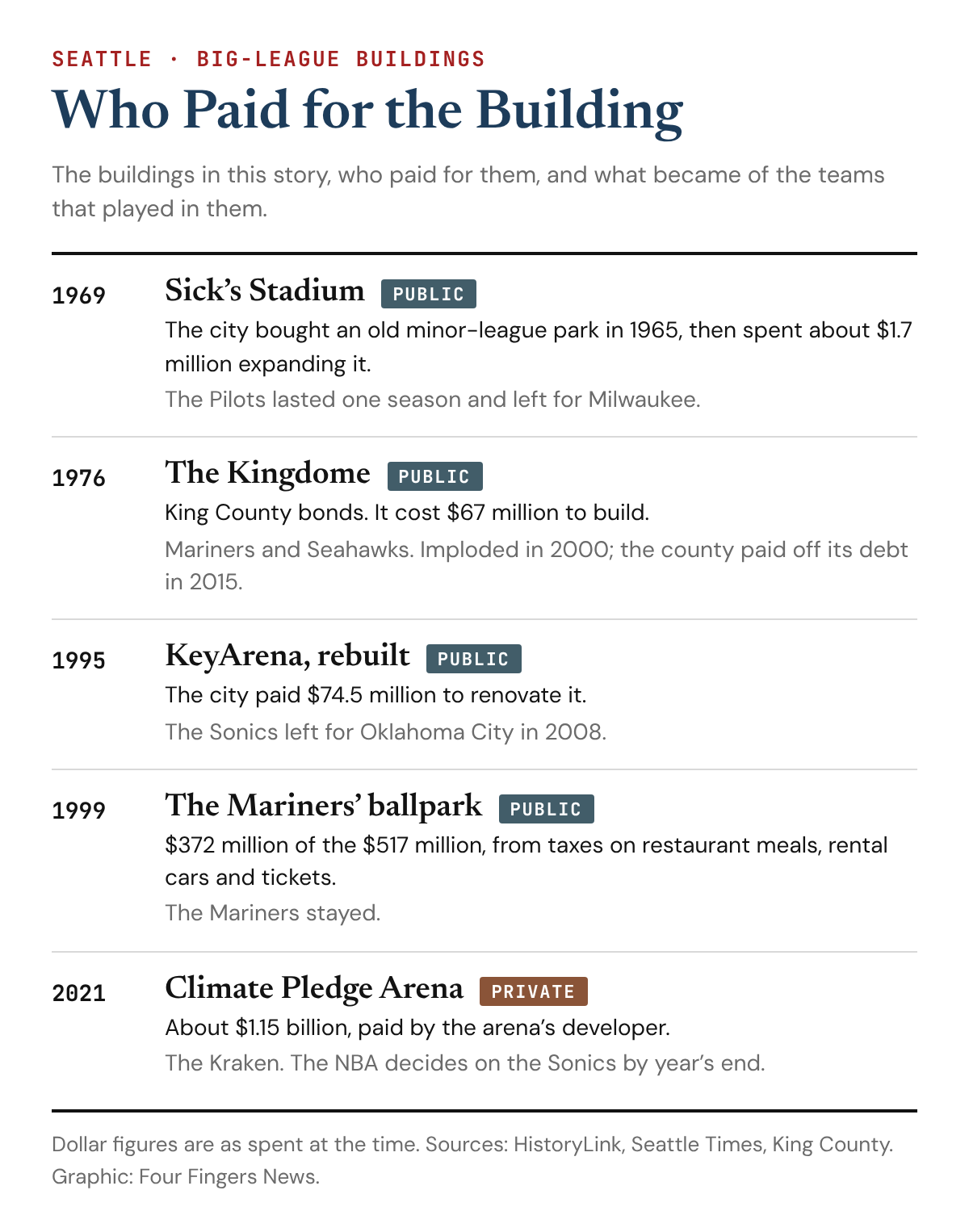
On the economics, the research is about as settled as it gets. A 2023 review of more than 130 studies found “near-universal consensus evidence that sports venues do not generate large positive effects on local economies.” Most of what people spend at the ballpark is money they’d have spent somewhere else in town. That was the case Seattle voters made in 2006, and the studies back them. That accounting doesn’t capture everything a team means to a city. But civic pride isn’t a blank check.
Now the NBA is deciding whether the Sonics come back. In March 2026 the league’s owners voted to explore adding teams in Seattle and Las Vegas, and the commissioner, Adam Silver, wants a decision by the end of the year. For the first time in this story, the building isn’t the fight. KeyArena was rebuilt as Climate Pledge Arena for the Kraken with about $1.15 billion in private money, and Silver has said that “if we were opening in five weeks we could be ready in Seattle.” The fight now is the price of the team. ESPN reported earlier this month that Seattle’s leading bid is about $6 billion, that bids for Las Vegas run as high as $10 billion, and that Seattle is no longer a lock.
A team is worth something real to a city, but the public shouldn’t subsidize an owner while bearing the risk that the team leaves anyway. King County spent 15 years paying for a dome it had already blown up.
Seattle has already answered the building question without a new public subsidy. The remaining fight is over a different price: what owners are willing to pay for the team.
Sources (13), on the site.
Seven Fronts
October 27, 2026 · Day 242 · 1,460 words
Seven Fronts
Seven Fronts, read aloud · 9 minutes.
Benjamin Netanyahu lost on Tuesday, and I want to walk you through how a man can lose an election and keep the job, because that’s what’s happening. Israel held its first election since the Hamas attack of October 7, 2023, the one Hamas named Al-Aqsa Flood, and it was a vote on Netanyahu and the wars he’s run since. Israel’s parliament, the Knesset, has 120 seats, and whoever can gather 61 of them forms the government. With less than half the ballots counted on Wednesday morning, Netanyahu’s side had 57. The parties behind Gadi Eisenkot, the former head of the army who ran to replace him, had 47. The two parties that represent Israel’s Arab citizens had the other 16. So more seats went to the people who ran to remove him than to his side, 63 to 57, and nobody reached 61. The soldiers’ ballots are counted last, through Friday, and they’re the one thing that could still change the picture.
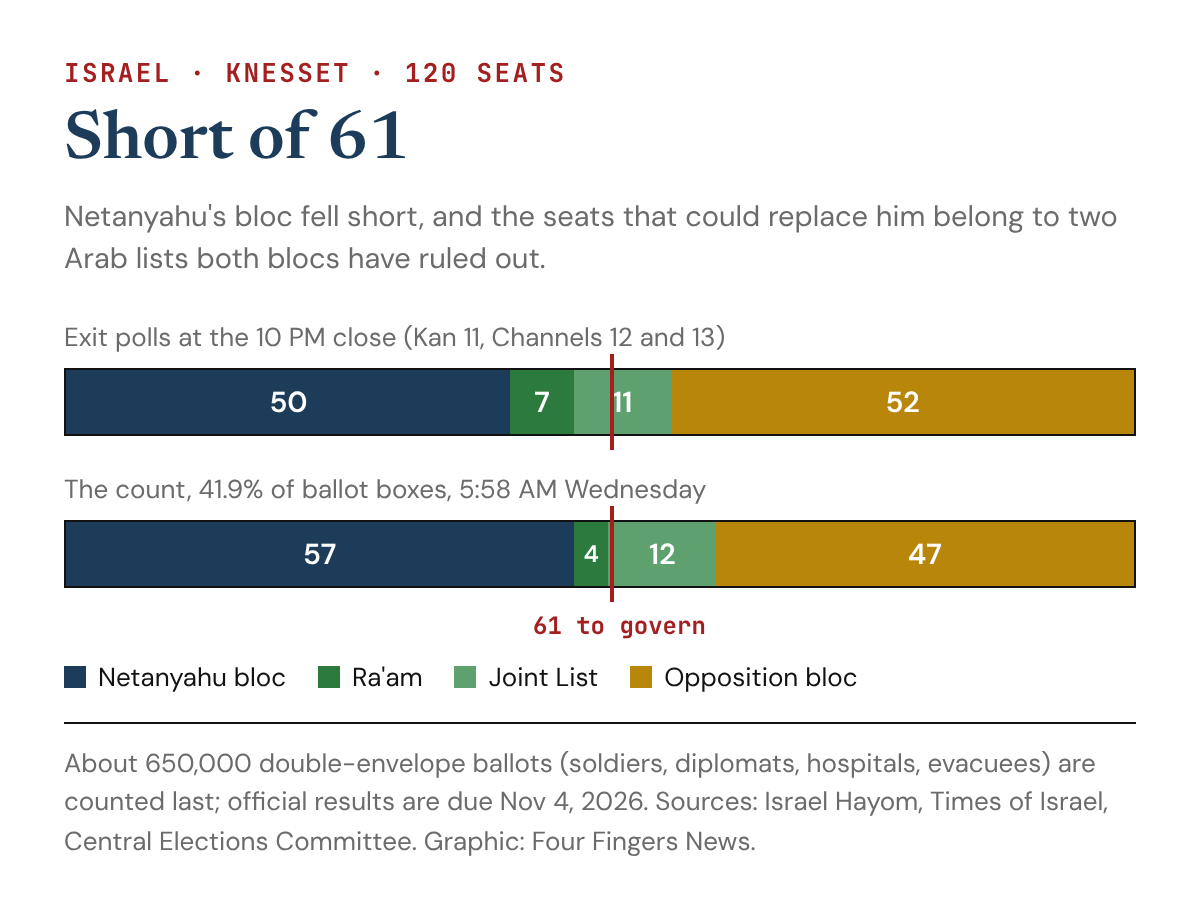
The reason he keeps the job comes in two parts. The first is the law: a government that loses its majority stays in office, with all of its powers, until a new one is sworn in. The second is a rule about those 16 seats. For thirty years Netanyahu has argued that the Arab parties can’t be part of any Israeli government, and his opponents have gone along with it. At 3 AM he called them “anti-Zionist” and said a government resting on them is “forbidden.” A Zionist believes Israel should be a Jewish state, and most of the Arab parties don’t, so that’s the disqualification. In practice, one in five of the people who voted on Tuesday got a seat for their ballot but no say in who governs, and the other 104 seats can’t produce 61 on their own.
A few things about him, for anyone who hasn’t followed closely. Netanyahu is 77 and has been prime minister for most of the last 17 years. He’s been on trial for bribery since 2020, with no verdict yet. Since November 2024 the International Criminal Court, the world’s war-crimes court in The Hague, has had a warrant out for his arrest, for starving civilians as a method of warfare and for murder and persecution in Gaza, where the count of the dead passed 74,500 this month. On Monday, the day before the vote, the United Nations commission that investigates the territories reported that the genocide it first found in September 2025 didn’t stop with last October’s ceasefire.
Why this reaches us in Washington State is Iran. Netanyahu still runs the war, and tonight the Wall Street Journal reported that the United States has told the Gulf states to expect a short, intense offensive against Iran after the November 3 midterms. After 3 AM, at his party’s headquarters in Jerusalem, Netanyahu told the room that Israel has “a historic, once-in-a-lifetime opportunity” with “our wonderful friend President Trump” to “remove the existential threat from Iran once and for all.” Two hours earlier, in Tel Aviv, Eisenkot had said that “Netanyahu is a caretaker prime minister, without a mandate and without the public’s confidence,” and then, to him directly, “do not dare use Israel’s security for your own political ends.” The trouble is that the law doesn’t limit a caretaker much: the decision to start a war belongs to the government and its security cabinet, whether or not that government is on its way out.
His party is Likud, and his partners are two ultra-Orthodox religious parties and two from the far right, Bezalel Smotrich, the finance minister, who told his own crowd tonight that “Jewish settlements will rise in Gaza,” and Itamar Ben Gvir, the national security minister. Eisenkot’s side is his new party, Yashar, plus Naftali Bennett, who was prime minister for a year, and two smaller parties.
I should explain who holds those 16 seats, because from here “Arab” and “Israeli” sound like opposites, and they aren’t. About 2.2 million of Israel’s 10.3 million citizens are Arab, the descendants of Palestinians who stayed inside Israel’s borders when the state was founded in 1948. They’re Israeli citizens who vote, a different group from the Palestinians in Gaza and the West Bank, who don’t. The Joint List, with 12 seats, is three parties running together, one of which, Balad, holds that Israel should be “a state of all its citizens” rather than a Jewish state. The other four seats belong to Ra’am, a religious Muslim party led by Mansour Abbas.
Both sides have said they won’t govern with them. Netanyahu, from the stage: “It is simply forbidden to endanger Israel and form a government that rests on anti-Zionist Arab parties,” parties “that see Hamas as a charitable organization, that call our soldiers war criminals.” Eisenkot sets three conditions for any partner, that they accept Israel as a Jewish and democratic state, accept military or national service for everyone, and support dismantling Hamas, and he’s said no Arab party meets them. The Arab parties, for their part, aren’t the ones saying no. The Joint List’s leaders have said they’d support a government from outside to remove Netanyahu, and Abbas wants in: he says he accepts a Jewish and democratic state and expects offers, and he’s the one Netanyahu accused on election day of “trying to steal the election from us.”
This has been tried before, twice. In 1992 Yitzhak Rabin won without a majority of his own and governed with the Arab parties voting for him from outside the government, and that’s the majority that passed the Oslo accords, the 1993 peace deal with the Palestinians. The right’s answer at the time was that a government without a Jewish majority had no right to give up land. Rabin called that racism. The argument has been made at every election since, and it’s the argument keeping Netanyahu in office tonight. Then in 2021 Abbas took Ra’am into Bennett’s government, the first Arab party ever inside an Israeli coalition, in exchange for money and infrastructure for Arab towns. That government lasted a year.
So what happens now. The count finishes this week, and then Israel’s president, Isaac Herzog, whose office is mostly ceremonial except for this one power, picks who gets the first try at building a majority. Herzog is also the man holding the pardon request Netanyahu filed in November 2025; he turned it down “at this stage” in April 2026 and has pushed for a plea deal instead. The last time the numbers looked like this, Israel voted four times in two years and went 508 days without a full government. I don’t know how the count ends or whose name Herzog calls first. What I can tell you is what’s on the table: either a prime minister under an international arrest warrant for the last war gets a full term to start the next one, or he gets a few more months of it by default, while the two sides that could end it argue over whether the 16 seats in the middle count.
I want the best for the Israeli people, and the genocide has to stop. I can’t judge a man’s soul and I don’t need to. I’ve watched Benjamin Netanyahu through three years of this war and I’m convinced he’s been a force for war and death in the world, and that the holy war his partners wrap it in, settlements rising in Gaza, a once-in-a-lifetime chance in Iran, is the oldest move in politics: a war to keep a man out of a courtroom. He told the UN in September 2024 that Israel is fighting on seven fronts, Gaza, Lebanon, Syria, the West Bank, Iraq, Yemen and Iran, and he said it as a boast. That’s delusions of grandeur, and ordinary Israelis pay for them: nearly 30,000 soldiers have come home wounded since October 7, two in three of them in the mind. Eisenkot is a general whose own son died in Gaza. He knows. These stories are never good against evil. They’re people. Victims and victims. I think Netanyahu is done, and I think the project he calls Greater Israel, which he told Israeli television last year is his “historic and spiritual mission,” ends with him. A country can’t belong to one religion and still be a democracy for everyone who lives in it, and the 2018 law that wrote “unique to the Jewish people” into Israel’s constitution is the same rule that says one in five of its citizens can vote but can’t count. America proved you don’t have to choose. I hope whoever Herzog calls is the one who fixes it.
If you want to know what I mean by genocide, visit ArchiveGenocide.org, or don’t. If you do, you’ll never be the same.
Sources (40), on the site.
In-Q-Tel
October 26, 2026 · Day 241 · 1,030 words
In-Q-Tel
In-Q-Tel, read aloud · 7 minutes.
In 1965, the American composer Alvin Lucier sat in a chair with electrodes taped to his scalp. The faint electrical signal from his brain ran through amplifiers into loudspeakers set against drums, cymbals and gongs around the room, and when he relaxed enough for the slow waves to come, the instruments shook and rattled with no one touching them. He died in 2021 at 90. The year before, knowing exactly what it was for, he let a team in Perth draw his blood. In the spring of 2025, at the Art Gallery of Western Australia, two white blobs grown from those blood cells sat on a plinth under a magnifying lens, firing pulses at 20 brass plates hung on the walls like paintings, while microphones in the room fed the sound back into the tissue. The team calls it Revivification, and whether that’s Lucier in some thin sense or just cells in a dish is a question nobody can answer, so I won’t pretend I can. What’s easier to answer is who’s paying for the hardware this kind of work now runs on, and one of the names on that list is a venture fund the CIA set up in 1999. That’s why I’m writing tonight.

Start with what exists, because it’s more than I’d assumed. Cortical Labs in Melbourne sells a box called the CL1 for $35,000. Inside are roughly 200,000 living human neurons, grown from donated blood cells onto a silicon chip and kept alive by pumps, gas and filters for up to six months. In March 2026 the company posted video of the cells learning to play Doom. In August 2026 a rack of 20 of them went live at the National University of Singapore with a data center operator called DayOne as the partner, and if you’d rather not buy a unit you can rent one over the internet for about $300 a week. In Vevey, Switzerland, FinalSpark does the same thing with 16 brain organoids about half a millimeter across; universities pay by the month, and the organoids die after roughly 100 days and get swapped out. Stanford researchers have put human brain organoids into rat brains and watched them wire themselves in. None of it is secret; it’s in journals, press releases and price lists.

It’s also worth saying what it isn’t yet. The cells play Doom badly and die constantly, and FinalSpark says each of its organoids holds about one bit of information. No independent benchmark has confirmed the companies’ energy claims, and the organoids stay tiny because there’s no blood supply to feed anything bigger. None of it is close to replacing a graphics card.
The money is moving because electricity is the constraint on the thing the money’s already in. Amazon, Alphabet, Microsoft and Meta have guided to roughly $735 billion of capital spending for 2026, up about 79% from around $410 billion in 2025, almost all of it data centers, chips and the power to run them, and if you own an index fund you own a piece of that bet. A human brain runs on about 20 watts, less than most light bulbs. That Singapore rack of 20 brain-cell units draws about 1,000 watts in total, and one modern AI server rack draws more than a hundred times that. When the limit on your business is the power grid, a technology that runs on a fraction of the electricity gets a hearing it wouldn’t otherwise get, even this early.
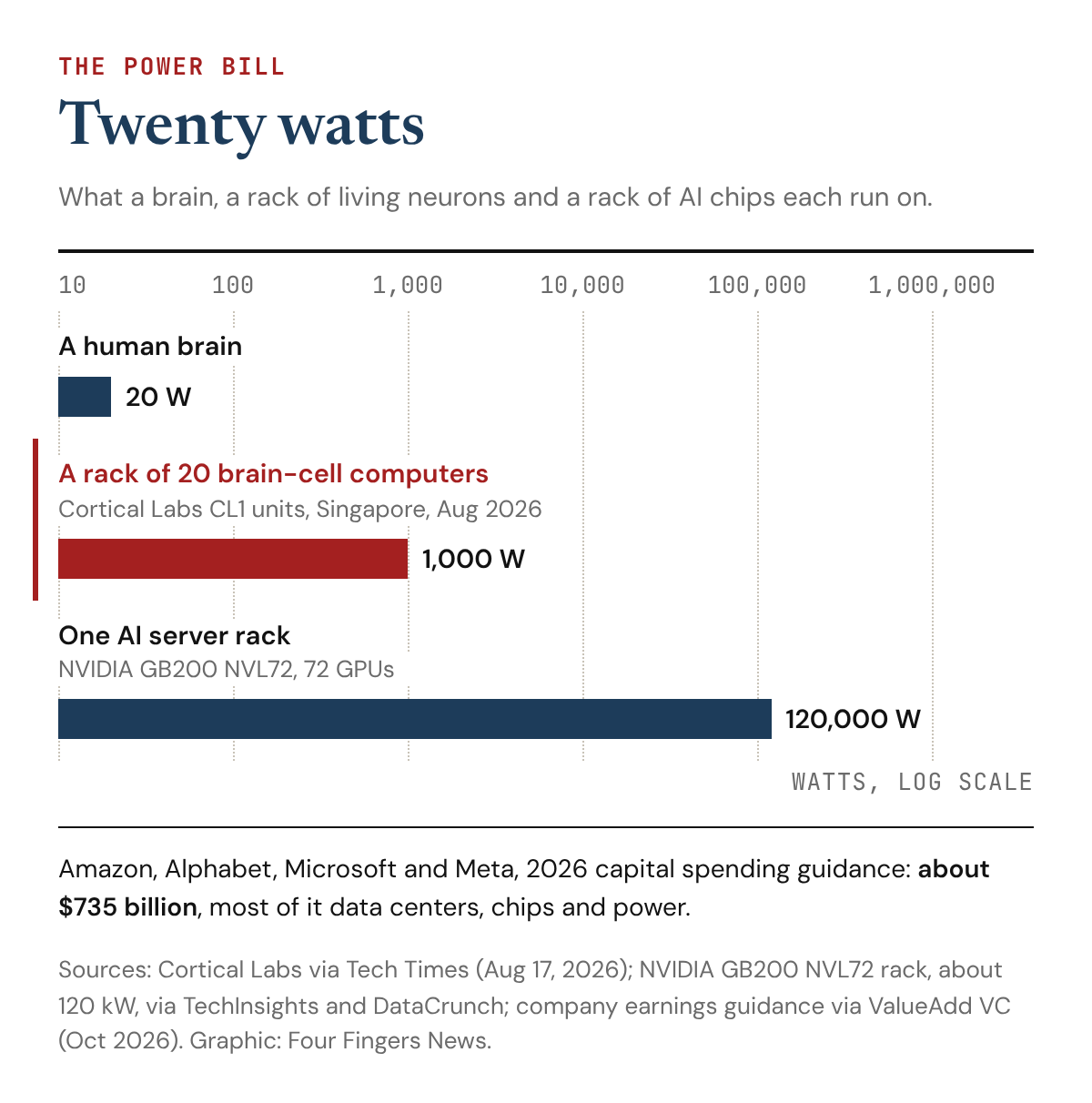
In April 2023, Cortical Labs raised $10 million. The round was led by Horizons Ventures, the private fund of Li Ka-shing, Hong Kong’s richest man, and one of the other names in it was In-Q-Tel. The Q is borrowed from the gadget man in the Bond films. In my family he’s a running joke: every Christmas since the GoldenEye years on the N64, my dad has given my brother and me one piece of technology “from Q,” and the Bond theme comes out of the player piano while we open it. The Tel is intelligence, as in the Central Intelligence Agency. The CIA set it up in 1999 as a nonprofit venture fund in Arlington, Virginia, so the agency could buy into startups the way Silicon Valley does. It takes about $100 million a year in taxpayer money, employs close to 200 people, and writes checks from a few hundred thousand dollars to a few million. Its early money went into Keyhole, which Google bought and turned into Google Earth, and into Palantir and Anduril. By its own account, every dollar it puts in draws about $40 more from commercial investors. And Cortical isn’t its only brain bet. In November 2025 it joined a $200 million round for Synchron, which places a brain implant through the jugular vein instead of through the skull, alongside Jeff Bezos’s fund and the Australian government’s own investment vehicle.
The caveat is real, and it cuts against me. In-Q-Tel has done around 28 deals this year alone and more than 500 since it started, so a slice of a $10 million round is a small bet, not a program. What the money buys is what In-Q-Tel exists to buy: a seat at the table and an early look at the data. I don’t know what the agency intends to do with living neurons on a chip, and I haven’t found anyone outside it who does.
The record, at least, is public. From 1953 to 1973 the CIA ran MKUltra, at least 149 subprojects across more than 80 universities, hospitals and prisons, to find out how a human mind could be bent. In January 1973 the outgoing director, Richard Helms, ordered the files destroyed. Seven boxes of financial records survived because they’d been misfiled, a public records request turned them up in 1977, and most of what’s known about the program was rebuilt from the bookkeeping. On Jun 30, 2026 a House Oversight task force held a hearing on all of it, and its chair said the CIA is now declassifying boxes it only recently found. That same agency’s venture arm is on the cap table of a company growing human brain cells on a chip.
Sources (15), on the site.
Two More Hours
October 25, 2026 · Day 240 · 1,340 words
Two More Hours
Two More Hours, read aloud · 8 minutes.
Brazil elected a president on Sunday, and if your first question is whether that’s good or bad, here’s the short version. The winner is the man who already had the job, Luiz Inácio Lula da Silva (“Lula”), who turns 81 on Tuesday. The loser, Flávio Bolsonaro (“Flávio”), is the son of the last president, who’s serving 27 years for trying to overturn his own defeat. Lula won by 4.4 million votes, 51.8% to 48.2%. Brazil votes twice: everyone runs on the first Sunday, and if nobody clears half, the top two meet again three weeks later. Flávio finished first on October 4, 2026 and led every final poll, so Sunday was an upset, though not a close one. The good part is that the vote held: about 124 million people cast ballots, the count was finished the same night, and nobody has pointed to a single vote that was miscounted or faked. The bad part is the last hour. With the polls about to close, a Supreme Court justice who used to be Lula’s own defense lawyer ordered every polling station in the country to stay open two more hours at the request of Lula’s party, and the Bolsonaro side was calling it rigged before the count had even resumed. The last time a Bolsonaro lost, his supporters stormed the capital. So my honest answer is that as an election it worked: 81% turned out, the count was done by bedtime, and 4.4 million votes isn’t a margin two hours can explain. What’s bad is the next two weeks, and the rest of this note is what’s actually on the record, so you can judge it yourself.
It matters here because the United States tried to pick this winner, and lost. Over the past year the Trump administration put a 50% tariff on Brazilian goods and said the reason was the prosecution of Jair Bolsonaro; it revoked the visas of eight Supreme Court justices and sanctioned the one running the coup case, and in May 2025 it sent State Department officials to Bolsonaro’s house while he awaited trial. The tariffs were later watered down and the sanctions quietly dropped, and Brazilian analysts say the whole episode lifted Lula in the polls. On Saturday Reuters named the official behind it, Darren Beattie, the State Department’s senior adviser for the Western Hemisphere, who told US diplomats in Brazil that the policy was to return Jair to power, then after Jair’s conviction his son Flávio, and not to engage other conservative candidates. Lula’s line in Friday’s debate was that Flávio was “licking up to Trump to get Brazil taxed.” Trump, asked on Sunday whom he hoped would win, said “I don’t want to get into that, but we are watching.” The State Department’s spokesman, asked about the Reuters story, said “the Brazilian people have the right to choose their leaders through free and fair elections.” They’ve now done that, by 4.4 million votes, and that sentence is about to be tested.
The cast, for anyone who hasn’t followed Brazil. Lula was a metalworker and union leader before he was president from 2003 to 2010, the years when Brazil felt like it was arriving; he lost the pinky finger of his left hand to a factory lathe as a teenager, and in Friday’s debate, arguing about taxes, Flávio told him it’s no use to “give with one hand and take away with nine fingers.” Lula said he wouldn’t be called “nine fingers” by a “militiaman,” his word for Flávio all night, and demanded an apology on air, and got one. He spent 580 days in prison on corruption convictions the Supreme Court later threw out, then beat Jair Bolsonaro by about two points in October 2022. Jair never conceded, and a week after Lula was sworn in, on January 8, 2023, his supporters stormed Congress, the Supreme Court and the presidential palace in Brasília. The coup conviction came in September 2025, and he’s serving the sentence under house arrest for his health. Flávio, 45, is his eldest son and a senator from Rio, and he ran on a promise to pardon his father.
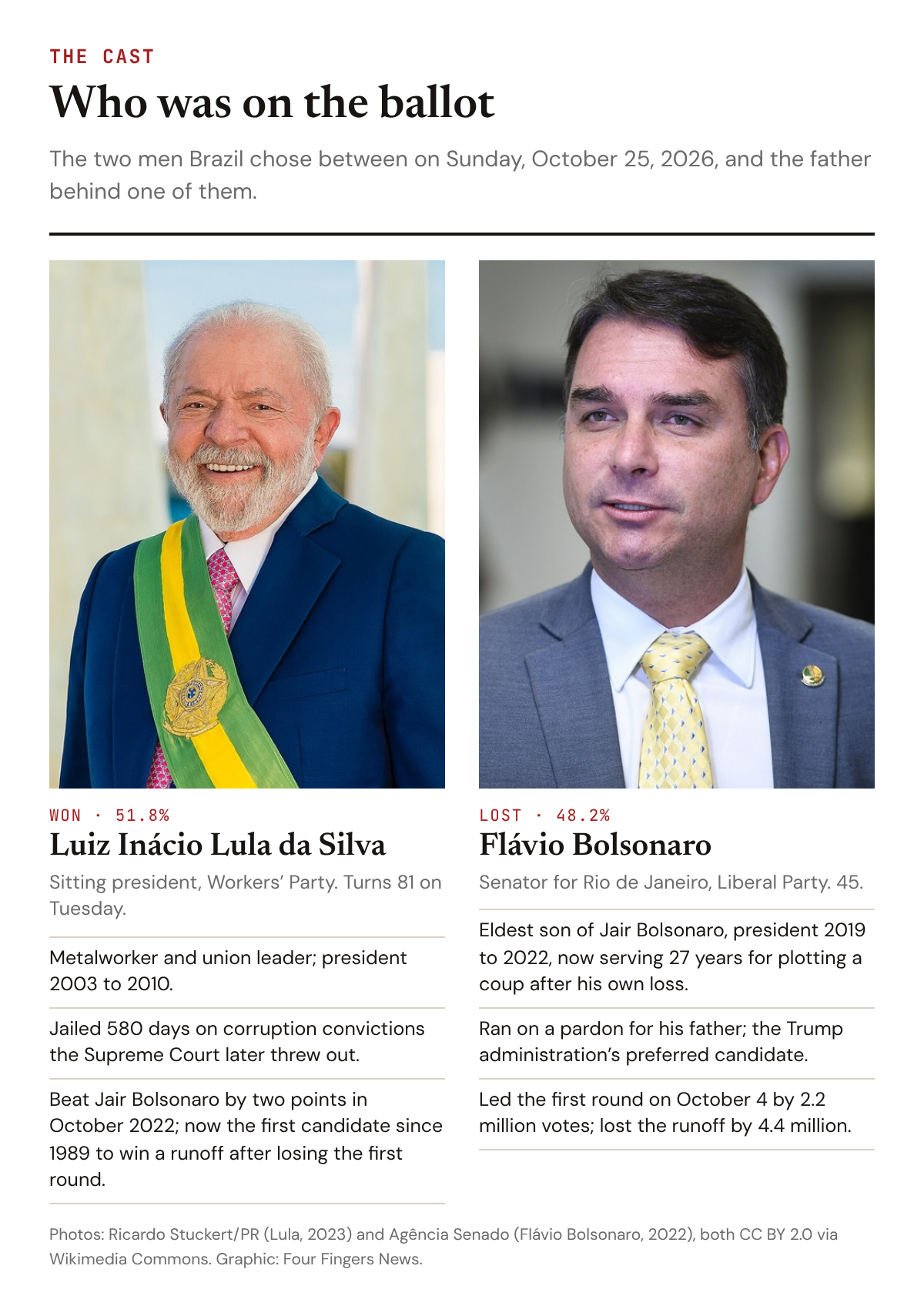
The two hours themselves went like this. Brazil votes from 8 in the morning to 5 in the afternoon, Brasília time. On Sunday morning an electoral judge in the state of Bahia, in the northeast, where Lula runs strongest, found that at least 75 city buses in Salvador had been kept in their garages on election day, and ordered the arrest of the city’s transport secretary. Salvador’s mayor, a Bolsonaro ally, said union activists had illegally plastered Workers’ Party material on the buses. Lula’s party asked for voting to be extended, citing bus problems in nine states. Flávio’s campaign also asked for an extension, in 17 towns across three southern states, because of heavy rain. Those requests normally go to the electoral court, whose president said he was studying the Bahia report. Before he ruled, a Supreme Court justice named Cristiano Zanin ordered two more hours of voting nationwide, until 7 PM, with any station that had already shut to stay shut. Zanin was Lula’s defense lawyer for years, and Lula put him on the court in 2023. The electoral court stopped the count at 5:20 PM with a third of a percent of the stations in, and started again after 7.
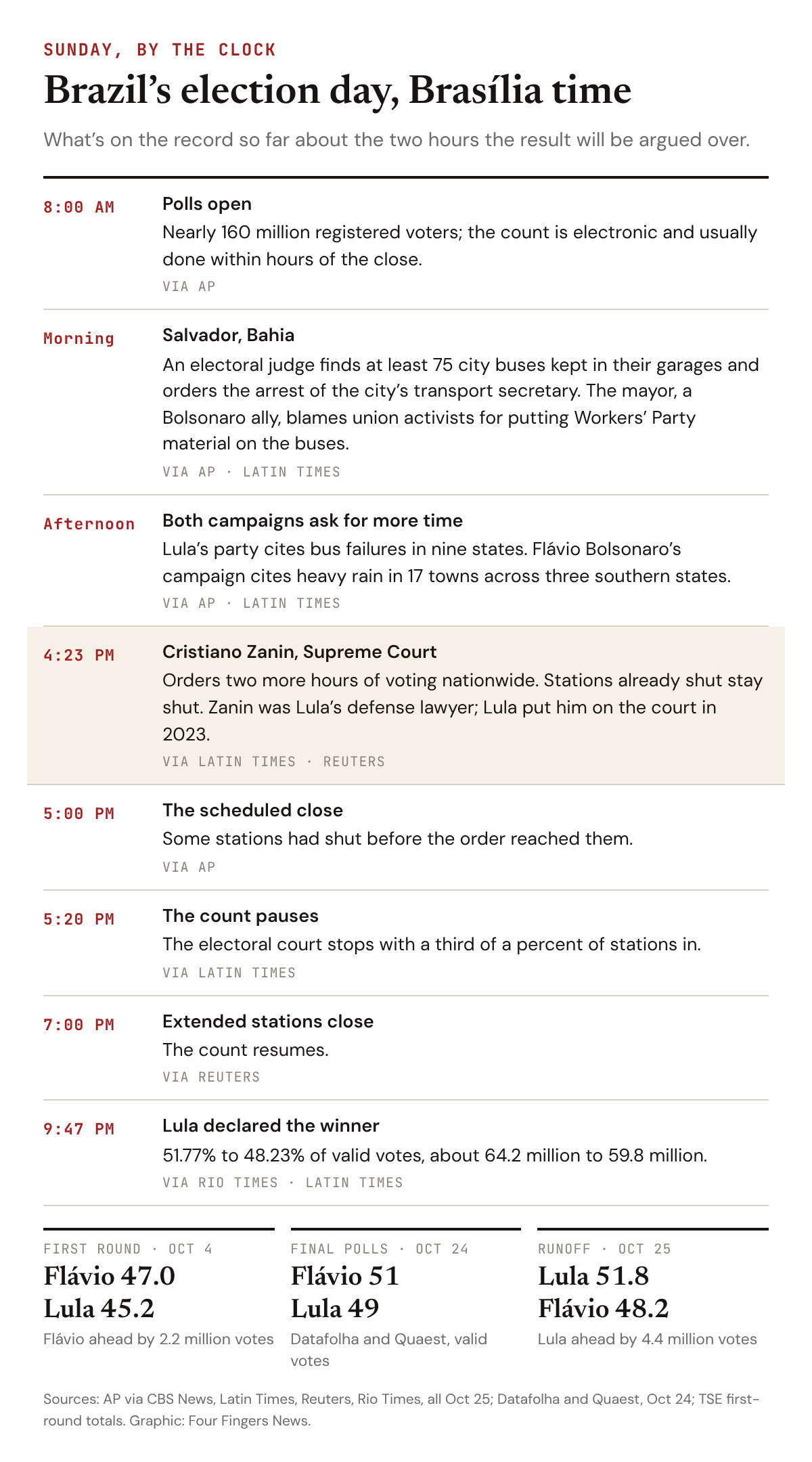
The Bolsonaro side said what you’d expect within the hour. Eduardo Bolsonaro, Flávio’s brother, said on his livestream that it “doesn’t inspire credibility,” and Nikolas Ferreira, a Bolsonaro ally in Congress, called it an attempt to contest a win that was already Flávio’s. Lula, earlier in the day, had said “we will not be robbed by mayors, governors or businessmen.” As of this writing Flávio hasn’t conceded, and I’d expect a legal challenge before a concession. So here’s what’s on the record and what isn’t. Whether a justice with Zanin’s history should have been the one to rule is a fair question, and the Bolsonaro side will keep asking it. Whether the extra two hours changed the result is a different question, and it’s a question with numbers. The margin was 4.4 million votes, and nobody has yet said how many were cast between 5 and 7, though some stations had already closed before the order reached them and stayed closed. One thing the losing side will remember is that Flávio led the running count from 7:45 PM until Lula passed him at 8:24 PM, which is what a count looks like when the south reports before the northeast, and it’s also what every stolen-election story starts with. The only interference anyone has documented so far ran the other way: buses held back in a Lula city by a Bolsonaro-allied administration, with a judge’s arrest warrant attached. Flávio’s own campaign asked for the same remedy for the same reason. I don’t know how the court cases come out; I do know that the people calling the count stolen will have to explain those buses.
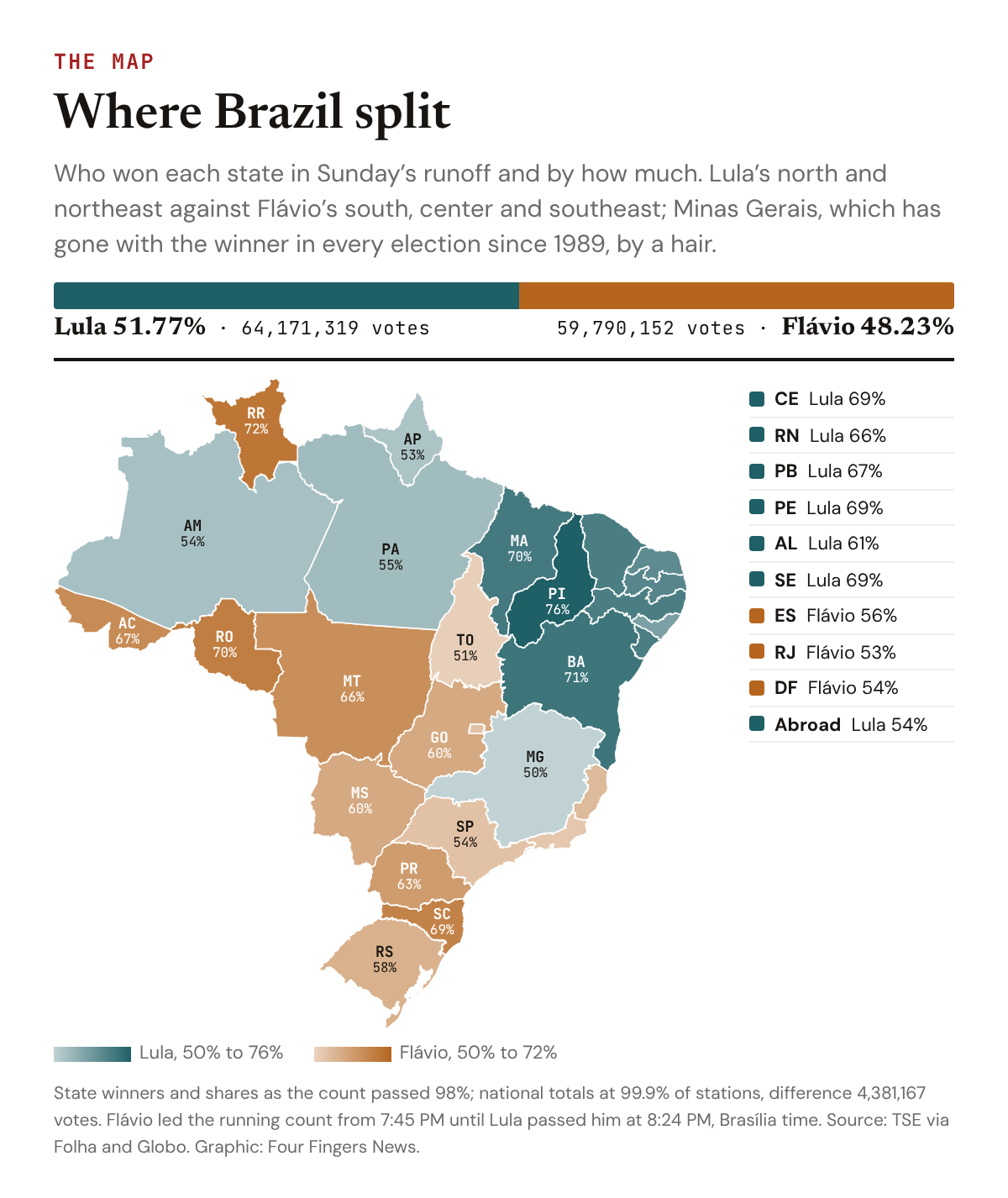
The map looks like the last three: Lula’s north and northeast against Flávio’s south and center, and Minas Gerais, the state that’s picked the winner in every election since 1989, went to Lula by a hair. Two more reasons a reader in Seattle or Montreal cares. Brazil is 212 million people and the biggest economy in Latin America, a founder of the BRICS group that spends its time working out how to trade without the dollar, and now one of the world’s ten biggest oil producers with Brent at $116 a barrel; who runs it decides how much of that trade happens in dollars. And Lula will be 85 when this term ends, so the fight over what comes after him starts now. What I’ll be watching this week isn’t the count, which is done. It’s whether the losing side accepts it, because the last time it didn’t, and it’s whether the electoral court publishes how many people voted in those two hours, because that number, whatever it is, settles more than any lawyer will.
Sources (11), on the site.
Still Looking for the Switch
October 24, 2026 · Day 239 · 900 words
Still Looking for the Switch
Still Looking for the Switch, read aloud · 6 minutes.
Last week I asked who holds the switch on Ukraine’s satellite links. On Saturday Ukraine’s defense ministry said Starlink and Starshield speeds are back to where they were before Oct 14, when hardware moving faster than about 160 km/h started losing its connection. That cap knocked out the interceptor drones Ukraine uses against Russia’s jet-powered drones for more than a week. I’ve spent the days since trying to work out who imposed it, and I still can’t tell you.
The accounts I’ve found don’t fit together. On Oct 14 Elon Musk said speed limits on Starshield are set by the US military and ultimately the president, because the US government owns and controls that network. Trump said two days later that “it wasn’t me, and I don’t think it was Elon,” and the Defense Secretary, Pete Hegseth, said the US government hadn’t cut Ukraine’s access and that the problem was terms of service Kyiv needed to comply with. On Tuesday The Wall Street Journal, citing US officials, reported that Musk ordered the slowdown himself and that he and Trump had discussed it before it happened. On Friday Trump said he hadn’t spoken to Musk and had “heard it was fixed,” hours after Zelensky said the speeds hadn’t been restored. Then on Saturday, with the service back, Musk said Ukraine had “violated Starlink terms of service and used it for offensive drone strikes to kill people,” and that “that loophole was closed last week,” which is a terms-of-service argument about a network he’d said ten days earlier wasn’t his to manage. Maybe those accounts can be reconciled, maybe the cap touched the commercial network and the military one in different ways, or maybe someone isn’t being straight. I don’t know which, and eight senators, four from each party, have asked the Pentagon’s inspector general to find out.
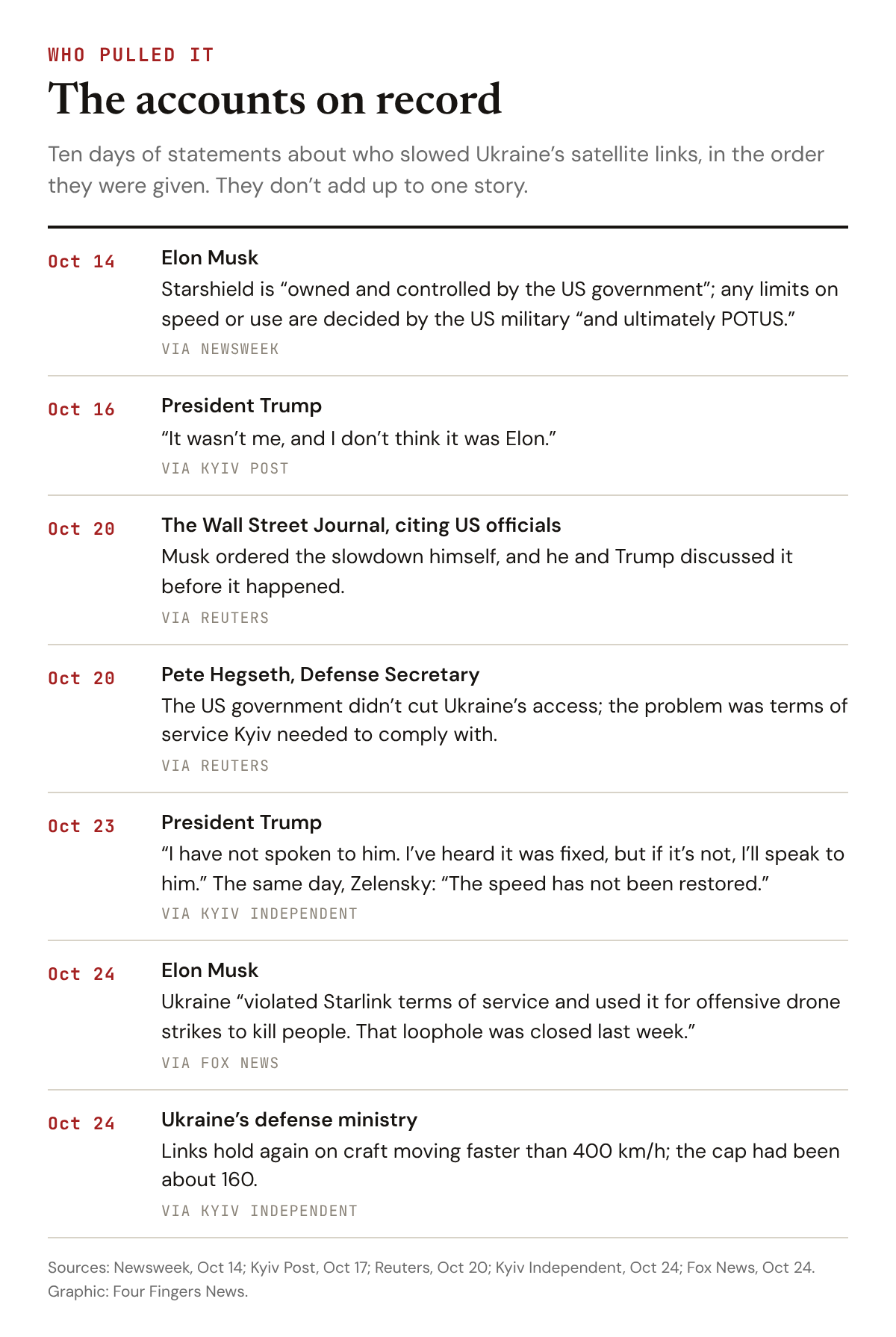
The timing is hard to ignore, since the US government had been pressing Ukraine to stop its drone strikes on Russian refineries because they were pushing fuel prices up. On Oct 11 it announced an energy ceasefire that neither Kyiv nor Moscow had been told about, and that same weekend, according to CNN, it warned Ukrainian and European officials that intelligence sharing and European purchases of American weapons for Ukraine could stop if the strikes went on. In the same stretch it made the deal for Russian diesel and waived the new Russia sanctions two days before they took effect. Ukraine says it went several days without warning of incoming Russian ballistic missiles; the US government says it never stopped sharing. The satellite cap landed in the middle of all that.
One reading is that this was money all the way down, though I’m less sure now whose money. Fuel prices are the administration’s worry, and Musk has his own. SpaceX has been a public company since June, when it raised more money than any company ever has in a listing, and the weekend before the cap he posted that Zelensky had “gone too far,” right after Trump said he’d told Zelensky to stop hitting Russian refineries. On Oct 20, with the cap still on, SpaceX reported a $4.4B quarterly profit after a string of losses, and Musk said SpaceX and Tesla had each set up a committee of independent directors to explore a merger that would make a company worth more than $3 trillion, if a majority of all Tesla shares vote for it. SpaceX’s stock rose more than 7% after hours. By one reading of its IPO filing, about a fifth of SpaceX’s revenue last year came from US federal agencies, and in May the Space Force gave it a $4.16B contract to build satellites that track aircraft and other airborne threats from space. For someone trying to put together the largest merger in history, staying on good terms with the government that signs those contracts probably matters a lot more than how the war in Ukraine goes, and that’s the reading I lean toward, though I can’t show it. The cap hit the interceptor drones and the frontline links; whether it also touched the long-range strikes the pressure was supposedly about depends on whose account you take, and nothing on the record ties the throttle to the merger.
The other two governments are easier to read. Russia wants the refinery strikes stopped because they take refining capacity offline, and this month it got sanctions relief on its fuel exports. Ukraine wants to keep the one form of pressure it can apply deep inside Russia, with three-way talks now penciled in for after Nov 10. It paused the refinery strikes for three days, resumed them Oct 15 with a strike on a refinery in Ryazan, and overnight Friday its General Staff says it hit a plant in Tolyatti that makes synthetic rubber for solid rocket fuel, all while its interceptor drones were degraded.
A capability this important to a war was dialed down for more than a week, and the people with the authority to explain it haven’t done so in a way that holds together, which bothers me more than any single answer would. It could be a private company making a call that belongs to a government, a government using a private company to avoid owning a decision, or something I haven’t thought of. I’d like to know, and right now I can’t tell you.
Sources (18), on the site.
The Third Proviso
October 23, 2026 · Day 238 · 870 words
The Third Proviso
The Third Proviso, read aloud · 5 minutes.
On Thursday a tanker called the Agioi Fanendes loaded 40,000 tons of Russian diesel at Primorsk, on the Baltic Sea, and set a course for New York. It’s due Nov 7, the first cargo under the deal that lifts American sanctions on Russian diesel in exchange for Moscow lifting its own export ban. Diesel was averaging $6.18 a gallon earlier this month, up from $3.48 in January, and the White House wants it down before the Nov 3 midterms. What’s strange is that the United States is the biggest oil producer in history and sells diesel abroad every day. A big part of the reason New York so often buys its fuel from overseas instead of from Texas is a law written 106 years ago by a senator from Yakima, and it was written mostly to help Seattle.
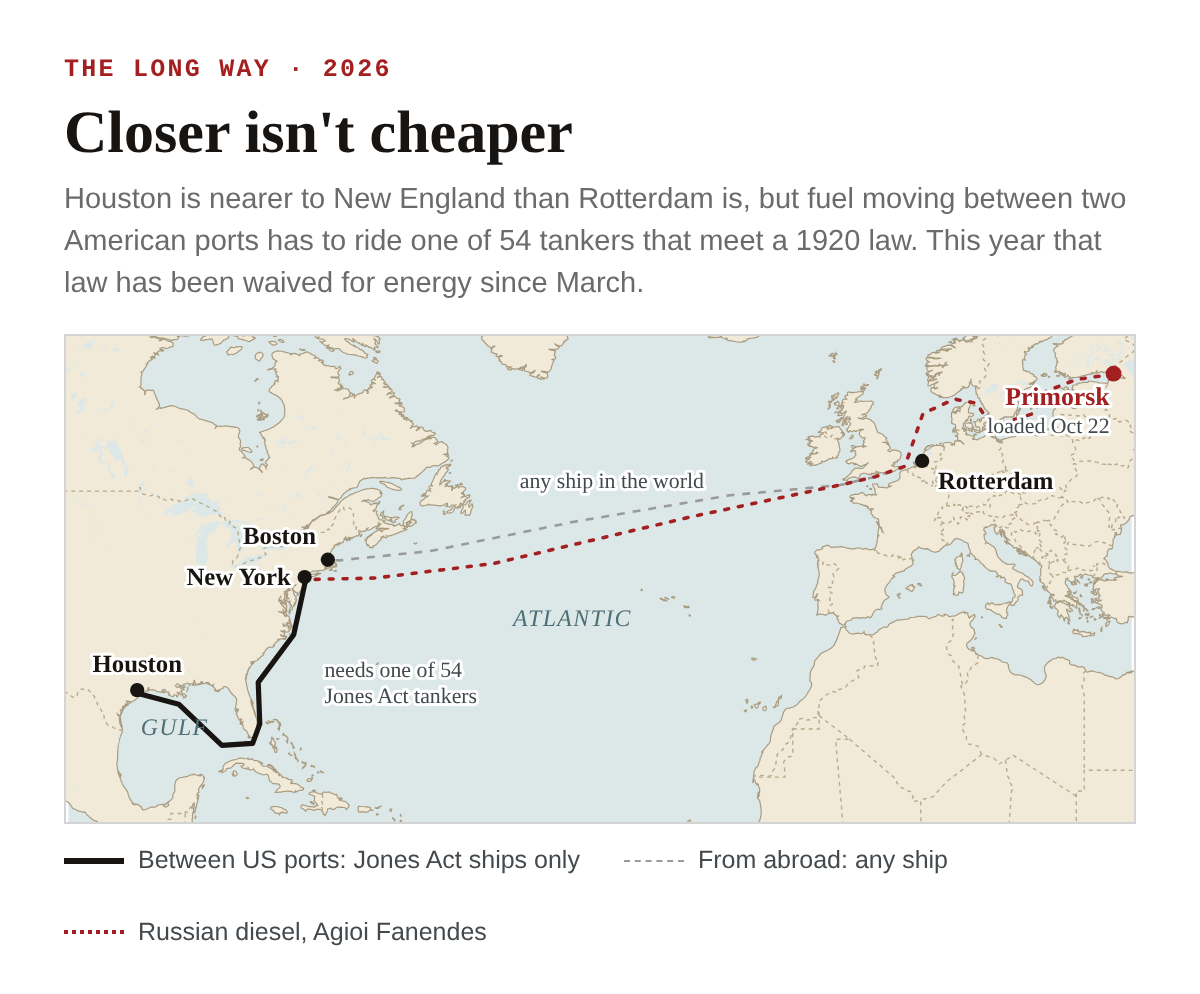
In 1920 Wesley Jones was Washington State’s senior senator and chairman of the Senate Commerce Committee, and he had a Canada problem. Seattle’s steamship lines ran the trade between the lower 48 and Alaska, which was a territory then, not a state, and had no vote in Congress. Those lines were losing business to a cheaper route: freight shipped by Canadian railroad to a Canadian port, then up the coast to Alaska on a foreign ship. Section 27 of Jones’s Merchant Marine Act of 1920, known ever since as the Jones Act, closed that door. From then on, anything carried by water between two American ports had to travel on a ship built in the United States, owned by Americans, flagged in the United States and crewed by Americans. Then came an exception, the third proviso in that section, which left the Canadian rail route open for the rest of the country but explicitly not for Alaska. Alaska’s one representative in Washington DC, George Grigsby, who wasn’t allowed to vote, said it plainly at the time: Seattle “does not want that Canadian competition, of course.”
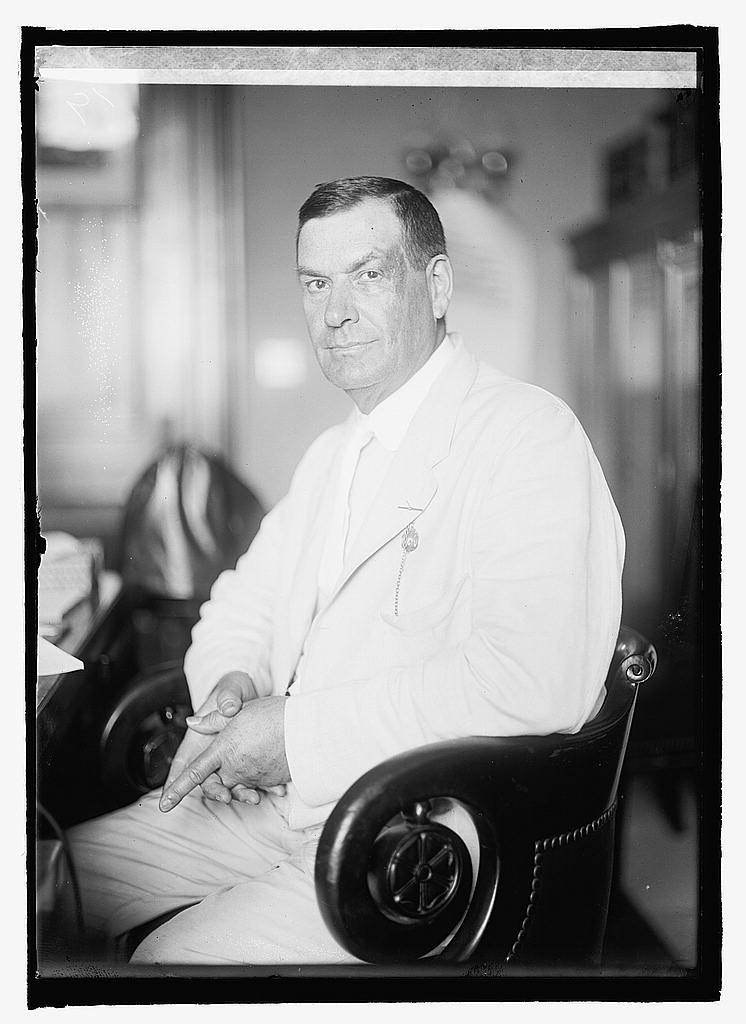
Alaska sued. A Juneau hardware store had bought goods in Michigan and shipped them home through Canada, and federal customs tried to seize them. Alaska’s attorney general took the case to the Supreme Court, arguing the Constitution forbids Congress from favoring one state’s ports over another’s. In February 1922 the Court ruled against Alaska unanimously, on the grounds that a territory isn’t a state. The exclusion lasted until Alaska became one in 1958.
The law outlived its reason and grew into something much bigger. Building a tanker in an American shipyard costs about $220M; building the same ship in Korea or Japan costs about $50M. So almost nobody builds them here. Of roughly 7,500 oil tankers in the world, 54 can legally carry fuel between American ports, according to the Cato Institute, and not one has been built since 2017. Every one of them is booked. The result is a map that makes no sense until you know the rule. Gasoline from the Gulf Coast has been shipped on foreign tankers to the Bahamas and from there to California, because a foreign ship isn’t allowed to carry it straight there. Fuel can be cheaper to bring to Boston from Rotterdam than from Houston, even though Houston is closer. In January 2018, during a deep freeze, Boston took a tanker of liquefied natural gas that reportedly included Russian gas from the Arctic, while the United States was on its way to becoming the world’s biggest gas exporter, because none of the roughly 500 LNG tankers on earth qualifies under the Jones Act.
The law’s defenders aren’t wrong about everything. The 1920 preamble was about national defense, about the country being able to build and crew its own ships in a war instead of renting them from someone else, and the law protects shipyards and maritime jobs that would otherwise be gone. The argument against it is what that protection now costs: a fleet so small that the Pentagon’s own shipping command says it needs 86 tankers built to carry refined fuel like diesel that it could count on in a war, and the Jones Act fleet has only 43.
This year the country got to see what happens when the law is switched off. On March 17, 2026, with the war driving fuel prices up, the government waived the Jones Act for energy shipments, the longest and broadest waiver since at least 1950. Foreign tankers have since moved at least 67.7 million barrels of American crude, gasoline and other fuel between American ports that the Jones Act fleet couldn’t have carried. The waiver has been extended twice. It runs out on Nov 15.
So two dates sit next to each other on the calendar. On Nov 7 a tanker of Russian diesel arrives in New York, bought from a country Washington DC has spent four years sanctioning. Eight days later, unless it’s extended again, a 1920 law aimed at keeping Canadian railroads out of Alaska goes back to requiring that a Texas refinery’s diesel bound for New York ride on one of just 54 ships. A senator from Yakima was trying to protect Seattle’s grip on the Alaska trade. A century later, his law is still quietly helping decide where the whole country’s fuel comes from.
Sources (9), on the site.
The Contract of the Century
October 22, 2026 · Day 237 · 900 words
The Contract of the Century
The Contract of the Century, read aloud · 6 minutes.
Israel has almost no oil of its own, and nearly half of the crude it buys from abroad reaches it through Türkiye. That’s the same Türkiye whose president, Recep Tayyip Erdoğan, calls Israel’s war in Gaza a genocide, and whose government says it hasn’t traded a single thing with Israel since June 2024. Both of those are true at the same time, and how they can both be true is a far better story than the plain hypocrisy most people would assume.
The oil itself comes from Azerbaijan, a small former Soviet country on the Caspian Sea, just north of Iran. It travels by pipeline west across the neighboring country of Georgia and then all the way across Türkiye to a Turkish port on the Mediterranean called Ceyhan, where it’s loaded onto tankers. From there it’s a short trip to Israel, and some of the tankers make it in a way that’s hard to miss once you know to look. Researchers following one of them, the Kimolos, found it would leave Ceyhan listing Egypt as its destination, switch off the tracking signal every large ship is supposed to broadcast, and disappear for a few days. It never showed up in Egypt. Satellite pictures caught it unloading at Ashkelon, on Israel’s southern coast a few miles up the beach from Gaza, ten times in a single year, and on Jan 4, 2026 it was there again.
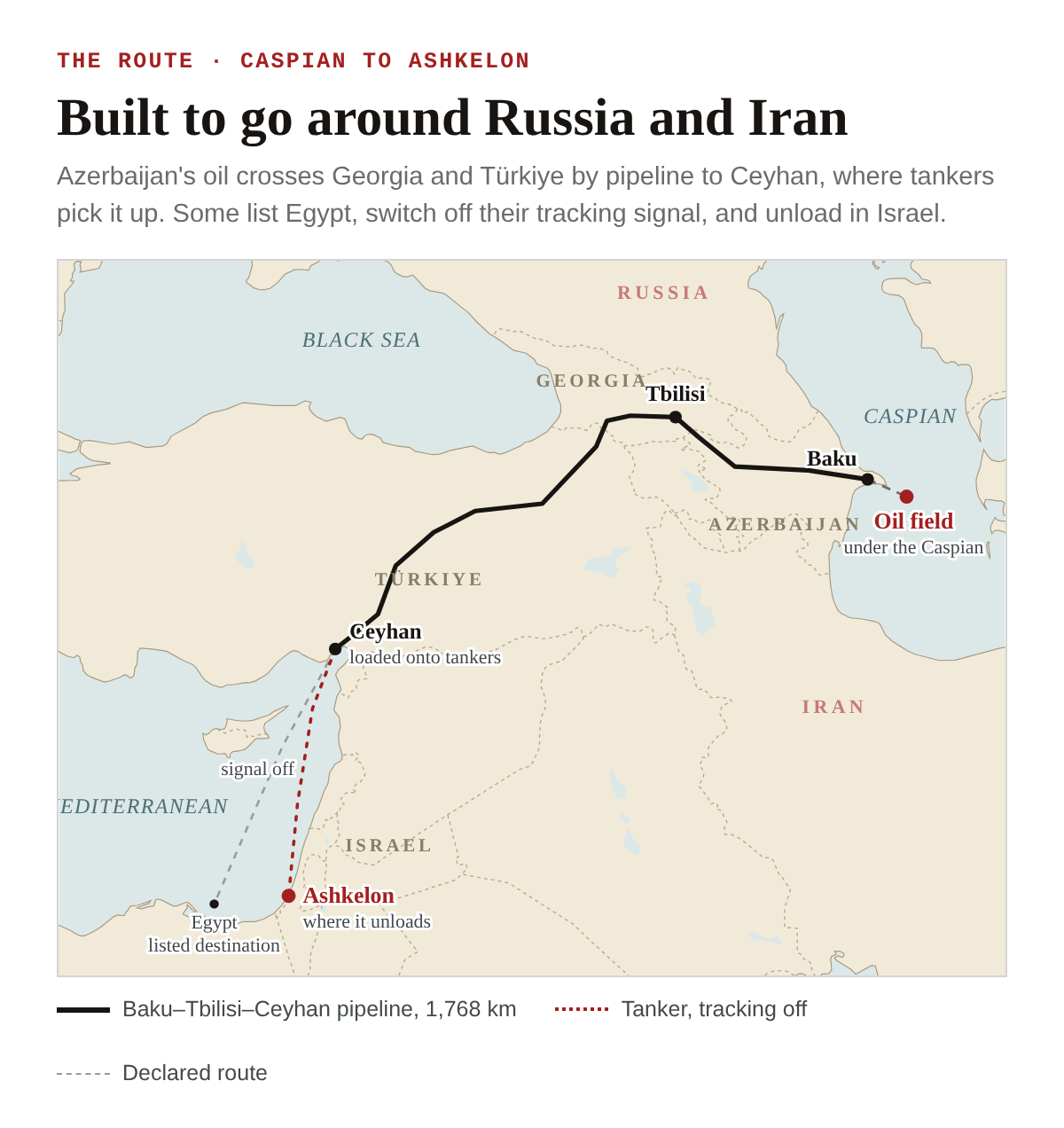
To see how that works, you have to start where the oil does, about 100 kilometers, or 60 miles, off the coast of Baku, Azerbaijan’s capital, where the oil sits a mile or two beneath the Caspian. In 1994 Azerbaijan was three years out of the Soviet Union, broke, and fresh off losing a war with Armenia. Its president, Heydar Aliyev, was a former KGB general who’d once sat on the Soviet Politburo, and he did something no one expected from a man with that résumé: his government signed what Azerbaijanis still call the Contract of the Century, handing the development of that offshore field to a group of Western oil companies led by BP. He was buying himself Western friends with the one thing he had.
The oil was only worth something if it could get out, and the Caspian is landlocked. The obvious routes ran north through Russia or south through Iran, and Washington DC didn’t want either one holding the valve on a new source of the world’s oil. So the Clinton administration pushed for a pipeline that went the long way around, west through the mountains of Georgia and then across Türkiye to the Mediterranean. Bill Clinton was in the room in Istanbul in November 1999 when Azerbaijan, Georgia and Türkiye signed the deal. The Baku-Tbilisi-Ceyhan pipeline runs 1,768 kilometers, about 1,100 miles, and it was built to do one thing: get Caspian oil to the world without passing through Russia or Iran. Türkiye was chosen because it was the only country that could make that possible.
That history is why Türkiye’s “zero” trade with Israel is technically accurate. Under the 1999 deal, Türkiye agreed to let the oil pass and not interfere with it. The pipeline belongs to the consortium, mostly BP and Azerbaijan’s state oil company. When a cargo is loaded at Ceyhan, it’s Azerbaijani oil being sold by its owners to a trader, and Türkiye’s trade ban covers Turkish trade. As one Turkish official put it to Middle East Eye, BP sells to intermediaries Ankara can’t control, and the tankers collect the oil “without declaring their final destination.” Türkiye’s books show nothing going to Israel because, on paper, Türkiye isn’t selling anything. It’s the landlord collecting a transit fee, about $1.27 a barrel, on oil that belongs to somebody else.
Türkiye could still shut the valve, and the reasons it doesn’t are bigger than Erdoğan. It would be breaking a treaty, inviting years of international arbitration, and torching its whole pitch to be the energy crossroads between Asia and Europe, the corridor that never closes. And it would be hurting Azerbaijan, which isn’t just a customer. The two countries speak closely related languages, call themselves “one nation, two states,” and signed a mutual defense pact in 2021. No Turkish government is going to cut off Baku’s best oil buyer to make a point.
Azerbaijan, for its part, has every reason to keep selling. Israel has been one of its main arms suppliers for years, and when Azerbaijan went to war with Armenia over Nagorno-Karabakh in 2020, Israeli-made loitering drones, the kind that circle a battlefield and then dive into a target, were part of how it won. Both countries also share the same worry, which sits on Azerbaijan’s long southern border: Iran. When this year’s war started, an adviser to the commander of Iran’s Revolutionary Guard threatened to strike the pipeline.
So the oil runs from a field signed away by a former KGB general, through a pipe Washington DC designed to keep Russia and Iran out, across a country that officially trades nothing with Israel, onto tankers that go quiet for a few days, and into a port a few miles from Gaza. Nobody in that chain is lying about the paperwork. Türkiye’s numbers really are zero, and the Kimolos really did unload at Ashkelon in January. In a war, the official records tell you who’s allowed to be seen doing business together, and the ships tell you who actually is.
Sources (11), on the site.
Soldier of Fortune
October 21, 2026 · Day 236 · 800 words
Soldier of Fortune
Soldier of Fortune, read aloud · 5 minutes.
I spent my entire young adult life hoping there’d never be a draft. So I’m honestly floored by what’s happening in Ukraine, where thousands of men from countries that aren’t at war have signed up, on purpose, to fight in a place most of them had never set foot in before. No government is drafting them, and some of them crossed an ocean to get there.

Alexander Ante and José Aron Medina are from Popayán, a colonial city in the mountains of southwest Colombia. They signed up to fight for Ukraine, served through 2023 and into 2024, and in July 2024 started home through Venezuela. They were stopped in Caracas still wearing Ukrainian uniforms, and since Venezuela is one of Moscow’s closest friends in the hemisphere, about a month later Russia announced it had them. In November 2025 a Russian-run court in occupied Donetsk gave each of them 13 years. Russia calls them mercenaries, Ukraine calls them volunteers, and from here there’s no way to know which word they’d use themselves.
They’re two of a crowd. By Kyiv’s count, Russia’s Defense Ministry has signed nearly 46,000 foreigners from 151 countries since 2022, from Nepal and Kenya to Peru and Uzbekistan, and North Korea sent whole units on top of that. Ukraine’s International Legion has taken more than 10,000 volunteers from about 75 countries, and unofficial counts of foreigners killed on that side put Americans first, Colombians second and Brazilians third. Some of these men went for the money, some went because they believed in a side, and some were lied to: a Somali man captured by Ukraine told the Kyiv Post he’d signed with Russia expecting a job as a security guard, with “No shooting, no killing.”
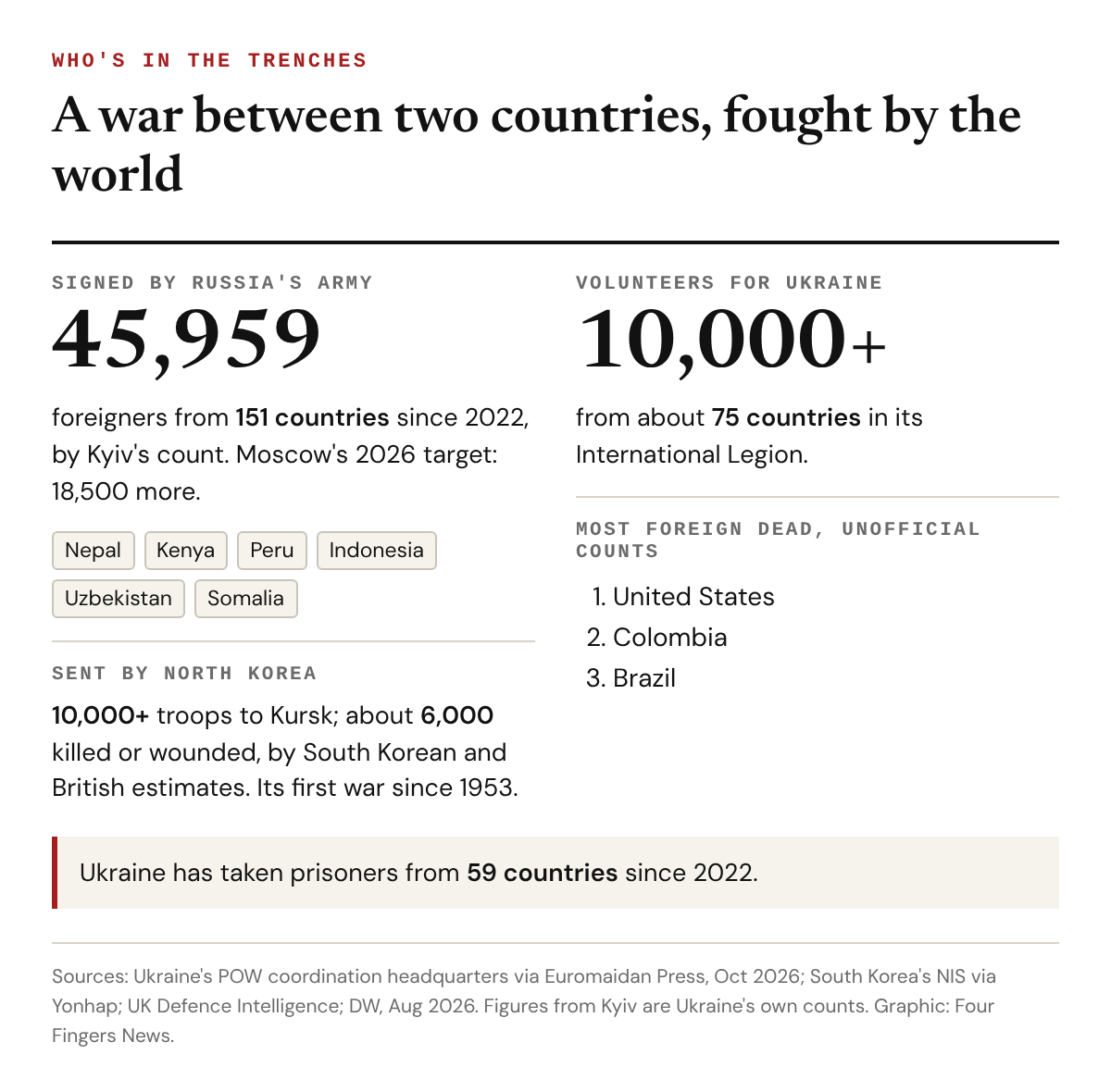
Men fighting other people’s wars for pay is as old as war. What’s new is what they bring home. Ukraine is the biggest drone war ever fought. A drone built from about $400 worth of parts and flown by somebody barely out of high school can destroy a tank that cost millions, and both sides now have so many of them in the air that a soldier near the front lives with the sound of propellers overhead. The tactics change every few weeks, as one side finds a new way to jam the other’s drones and the other finds a way around it, and no army on earth has ever fought like this before, and every one of them wants to know how. Germany and the US have brought Ukrainian veterans in to teach their own soldiers. The Financial Times has reported that Colombian armed groups and criminal organizations want the same skills to use against Colombia’s own army, and the State Department says it’s working with law enforcement to limit the risk of what it calls “battlefield skills transfers.”
North Korea is the plainest case of all. Its army is one of the largest in the world, and until two years ago it hadn’t fought a war since the Korean War ended in 1953. In late 2024 it sent more than 10,000 troops to Russia’s Kursk region, and South Korea’s intelligence service and Britain’s defense intelligence both estimate roughly 6,000 of them were killed or wounded. Seoul’s spies also say that despite those losses, the North Koreans came away with modern combat tactics and battlefield data they couldn’t have gotten anywhere else, and that soldiers who rotated home in December 2025 may be sent back. Ukraine says Pyongyang has now started sending drone operators. A country that hasn’t seen combat in 70 years is putting its army through school, and the tuition is paid in its own soldiers.
Israel figured out the commercial version of this a long time ago. Its arms companies sell their missiles, rockets and air-defense systems as tested and improved in real combat, and buyers pay for it: Israel’s weapons exports hit a record of nearly $15B in 2024, more than double five years earlier. Israel’s Defense Ministry denies using battlefields as testing grounds, but the sales pitch says the rest. The same logic now applies to people. A man who’s survived a year of Ukraine’s drone war has the most valuable military résumé in the world, and plenty of buyers want him, governments and otherwise.
That’s what makes these men so hard to read. Looking at a single prisoner, you can’t tell whether you’re seeing a believer, a paycheck, a duped laborer or a student some government or gang sent to learn, and nothing suggests Ante and Medina were anything but what they said they were. But the war doesn’t care which one a man is. It’s being fought between two countries and taught to the world, and every one of these men who makes it home takes the lesson with him.
Sources (11), on the site.
Out of Stock
October 20, 2026 · Day 235 · 1,310 words
Out of Stock
Out of Stock, read aloud · 8 minutes.
Tonight I was at Target with my daughter, hunting for something orange. Her school does Unity Day tomorrow, the anti-bullying thing where everybody wears orange, and she wanted to know why they’d pick such an odd color. I told her the choice is the whole trick, and that it’s the same trick behind what the news calls a color revolution: you have to pick something that stands out and that nobody wears anyway. You can’t declare the black revolution, because then everyone in black is your ally, including all the people who just own black. We searched the store and found exactly one orange thing, a burnt-orange sweater she loved. The shelf proved the point. The reason there was only one orange sweater in the store is the reason orange works.
The phrase gets thrown around about Ukraine and the Middle East and almost never explained. The history runs 40 years, and once you know it you see it all over this month’s news. Orange is already the color we use when the whole point is to be impossible to miss: hunting vests, traffic cones, life jackets. Nobody owns it, everybody sees it. And in the fall of 2004 a presidential campaign in Ukraine did the same shelf math my daughter’s school did.
That year’s election came down to the government’s man, Viktor Yanukovych, against the challenger Viktor Yushchenko, who spent the campaign’s final weeks with his face scarred from a dioxin poisoning he barely survived. Yushchenko’s campaign needed a color. Blue and white belonged to the government’s campaign, red belonged to the Communists, and yellow and blue together are the national flag, which is everyone’s and so no one’s. What was left was orange, and it glowed against a gray Kyiv November. When the runoff count came in rigged in Yanukovych’s favor, hundreds of thousands of people stood in Independence Square in orange scarves and orange ribbons through freezing weeks, until the Supreme Court threw the result out and ordered a revote, which Yushchenko won. The world named it the Orange Revolution.
Ukraine didn’t invent it. The modern original is the Philippines, which by 1983 had spent two decades under Ferdinand Marcos, much of it under martial law. The regime’s most famous critic, a senator named Ninoy Aquino, had spent seven years in Marcos’s prisons before being released to America for heart surgery, and he’d stayed on in Boston for three years. In August 1983 he boarded a flight home to Manila to challenge Marcos anyway, knowing he’d probably be arrested the moment he landed. To welcome him home, his supporters tied yellow ribbons on trees across the city, an idea borrowed from a corny 1970s pop song in which a man coming home from prison asks for a yellow ribbon around the old oak tree if he’s still loved. Aquino never saw one, because government soldiers shot him dead on the tarmac before he reached the bottom of the aircraft stairs. The ribbons stayed up, and wearing yellow quietly became the way ordinary Filipinos said they were done with Marcos. Three years later Marcos stole an election from Aquino’s widow, Corazon, and two million people in yellow filled the main highway through Manila, a road called EDSA. Nuns knelt in front of the tanks, and the soldiers wouldn’t fire. Marcos had been Washington DC’s ally for 20 years, host to America’s two biggest overseas military bases, but a client who steals an election in front of two million people stops being worth the trouble. On the fourth day the White House told him to go, and the helicopter that flew him out was American. Yellow had become a language.
The lesson traveled with teachers. In 2000 it reached Serbia, the largest piece of broken-up Yugoslavia in Europe’s southeast, where Slobodan Milošević had spent the 1990s dragging the Balkans through wars and had just lost an election he refused to concede. The students who’d been organizing against him for two years called themselves Otpor, which means resistance, and their symbol was a clenched fist, a mocking steal of the old communist salute, stenciled on walls all over the country. When he tried to hang on, hundreds of thousands of Serbs poured into Belgrade, a construction digger rammed the doors of state television, which is why Serbs call it the Bulldozer Revolution, the police decided not to fight the crowd, and within a day he conceded. Then the graduates went into business. Otpor’s veterans started teaching what they’d learned, drawing on the handbook of Gene Sharp, an American academic whose core idea is that a regime runs on obedience, and obedience is something people can stop giving. They trained the students of Georgia, the country on Russia’s southern border, not the American state, who marched into parliament carrying roses in 2003 until their president, Eduard Shevardnadze, once the Soviet Union’s foreign minister, resigned. And they spent months advising the Ukrainian youth movement before the orange winter of 2004. After that came tulips in Kyrgyzstan in Central Asia, a cedar tree in Lebanon, green in Iran in 2009, yellow umbrellas in Hong Kong, and the old white-red-white flag in Belarus, Russia’s neighbor.
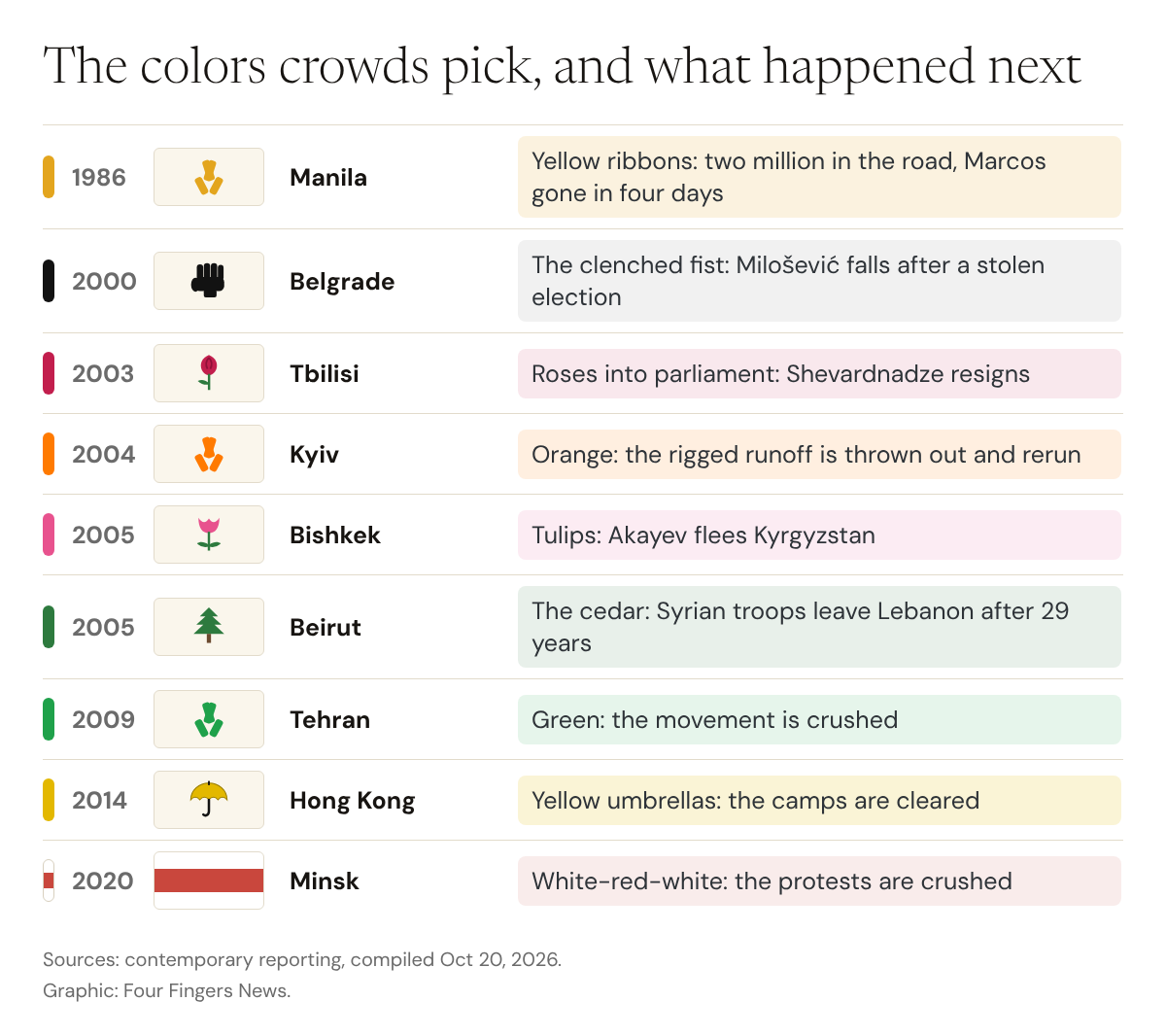
The technology underneath is always the same, and it’s the shelf at Target. A government can ban a rally, arrest a leader and shut a newspaper, but it can’t ban a color. A color has no membership list and no headquarters. What it does is let a frightened majority count itself: you wear a ribbon to the market and discover the butcher wears one too, and so does the woman at the bank, and suddenly everyone knows what until that morning each person only privately suspected. The cost is low enough that millions dare, and the signal is loud enough that the millions see each other. The one requirement is scarcity. It has to be a color nobody wears by accident, which is why it’s never black and never blue, and why the store shelf is nearly empty where it lives.
Say “color revolution” in Moscow, Beijing or Tehran, though, and you’ve said something different: not a people counting itself but a Western technique wearing local clothes. Putin called the protests that swept Iran this past January a “color revolution” scenario run from abroad. Russia’s foreign minister, Sergey Lavrov, said on Friday that “absolutely any country” can fall victim and that Russia has already “obstructed” such attempts among its neighbors. China’s Xi Jinping tells fellow governments the thing must be prevented, the way you’d talk about a disease. And the suspicion isn’t invented from nothing: Otpor took American government money and concealed it, and its trainers really did go from Serbia to Georgia to Ukraine. Both things are true at once. The anger in those squares was real and homegrown, and the technique had teachers, and the teachers had sponsors. Forty years on, the argument between those two truths is still what half the world’s propaganda is about.
A color revolution, the real thing, is the whole package: the stolen election, the weeks in the square, a state deciding whether to shoot. The color trick on its own is the lesser thing, and it escaped into ordinary life long ago: pink ribbons in October for breast cancer, orange at school for the bullied. The technique stopped caring what it’s for. But whether a crowd in one color gets called a movement or an operation has always depended less on the crowd than on which side of the barricade the person naming it stands.
Tomorrow morning my daughter puts on the one orange sweater in the store. She picked it for the same two reasons every crowd in this story picked its color: it stands out, and nobody else is wearing one. From a school hallway to Independence Square, that’s the whole trick. Once you see it, you’ll see it everywhere.
Sources (10), on the site.
Spoken Here
October 19, 2026 · Day 234 · 960 words
Spoken Here
Spoken Here, read aloud · 6 minutes.
France is having its worst riots in years. On Saturday hundreds of thousands of people marched in more than 140 cities against the cost of living and the state of the country’s schools, and in Paris, Lyon and Marseille the marches turned into looting and fires. Almost 1,000 police officers were hurt and about 2,400 people were arrested. The interior minister, Laurent Nuñez, said the police had lost control and offered to resign, and President Emmanuel Macron told him to stay and put an end to the looting instead. In Paris, crowds partly pulled apart the base of the statue of Marianne, the figure that stands for the French Republic itself.

All of it started a month ago at one high school. On Sep 17, 2026, a few teachers at the Lycée Saint-Exupéry in Créteil, a working-class suburb southeast of Paris, went on strike because the school didn’t have enough teachers. The nurse was out and the classrooms were packed, so the students piled bins in front of the gates and joined in. The school got its extra staff and the strike ended, but by then videos of it were all over social media and high schools across the Paris suburbs were blockading their own gates. The universities followed, then the unions, and by Saturday it was the whole country. The last time French students set off something this big was May 1968, which ended with 10 million workers on strike and President Charles de Gaulle secretly flying to the French army in West Germany to make sure it would back him.
The kids in those schools are a big part of this story, and almost nobody outside France knows how they got there. A lot of them are the children and grandchildren of people France brought over from its own empire in North and West Africa, which is why they speak French, why they live where they live, and why their schools are the ones short of teachers.
In Seine-Saint-Denis, the suburbs just north of Paris where some of the first school blockades spread, about 32% of residents are immigrants, against about 10% for France as a whole. More immigrants in France were born in Algeria and Morocco than anywhere else, and almost half were born somewhere in Africa. People argue about why they pick France, welfare and everything else, but the biggest reason is simple: they already speak French. About 396 million people in the world speak French, and 65% of them live in Africa, including more than 15 million in Algeria and nearly 14 million in Morocco. That’s because France ran the schools, courts and government offices of its colonies in French, in Algeria’s case for 132 years. By 2050, nine of every ten French speakers are expected to be African.
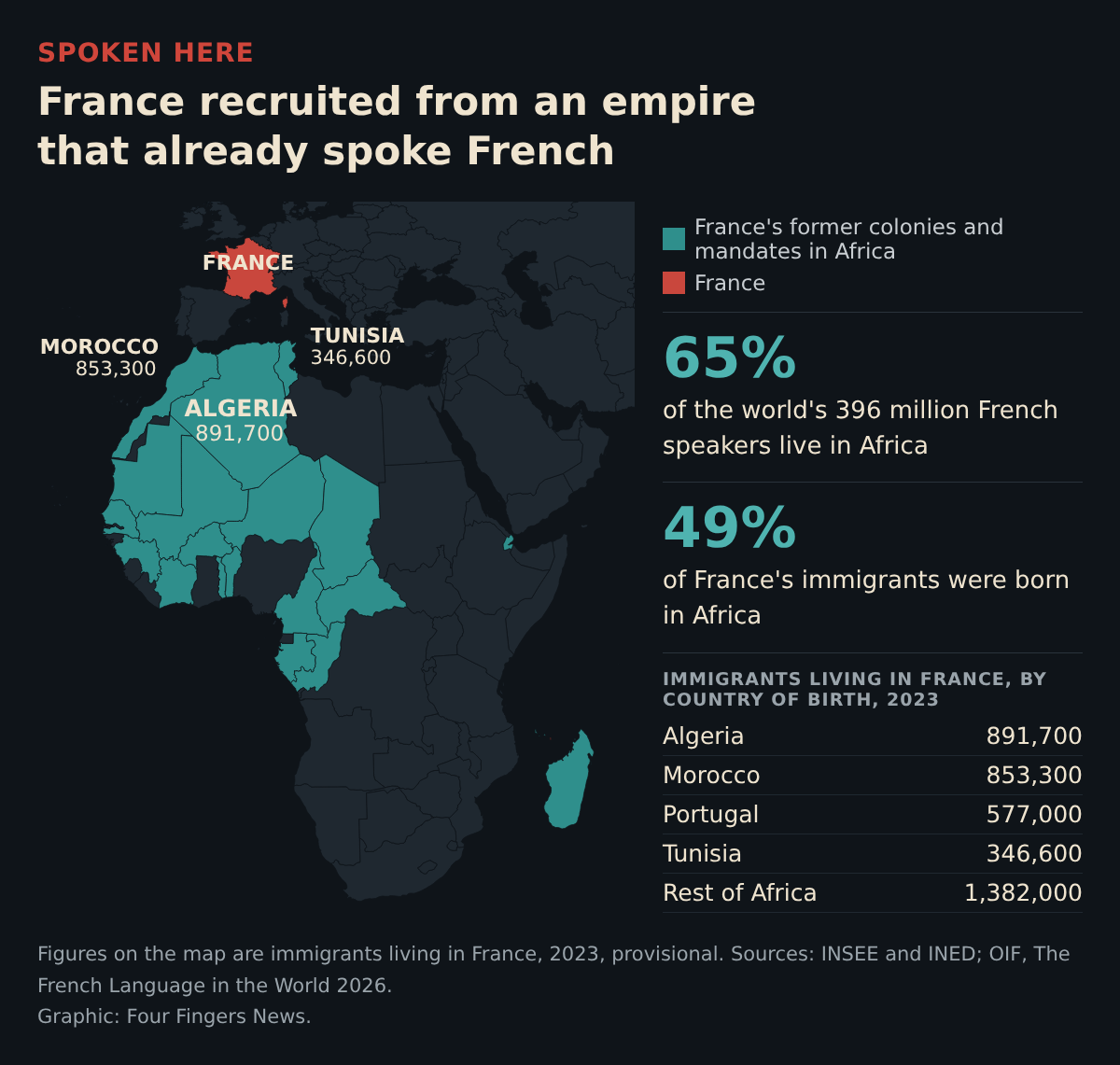
France didn’t just wait for workers to show up, either; it went and recruited them. Algeria was legally part of France until it won its independence in 1962, so Algerians could move to the mainland, and about 350,000 Algerian workers and their families were already living there by 1945. After the war France needed workers to rebuild, so in the 1960s it signed deals to recruit them from Morocco, Tunisia and a newly independent Algeria, as well as from Spain, Portugal, Türkiye and Yugoslavia. The men lived first in shantytowns on the edge of Paris and later in huge public housing towers built on cheap land outside the cities. When the oil shock hit and France stopped recruiting in 1974, about 3.5 million migrants were living in the country, around 7% of the population. Most of those workers stayed and brought their wives and children over, and when the government tried to ban that too, France’s top administrative court struck the ban down in 1978.
Those men are the grandparents of the kids in Créteil. Most of the kids are French, born in France, and a lot of them grew up in the same towers their grandfathers helped build. A third of France’s population is an immigrant or has an immigrant parent or grandparent, according to the country’s national statistics agency.
That relationship has had uglier moments, and the worst was 65 years ago this past Saturday. On Oct 17, 1961, with Algeria’s war for independence in its seventh year and Algerian fighters killing Paris police officers, about 30,000 Algerians marched into Paris to protest a curfew that applied only to them. The city’s police chief, Maurice Papon, had told his officers they’d be covered for any violence, and they beat and shot the marchers and threw some of them into the Seine. The official toll the next day was three dead; historians now say at least 48 people were killed that night, and many believe it was well over 100. Papon had helped send Jews to the Nazi death camps during the Second World War, and in 1998 he was finally convicted for that, but never for the Seine.
Nobody marching on Saturday was talking about 1961. They want teachers, school buildings that aren’t falling apart and prices people can afford, fuel included. But the schools that are short of teachers are in the towns France built for the people it recruited and then stopped spending on, and it’s no accident that it started in Créteil. Even students at Henri-IV, one of the most elite high schools in Paris, have been careful to say they’re marching in solidarity with schools that have less.
The kids in those classrooms aren’t arriving from anywhere; they’re French, and they speak French because France taught it to their grandparents in their own countries first. The empire didn’t so much end in 1962 as move into the towers at the edge of Paris, and its grandchildren are the ones still waiting on a teacher.
Sources (19), on the site.
Who Holds the Switch
October 18, 2026 · Day 233 · 1,410 words
Who Holds the Switch
Who Holds the Switch, read aloud · 9 minutes.
Day 233. Around 1 a.m. on Oct 14, with Russian missiles and drones in the air over Ukraine, the satellite links Ukraine’s military uses to fly its drones started cutting out for anything moving faster than about 100 miles an hour. The system is Starshield, the military version of Starlink, and the cap landed hardest on the interceptor drones Ukraine sends up after Russia’s jet-powered Shaheds. Zelensky said those Shaheds come in at more than 400 km/h, about 250 miles an hour, while some of the drones chasing them had been slowed to as little as 70 km/h, about 43. Service came back in stages over the next few days, and Ukraine’s government says it still isn’t where it was.
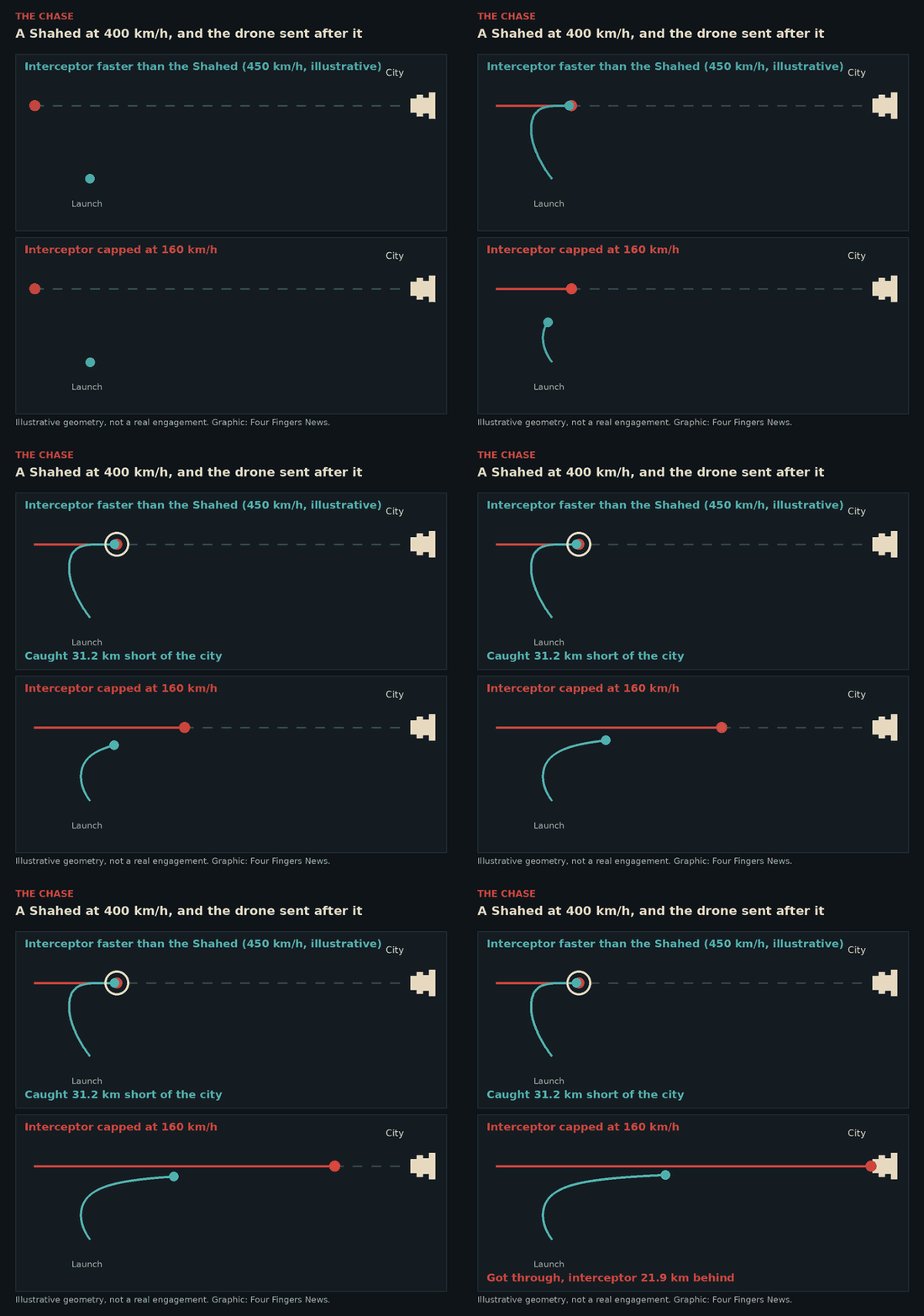
SpaceX builds and runs the network, but it belongs to the United States, and the company’s owner, Elon Musk, says Starshield is “owned and controlled by the US government” and that limits on its use are set by the US military. Reuters reported on Oct 15, citing two US officials and a Western official, that the instruction to slow the service for Ukraine came from inside the White House. The US government’s official position, as the Secretary of State put it on Saturday, is that nobody ordered it and that it “sort of happened.”
The switch sits there because of what happened in September 2022, when Ukraine asked for Starlink coverage near Crimea for an attack on Russia’s Black Sea Fleet and Musk, who was then providing the service for free, refused. The Pentagon’s answer was to put the service under contract, and in 2024 it paid to bring the number of Ukrainian terminals on Starshield to about 3,000, so that no private citizen could make that call again. It worked, in the sense that the decision no longer belongs to a businessman. It belongs to a state, and a state has interests of its own.
This week those interests and Ukraine’s pulled in different directions over one thing, Russian oil. The United States is fighting a war with Iran that’s cut shipping through the Strait of Hormuz to roughly a third of its prewar level, diesel set a record in September, and the country’s Strategic Petroleum Reserve is at its lowest since 1982. Every Russian refinery Ukraine sets on fire takes more fuel off a market that’s already short. So on Oct 11 the United States announced an energy ceasefire between Russia and Ukraine, though neither government had been told, and the next day US intelligence officials warned Ukraine’s embassy that all intelligence sharing would stop if Ukraine hit Russian energy sites again. On Friday the United States suspended the new sanctions and tariffs it had written into law in September, two days before they’d have taken effect, and Russia’s envoy for economic matters, Kirill Dmitriev, called it “an important and truly historic moment.”
Ukraine’s interests run the other way, and they’re just as plain. The refineries pay for the missiles hitting Ukraine’s power plants, and striking them is the one form of pressure on Russia that Ukraine can apply with its own hands, without asking anyone. Zelensky counted 76 Russian strikes on Ukraine’s energy system in the week of the ceasefire, and last night Ukrainian drones set St. Petersburg’s oil terminal on fire. Russia, which wasn’t asked to give anything up, ended the week with the new sanctions suspended and its enemy’s drones slowed.
Russia’s interests are the oldest of the three, and its government has stated them for nearly two decades. In February 2008 the US ambassador in Moscow, Bill Burns, wrote to the Secretary of State, Condoleezza Rice, that Ukraine in NATO was the brightest of all red lines for Russia’s elite, not just for Putin, and Russia has gone to war over Ukraine twice since. Its government treats a Western-aligned Ukraine on its border the way the United States treated Soviet missiles in Cuba in 1962, as a question of survival, and the four regions, the land bridge to Crimea and now a security zone along the border are how it intends to settle that question on the ground.
The thing none of them will settle is what the end of this war is supposed to look like. Ukraine’s official answer is its 1991 borders, Crimea included, which would mean taking back territory a nuclear power treats as its own soil, from a country with more than three times Ukraine’s population. Russia’s answer, set out in June 2024 and repeated by the Kremlin as recently as this June, is all four regions it annexed on paper in 2022, including the parts it doesn’t hold, along with a Ukraine that formally gives up on NATO. It hasn’t taken them in more than four years, and that says less about what its army could do than about the price it’s been willing to pay, because what’s left of them includes Zaporizhzhia, Kramatorsk and Sloviansk, and storming cities that size would mean mass death on both sides, so Russia has chosen to grind instead. This week Putin added to it, saying a 660 km “security zone” Russia is carving out of Sumy and Kharkiv, outside those four regions, won’t be up for negotiation, and the Kremlin says its troops already hold about 70% of that line. Russia has never been conquered, and when it’s lost wars before, in Crimea in 1856, against Japan in 1905, at Brest-Litovsk in 1918 and in Afghanistan in 1989, it lost by deciding at home that the war cost more than it was worth. That’s the logic behind Ukraine’s refinery campaign, which aims at exhaustion rather than conquest, and it’s the campaign the United States spent this week slowing down. The United States, which holds more of the levers than either side doing the fighting, hasn’t said what outcome it’s working toward, only which Ukrainian strikes it won’t support.
Realists have a name for this: alliances are instruments, and a patron backs a client’s war exactly as far as it serves the patron. The cleanest case on record is one the United States ran against its closest ally. In July 1956 Egypt’s president, Gamal Abdel Nasser, nationalized the Suez Canal, and that fall Britain, France and Israel secretly agreed to take it back by force. The United States didn’t want to be tied to European empire in the same week it was condemning the Soviet invasion of Hungary, and it worried the Soviets would step in on Egypt’s side, so it wouldn’t back them. As British paratroopers landed at Port Said, money ran from the pound, and the United States refused to support it and made clear Britain’s emergency loan from the International Monetary Fund would wait on a ceasefire. Britain’s reserves fell $279 million in the first few days of November. The Chancellor of the Exchequer, Harold Macmillan, who’d drawn up the plan for retaking the canal by force that August, was among the first in the cabinet to see that Britain couldn’t go on, and the ceasefire took effect at midnight on Nov 6. Britain had the army, the fleet and the will, and it stopped anyway, because the money it needed to keep fighting ran through someone else’s hands.
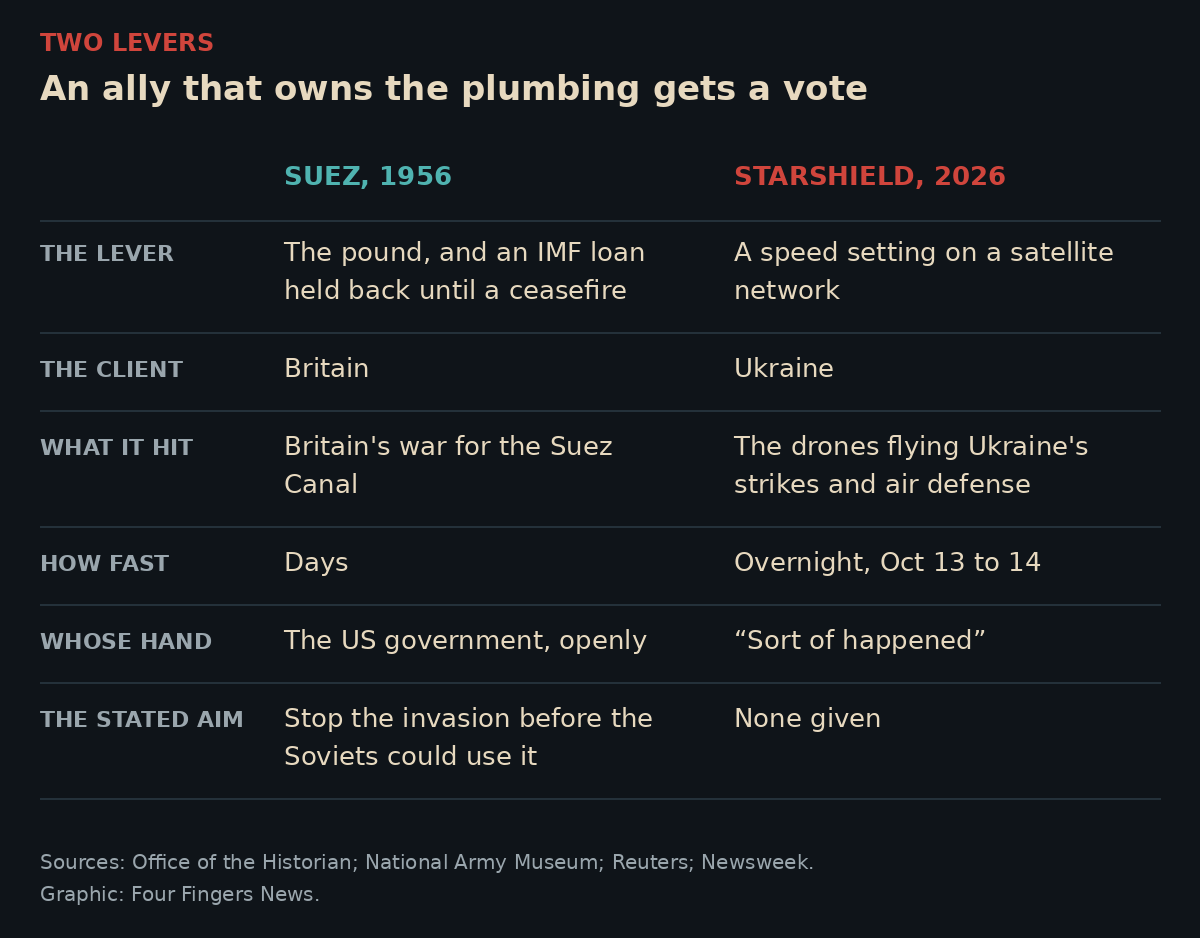
The difference between 1956 and this week isn’t the lever, which works the same way it always has, but the signature and the destination. In 1956 the pressure ran through the Treasury and the IMF’s board over several days, everybody in London knew whose hand was on it, and the United States said plainly what it wanted, which was the invasion stopped before the Soviets could make use of it. This week’s lever was a speed setting on a satellite network, changed in the middle of a Russian barrage, and the government that owns the network says no one changed it and hasn’t said where it’s steering. It can afford not to say, because it’s the only country at this table that can’t lose anything it can’t live without. Two oceans and the world’s reserve currency make every war the United States joins optional, which is how it left Saigon from a rooftop in 1975 and Kabul from an airport in 2021 and went home both times. Russia and Ukraine have no home to go back to if they lose this one. Two countries are fighting what each believes is a war for its survival, and the switch on that war sits with a third whose stake in it is the price of diesel.
Sources (24), on the site.
The Dinner Party
October 17, 2026 · Day 232 · 540 words
The Dinner Party
The Dinner Party, read aloud · 4 minutes.
The story goes like this. One evening in January 1857, a French warship arrived at Aden, the British port at the southern tip of Arabia. The British governor, a brigadier named William Coghlan, invited the captain and his officers to dinner. He had a hunch about why they’d come. For months there’d been talk that France wanted Perim, a little volcanic island about 100 miles west of Aden, sitting right in the strait at the mouth of the Red Sea. So Coghlan kept the wine coming. Sometime after the plates were cleared, one of the Frenchmen, a few glasses past careful, let it slip that they were sailing in the morning to plant the French flag on Perim. Coghlan excused himself from the table and gave the order. While his guests kept drinking, a boatload of British soldiers left the harbor in the dark. When the French ship reached Perim the next day, the soldiers were already on the beach, and a British flag was flying over the rock.
People loved it. A British cabinet minister was still telling it that way years later, and by 1901 an American newspaper had added an Irish maid who coaxed the secret out of a French sailor.
Two empires were racing each other to a rock about 3.5 miles long, with no fresh water and no real harbor, because of what everyone could see coming. The French were already planning a canal at Suez, at the Red Sea’s northern end, to connect it to the Mediterranean. If the canal got built, the strait at the southern end, Bab el-Mandeb, between Yemen and the Horn of Africa, would become one of the most important stretches of water on earth, and Perim sits in the middle of it. The canal opened in 1869. For nearly a century afterward, every ship traveling between Europe and Asia sailed past a British flag on the island France lost at a dinner party.
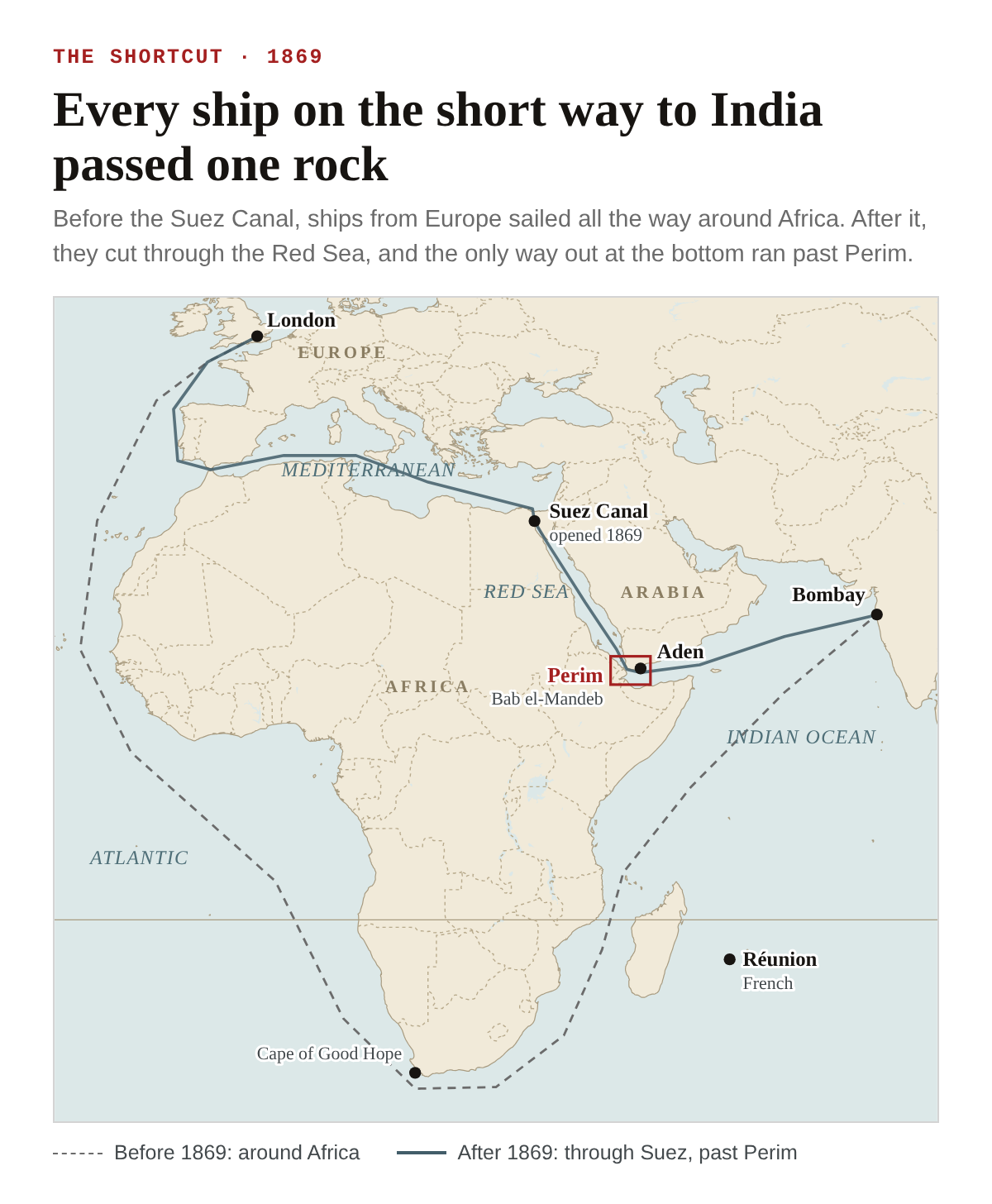
France, shut out, bought a strip of coast across the strait in 1862. That foothold grew into Djibouti, which still hosts French troops today, along with American and Chinese bases. Britain kept Perim until it pulled out of Aden in 1967.
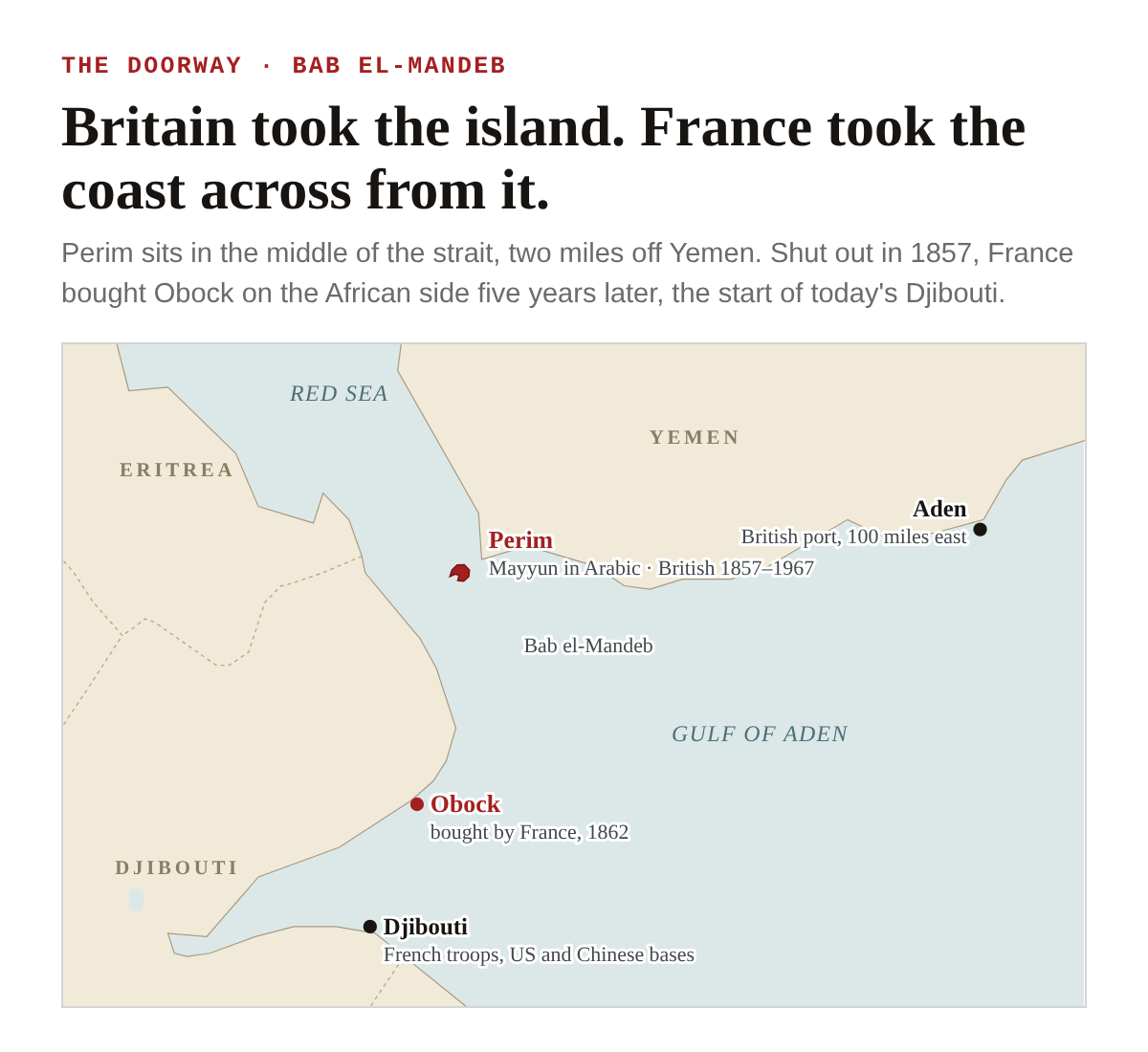
Coghlan spent years insisting it hadn’t happened the way people told it. He said he’d had orders from Bombay to beat the French to Perim long before their ship showed up, and that nobody mentioned the island at dinner. Hardly anyone listened, which tells you which version was more fun to repeat.
The island went quiet after Britain left Aden in 1967. Then in 2021 satellite photos showed trucks building a runway more than a mile long across it, big enough for warplanes. No country admitted building it, and the ships hauling in equipment had switched off the transponders that broadcast their locations. Yemeni officials said the United Arab Emirates was behind it. This year Perim has changed hands twice. Ansarallah, the Iran-aligned movement that governs northern Yemen, took it as part of the Iran war, and on Oct 9 Yemen’s Saudi-backed government said its forces had taken it back. Ansarallah denies that.
Whether or not the dinner happened, the race it stands for has never stopped. The people running it now aren’t waiting for anyone to get drunk.
Sources (10), on the site.
Red Handed
October 16, 2026 · Day 231 · 870 words
Red Handed
Red Handed, read aloud · 6 minutes.
Pull up to the diesel pumps at a farm co-op and you’ll find two kinds of fuel. One’s clear, and it carries 24.4 cents a gallon in federal tax plus whatever your state adds. The other is the exact same fuel with a splash of red dye in it, and it’s tax-free, because it’s meant for tractors, bulldozers and generators that never touch a public road. The dye is the whole difference. It’s the cheapest, dumbest, most effective piece of tax enforcement this country’s ever come up with, and we have the mob to thank for it.
In the early 1980s, a few émigrés from the Soviet Union working the fuel business in New York noticed that the federal fuel tax was collected from wholesalers, and wholesalers could vanish. The trick was called a daisy chain. Fuel got sold on paper from one company to the next, a dozen or more times, until the tax bill landed on a firm that was nothing but a mailing address, a phone line and a front man. That firm, the “burnout company,” sold the fuel to gas stations on invoices stamped all taxes paid, then went bankrupt before anyone came to collect. Next week, a new chain.
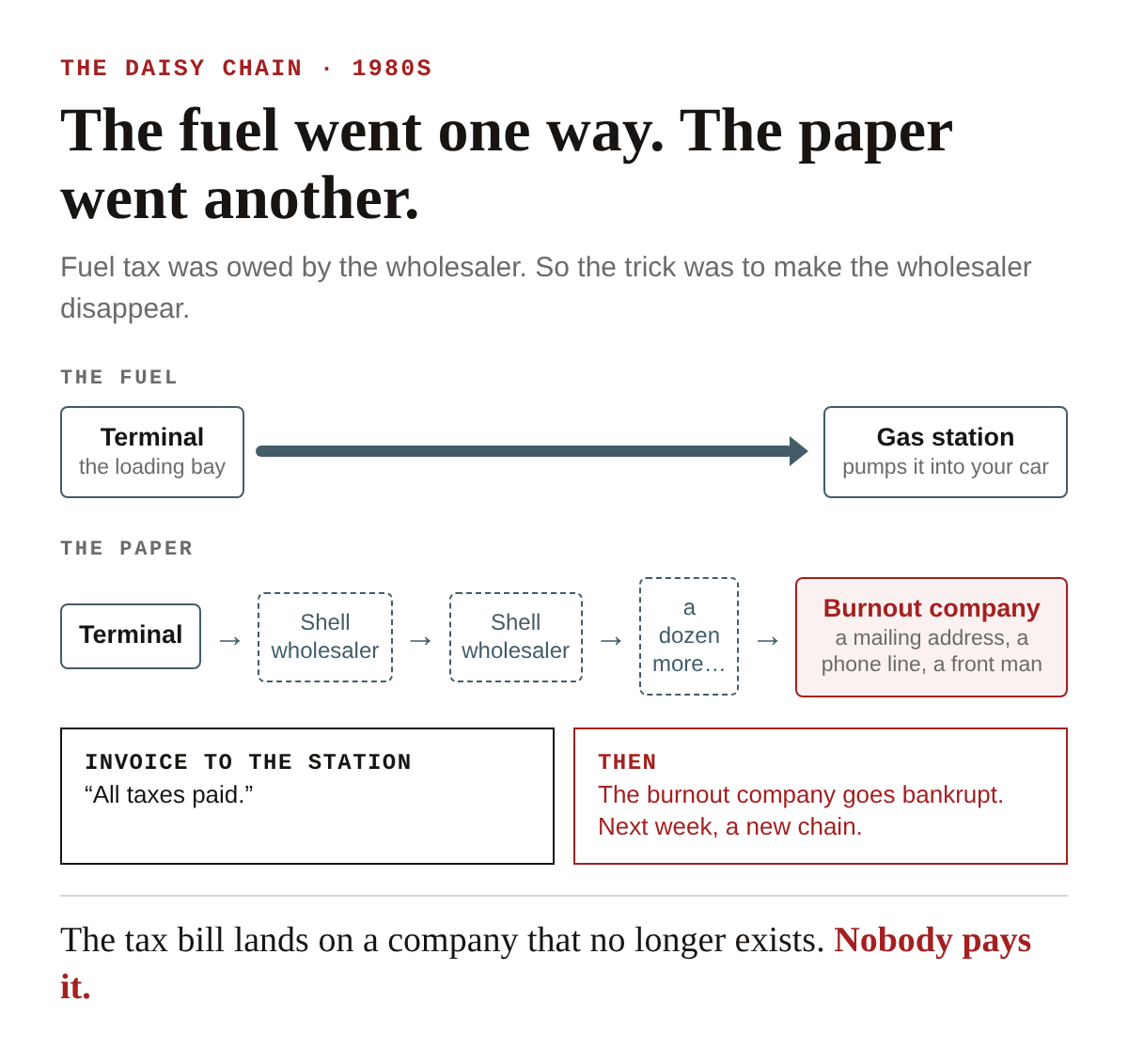
The Italians noticed. Michael Franzese, a captain in the Colombo crime family, got pulled in around 1980 to lean on someone over a $70,000 debt from one of these swindles, and before long he was running chains of his own through shell companies in Panama. An associate testified Franzese was clearing $1 million a week. Fortune put him 18th on its 1986 list of the country’s 50 biggest mob bosses. New York figured it was losing $250 million a year in gas tax to the racket. Years later Franzese summed up his conscience on the matter: “I didn’t have a moral issue with taking tax from the government.”
Congress plugged gasoline in 1986 by moving the tax up to the terminal rack, the loading bay where fuel pours into tanker trucks, which cut down the number of hands the tax passed through. So the crooks switched to diesel. Diesel had a hole gasoline didn’t: a huge share of it is legitimately tax-free. Farms, boats, trains, construction sites. Nobody could tell a gallon headed for a combine from one headed for an 18-wheeler. By the early 1990s the Federal Highway Administration put combined federal and state fuel tax losses near $3 billion a year.
On Jan 1, 1994, the government quit chasing paper and marked the fuel instead. Diesel got taxed at the rack, and any gallon leaving tax-free had to leave red. Diesel tax collections jumped about $1.2 billion that first year, and Treasury figured $600 million to $700 million of it was people simply paying what they owed.
I’ve always had a soft spot for this one. When I was learning the Internal Revenue Code, the most useful trick was to ask two questions of every section: what loophole was somebody abusing that this closes, or what behavior is the government trying to get out of us? Nearly every rule answers one or the other. The dye answers the first, and it’s the only one I know of that’s a color. Enforcement is gloriously low-tech: an IRS compliance officer, or here in Washington State a state trooper, slides a long straw into your fuel tank and looks at what comes up. If it’s pink, the fine is $10 a gallon or $1,000, whichever’s more, and it climbs with every repeat. They’ll check the storage tank you filled from, too. In 2005 the Washington State Patrol dipped more than 25,000 vehicles and caught 95. One street-sweeping company turned out to have bought roughly 98,000 gallons of red since 2003, and the fine was figured at $10 a gallon, plus extra for the storage tank and its fleet of 25 trucks.
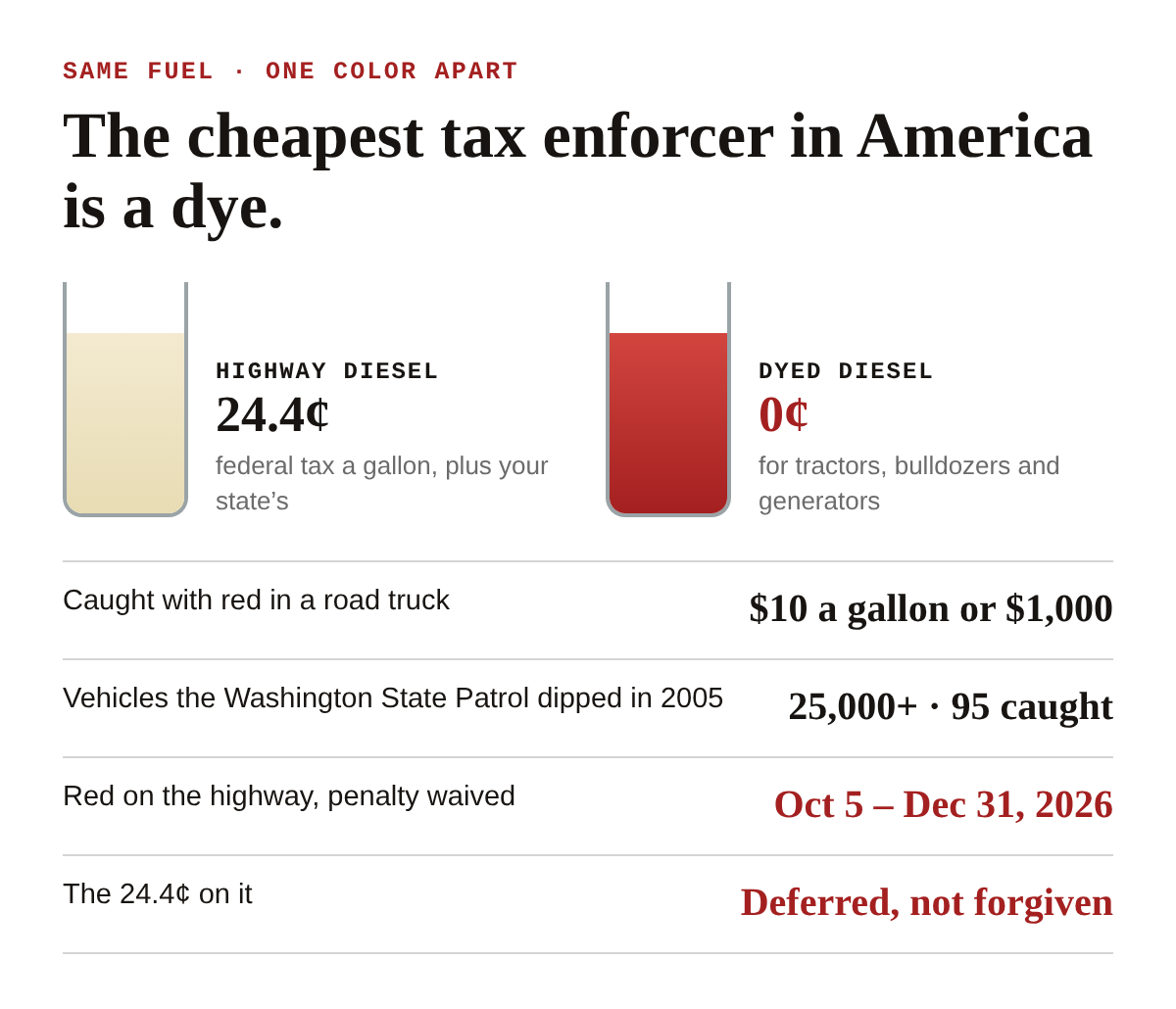
Since Oct 5, 2026, the straw’s been in the trunk. With diesel hitting a record $6.53 a gallon on Sep 22, 2026, against about $3.76 before the war, an executive order out of Washington DC told the IRS to stop penalizing red diesel on the highway through Dec 31 and to hold off collecting the 24.4 cents on it. Ten states, Texas, Oklahoma, North Carolina and Alabama among them, had already waved it through in the days before. California still hasn’t.
Read the fine print, though, because that’s where the tax guy gets interested. The order defers the tax. It doesn’t cancel it; Treasury’s only been told to look into forgiving it. “Deferred” is the most misunderstood word in the tax code, because people hear “free.” A deferred tax is a bill with the date left blank.
For 32 years the dye answered the first question. This fall it’s answering the second: keep the trucks moving. The government built a system on the idea that nobody can be trusted with cheap fuel, and the first time fuel got expensive enough, it trusted everybody for 88 days. On January 1 a lot of tanks out there will still be pink. The fuel won’t change color at midnight. What the color means will. And on January 2, somewhere on I-90, a trooper’s going to get the straw back out.
Sources (12), on the site.
Dark Fiber
October 15, 2026 · Day 230 · 1,330 words
Dark Fiber
Dark Fiber, read aloud · 8 minutes.
In 1996 Congress passed the Telecommunications Act, which broke open the old phone monopolies and let anyone build a network and compete for local, long-distance and internet traffic. A story went around the business that internet traffic was doubling every 100 days. Gary Winnick, whose Global Crossing was worth $47 billion by 1999, two years after he founded it, told it to anyone who’d listen, and the banks listened. A mathematician at AT&T’s own research labs, Andrew Odlyzko, went and measured the traffic and found it was roughly doubling once a year, fast, but nowhere near the story, and nobody wanted his number. In the five years after the Act, hundreds of new carriers and the old ones alike borrowed and spent more than $500 billion, most of it on fiber optic cable, trenched along railroads and highways and laid across the floor of the Atlantic, enough glass to carry every phone call and web page on earth many times over. By 2002 most of that cable had never been switched on. The industry called it dark fiber: glass in the ground that had never carried a single pulse of light.
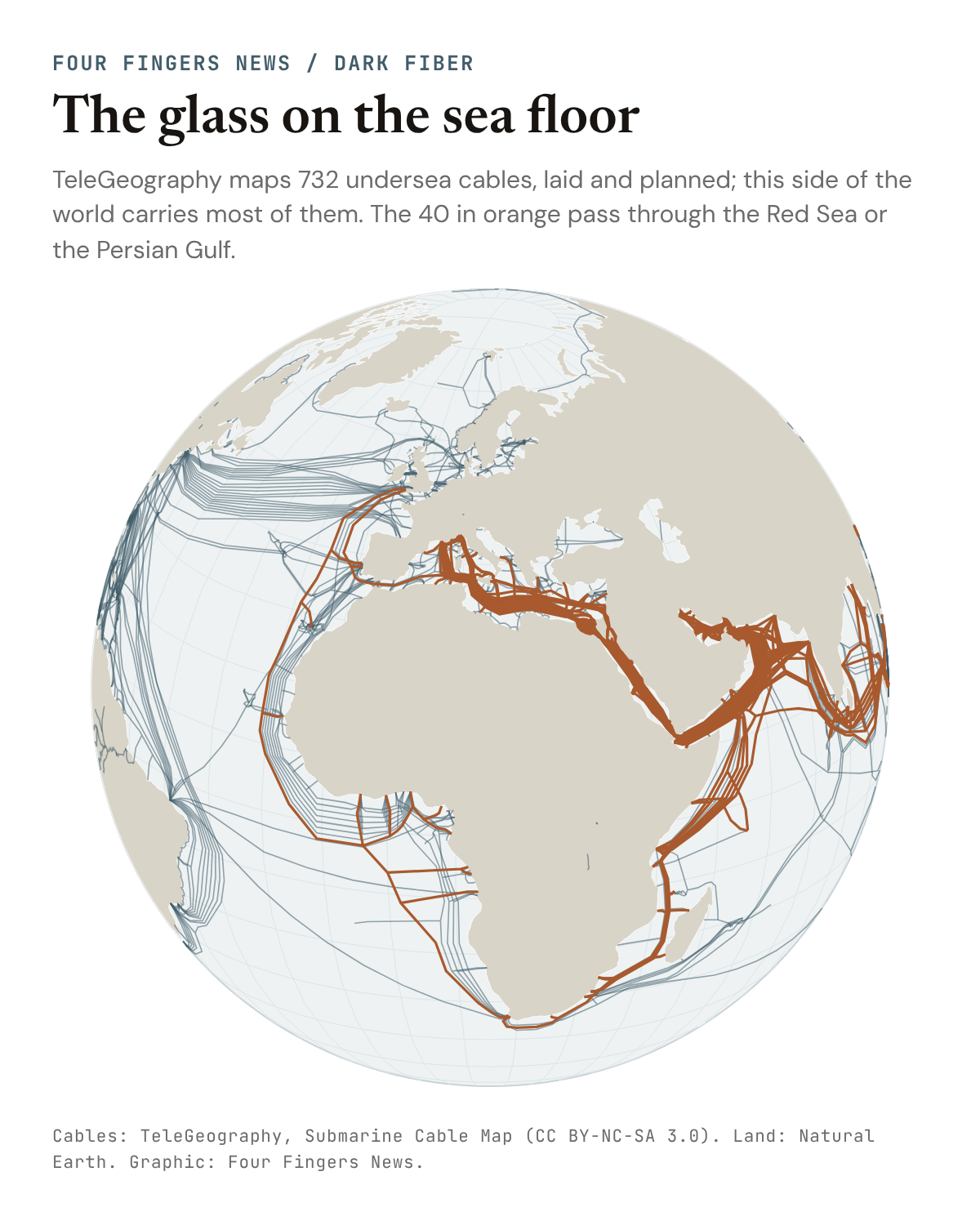
Then the bill came. Everyone had laid cable along the same routes at the same time, so just as the glass lit up, the price of carrying traffic fell through the floor. Global Crossing had never turned a profit; it owed $12.4 billion, about $600 million a year in interest alone, and in its last quarter it lost $3.4 billion on $793 million of sales. It filed for bankruptcy in January 2002, and by then Winnick had sold about $420 million of his own shares, and his fellow executives about $900 million more. WorldCom, which owned the biggest internet backbone in the world, followed in July with $107 billion in assets, at the time the largest bankruptcy in American history, and its chief executive went to prison over an $11 billion accounting fraud that had dressed up the numbers while the traffic didn’t come. More than 60 telecoms failed between 2001 and 2003, the industry owed about a trillion dollars, and the bondholders who’d financed the build got back a little over 20 cents on the dollar. The Nasdaq lost 78 percent of its value from the top. The fiber itself didn’t go anywhere; creditors sold the networks for a fraction of what they cost, the buyers lit them up over the next decade, and that dead glass is what Netflix, YouTube and the cloud ran on when they arrived. The engineers were right about the future, but the people who paid for it weren’t the people who got rich off it.
That’s the shape of every one of these, and it’s old. Britain did it with railways in the 1840s; America did it with canals, then railroads, then radio. The technology is real, the build runs ahead of the money that can pay for it, the builders borrow against a future that does arrive, just later and cheaper than they promised, and the debt lands on whoever’s holding it when the music stops. The infrastructure survives; the balance sheets don’t.
This morning in Seoul the Kospi fell 7.6 percent, its seventh straight loss, hard enough to trip the circuit breakers that halt trading; Samsung lost 9.5 percent and SK hynix 11.1; foreign investors pulled about $2.5 billion out of Korean stocks in a single session, while Tokyo’s Nikkei fell about 5 percent. Those two Korean companies make most of the world’s memory chips, including the high-bandwidth memory every AI data center is stuffed with, so they’re the picks and shovels of this boom the way the fiber makers and Cisco were of the last one. That one started with a change in the law that made everyone sure the market was theirs to win; this one started with a chatbot in November 2022 that did the same. The desks in Seoul pointed at three things: doubts about what all that AI infrastructure will ever earn, the bonds of CoreWeave, which rents out AI computing and now has to pay about 15 percent to borrow, and a 10-year Treasury yield near 5.3 percent. Then September’s wholesale prices came out in the United States, up 6.3 percent on the year, the steepest since 2022.
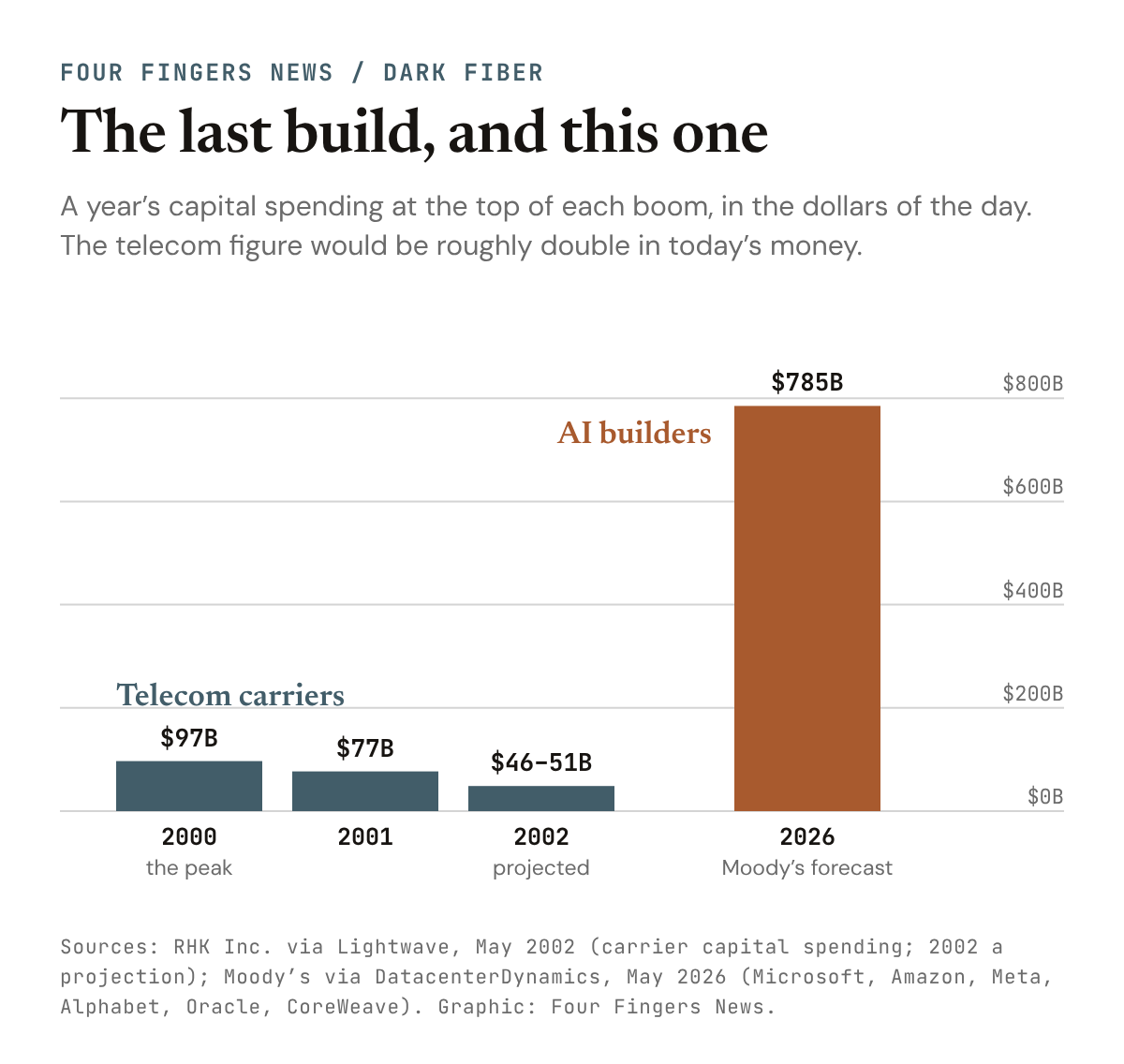
Korea is where it cracked first, and it’s the country most exposed to this year’s two wars while being party to neither. About 70 percent of its crude comes through the Strait of Hormuz, so the Iran war hit its fuel and its currency in March, when the won broke 1,500 to the dollar for the first time since 2009. Its own enemy, North Korea, has spent the Ukraine war sending men and shells to Russia, and the American general who commands US troops in Korea said this week that Pyongyang came out of it knowing how to move an army across a continent and keep it supplied. And in March the Pentagon pulled THAAD interceptors and Patriot launchers off the peninsula for the Gulf; President Lee Jae-myung said Seoul had “voiced an opposing view” but couldn’t “fully have our way.” A country with its oil in one war, its enemy learning from another, and its protector’s missiles packed for the first, put a huge share of its savings into two chip stocks riding a third boom. In 1998, when the Asian crisis broke Korea’s currency, 3.5 million people lined up to hand in their own gold, wedding rings and baby rings, to help pay off the IMF. Korea knows what it costs when the money leaves first.
So where’s the dark fiber this time? The data centers will still be standing in 2035, like the cable. The question is whose money turns out to have paid for them. In 2000 it was junk bonds and stock, owned by people who knew they were gambling, but this build is financed differently. Oracle has signed about $288 billion of data center leases that don’t sit on its balance sheet yet, and its credit rating is one notch above junk. Meta’s Louisiana campus was paid for with about $27 billion of debt, roughly two-thirds of it bought by the bond giant Pimco, through a company set up so the debt wouldn’t sit on Meta’s books either. I was finishing an accounting degree the year Enron and WorldCom went down. Enron, the Houston energy trader, had hidden its debts in companies just like that, and the law Congress wrote in answer, Sarbanes-Oxley, was supposed to make debt like that impossible to hide; I went to work under it. Twenty-four years later the biggest build in history is being financed through companies set up so the debt doesn’t sit on the builder’s books, and it’s all disclosed and all legal. Much of the rest has gone through private credit, the funds that lend outside the banking system, and some of the biggest buyers of private credit are life insurers and pension funds, which means some of it may sit, a long way down the chain, in an ordinary annuity or pension, owned by people who never bought an AI stock.
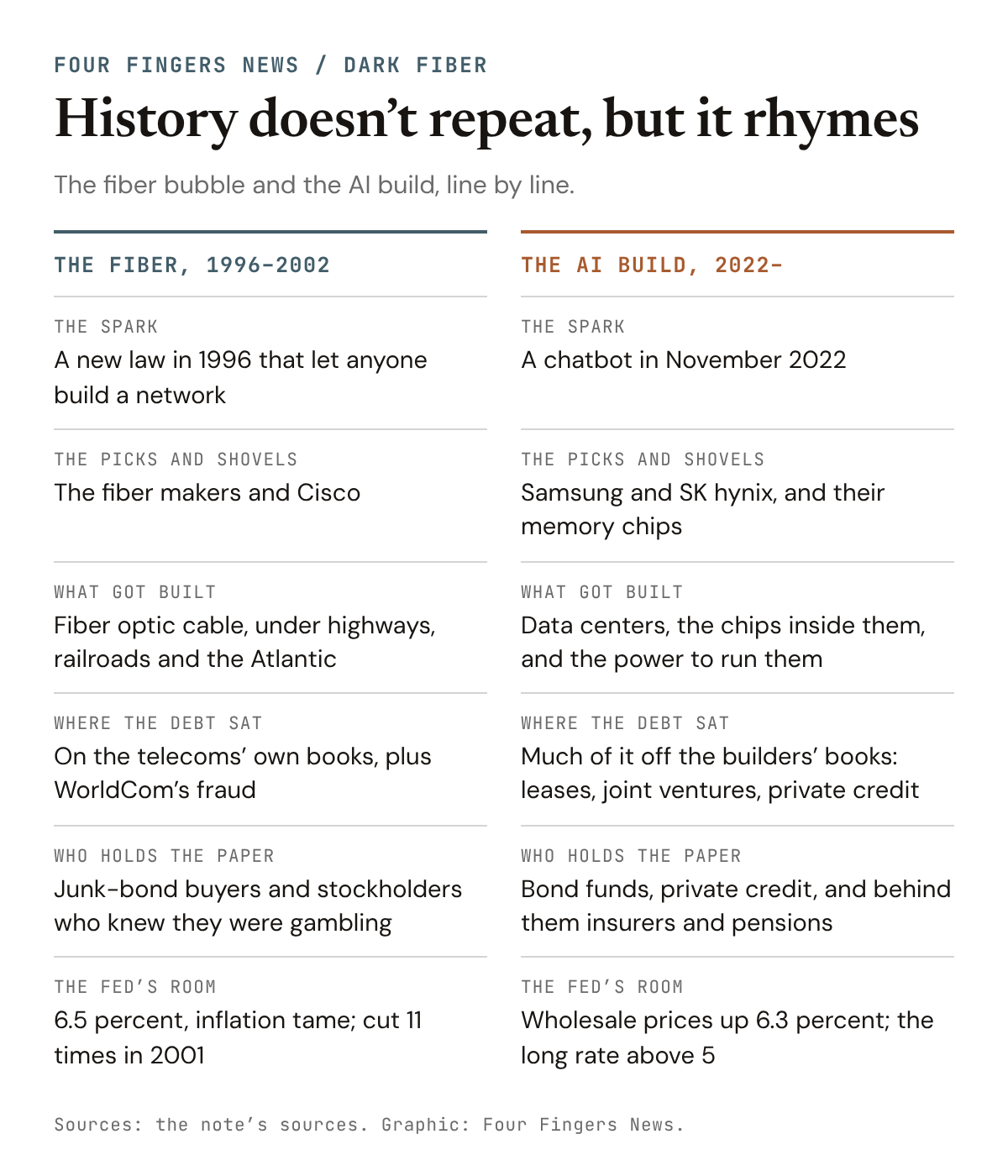
And the catcher looks different this time: when the fiber bubble burst, the Federal Reserve was sitting at 6.5 percent with inflation tame, and it cut 11 times in 2001 to break the fall. Tonight wholesale prices are rising 6 percent a year, the long rate is above 5, there’s a war on with oil above $100, and the Fed can’t cut into that without lighting the inflation it’s supposed to be fighting. One bad day in Seoul isn’t a crash, and nobody knows whether this is the top. But the last time the world built the future on borrowed money, the future showed up right on time and the lenders got 20 cents on the dollar. It’s a fair thing to wonder, before the lights come on in all those buildings, whose dollar it is.
Sources (24), on the site.
Somebody Always Knows
October 14, 2026 · Day 229 · 2,100 words
Somebody Always Knows
Somebody Always Knows, read aloud · 12 minutes.
On Sunday morning, Nov 30, 1941, the Honolulu Advertiser, the morning paper of record in Hawaii since 1856, landed on the porches of Oahu with a banner across the top of the front page: JAPANESE MAY STRIKE OVER WEEKEND. Of the men aboard the USS Arizona that morning, 1,177 had a week to live, and that was the paper on the porch. Here’s the part none of us got in school. Japan bought about 80 percent of its oil from the United States, and on July 26, 1941, the United States froze Japan’s money, and within days the oil stopped, with Britain and the Dutch following. From that day Japan had about 18 months of fuel for its navy and no way to buy more, and everyone in Washington DC who signed the order understood that a country in that position fights or folds, and that Japan wasn’t going to fold. On Nov 26 the Secretary of State, Cordell Hull, handed Japan’s envoys the note that carries his name, which told them to pull every soldier out of China and Indochina; Tojo, Japan’s prime minister, read it as an ultimatum, and so would anyone. The day before, the Secretary of War, Henry Stimson, wrote in his diary that the question was how to “maneuver them into the position of firing the first shot without allowing too much danger to ourselves.” American codebreakers were reading Japan’s diplomatic cables, and they’d read the one that set a deadline of Nov 29 and said that after it “things are automatically going to happen.” On Nov 27 the Navy sent its Pacific commanders a dispatch that opened, “This dispatch is to be considered a war warning,” and named four places Japan would hit, and Pearl Harbor wasn’t one of them. The next Sunday 2,403 Americans were dead, and the Pacific Fleet’s three aircraft carriers were elsewhere, two of them at sea delivering planes to the outposts at Wake and Midway and the third in the shipyard at Bremerton, across the water from Seattle. Congress spent the spring of 1946 on it and found errors of judgment, “interdepartmental misunderstanding,” and no evidence the administration had “tricked, provoked, incited, cajoled, or coerced” Japan into attacking; two senators called that illogical and signed a dissent. Read the sequence again and make up your own mind. The war was chosen in July, written down in November, and printed on Sunday. The only people it surprised were the ones who died in it.
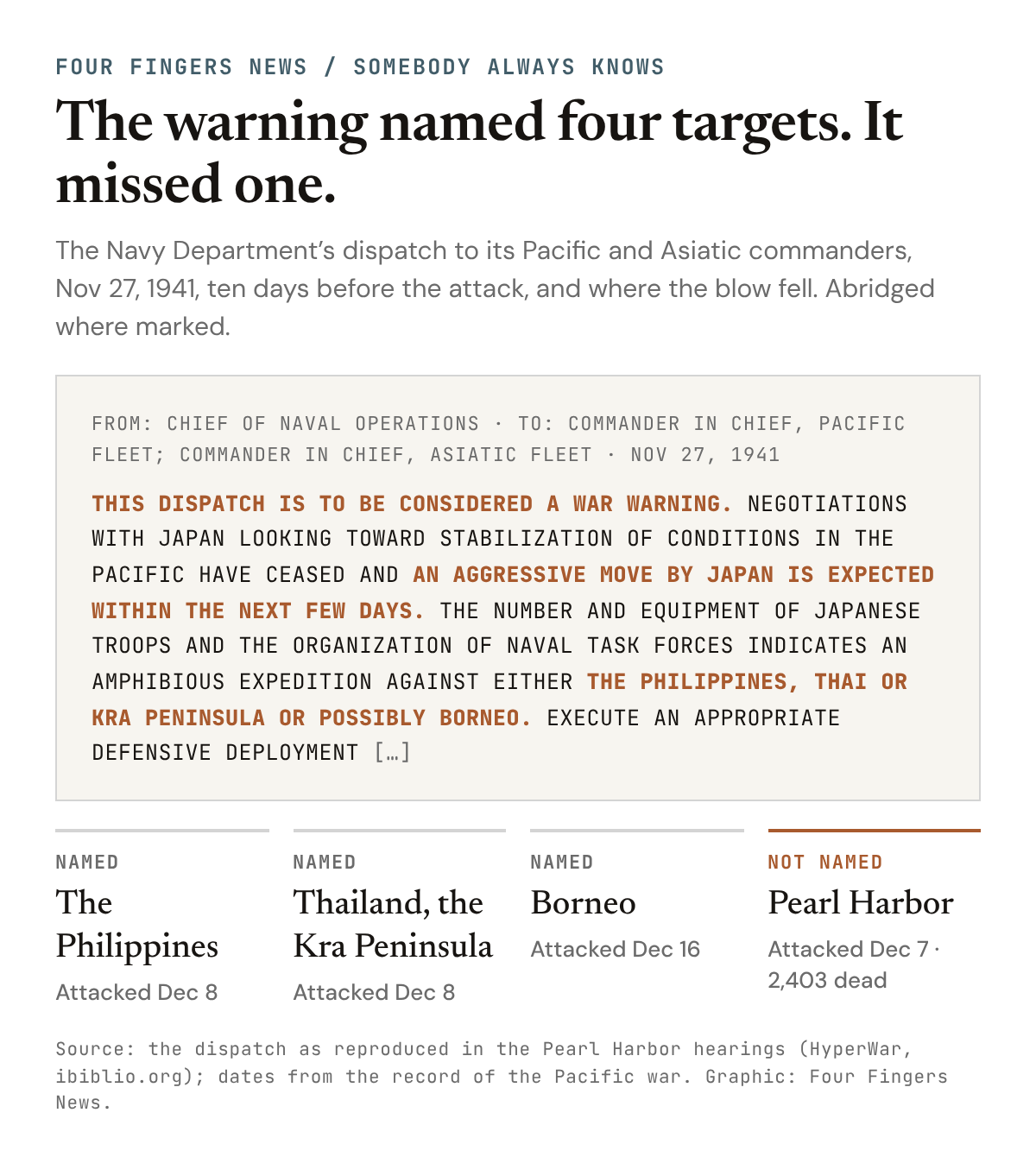
If it’s hard to believe a government would do that on purpose, there’s a document for that. In 1962 the Joint Chiefs of Staff put their names to a plan called Northwoods: stage attacks on Americans, sink a boat, shoot down a plane, blame Cuba, and go to war. It was declassified in 1997 and you can read it. President Kennedy’s administration declined to follow through, which is the only reason it’s a footnote and not a war. Now read the signature at the bottom of that page. Lyman Lemnitzer, the chairman of the Joint Chiefs, put his name to a plan to kill Americans and blame it on Cuba, and nothing happened to him. Nobody was fired, nobody was charged, nobody was asked to explain. Within a year he was Supreme Allied Commander of NATO, in charge of every soldier the West had pointed at Russia, and he held the job for six years. That’s the career of a man who proposed a false flag against his own country, and it tells you exactly how the people in the room think about the people outside it. That’s the whole point of this note, and it’s the thing nobody in charge will ever say out loud: war is a decision, made by a few people, for reasons they know and you don’t, and a decision leaks. It leaks into a newspaper a week early, it leaks into a diary, and it leaks into money, because the people in the room have brokers.
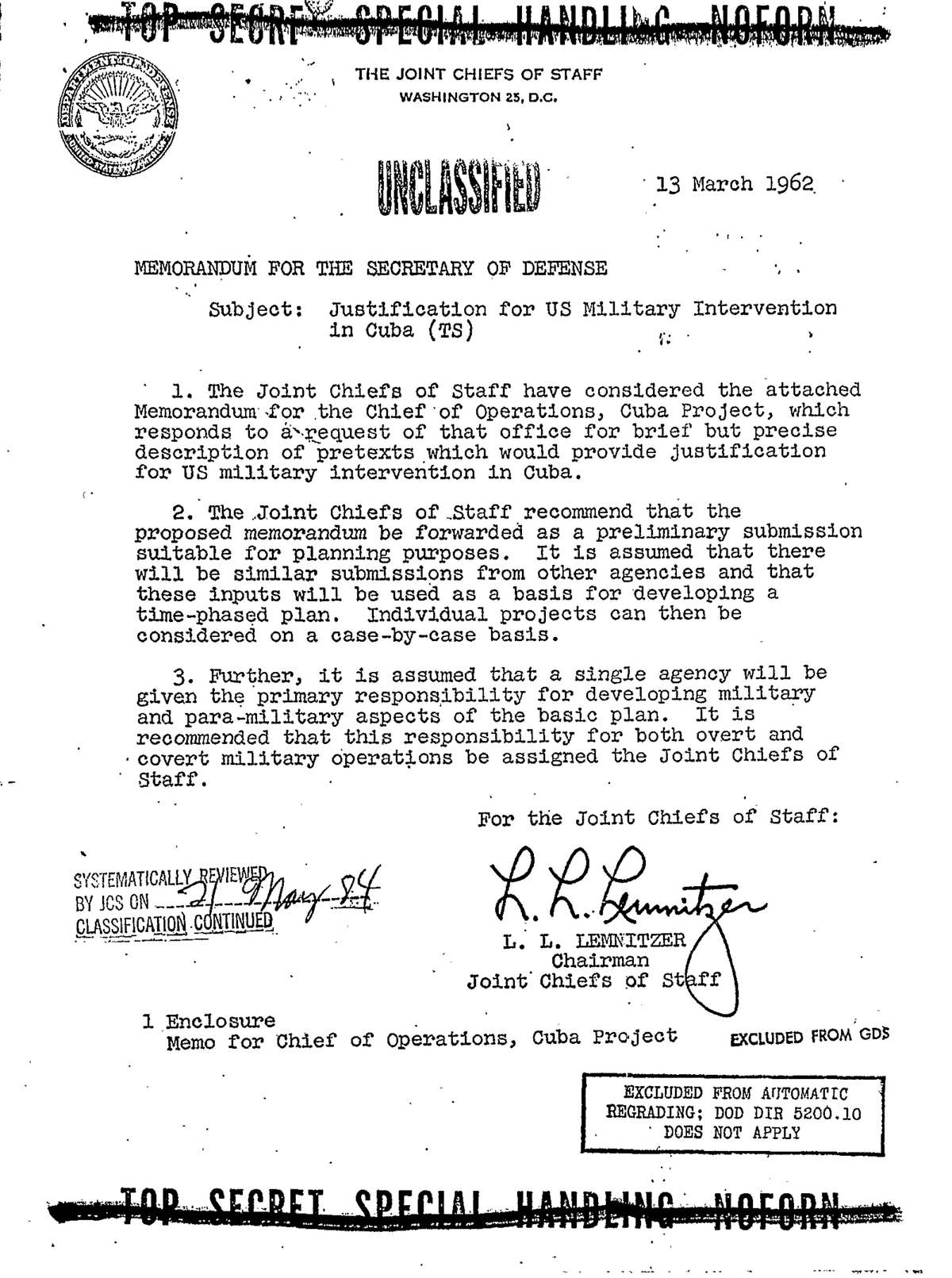
In the week before Sep 11, 2001, somebody bought an unusual number of put options, a bet that a stock will fall, on United Airlines on Sep 6 and on American on Sep 10, the two airlines whose planes would be flown into buildings. The SEC and the FBI spent years on it and the 9/11 Commission put the answer in a footnote: “Some unusual trading did in fact occur, but each such trade proved to have an innocuous explanation.” Read the next sentence slowly, because it’s the one everybody skims. Ninety-five percent of the bets that United Airlines would fall, placed five days before United’s planes were flown into the World Trade Center, came from a single buyer. One institution, American, unnamed then and unnamed now. The Commission said it had “no conceivable ties to al Qaeda” and that the puts were part of a strategy that also had it buying 115,000 shares of American Airlines four days later, and on that basis the matter was closed. Nobody has ever said who it was, and that part is a choice. The SEC and the FBI know the name; it’s in their files, and when some of those files were pried loose under a records request in 2009 it was blacked out on every page. Twenty-five years, two agencies, a dead-certain answer sitting in a folder, and no interest, ever, in letting the country see it. Think about what it means that one desk, somewhere in this country, owned 95 percent of the market’s bet against United on Sep 6, 2001, and that the official answer is a footnote with the name cut out. A finance professor at Illinois, Allen Poteshman, ran the same numbers in 2006 and found the put volume “consistent with informed investors having traded in the option market in advance of the attacks.” Both sentences are in the record and the record stops there, which is where it always stops. After the Hamas attack of Oct 7, 2023, two law professors found a spike in short selling of a fund of Israeli stocks five days before it; they’d botched one figure, the Tel Aviv exchange made sure everyone knew, they corrected it and stood by the spike, and nobody’s been named. Three wars, three records, and the same shape in all of them: somebody knew. Not everybody; somebody. Money runs from a war before the war arrives, and it always has: the First World War moved the world’s banking from London to New York because that’s where the money ran, and by 1945 the United States held two-thirds of the world’s monetary gold. Nobody voted for that; the money just left Europe first.
So the question underneath all of it is why they decide, and the oldest answer in the record comes from a Roman named Sallust, who watched his Republic come apart from the inside and wrote it down around 40 BC. Carthage was the enemy Rome grew up on: the rival city across the Mediterranean, in what’s now Tunisia, whose general Hannibal had marched elephants over the Alps and spent 15 years loose in Italy, the monster every Roman child was raised to fear. Rome finally burned it to the ground in 146 BC. Before that, Sallust said, the senate and the people governed together, with restraint, because “fear of the enemy preserved the good morals of the state.” Then Carthage was gone, and with it the fear, and prosperity did what prosperity does: “the nobles began to abuse their position and the people their liberty,” and “the community was split into two parties, and between these the state was torn to pieces.” The Republic didn’t fall to an enemy; it fell to the absence of one. Sallust’s phrase for the glue was metus hostilis, the fear of the enemy, and it’s the most practical thing a politician ever learned: a state that wants to stay in one piece keeps something to fear outside the walls, and when it runs out, it finds something. Nobody starts a war fat and happy; they start one when the house is coming apart, because an enemy at the gate is the only thing that’s ever made a divided people stop looking at each other. Four centuries after Sallust an emperor tried the other trick. In 376 Valens, who ruled the eastern half of an empire already split in two, let the Goths, a Germanic people running from the Huns, across the Danube, the river that was Rome’s northern wall, to settle them and fill his army with their sons. Roman officials starved and cheated them, they rose, and in 378 at Adrianople, in the corner of Europe that’s now Türkiye, they killed Valens and most of his army, the worst defeat Rome had taken since Hannibal, nearly six centuries before. Import your enemy or invent one; both are the same bet.
Now watch it happen, this week, in Berlin. Germany’s governing party is polling at 18 percent, 12 points behind the AfD, the hard-right party the rest of German politics has spent a decade refusing to sit with, and 79 percent of Germans are telling the pollster they’re dissatisfied with the chancellor. The same government raised its growth forecast for 2026 last week and said in so many words that the reason was borrowed money for the army. Europe has pledged about €800 billion to rearm, and the person who speaks for its foreign policy, Kaja Kallas, Estonia’s former prime minister, said in Tallinn in May 2024 that Russia’s defeat “is not a bad thing” and that if the country came apart into its smaller nations, “it’s not a bad thing if the big power is much smaller.” Her mother was six months old when the Soviets sent her to Siberia; she has her reasons, and they aren’t Europe’s. Russia isn’t communist anymore, it has nothing to gain west of its border, and it is, right now, a country on a full war economy with the largest nuclear arsenal on earth, which could do to Europe whatever it decided to do. Europe knows that, and chose it as the enemy anyway, because the alternative is a union of 27 countries with nothing to fear but each other, and Sallust already told us how that ends. The question isn’t whether Russia is dangerous; it’s what Europe is willing to pay to keep its own house from splitting, and the answer so far is €800 billion and a frontier.
And then there’s us, running the same play. The United States has had Iran under sanctions since 1979, has been at war with it since Feb 28, and has had its ports under a naval blockade since the spring, which is the Japan playbook with the words changed: freeze the money, stop the oil, wait for the first shot. Iran knows the playbook better than we do, because it wrote the other half. The hostages taken in 1979 were released on Jan 20, 1981, the minute Ronald Reagan finished his oath, and the men in Tehran who did that understood American elections better than most Americans. This week Iranian officials told Reuters their attacks on shipping are paced to the Nov 3 vote, and on Oct 8 the White House posted that it wouldn’t attack Iran before the midterms, so both sides are working the same calendar. Meanwhile Alberta votes Monday on whether to start the legal road out of Canada, Germany is at 18 percent, and the United States is running a war with 3.7 percent inflation and gasoline up 34 percent on the year. Everybody’s house is coming apart, and everybody’s reaching for the one thing that’s ever held one together.
So, somebody always knows, and the record says who. The people who choose the enemy know why they chose it, and the money that sits next to them moves before the speech is written, which is why the headline was on the porch a week early and the puts were in the book before the planes. You and I don’t get to sit in that room. What we get is the pattern, and the pattern is enough: when a government tells you who to fear, the useful question isn’t whether the enemy is real, because it usually is, in part. It’s what was happening inside the walls the week they started pointing, and who turned the valve, and when. The men on the Arizona had the answer in the Sunday paper and didn’t know it was for them. That’s the one advantage we have over them, and it’s the only one.
Sources (24), on the site.
Inside the House
October 13, 2026 · Day 228 · 1,830 words
Inside the House
Inside the House, read aloud · 11 minutes · a synthetic British voice, not the publisher’s.
Day 228. Saudi Arabia’s crown prince, Mohammed bin Salman (“MBS”), hasn’t been seen in public since Oct 6. Saudi officials told the Wall Street Journal on Monday that he’s moving between palaces built with bunkers, with a security detail he hand-picked, while Saudi Arabia runs low on the interceptors meant to stop what Ansarallah, the movement that governs northwest Yemen from Sanaa (Yemen’s capital), keeps firing at Riyadh (Saudi Arabia’s capital). The worry in those accounts is a missile from the south. The record of his own house points somewhere else. (The New Arab · The Journal’s report, Oct 12; Times of Israel · Interceptors and batteries, Oct 12)
The deal is older than Bitter Lake, and I’ve told that part before: since 1744 the Saudi family has held the sword and the clerics the pulpit, and the United States signed on to protect the pair in 1945. What I didn’t explain is what the clerics teach, and it sits behind two words that come up every time this region is on the news. The first is Wahhabi. Islam has two main branches, Sunni and Shia, and the preacher who made the pact at Diriyah, outside what’s now Riyadh, was a Sunni named Muhammad ibn Abd al-Wahhab. A Wahhabi follows his teaching: that most Muslims had slid back into idolatry, and that the shrines they prayed at had to be leveled. The second is Takfiri. It comes from Takfir, the act of declaring another Muslim no Muslim at all, an apostate, which the groups that practice it treat as a license to kill, and a Takfiri is someone who does it. The men who built al-Qaeda and ISIS were Takfiris. They’re the ones you remember from the videos, sawing the head off the Wall Street Journal’s Daniel Pearl in Pakistan in 2002, and they came out of that house, the one the United States calls its ally, not the one it calls its enemy. The United States helped pay the bill: through the 1980s the CIA and Saudi Arabia funded the Afghan war against the Soviets dollar for dollar, and that’s the fight Osama bin Laden came out of. For a lot of Americans it was the only Islam the news ever showed them, and a good share of what Americans believe about Muslims comes from mistaking that fringe for the whole. The Takfiris are a sliver of a faith of about two billion people, most of whom they’d count as apostates too, and the people they’ve killed are overwhelmingly Muslims. (Wikipedia · Emirate of Diriyah; Wikipedia · Takfir; Wikipedia · Daniel Pearl; Wikipedia · Operation Cyclone)
The house in the title is the House of Saud, the family the country is named after, and every time it’s been hit, the blow has come from inside it. The family’s first army was a brotherhood of Bedouin called the Ikhwan: tribesmen settled into camps, taught the preacher’s doctrine and pointed at the family’s enemies. They won Mecca and Medina for Ibn Saud in the 1920s, and then they turned on him, because he drove cars, used the telegraph and honored borders the British had drawn, and the doctrine they’d been taught said all of that was sin. So in 1929, at a watering place called Sabilla, the king lined up machine guns mounted on cars, with four British aircraft and British pilots overhead, and cut down the tribesmen who’d won him his kingdom, men from the same tribes he’d married into, a wife from each one he conquered. That’s the founding: British guns, a wife from every tribe, and the tribesmen machine-gunned when they got in the way. Why the British were there at all is the empire’s two reasons for anything, the road to India and oil. They’d been paying Ibn Saud a stipend since 1915 to keep the peninsula quiet, and by 1929 the borders his Ikhwan were raiding across had oil behind them: Britain’s company had struck it at Kirkuk, in Iraq, two years earlier and had been pumping Persia’s since 1908. That company is BP today, and in 1953, when Iran’s elected prime minister nationalized it, Britain and the CIA overthrew him to keep it, which is where the Iran the United States has been bombing since February starts its own count of grievances. Saudi Arabia’s own oil was nine years from being found, and when it was, it went to the Americans, which is the deal Bitter Lake sealed. Five years later he took three provinces from Yemen in a short war, and this month’s missiles have been landing on exactly that ground. (Wikipedia · The Ikhwan; Wikipedia · Battle of Sabilla; Wikipedia · Kirkuk, 1927, and the Gulf’s oil; Wikipedia · The 1953 coup in Iran; Wikipedia · The 1934 war and the Treaty of Taif; TASS · Najran and Khamis Mushait, Oct 8)
That pattern held for the next 50 years. In 1975 the king was Faisal, the one who’d turned off the oil to America two years earlier, and like every Saudi king he held a majlis, an open audience where a subject can walk up and put a petition in his hand. On Mar 25 his nephew, Prince Faisal bin Musaid, joined the line, bent to kiss the king’s head, and shot him twice in it. Ten years earlier the nephew’s brother had been killed by police while leading an attack on Saudi Arabia’s first television station, because pictures of human beings were sin, which is the Ikhwan’s complaint about cars and telegraphs in a new generation. The nephew was beheaded in a public square in Riyadh. (Wikipedia · King Faisal’s assassination; Wikipedia · Faisal bin Musaid)
Then came 1979, the year this story turns on. In February, Iran’s revolution put Shia clerics in power across the Gulf. On Nov 20, the first morning of a new Islamic century, a former National Guardsman named Juhayman al-Otaybi, from the Otaybah, the tribe that rode as Ikhwan and was cut down at Sabilla, and whose grandfather had ridden with them, walked into the Grand Mosque in Mecca, the holiest place in Islam, with hundreds of armed followers and announced that his brother-in-law was the Mahdi, the redeemer Muslims expect at the end of days. He’d raised his followers in the Ikhwan’s image, and his charge against the royal family was the Ikhwan’s charge again: that it worshipped money and spent it on palaces, that it kept company with Christian infidels, that it was letting the West in. It wasn’t revenge for Sabilla so much as Sabilla unfinished. The family couldn’t send troops into the mosque without the clerics’ permission, and the clerics gave it. The fighting lasted two weeks, the official count was 255 dead, and 63 of the rebels were beheaded in eight cities on one January morning. The same week, on the oil coast, the Shia of Qatif, who’d just watched Iran, marched for the holy day of Ashura in defiance of a ban, and the National Guard put them down with about two dozen dead. Neither blow came from a foreign army, and both came from people the house had made. (Wikipedia · Grand Mosque seizure, 1979; Wikipedia · Qatif uprising, 1979)
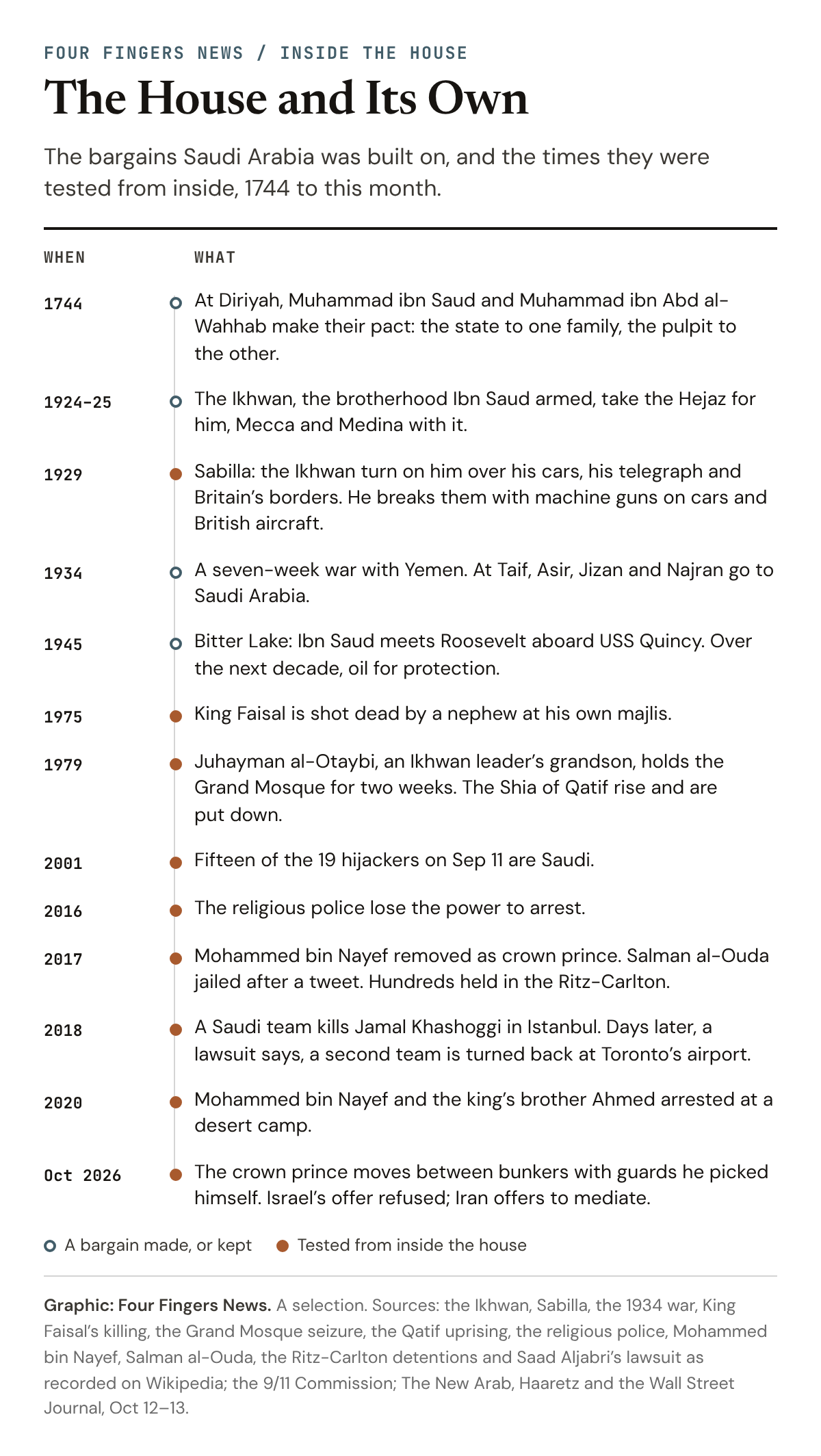
The royal answer to 1979 was more religion, not less, at home and abroad, and the crown prince himself said in 2018 that Saudi Arabia spread it at its Western allies’ request during the Cold War. Fifteen of the 19 men who flew into the towers on Sep 11, 2001, were Saudi. (Wikipedia · Grand Mosque seizure, 1979; Washington Post via Gulf Times · The crown prince on the Cold War, March 2018; 9/11 Commission Report · Chapter 7)
I laid out his record on Oct 2 in The Grandson: the cousin he pushed aside as crown prince in 2017, the princes locked in the Ritz-Carlton that same year, the killing of the columnist Jamal Khashoggi in the Istanbul consulate in 2018, which earned his initials a second reading, Mister Bone Saw, the arrests of that same cousin and the king’s own brother in 2020. In the same years Saudi Arabia’s wealth fund, which he chairs, started a golf tour, LIV, and last fall put on a comedy festival in Riyadh with Dave Chappelle, Kevin Hart and Bill Burr on the bill. Read from inside the house, that record is a list of the people it crossed. (Wikipedia · LIV Golf; Wikipedia · Riyadh Comedy Festival)
The clerics. In 2016 the religious police lost the power to arrest anyone, and in 2017 one of Saudi Arabia’s best-known preachers was jailed hours after a tweet, and prosecutors later asked for his death. (Wikipedia · The religious police, April 2016; Wikipedia · Salman al-Ouda)
The family. Among the princes held in the Ritz until they signed over their fortunes was the one who’d commanded the National Guard, the Ikhwan’s descendant, a second army raised from loyal tribes and kept separate from the first for one purpose, to protect the family from a coup. (Wikipedia · The Ritz-Carlton detentions; Wikipedia · Saudi Arabian National Guard)
The old security men. The cousin had run Saudi Arabia’s counterterrorism work, and the CIA had given him a medal four months before his removal. His intelligence chief, now in Canada, says in a US lawsuit that days after the Istanbul killing a second team flew to Toronto for him and was turned back at the airport. (Wikipedia · Mohammed bin Nayef; Wikipedia · Saad Aljabri’s lawsuit)
The detail in the Journal’s story isn’t the bunker, it’s the guards he picked himself.
Now put an offer of help in front of a man who doesn’t trust the people around him. Israel’s prime minister, Benjamin Netanyahu, asked through US intermediaries to join the campaign against Ansarallah, Haaretz, Israel’s oldest daily and one of its leading papers, reported on Monday, and the crown prince said no, because cooperation with Israel could provoke anger among the Saudi public, the paper’s source said. Israeli outlets have reported since September that intelligence on Ansarallah reaches Saudi Arabia from Israel through US Central Command. Neither government has confirmed it, and the reports come from papers with an interest in the warming. What’s on the record is a phone call on Sunday night in which Iran’s foreign minister, Abbas Araghchi, told his Saudi counterpart that Iran was ready to help bring Saudi Arabia and Ansarallah into dialogue. The king’s title is Custodian of the Two Holy Mosques, and the pulpit is the one source of legitimacy the family hasn’t replaced yet. An Israeli jet over the holy cities would hand every cleric he jailed and every prince he locked in the Ritz the argument they’ve been missing. The crown prince can take help from Iran before he can take it from Israel, and that’s the deal of 1744 still running. (The New Arab · Haaretz’s report, Oct 13; Jerusalem Post · Neither government has confirmed, Oct 12; The New Arab · Araghchi’s call, Oct 12)
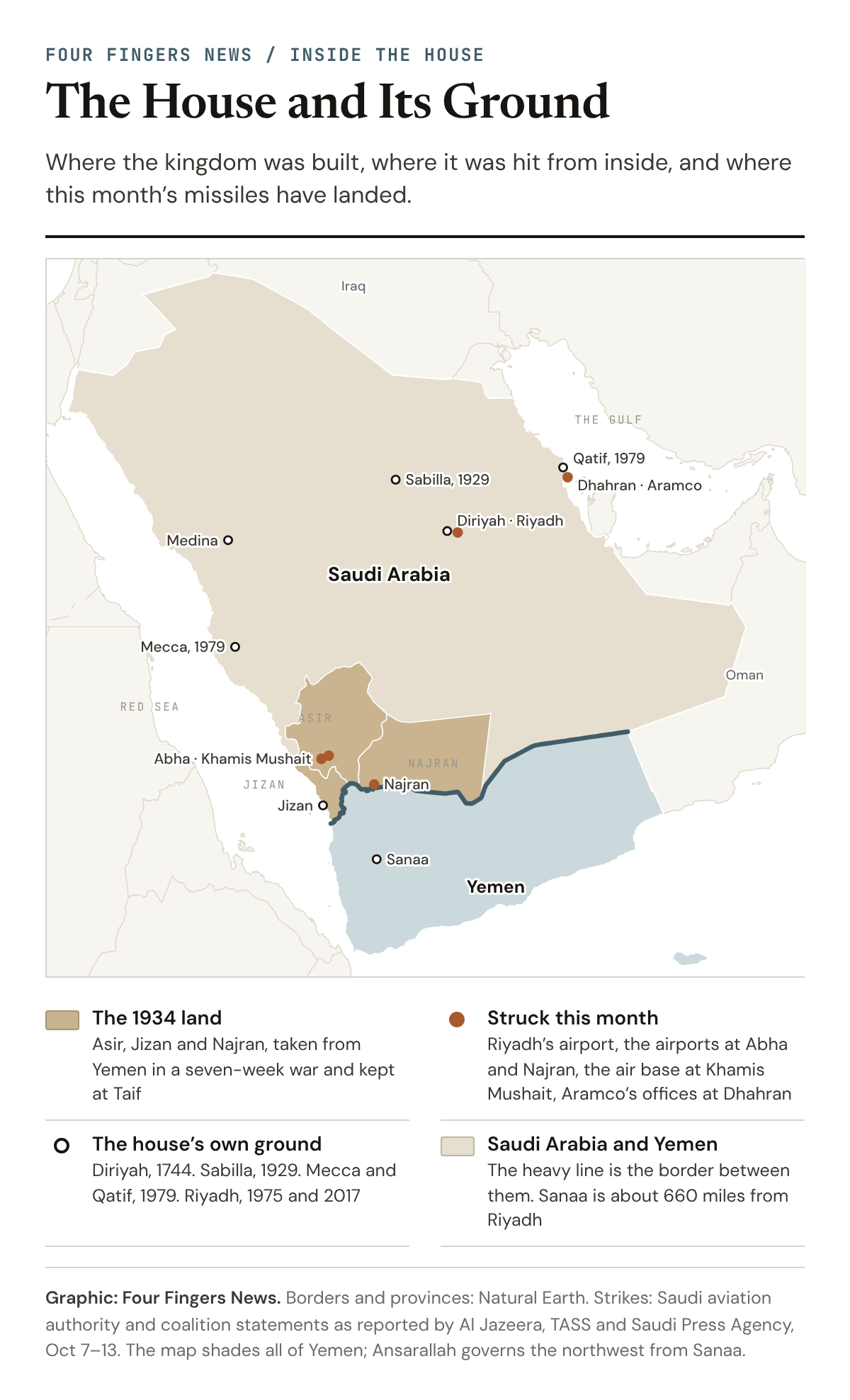
The groups that run on Takfir count the Shia as their first apostates. Ansarallah is Zaydi, a branch of Shia Islam, and its worst day at ISIS’s hands came on Mar 20, 2015, when suicide bombers killed 137 people at two Sanaa mosques its followers prayed in. Iran is Shia too. So the creed Saudi Arabia spent 40 years exporting and the movement firing at Riyadh tonight are enemies of each other. The United States has been bombing the Shia country since February, and the ally it may be about to defend is the one the men in the videos came out of. Whose side are we on? The missiles that closed the airport come from more than 500 miles to the south, and the Journal says that’s why he’s underground. The record of this house has said something else since 1929. It’s October, and anyone who’s sat through a horror movie knows the line. It’s from When a Stranger Calls, which came out in 1979, the year this story turns on. “We’ve traced the call… it’s coming from inside the house!” (Wikipedia · Takfir; Wikipedia · The Sanaa mosque bombings, March 2015; BreakThrough News · Trump on joining the strikes, Oct 13; Four Fingers News · Silver or Lead?, Oct 12; Wikipedia · When a Stranger Calls, 1979)
Silver or Lead?
Day 227. The offer the Colombian cartels made famous came in two metals, and the man across the table could take the silver, meaning the bribe, or the lead, meaning the bullet. It’s a boss’s offer and it rests on a bluff, because it only works for as long as everybody who hears it believes the lead will arrive and nobody makes the boss prove it.
Saudi Arabia has made both halves of that offer. The silver went mostly to Pakistan, which sent a squadron of about 16 fighter jets to the kingdom in April and by May had around 8,000 troops and a Chinese-made air-defense system there, with Saudi Arabia paying for the equipment, Reuters reported. On Apr 16, Saudi Arabia put $3B on deposit at Pakistan’s central bank and extended a $5B deposit that was already there, and on Aug 7 the two countries and Türkiye signed a pact in Mecca (the holy city in western Saudi Arabia) that treats an armed attack on one of them as an attack on all three. (Reuters via MarketScreener · Pakistan’s deployment, May 18; Xinhua via Capital FM · Saudi deposits, Apr 16; Reuters via Defense News · The pact and Fidan, Oct 8)
The lead went to Yemen, where a Saudi-led coalition went to war in 2015 against Ansarallah, the movement that governs most of northwest Yemen, and bombed the country for seven years before a truce. The UN Development Programme estimated the war’s toll would reach 377,000 by the end of 2021, most of it from hunger and disease. The truce collapsed in July and the bombing started again, and the health ministry in Sanaa (Yemen’s capital), where Ansarallah still governs, counts 91 Yemenis killed by coalition strikes in the past five weeks. (AP via Christian Science Monitor · Sanaa’s count, Oct 11; UNDP · The war’s toll through 2021; The National · The 2022 truce, Oct 2)
Now the lead is coming back across the border, and it’s landing on the main airport in Riyadh (Saudi Arabia’s capital). On Saturday the question there was who’d still get on a plane, and two days later nobody can, because Saudi Arabia has closed the airport through this coming Saturday. Ansarallah’s missiles struck it four times in five days, hitting a passenger terminal on Saturday and the domestic terminals on Sunday, and killed at least 18 people. Reuters called Saturday’s strike the deadliest attack inside the kingdom in more than a decade. (Four Fingers News · Check with Your Airline, Oct 10; CNN · The closure and the US requests, Oct 12; Al Jazeera · Four strikes in five days, Oct 12; Al Jazeera · The toll at the airport, Oct 13; Reuters via PhilSTAR Life · Saturday’s strike, Oct 11)

That’s what it looks like when somebody calls the bluff, and once it’s called, the cards have to go on the table. Saudi Arabia laid its hand down a week ago today, when it invoked the pact and the three governments announced they’d move “the agreed military forces and capabilities” into the kingdom quickly. Two days later the New York Times quoted an unnamed senior Pakistani officer saying Pakistan’s jets were bombing Ansarallah, and within a day Pakistan’s information ministry called the story “fake and fabricated.” Türkiye’s foreign minister, Hakan Fidan, said Turkish troops won’t be sent to attack inside another country. The United States turned down two Saudi requests for strikes on Yemen last month, and its president says only that it “may” join now. (Anadolu · Joint statement, Oct 5; Express Tribune · Pakistan’s denial, Oct 9; Reuters via Defense News · The pact and Fidan, Oct 8; CNN · The closure and the US requests, Oct 12)
Silver can put another country’s soldiers on a base, and it can’t make that country want the war. Anybody who’s been handed a job they didn’t believe in knows how that job gets done, which is on time, by the book and not an inch past what the book requires. Pakistan shares a border with Iran, which supports Ansarallah, and its parliament voted unanimously in 2015 to stay out of Yemen while promising to defend Saudi territory, which is the promise its government is keeping to the letter this week. (Voice of America · Parliament’s vote, April 2015)
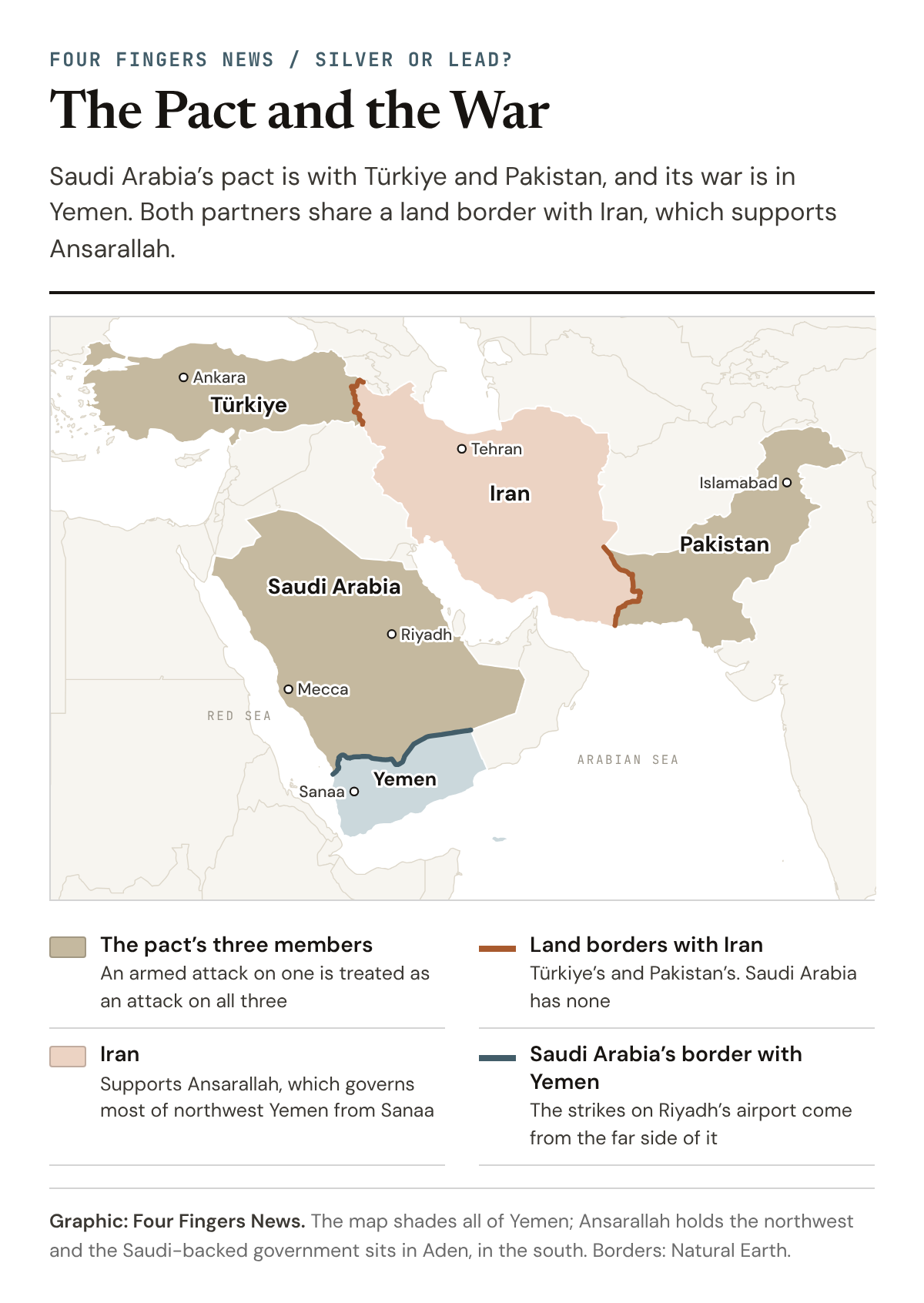
The hand that’s face up on the table holds friends who took the silver and won’t fight the war in Yemen, and an enemy that took the lead for years and is now sending it back.
The Guest List
Day 226. Three times last year, in April, September and December, leaders of a group that wants Alberta (the Canadian province north of Montana) to become its own country met American officials at State Department headquarters in Washington DC. One of them, a former heart surgeon named Dennis Modry who co-founded the Alberta Prosperity Project, has since told the Globe and Mail, one of Canada’s national newspapers, that the group brought a document describing what an independent Alberta might offer the United States, and that it covered fresh water, a share of the province’s oil royalties, pipeline routes through American territory and land for a rail line to Alaska. “Does the U.S. need more water?” was how he framed it for the paper, which published its investigation on Oct 3. (The Globe and Mail · Investigation, Oct 3; Culture Alberta · The Globe’s findings, Oct 4)
Other leaders of the movement dispute his account. The lawyer who arranged the meetings told the Globe the resource ideas were never discussed and called the document “stupid,” the group’s chief executive says water and oil didn’t come up at the one meeting he attended, and Modry wouldn’t give the paper a copy. The White House says its officials meet with all kinds of groups and that “no support or commitments were conveyed,” and the State Department says only staff took part. (Culture Alberta · The Globe’s findings, Oct 4; Global News · Sylvestre’s denial, Oct 5; NBC News · White House and State Department statements)
The water and the royalties Modry described belong to what Canadians call the Crown, which in practice means the provincial government holds them on behalf of everyone who lives in Alberta. Oil royalties are a large share of the province’s budget, and water is scarce enough in the south that the basins of the Bow (the river that runs through Banff and Calgary), the Oldman and the South Saskatchewan have been closed to new surface water allocations since 2006. The Bow and the Oldman run their whole length through Treaty 7 land, covered by an agreement signed in 1877 between the Crown and the Blackfoot nations and their neighbors, 28 years before Alberta existed as a province. Most of the oil sands lie in the north, under Treaty 8, signed in 1899. Canada’s constitution protects the rights in those treaties, and a judge has found that secession would breach them by removing Canada as the treaty partner. (Culture Alberta · The Globe’s findings, Oct 4; CBC News · Closed basins, April 2024; Crown-Indigenous Relations Canada · Historic treaty map; Natural Resources Canada · Map 900A, 2025; Fasken · The two rulings, May 28)

The people at those State Department meetings were separatist leaders and American officials, and the Indigenous nations that signed those treaties, known in Canada as First Nations, have spent the past year in Alberta’s courts instead. In December, a judge reviewing the separatists’ first proposed referendum question ruled that it would violate treaty rights, writing that First Nations were founding partners in Alberta and “cannot be ignored or bypassed” as the province weighs its future. After the legislature changed the petition law and elections officials approved a reworded question, the Athabasca Chipewyan First Nation from the north and the Piikani, Siksika and Blood Tribe of the Blackfoot Confederacy from the south went to court, and in May a second judge threw the approval out because the province hadn’t consulted them. Premier Danielle Smith called that ruling “anti-democratic,” and her government then wrote its own question for the Oct 19 ballot, one she said the ruling wouldn’t apply to. The province and the separatists are both appealing, and First Nations leaders say the litigation has put growing financial and legal burdens on the nations defending their treaties. (Global News · December ruling; Alberta Court of Appeal · June 29 decision; Global News · Smith on the May ruling; Government of Alberta · Premier’s address, May 21; Alberta Native News · Treaty 6 statement)
The ballot on Oct 19 can’t take Alberta out of Canada, because the most it can do is start the legal work toward a second, binding vote, and advance voting opens Tuesday. The people who want out have real complaints, since Alberta is landlocked, produces most of Canada’s oil, and has argued for decades that Canada’s federal government manages that wealth over its head. The group’s own chief executive says the goal is “sovereignty independent of the U.S.” (Alberta Court of Appeal · June 29 decision; Elections Alberta · Voting dates; Canada Energy Regulator · 2025 production; DisinfoWatch · Alberta report, May 6; CP24 · Sylvestre on sovereignty, Jan 24)
The United States hosted the group’s three meetings, which means American officials sat down three times with people working to take a province out of an allied country. The White House says they conveyed no support, but President Trump has pushed to make Canada the 51st state, and since Sep 29 the US has been turning back Canadian alcohol, dairy products and motorcycles at the border. Canadians had already cut back on trips across that border, and Statistics Canada counted about a quarter fewer return trips from the United States this August than in August 2024. (NBC News · White House and State Department statements; AP via Fox 35 · Import bans, Sep 29; Travelweek · Statistics Canada’s August count)
On Jan 22, 2026, a mere 37 days before the US went to war with Iran, the US Treasury Secretary, Scott Bessent, went on television, said Canada wouldn’t let Alberta build a pipeline to the Pacific, and added “I think we should let them come down into the U.S.” before giving his view of the province:
“They have great resources.”
Check with Your Airline
Day 225. A strike on King Khalid International, the main airport in Riyadh (Saudi Arabia’s capital), killed 12 people and wounded 309 on Saturday, after strikes there on Wednesday and Thursday had already killed four. An injured traveler told Reuters that part of the ceiling near a departure gate came down. Ansarallah, the movement that governs most of northwest Yemen from Sanaa (Yemen’s capital), claimed the week’s earlier strikes, and after this one the head of its media office posted that the group had “shut down Riyadh international airport,” which Reuters reports as a claim of responsibility. (CBS News · Aviation authority toll, Oct 10; AFP via Malay Mail · Oct 7; CBS News · Live file, Oct 9 and 10; Reuters via Jerusalem Post · Airport strike, Oct 10)
Who gets on a plane at an airport that took a ballistic missile two days earlier?
Here’s the week behind that question. On Monday, Ansarallah told every airline flying over Saudi Arabia that the country’s skies were now part of the war, and that night it said it had fired on King Khalid. On Wednesday, a strike there killed a man, and flights stopped for a little over an hour and then started again. On Thursday morning, Ansarallah repeated the warning “for the last time” while the departure board showed 58 flights delayed and 11 cancelled, and later that day a strike killed a captain with Saudia, the national airline, and two other people and heavily damaged a parked airliner. By Friday, Saudi media were reporting that air traffic was back to normal, and Ansarallah had said the only flights allowed into Riyadh were humanitarian ones carrying its permit. None of this was hidden, since the warnings were posted in public and Saudi Arabia’s own aviation authority announced the dead, and on Saturday there were travelers at the departure gates again when the next strike came. I wouldn’t have gone near that airport after Wednesday. Boarding there on Saturday was Russian roulette played after the gun had already gone off twice, and I went looking for who was playing and what they’d been told. (dpa via GNA · Oct 5 notice; AeroCorner · Monday’s claimed strike; The National · Thursday’s board, Oct 8; AP via News4Jax · Final warning, Oct 8; CBS News · Live file, Oct 9 and 10; Reuters via Jerusalem Post · Airport strike, Oct 10; Al Jazeera · Flights resume, Oct 9)
The warning is older than this week. On July 14, the day after a strike hit the runway at Sanaa’s airport, Ansarallah warned every airline to stay out of Saudi airspace until the Saudi-led blockade of that airport was lifted. Monday’s notice, from its coordination center in Sanaa, called the kingdom’s skies a theater of military operations, exempted Mecca and Medina (the two holiest sites in Islam) for the sake of pilgrims, and said it wouldn’t answer for what followed. The reason it gave was Saudi airstrikes on Yemen, where 100 jets from the Saudi-led coalition had flown that morning and where, a day later, the health ministry in Sanaa said one strike killed six members of a family in Hajjah, four of them children. (FDD’s Long War Journal · July 14 warning; dpa via GNA · Oct 5 notice; AFP via Hürriyet Daily News · Coalition jets, Oct 5; AFP via Malay Mail · Oct 7)
Airlines with somewhere else to fly acted on it. By Friday, Lufthansa, Air India, Emirates, Etihad, flydubai, Air Arabia and Pakistan International had suspended flights to Riyadh, and Europe’s aviation regulator had advised against parts of Saudi airspace. The airlines based in the kingdom cut their schedules and kept flying. On Thursday, the day Capt. Hamoud Ali Alkalthami and two other Saudis were killed, Saudia had cancelled 97 of its 140 departures by late afternoon, and across the airport 293 of the day’s 747 flights were off while the rest were still listed. (CBS News · Live file, Oct 9 and 10; Khaleej Times · Cirium count, Oct 8; Gulf News · Cirium count, Oct 8)
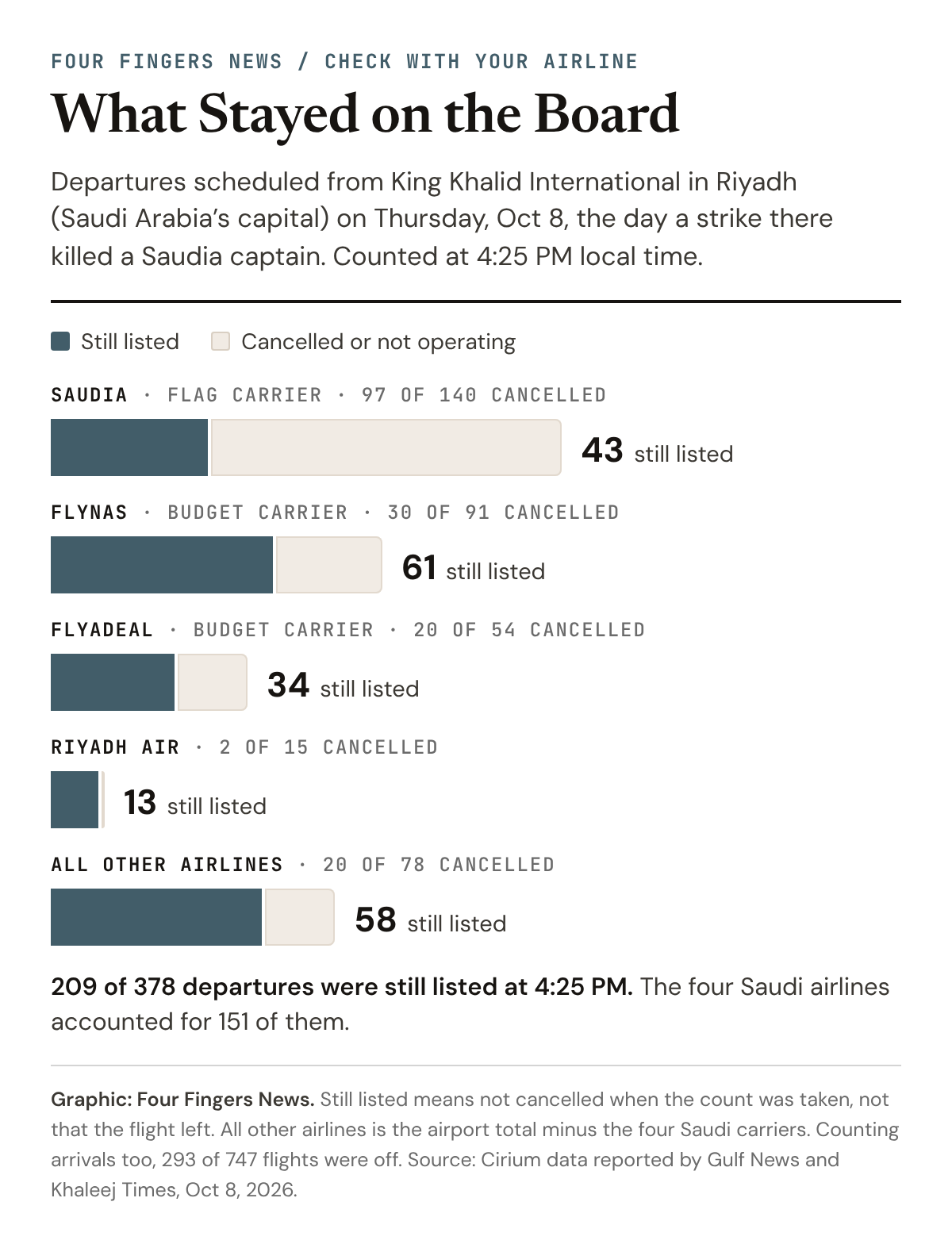
The casualty lists say who was there, and on Saturday that was four Saudis, two Bangladeshis, an American, an Egyptian, a Jordanian, a Palestinian, a Sudanese and a Syrian. Wednesday’s dead was a Sudanese resident, and Thursday’s delay board included a Yemenia flight to Aden, the city in southern Yemen where the Saudi-backed government sits, running more than three hours late. The list reads like the region’s workforce and its neighbors, and it can’t tell you why any one of them was traveling or how much they knew about the risk. (CBS News · Aviation authority toll, Oct 10; CBS News · Live file, Oct 9 and 10; The National · Thursday’s board, Oct 8)
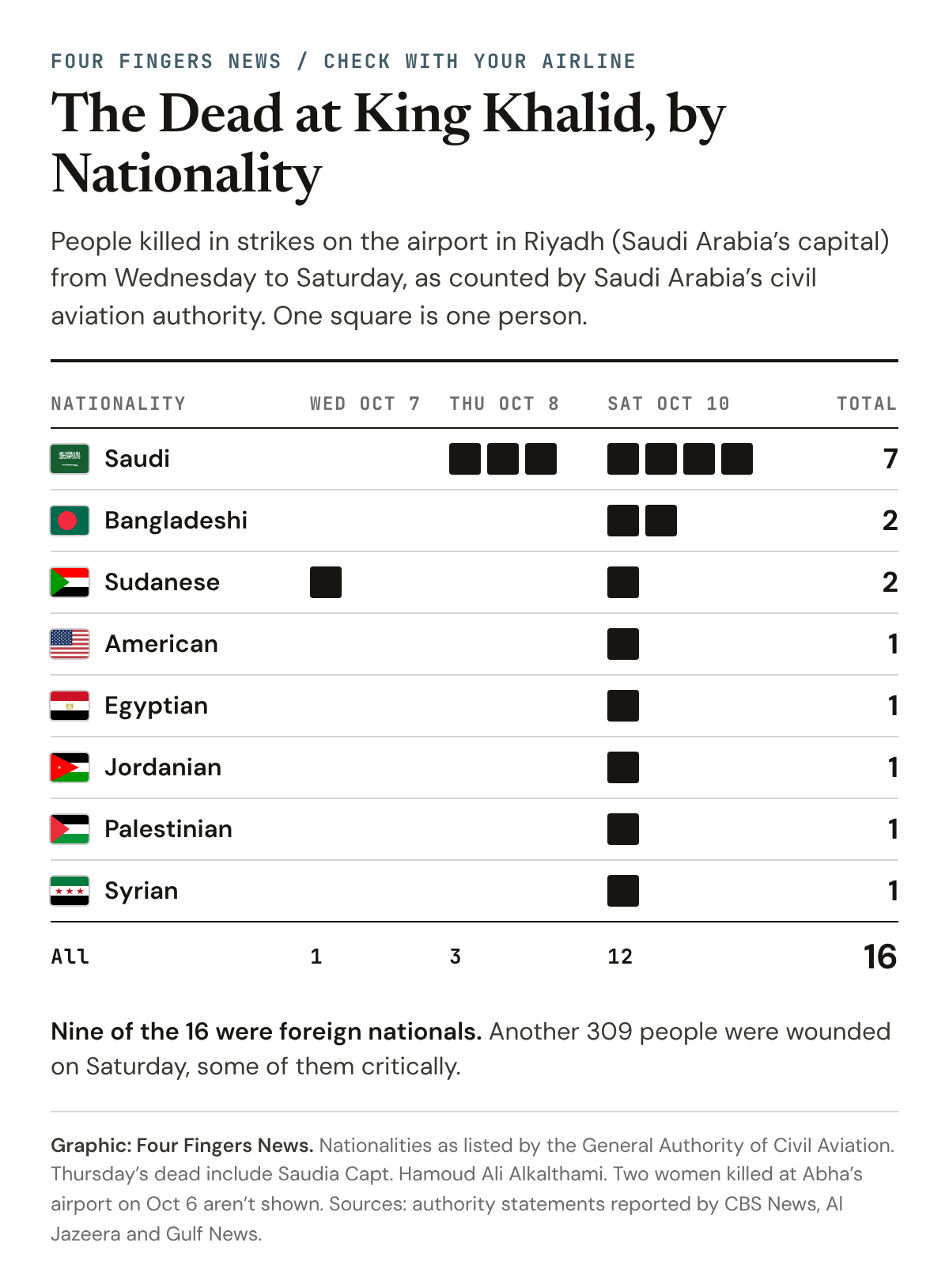
What Ansarallah announced and what passengers were told inside Saudi Arabia aren’t the same thing. AFP reports that Saudi Arabia has kept tight control of information about the strikes on its soil, leaving residents unclear about the danger. The kingdom has a way to alert people on the ground, and on Sept 19 it used it, sending phone alerts across Riyadh hours before a fire broke out at the airport’s fuel storage. Reuters reports that Saturday’s strike came with no alert from the kingdom’s threat warning system. What passengers had was the airport’s advice, given on Thursday and again on Saturday, to check their flight’s status with their airline. (CBS News · Live file, Oct 9 and 10; Reuters via South China Morning Post · Sept 19 alerts; Reuters via Jerusalem Post · Airport strike, Oct 10; Gulf News · Airport advisory, Oct 8; Arab News · Airport advisory, Oct 10)
As for why the airport stays open, part of the answer is that King Khalid moved 37 million people in 2024, and part, I think, is that closing it would concede what Ansarallah claimed on Friday, which is that it now decides what lands in Riyadh. Saudi Arabia has made that same claim over Sanaa’s airport for 11 years. In April 2015, Saudi jets bombed Sanaa’s runway to keep an Iranian plane carrying aid from landing, and from Aug 2016 until a truce in 2022, the Saudi-led coalition kept the airport shut to most flights. Then on July 13 of this year, a strike claimed by Yemen’s Saudi-backed government hit the runway again to keep another Iranian plane from landing, this one carrying Ansarallah’s delegation home from the funeral of Ali Khamenei, Iran’s supreme leader. The plane diverted to Hodeidah, on Yemen’s Red Sea coast, and the warning to airlines came the next day. (Khaleej Times · Cirium count, Oct 8; AP via Fox · Runway, April 2015; AFP via Jordan Times · Airport blockade; Xinhua · Runway, July 13; FDD’s Long War Journal · July 14 warning)
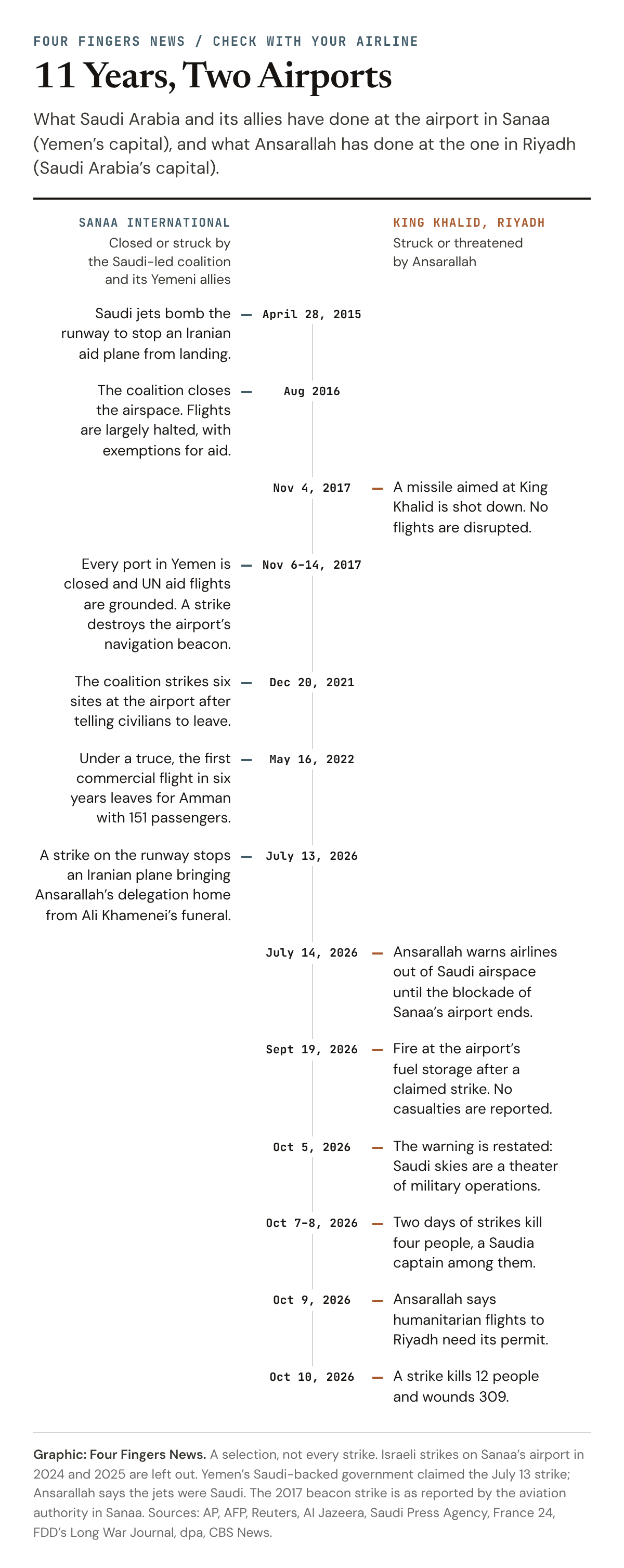
It’s Russian roulette, and the passenger picks up the gun by boarding. The record says who loaded it, because Ansarallah has announced as much since July, and who keeps the game going, because Saudi Arabia holds the airport open, controls the news about the strikes and sent no alert on Saturday. It doesn’t say why anyone still plays after a warning that plain and four deaths at the same airport in the same week. The only thing I can offer is that a flight still on the schedule tells you what the people who run the airport have decided, which isn’t the same as telling you it’s safe. (CBS News · Live file, Oct 9 and 10; Reuters via Jerusalem Post · Airport strike, Oct 10)
Aim Point
Day 224. The Congressional Research Service reported this week that 45 Reapers are among the 81 US aircraft lost or damaged in this war. Most people couldn’t tell you what a Reaper is, so here’s a story about one. (Stars and Stripes · CRS count, Oct 7)
It comes from Lawrence Wilkerson, the retired Army colonel who was Colin Powell’s chief of staff, and he tells it about his son.
The son flew the Reaper, an Air Force drone with a 66-foot wingspan, a propeller, a camera and Hellfire missiles under the wings. Nobody rides in it. The pilot sits at a console and flies it over a satellite link, and in this case the console was in Nashville while the drone was over Afghanistan, more than 7,000 miles away. (Air Force · MQ-9 Reaper fact sheet)
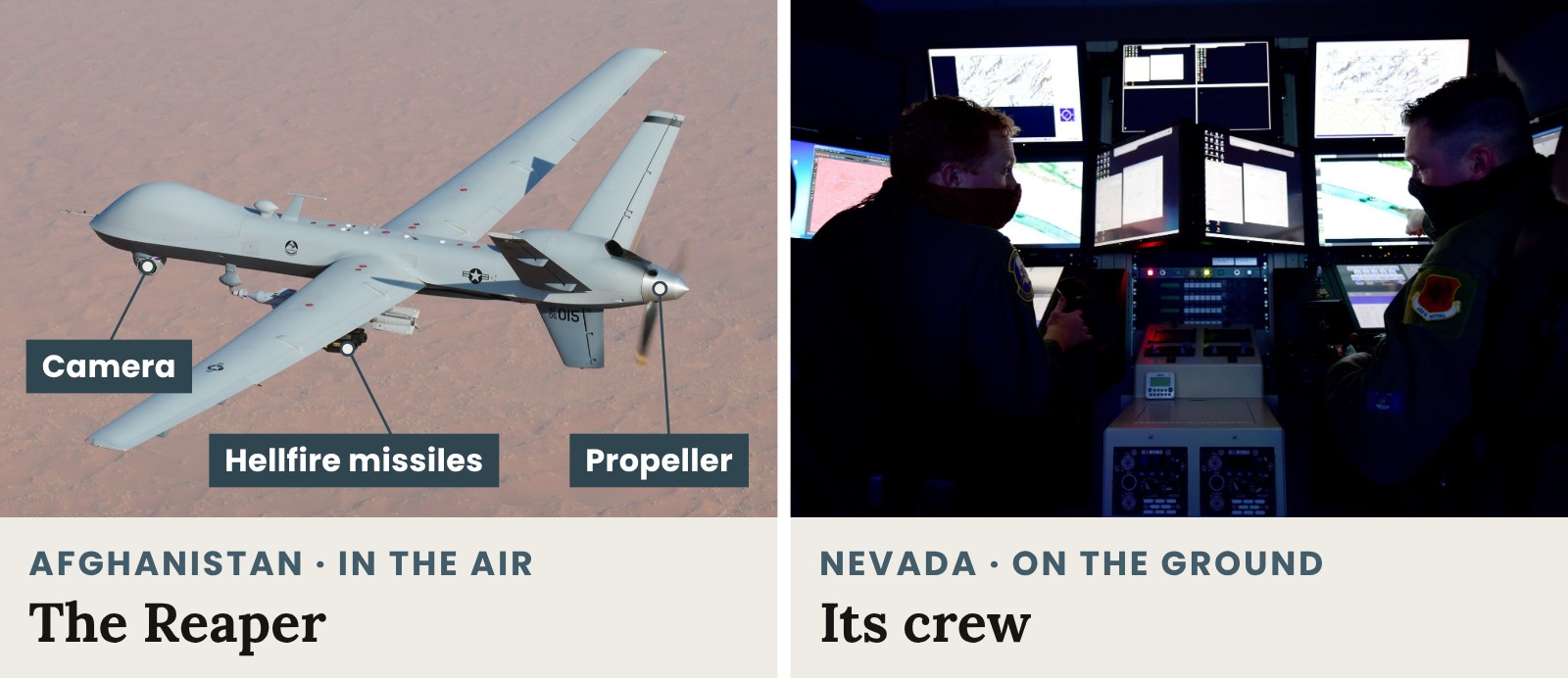
By the colonel’s account, the enemy had nothing that could reach it, so it could circle over a firefight while the pilot watched the ground on a screen and talked by radio to the Americans down there. Sometimes the voice on the radio belonged to the leader of a Special Forces team asking for a missile on an enemy 50 feet from where he stood. Soldiers have a radio call for a strike that close to their own people, which is “danger close.”
One day a man on the ground asked for something closer than that. He gave his own position and told the pilot, “Your aim point is me.”
The pilot refused, because you don’t fire on your own people and the rules say so. The man told him to do it anyway and said he wouldn’t be there when the missiles landed.
So the pilot did it. The team cleared out as soon as the call was made, and by the time the missiles came down, the Americans were gone and the enemy was standing on the spot they’d left.
That’s the colonel’s telling, and I can’t check the strike itself. What I can check is the console: a bio of the colonel puts his son in the Tennessee Air National Guard in Nashville, and the Guard’s 118th Wing flies Reapers from Berry Field, at the city’s airport. (Military Religious Freedom Foundation · Wilkerson bio; Air National Guard · 118th Wing at Berry Field)
I spent the week reading counts of targets destroyed, jets flown and drones lost, and none of them has a column for what happened on that radio, which was one man deciding to trust another with his life and being right. It’s the only thing I heard all week that I couldn’t put a number on.
Stealth Tax
Day 223. No matter what anyone wants out of this war, the tab is running. And it’s running fast and high.
The Congressional Budget Office (CBO) closed the books on the fiscal year Thursday. The deficit was $2T. Interest on the debt came to $1.14T, a record. That’s $3.1B a day, and $227B more than the military cost in a year with a war in it. (CBO · Monthly Budget Review, Oct 8)
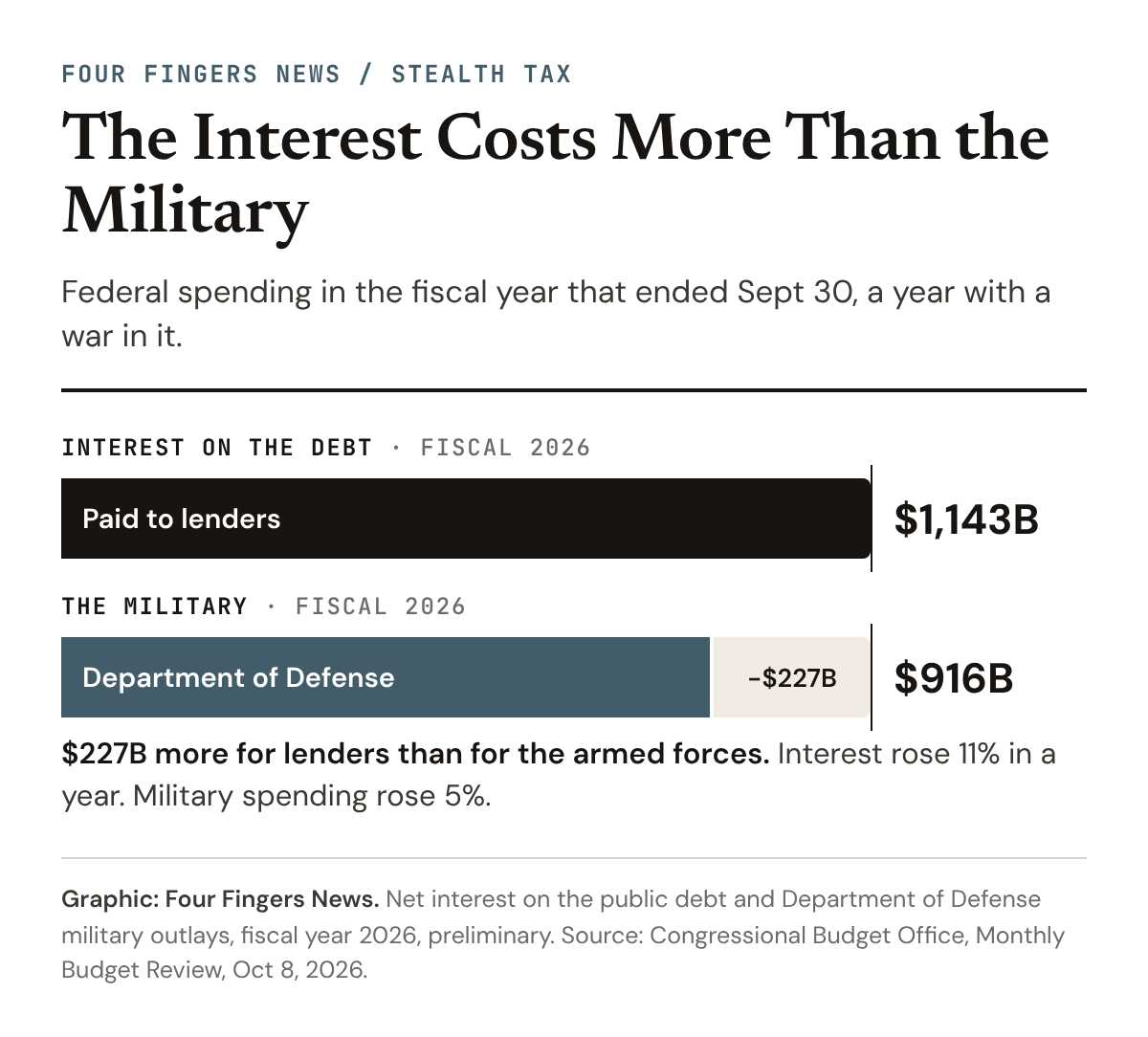
Three nights earlier the Treasury secretary told a business dinner in Hershey, Pennsylvania, that the debt curve is about to bend, and “very, very quickly.” (BBH · Bessent, Oct 5; CBS 21 · Chamber dinner)
“What is important is the debt-to-GDP, and we will start bending that curve and bringing it down … I think it could happen very, very quickly.”
Nobody’s been asked to pay for the war. The Pentagon’s count was $11.3B after six days, $25B by late April, $37.5B in July and $43.6B by Sept 3. It lists $32.4B of that as unfunded: munitions and aircraft it hasn’t been given the money to replace. CBO adds $2B to $3B a month. The White House asked Congress for $87.6B in June. Congress hasn’t passed it. Asked in March whether taxes would rise to cover the war, Scott Bessent said they wouldn’t. “We have plenty of money to fund this war.” (New York Times via Fox · First six days; Air & Space Forces · April 29; Roll Call · Pentagon ledger, Sept 18; CSIS · Supplemental request; Reuters · Bessent, March 22)
That’s how the last ones were paid for too. Brown University’s Costs of War project puts the wars since 9/11 at about $8T through 2022, counting veterans’ care still owed. They ran through four presidents, two from each party. There was no war tax and no bond drive. Of that total, $1.1T is interest. The first of those wars began 25 years ago Wednesday. The debt was $5.8T then. It’s $40.3T now. (Brown · Costs of War; Treasury · Historical debt; Treasury · Debt to the Penny)
Niall Ferguson, a historian at the Hoover Institution, has a rule for this. A great power that spends more on debt service than on defense risks ceasing to be one. Habsburg Spain crossed that line. So did Bourbon France, the Ottomans and Britain between the wars. America crossed it in 2024. This year, with a war on, it wasn’t close. The lenders have noticed. This week the 10-year Treasury yield hit its highest since 2002. About $9.2T of the debt is owed abroad. (Hoover · Ferguson’s Law; Treasury · Daily yields; Treasury · Foreign holders)
A debt this size gets carried one of three ways: tax for it, cut for it or let prices shrink it. The debt grew 6.4% in the past year. That’s $6.6B a day. For the curve to bend, the economy has to grow faster than that, counted in dollars. Give Bessent the 3% real growth he says the economy can sustain. Give the Federal Reserve the 2% inflation it voted 12-0 last month to get back to. That’s 5%. The other 1.4 points have to come from taxes, spending or prices. (Treasury · Debt to the Penny; Federal Reserve · Sept 16 statement)
The first two take a vote. The third doesn’t, and it’s already doing the work. Over the past year the economy grew 6.3% in dollars, nearly matching the debt. In goods and services it grew 2.2%. The rest was prices. (BEA · GDP in dollars; BEA · Real GDP)
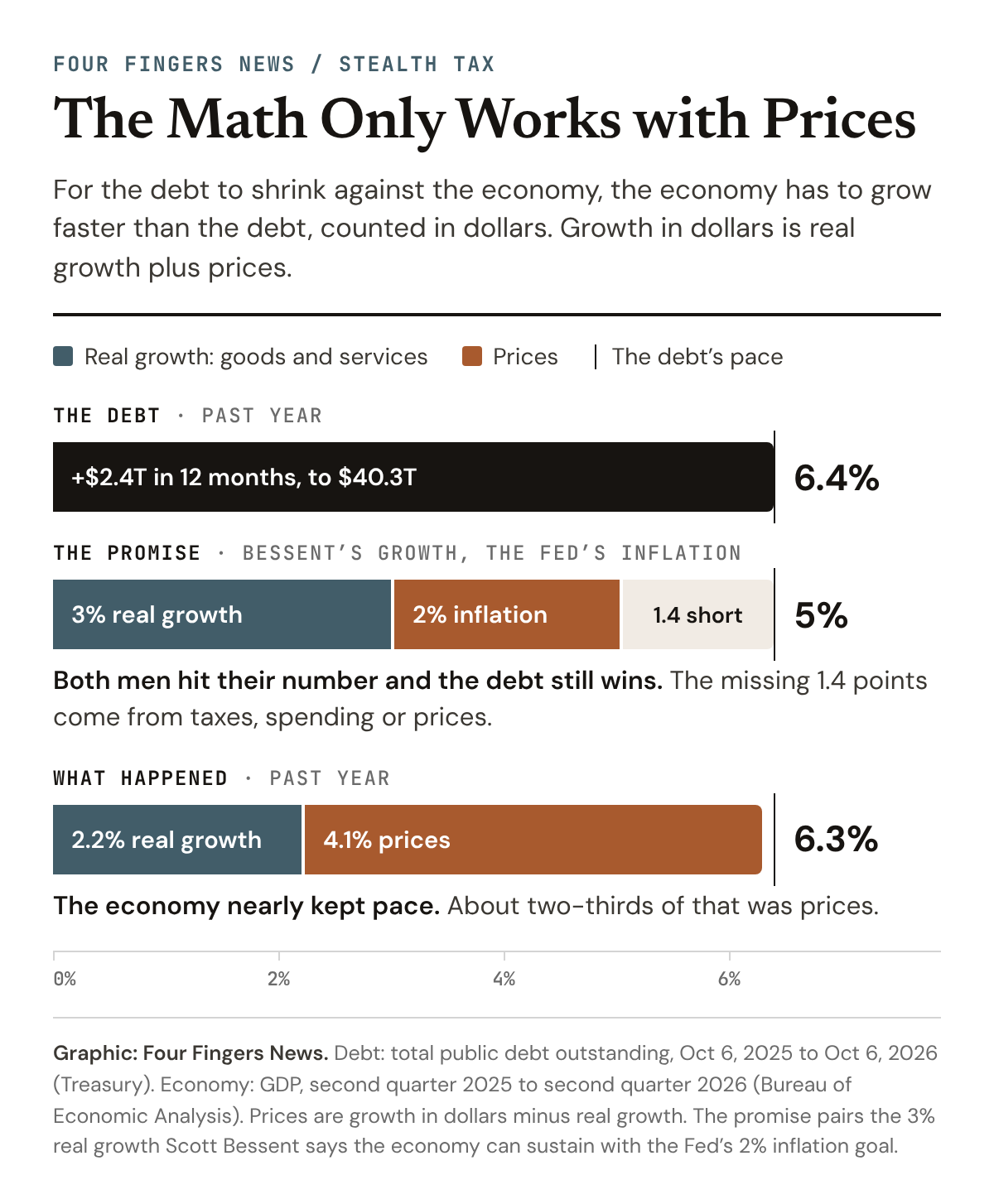
It’s been done before. In World War II, 85M Americans bought war bonds, $18.75 in and $25 back after 10 years. When a 1942 bond came due, the $25 bought about what $15 had. From 1946 to 1955 the debt went from 119% of GDP to 64% without being paid down. Growth did part of that. Prices did the rest. (USHMM · War bonds; BLS · Consumer prices; Treasury · Historical debt; FRED · Debt to GDP)
Today it’s collected from people who are paid in dollars and save in dollars. Real hourly earnings fell 0.3% over the year to August. Lenders can raise their price. A paycheck can’t. (BLS · Real earnings)
I’d love to go back to debating tax policy. Who should pay more, who should pay less. That argument assumes somebody gets a bill. For 25 years, under both parties and now in another war, nobody has.
Mr. Secretary: who pays for this one?
Somebody already is. It just isn’t called a tax.
The Warnings Were There
Israel’s border soldiers saw Hamas preparing and reported it. Intelligence had the invasion blueprint. The warnings reached commanders with the power to change the defense. They left it unprepared. My judgment is that those decisions allowed a known danger to become a successful attack. Three years after Al-Aqsa Flood, the soldiers’ accounts show how often the danger was brought to the command’s attention. (N12 · Soldiers’ interviews, Dec 3, 2023; New York Times investigation; IDF review · Nov 10, 2025; Reuters · Oct 10, 2023)
The border before October 7
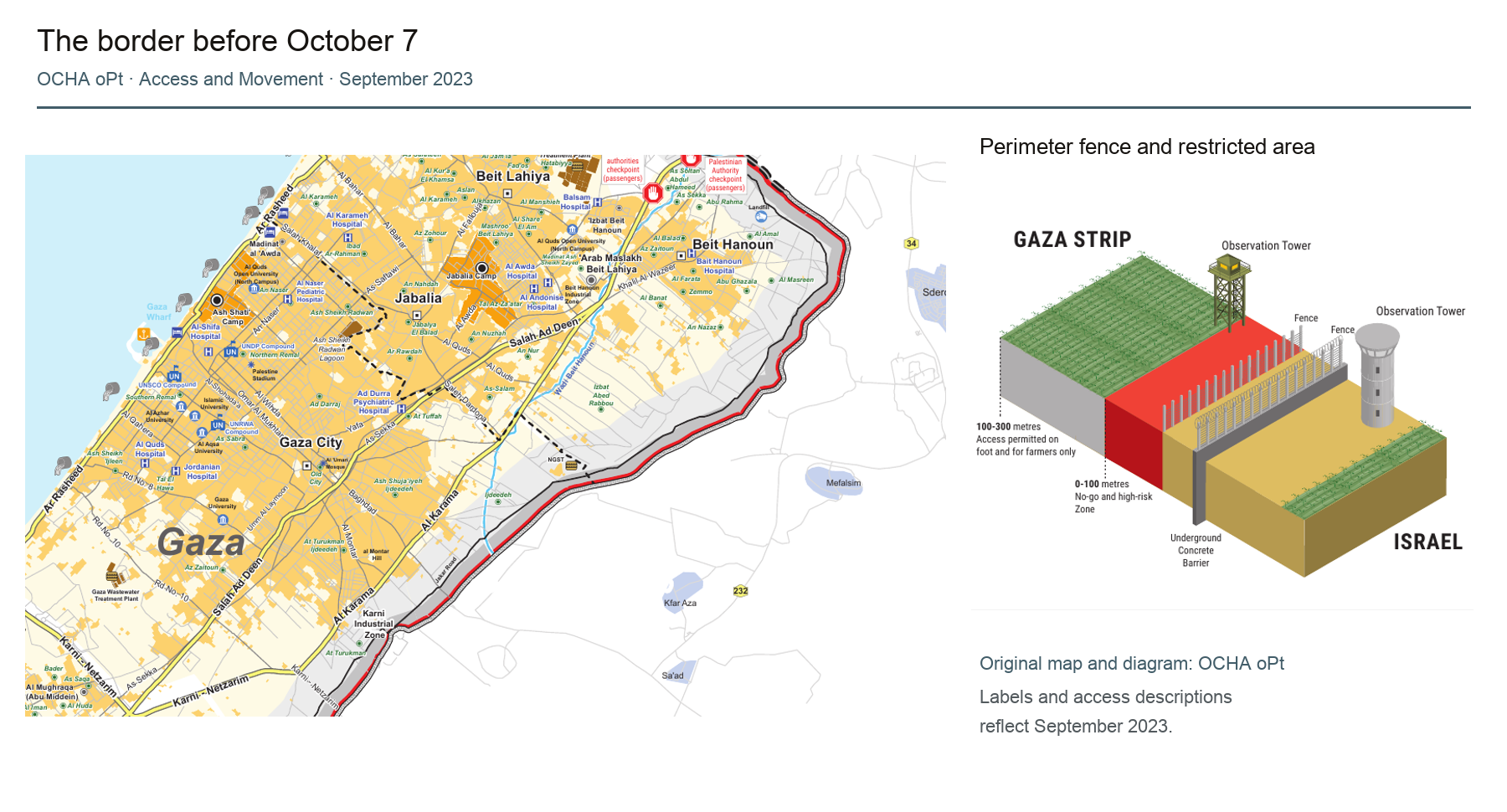
Roni Lifshitz described increasingly frequent convoys of Hamas fighters examining positions along the border, photographing and pointing. Margaret Weinstein described more crossings, shooting and disturbances. In their December 2023 interviews with N12, the soldiers described watching exercises that rehearsed breaching fences and kidnapping people, as well as explosives being planted near the border. Weinstein also said they’d repeatedly been briefed to expect a major event after Sukkot, in October. She said nobody had described the scale it would reach. These were soldiers observing preparations in the territory they were assigned to watch. (N12 · Soldiers’ interviews, Dec 3, 2023)
The observers describe what they reported

Some lookouts said they were threatened for continuing to raise the alarm. N12 reported in November 2023 that soldiers who escalated their warnings to a senior sector commander were told to stop bringing him what he called nonsense, or face disciplinary proceedings. The report didn’t name the soldiers or the commander. Their allegation describes an active effort to silence reporting from the border. (N12 · Reported threat, Nov 18, 2023)
Israeli intelligence also had the attack blueprint. The roughly 40-page document it code-named “Jericho Wall” described drones disabling border cameras and automated guns, then fighters crossing in large numbers to attack communities and military bases. Officials assessed an operation of that scale as beyond Hamas’s capabilities. In July 2023, a Unit 8200 analyst warned that a Hamas exercise closely followed the plan and demonstrated growing capability. A Gaza division colonel dismissed the scenario as “totally imaginative.” The plan gave no attack date; the warning concerned Hamas’s developing ability to carry it out. (New York Times investigation)
Then there’s the patrol order. Golani soldier Shalom Sheetrit told Arutz 7 in July 2024 that, at 5:20 a.m. on October 7, his deputy battalion commander radioed an instruction cancelling fence patrols until 9 a.m. Sheetrit recalled the commander saying he didn’t know why the order had been issued. He said he later received an explanation involving an anti-tank threat, which he questioned. He also said his own mortar platoon went on dawn alert. His account identifies a specific restriction before the attack; he declined to speculate about whether other platoons had been told to stay asleep. (Arutz 7 · Sheetrit interview, July 17, 2024)
Sheetrit recalls the 05:20 instruction

The radio instruction has since appeared in reporting on audio played at the Knesset. Ynet describes deputy commander Nir Boimflak relaying a brigade directive barring vehicles from the Burma route near the fence until 9 a.m., and reports a grenade-launcher and RPG threat as the reason. Ilan Kfir’s reconstruction, published by Ynet, describes Boimflak moving toward the fence after the attack began, ordering mortar fire and directing troops to defend Nahal Oz. Those accounts describe a pre-attack route restriction and combat orders once the attack began. The record doesn’t establish a general instruction to let Hamas through. (Ynet · Radio audio shown at the Knesset, June 2026; Ilan Kfir’s reconstruction · Ynet)
The military’s own November 2025 review found that unusual intelligence accumulated during the night before the attack could and should have prompted an alert. Southern Command hadn’t adapted troop numbers, readiness or operational plans to the threat. The Gaza division hadn’t raised its alert level or changed its force composition in response to the night’s information. The review also said the handling of intelligence over preceding years, including Jericho Wall’s wider operational implications, hadn’t been fully examined. Those are findings about decisions and preparation within the army. (IDF review · Nov 10, 2025)
In the critical hours before the attack, not a single significant action was taken among frontline forces or reserves.
Sheetrit responds to the Paga inquiry

Sheetrit lost a leg at Paga. In his Channel 13 interview last month, he described soldiers fighting with a single magazine of ammunition. He asked: “How is it that, three years later, nobody’s even in prison?” (Channel 13 · Sheetrit interview, Sept 24, 2026)
The Engine Room
Day 221. On Monday evening the master of a tanker leaving the Strait of Hormuz called the Royal Navy office that takes distress reports from merchant ships. An unknown projectile had hit his ship and set the engine room on fire. The crew was still fighting it. The first notice listed no casualties. (Maritime Executive, Oct 5)
A day later India and Oman reported a tanker hit in the same waters. It’s the On Peace, and 12 of its 19 crew are wounded. An Omani air force helicopter flew 10 of them to hospital in Khasab. Two shipping publications say the reports appear to describe one ship. India and Oman date the attack to Tuesday. (India’s statement via The Tribune; Maritime Executive, Oct 6; gCaptain)
The On Peace flies Panama’s flag. A Dubai company owns it, and a South Korean yard built it in 2021. Seventeen of its 19 crew are Indian. Nobody’s claimed the hit. Maritime Executive counts it as the 12th likely Iranian attack since last Wednesday. (Splash247; Maritime Executive, Oct 6)
India supplies about one of every eight seafarers on earth: 311,936 of the world’s 2.57M seafarers, second only to the Philippines. The International Maritime Organization (IMO), the UN’s shipping agency, has confirmed 93 incidents and 24 seafarers killed since the war began on Feb 28, 2026. The Wire, an Indian news site, puts the number of Indian seafarers killed around the strait at about a dozen. (BIMCO-ICS workforce report via Onmanorama; Splash247; The Wire)
They weren’t all killed by the same side. On Jun 10, 2026, an American warplane fired missiles into the engine room of the tanker Settebello in the Gulf of Oman. US Central Command said the ship was running its blockade of Iran’s ports, had ignored nearly 60 radio warnings and got 15 minutes to clear the engine room. A union leader said the crew told him they’d heard only general warnings they didn’t think applied to their ship. The New York Times reported that an engineer and a mechanic had just started their shifts there. Chief engineer Suresh Patnala, fitter Shivanand Chaurasia and trainee cadet Aditya Sharma were killed. (New York Times via GV Wire)
On Jul 14, 2026, the United Arab Emirates (UAE) said two Iranian cruise missiles had hit its tankers Mombasa and Al Bahiyah. An Indian sailor died aboard the Mombasa. On Sep 23, 2026, two projectiles hit the bulk carrier Cape Dao, one in the engine room and one in the crew’s quarters. Oman’s navy took 27 of the crew off. Suraj Yadav, a 26-year-old from Deoria in Uttar Pradesh, was killed. He was a wiper. A wiper cleans the engine room. It’s the first rung on the ladder. (Business Today; Maritime Executive, Sep 23)
The engine room is where a ship gets stopped. A Central Command spokesman told the Times that seizing a ship that resists is risky and it’s safer to disable it. Whoever’s aiming, that means the same compartment. Washington calls it enforcing a blockade. Iran’s Fars news agency says the Revolutionary Guard’s navy hit seven “violating” tankers in five days. (New York Times via GV Wire; Fars via IANS)
India tried the lever it had. On Jul 15, 2026, its shipping regulator barred owners from sending Indian seafarers through the strait. Three weeks later it lifted the ban. What it requires now is each seafarer’s consent. (Business Standard; The National)
Here’s the offer. The Financial Times reports that ordinary crew, who earn about $1,500 a month in normal times, are getting at least four to six times their usual wage to make the transit. Captains can earn about $100,000 a month plus $50,000 a crossing. Under the industry’s war-zone rules, a seafarer can still refuse the voyage and be sent home at the company’s expense. (Financial Times via investingLive; International Transport Workers’ Federation)
Shell’s chief executive said Tuesday that the region’s oil flows are back “close to 80-plus percent of prewar levels.” Nearly every barrel in that number leaves on a ship. Every ship has an engine room, and somebody’s on shift. (CBS News)
Hold My Bag
Anthropic’s prospective IPO could invite ordinary investors into a company valued above $2T. That’s the figure Reuters reported last week after reviewing its confidential prospectus. In March 2025, a private financing round valued Anthropic at $61.5B. By May 2026, another round put it at $965B. A tremendous increase in the company’s valuation has already happened before its shares reached a public exchange. Reuters, Anthropic’s March announcement, May announcement
There’s also a tremendous amount left to pay for. Reuters reported more than $8B in operating losses in 2025, even as revenue grew twelvefold to nearly $4.6B. Separate reporting put Anthropic’s computing and infrastructure commitments at $518B over a decade. About 80% is noncancelable or payable regardless of usage. Those obligations will belong to the business public investors are being offered a stake in. Financial reporting, infrastructure commitments
The debate will concentrate on whether Anthropic deserves that valuation. Congress helped change how much of a company’s growth could happen before ordinary investors had a chance to buy its shares.
Microsoft’s 1986 offering priced the company at about $519M, in that year’s dollars. Public shareholders could own it through decades of expansion. They had to recognize the opportunity, take the risk and keep holding. Plenty of other investments disappointed people. But someone with a brokerage account could buy Microsoft while much of the business we know today was still ahead of it. Original prospectus
That opportunity wasn’t simply a gift from generous founders. Rules helped bring companies into public ownership.
In 1996, Congress passed the National Securities Markets Improvement Act. Among its changes, it created a private-fund exemption that removed the existing 100-investor ceiling for funds whose investors met the more demanding “qualified purchaser” standard. Institutions had already been investing in venture capital. The change gave private funds more room to assemble large pools of money. SEC’s contemporary explanation
That mattered to a growing company’s choices. Raising serious money increasingly became possible without selling shares to the public. Research by Michael Ewens and Joan Farre-Mensa identifies the law as one of several changes that expanded late-stage private financing and helped companies stay private longer. Research
Then came the JOBS Act in 2012.
That’s the Jumpstart Our Business Startups Act. Somebody in Congress must’ve been very pleased when they got the letters to spell JOBS.
For companies with more than $10M in assets, the old threshold of 500 shareholders of record became 2,000 overall, or 500 who weren’t accredited investors. Qualifying shares issued through employee compensation plans were excluded from the count. A growing workforce could receive equity without pushing the company toward public reporting in the same way. SEC
The old rule required registration and financial reporting, rather than an IPO. But that requirement created pressure: once a company had to disclose its financial results anyway, an important advantage of remaining private had diminished. Goldman Sachs, which helped take Microsoft public, describes the approaching shareholder threshold as a factor in its decision. Goldman Sachs
Private share sales also give employees and early investors ways to turn equity into cash without a listing. Those transactions existed before the JOBS Act. Alongside larger pools of private capital and looser reporting thresholds, they reduce another reason to enter the public market.
The advantages for a company are understandable. Founders gain flexibility. Employees can get paid. Investors can negotiate deals without the full obligations of public ownership.
The consequence for someone building wealth through public stocks deserves equal attention. More of a company’s development can happen within a market they can’t readily enter. By the time an IPO arrives, years of financing rounds have established a much higher starting valuation for their investment.
Some ordinary savers have indirect exposure through pensions or funds. That’s different from being able to choose a company and buy its shares during that earlier period.
“Socialize the losses” is the concern this arrangement brings to mind. An IPO alone doesn’t establish a taxpayer bailout, and private investors have borne real losses along the way. But an offering can broaden who bears the next stage of risk. Where existing owners sell, it can also let them realize gains while new buyers take their place.
The offering’s terms will tell us how much money goes into Anthropic and how much goes to existing shareholders. Calling both “investment in the future” would obscure an important distinction.
Anthropic may build a business that rewards its public shareholders. That possibility doesn’t erase what changed in the meantime. Congress gave companies and private capital more freedom to decide how long early ownership would remain private. Ordinary investors’ access depended on those decisions.
For someone saving out of a paycheck, the March 2025 entry point won’t be available at the IPO. Their decision could begin above $2T, with a decade of computing bills still ahead.
Separate on Paper
In 1981, an Italian government fell after the exposure of a clandestine Masonic lodge. A published list contained 962 alleged members. Intelligence chiefs, politicians and senior military officers were caught in the scandal. The organization was called Propaganda Due, or P2.1
A parliamentary inquiry documented P2’s penetration of political, military and economic leadership, and its leader’s control over the newspaper Corriere della Sera.2
A government. Its intelligence services. A major newspaper. Separate institutions, connected through a private organization the public hadn’t known was there. The lesson isn’t simply that powerful people join clubs. It’s that power can be concentrated while the institutions exercising it still look independent.
That’s a different way to read an official biography. The title identifies someone’s public responsibility. It doesn’t necessarily reveal the relationships through which they were recruited, the people whose judgment they trust, or the institutions that helped form their priorities.
American intelligence drew heavily from precisely that kind of established social world. The wartime Office of Strategic Services (OSS), a predecessor of the Central Intelligence Agency (CIA), and the agency that followed it recruited extensively from the Ivy League, particularly Yale. Historian Robin Winks documented those connections in Cloak and Gown. The new intelligence institutions weren’t assembling their personnel from strangers. They were drawing on relationships that already existed.3
Yale also housed Skull and Bones. In 2004, both major-party presidential candidates, George W. Bush and John Kerry, were members.4

The affiliations reach into much older institutions. CIA director William Casey and former secretary of state Alexander Haig were members of the Knights of Malta, formally the Sovereign Military Order of Malta (SMOM).5
The order traces its origins to an eleventh-century hospital in Jerusalem. It maintains diplomatic relations with more than a hundred states and permanent observer status at the United Nations (UN). A medieval religious order and a modern intelligence agency can appear in the same biography. The job title alone doesn’t show the full set of relationships.6
It also issues its own biometric passports. The Order reports roughly 500 diplomatic passports in circulation for its leadership, diplomats and other authorized recipients. It says all 118 of its diplomatic partners accept them as valid travel documents. The Council of the European Union catalogs the passport in its official register, complete with watermarks and security features.78
Bohemian Grove shows what a private audience can offer a political career. Richard Nixon called his off-the-record speech there in July 1967 the “first milestone on my road to the presidency.” He also described discussing the coming primaries with Ronald Reagan during that visit. The Grove’s giant owl and ceremonial burning of an effigy called Care are real. So was the opportunity to address influential men away from the public campaign. The ritual attracts attention; the private access explains why it matters.9
The policy work has its own institutions. The Council on Foreign Relations (CFR) says its War and Peace Studies project produced 670 memoranda for the State Department between 1939 and 1945. David Rockefeller founded the Trilateral Commission in 1973 to bring people from policymaking, business, media and academia into continuing relationships. Private organizations weren’t simply watching government. They were developing advice for it and cultivating relationships across the professions that help explain and evaluate its decisions.1011
Other arrangements supplied operational muscle. In the late 1970s, the Safari Club brought together Saudi Arabia and partners including France, Egypt and Morocco for covert operations in Africa while Congress was restricting the CIA. Former Saudi intelligence chief Prince Turki al-Faisal later described their contribution at Georgetown as helping at a time when the United States couldn’t act. Congressional restraint and the capacity to continue operations existed simultaneously, in different parts of the network.12
Turki’s name later appeared alongside Peter Thiel’s in SafeGraph’s announcement of a $16 million financing round. Its product was geospatial data about physical places and their relationship to people. WIRED subsequently reported that company materials identified funding from In-Q-Tel (IQT) and an IQT investment executive on SafeGraph’s board. The CIA established IQT in 1999 to connect commercial technology with intelligence requirements. Here, the connection runs through financing and product development, not just a guest list. Intelligence agencies can help shape the technology that later reaches the market.131415
The World Economic Forum (WEF) supplied an unusually blunt description of its own ambitions. At Harvard in 2017, Klaus Schwab invoked Angela Merkel, Vladimir Putin and Justin Trudeau while discussing the Forum’s political reach. “We penetrate the cabinets,” he said, referring to its Young Global Leaders. Those names were part of Schwab’s claim, not a verified alumni list. What he chose to celebrate was the presence of people associated with his organization inside national governments.1617
These aren’t interchangeable cases. An intelligence investment, a social retreat and P2’s clandestine penetration of state institutions establish different things. But each challenges the habit of treating an official position as the whole story. The question is what the relationship enables: access, recruitment, policy development, financing or the exercise of power beyond the public’s view.
Consider the next policy announced by a government, endorsed by a think tank and welcomed by industry. Three institutional names don’t automatically amount to three independent judgments. Did they arrive separately at the same conclusion, or did the proposal move through relationships they already shared? Who financed the research? Who recruited the advisers? Who gets the contract? Those are questions that records can answer.
The stakes aren’t whether a few officials have unusual hobbies. They’re whether institutions that are supposed to scrutinize one another actually do so. A public asked to accept a consensus deserves to know how independent its authors were. And an election can change the person holding an office without changing the relationships that supply its advice, personnel and capabilities.
Knowing who holds the office isn’t the same as knowing whose influence enters with them.
$5,000
The president keeps coming back to 1929.
Donald Trump’s $5,000 payment promise and 1929 warning · October 3, 2026. Source: Dialogue Works, 39:51–41:04.
Trump keeps returning to Herbert Hoover. In his July 2 CNBC interview, he said, “I don’t want to be a president with a depression on his resume,” and repeatedly named Hoover as the president he doesn’t want to become. Interview transcript.
Hoover was a Republican, with Republican majorities in both chambers when the Depression began. House history. Banking panics and Federal Reserve mistakes helped deepen the collapse. Congressional party control alone doesn’t explain what happened. Federal Reserve history.
Now Trump promises every adult citizen $5,000 if Republicans keep the House and Senate. Elect Democrats, he says, and the result will be “an economic depression much like 1929.” His own term isn’t on November’s ballot. Oct 3 video.
Five thousand dollars would matter to plenty of households. The appeal doesn’t need explaining.
Read alongside the Hoover remarks, the warning sounds to me like an attempt to assign responsibility for a possible collapse before it happens. He’s named the presidential reputation he wants to avoid. The new clip points to higher taxes, without explaining which tax changes would produce the disaster he’s forecasting.
The Grandson
Day 217. Saudi Arabia is 94 years old and named after a family. Its founder, Abdulaziz ibn Saud, took Riyadh in 1902 with 40 men. For years his lands were a British protectorate, and he drew a British stipend of £5,000 a month. Later the protector was American. (Treaty of Darin; British subsidy; Bitter Lake)
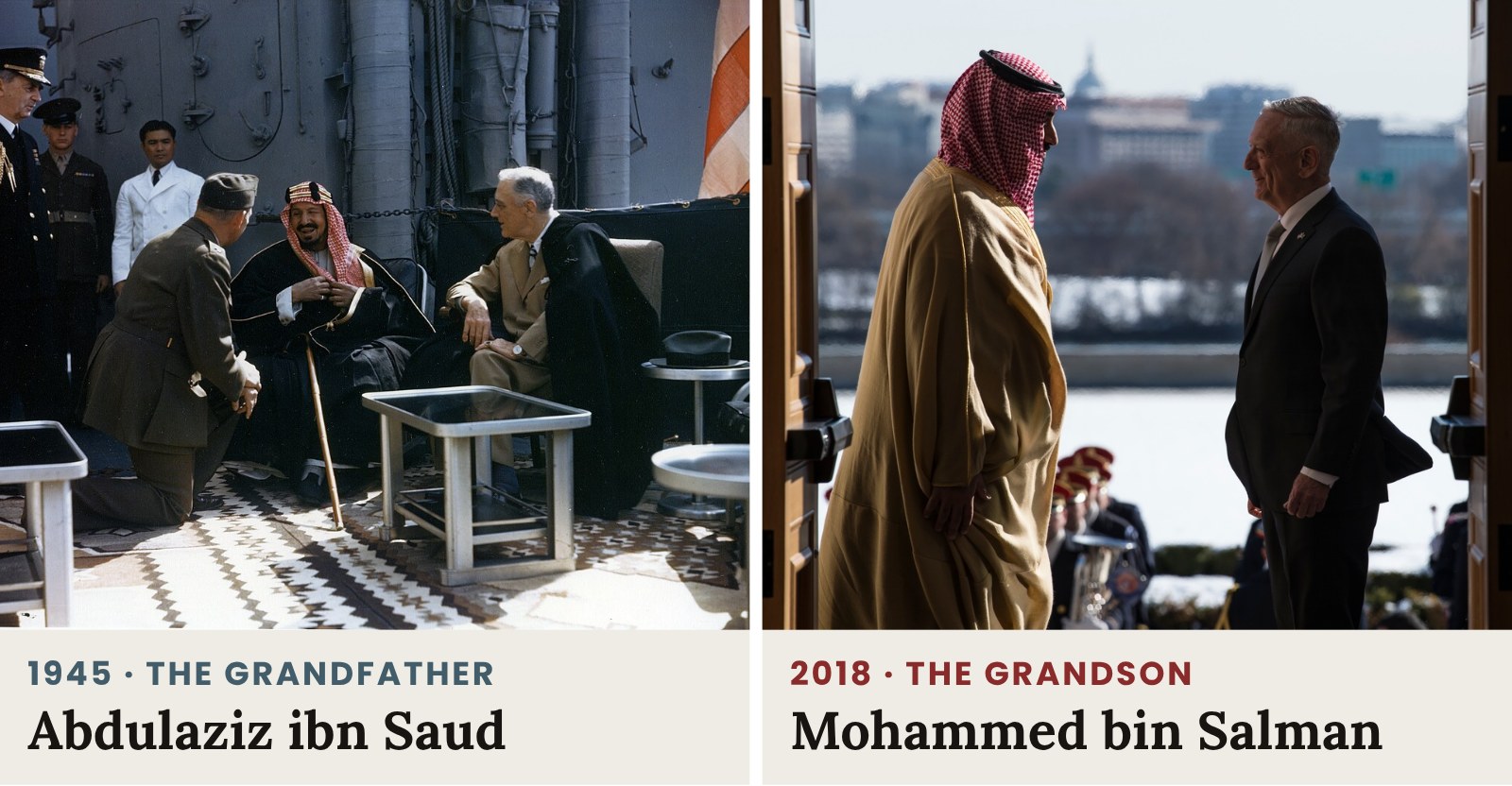
He had at least 22 wives and 45 sons. He took a wife from each tribe he conquered. I’m sure he was a great son-in-law. One wife, Fahda, was the widow of a rival dynasty’s emir. Her son grew up to be King Abdullah. (PBS; Abdullah’s family history)
Every Saudi king since 1953 has been one of the founder’s sons. The first grandson to run the place is Crown Prince Mohammed bin Salman (“MBS”). Here’s his record.
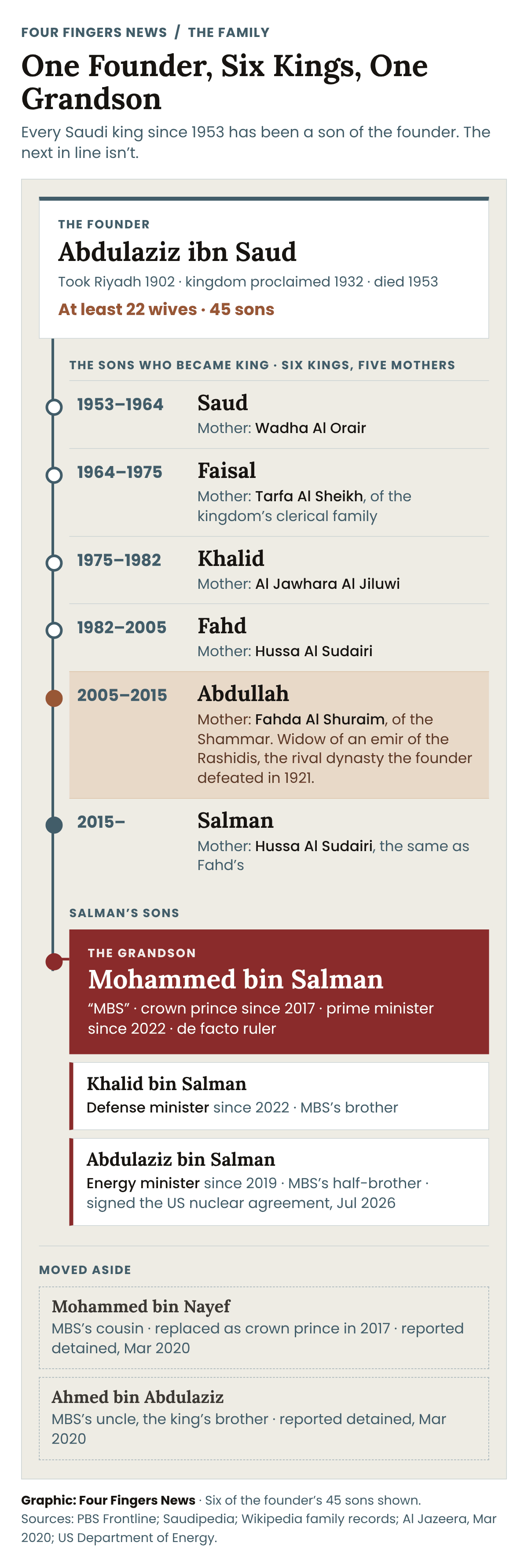
Eight years ago today, a 15-man Saudi team killed the journalist Jamal Khashoggi inside the kingdom’s Istanbul consulate and cut up his body. His remains were never found. US intelligence concluded MBS “approved an operation in Istanbul, Turkey to capture or kill” him. He denies ordering it. (US intelligence assessment; RSF)
“We assess that Saudi Arabia’s Crown Prince Muhammad bin Salman approved an operation in Istanbul, Turkey to capture or kill Saudi journalist Jamal Khashoggi.”
Read the original document
In 2017 MBS replaced his cousin as crown prince. Five months later, hundreds of princes and businessmen were locked in the Riyadh Ritz-Carlton. The New York Times reported that at least 17 detainees needed hospital treatment for physical abuse. One general died in custody; a witness described his neck as twisted. In 2020 the detainees included that same cousin and MBS’s own uncle, the king’s brother. (Human Rights Watch; Al Jazeera)
As defense minister in 2015 he took the kingdom into Yemen’s war. UNDP estimated the war’s toll would reach 377,000 by the end of 2021, most from hunger, disease and other indirect causes. (UNDP)
Ansarallah governs about 70% of Yemen’s people. This July, after four years of relative calm between it and Riyadh, a Saudi-led strike disabled the runway at Sanaa airport to stop an Iranian plane from landing. People have lived in Sanaa for more than 2,500 years. An Ansarallah official said Riyadh had “dug its own grave.” (AP; World Bank; UNESCO; Ynet)
Since then, Ansarallah has hit Saudi oil facilities and seized Mokha and islands at the entrance to the Red Sea. The kingdom is preparing another offensive. MBS asked Washington for airstrikes. Washington said no, for now. (AP; Reuters)
In July MBS’s half-brother, the energy minister, signed a nuclear agreement with the United States. It doesn’t bar Saudi Arabia from enriching uranium. The administration says it has the safeguards the law requires. MBS told Fox News that if Iran gets a bomb, “we have to get one.” (Department of Energy; Reuters; Al-Monitor)
Iran’s history of statehood reaches back some 2,500 years. Saudi Arabia turned 94 last week. (Britannica)
A Senate vote is expected before Dec 13. Senators: which line of that résumé says trust him with enrichment?
Watch: The Crown Prince of Saudi Arabia
FRONTLINE · Oct 1, 2019 · 1 hr 54 min · Correspondent Martin Smith
Sending the Metal
Day 216. Two Georges hold the Arabian Sea, and a Teddy is on his way.
The George H.W. Bush and George Washington carrier groups are already on station. The Theodore Roosevelt left San Diego on Sunday, and a day behind it came the Makin Island and two more ships carrying about 2,200 Marines and sailors of the 13th Marine Expeditionary Unit. It’s a landing force that brings its own stealth jets. (USNI News, Sep 28, 2026; USNI News, Sep 29, 2026)
The metal already out there isn’t small. The Naval Institute’s tracker names 26 American hulls between the Mediterranean and the Indian Ocean, 16 of them in the Arabian Sea, on the doorstep of a strait that carried a fifth of the world’s oil before the war. The Roosevelt’s four escorts add roughly 400 missile tubes. The ships named in USNI’s September 28 regional tracker are drawn to scale below. (USNI fleet tracker; EIA; The War Zone)
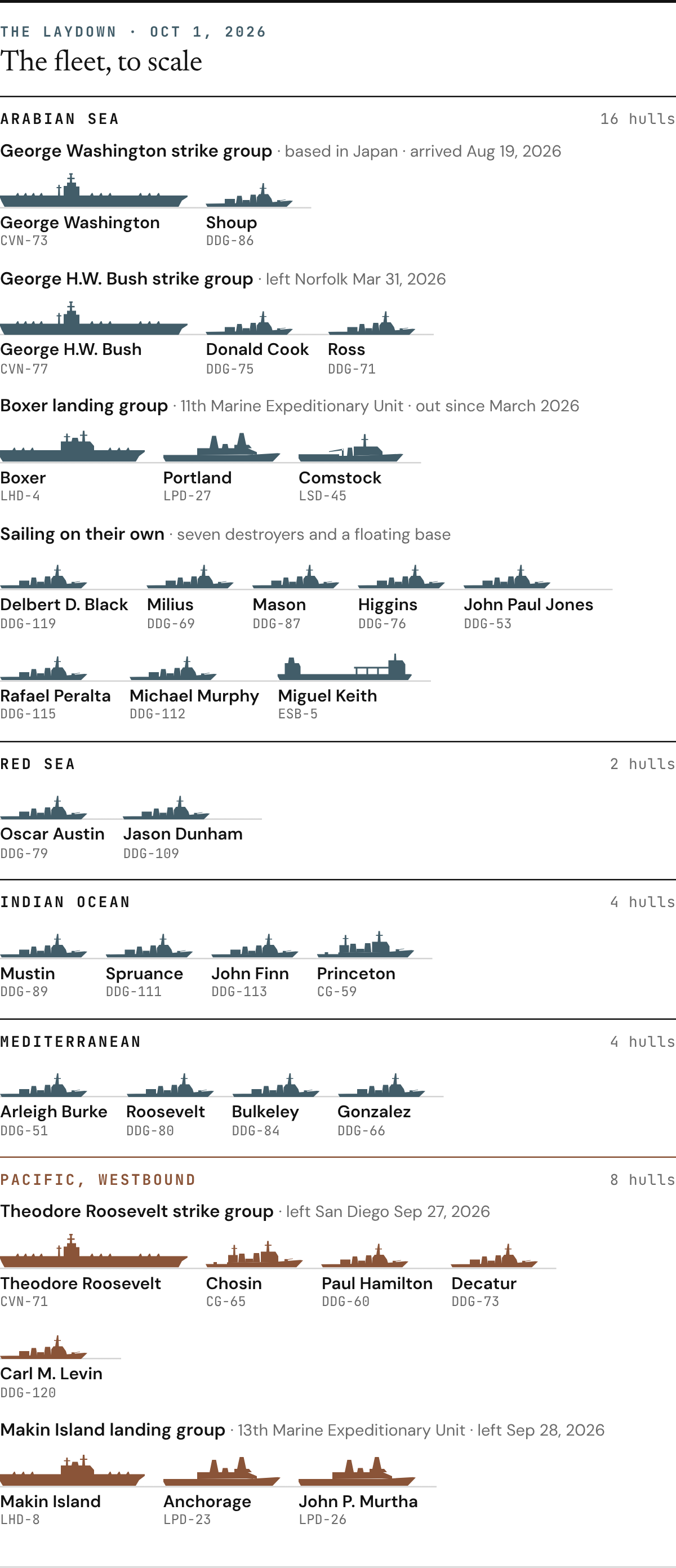
If nobody goes home when the Roosevelt arrives, three American carriers will be working the same theater. That happened for eight days in spring 2026, and it was the first time since the invasion of Iraq in 2003. (Al Jazeera, Apr 24, 2026; The War Zone, May 4, 2026)
The unofficial word is “options.” On the record, the Roosevelt is expected to relieve a carrier that’s already there, and a Navy official called the Marines’ sailing a “scheduled deployment.” The Jerusalem Post, reporting the deployment from an unnamed US official, describes the result as “a wider range of options for potential action against Iran.” Arrival estimates differ, so the timing of any overlap remains uncertain. So the Navy is sending a 100,000-ton option with more combat aircraft on its deck than many national air forces own. (Jerusalem Post)
Iran brought a seven-day roadmap to the United Nations: the blockade of its ports lifts, the frozen money moves, and on day seven the strait reopens and the talking starts. Washington’s official answer went back through the mediators and hasn’t been made public. The answer anyone can see is a third carrier and a landing force. In the strait on Thursday, a tanker was burning, hit by a projectile nobody has claimed. (Al Jazeera, Sep 26, 2026; AP via Arab News; UKMTO via Arab Times)
The timing is the tell. TIME asked Trump whether he’d ramp up the bombing after the midterms. “Possible,” he said. And the buildup itself arrived as a leak: at least five outlets on Thursday, every one of them citing officials who wouldn’t be named. You don’t have to trust the messenger to read the message. When Washington wants Tehran to see something, it prints it. Tehran does the same; three senior Iranian officials told Reuters their commanders are reviewing a longer target list. The story is the message. The carrier is the underline. (TIME; AP; Bloomberg; Al Jazeera via Newsquawk; Reuters via Cyprus Mail)
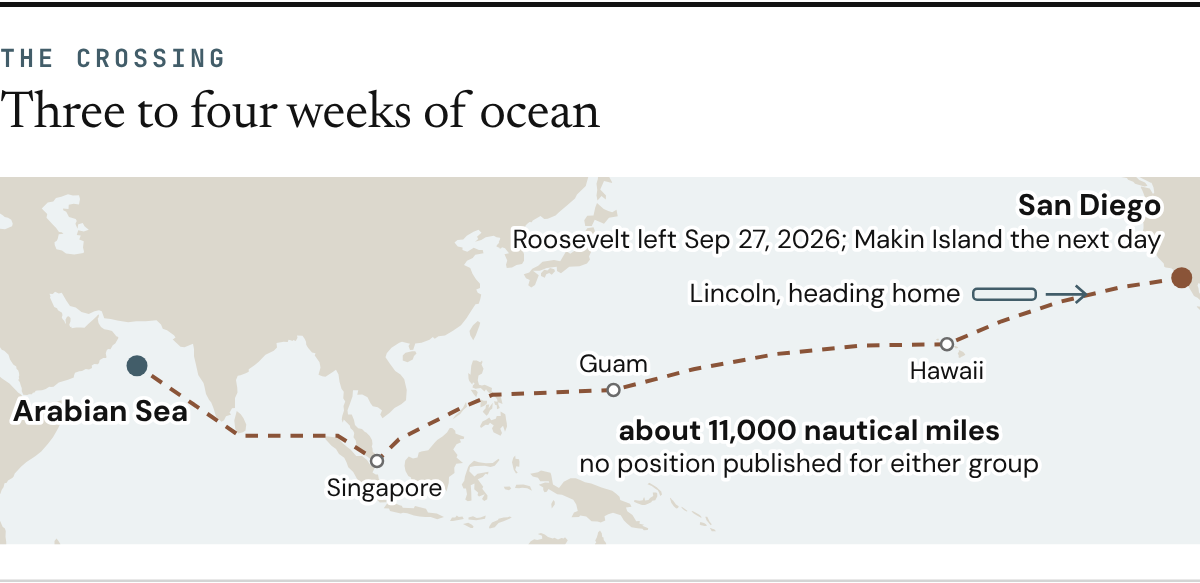
Teddy Roosevelt’s advice was to speak softly and carry a big stick. The ship that bears his name is nicknamed the Big Stick, and it’s crossing the Pacific on behalf of a president who has never once tried speaking softly.
September 2026 29 notes
The AI Boom Has a Landlord
New Mexico has a history with chain reactions. This one comes with lease payments.
A data center is a building that makes money only when the power arrives. Oracle’s New Mexico site, Project Jupiter, learned that the hard way: the 17.8-mile gas pipeline that feeds the plant lost its state right-of-way twice, got rerouted across federal land, and now arrives in February 2027 instead of August 2026 — a longer wait for electrons, and an unchanged stack of bills (CryptoBriefing, Aug 18; Reuters, Sep 24). The building keeps costing whether or not the lights are on. That’s what it means to be the landlord.
Oracle’s the AI boom’s landlord. It borrows like a utility, builds like a developer, and rents compute to the companies having the boom. And the landlord’s problem is old and unforgiving: the rent has to cover the mortgage. Here’s the mortgage. Debt past $125 billion. Free cash flow last year near negative $24 billion. Capital spending that ran $56 billion last fiscal year and $28 billion in the latest quarter alone. And in an SEC filing, $288 billion of lease commitments — nearly all data centers — that start between this quarter and fiscal 2029 and then run 15 to 19 years each, none of it on the balance sheet yet (company filings). In July, S&P cut Oracle to BBB-, one notch above junk. A further downgrade doesn’t just raise the interest bill; it could force some institutional holders to sell, whether they like the AI story or not.
Here’s the rent. Oracle sold $18 billion in bonds in September 2025, the same month a cloud contract with OpenAI worth roughly $300 billion over five years was reported. OpenAI burns cash rather than producing it, reportedly expects to burn $278 billion from 2026 through 2030, and has pushed its listing out of this year (FT via Reuters, Sep 18; Fortune, Sep 12). A lease is a promise about the future, and the future tenant’s still raising the deposit. Bondholders sued in January, saying the full scope of the financing needs wasn’t disclosed when they bought in.
And here’s the meter. On Sep 24, five-year credit default swaps on Oracle traded at 227.5 basis points — a record — meaning it costs $2.28 a year to insure $100 of Oracle debt, more than four times the investment-grade index (Barron’s, Bloomberg data; Reuters). Trading in tech-name CDS reached nearly $650 million in the second quarter, up almost 600% from a year earlier, and in February JPMorgan began selling a basket of swaps on five hyperscalers — Alphabet, Amazon, Meta, Microsoft and Oracle — as a standalone product (DTCC; Reuters; CryptoBriefing, Aug 12). Oracle also sent a force majeure notice on Project Jupiter, its flagship build — the clause you invoke when you need the contract to forgive what physics or finance won’t. Look at who got the notice: Blue Owl, the asset manager that owns the developer building Jupiter. Oracle is landlord to OpenAI and tenant to Blue Owl, and this is the tenant asking to defer the higher rent that kicks in once the building is running. Oracle says the project remains on schedule. Ask who’s writing the other side of all that insurance, and you have the only question in this story that matters.
The exposure isn’t one company’s spreadsheet: the five biggest spenders are on pace for combined 2026 capital spending near three-quarters of a trillion dollars, much of it bond-financed, and Alphabet last quarter posted the first negative free cash flow in its 22 years as a public company. The boom’s landlord is leveraged, its biggest tenant is unprofitable, its power is late, and its insurance bill just hit a record.
The boom has a landlord. The landlord has a mortgage. The mortgage doesn’t wait for power.
Zoom In
Open Google Maps, switch to satellite, and go to Rafah. As of this weekend you can. Google quietly replaced its Gaza tiles with imagery from as recently as June 2026, and the internet spent Sunday panning across it.
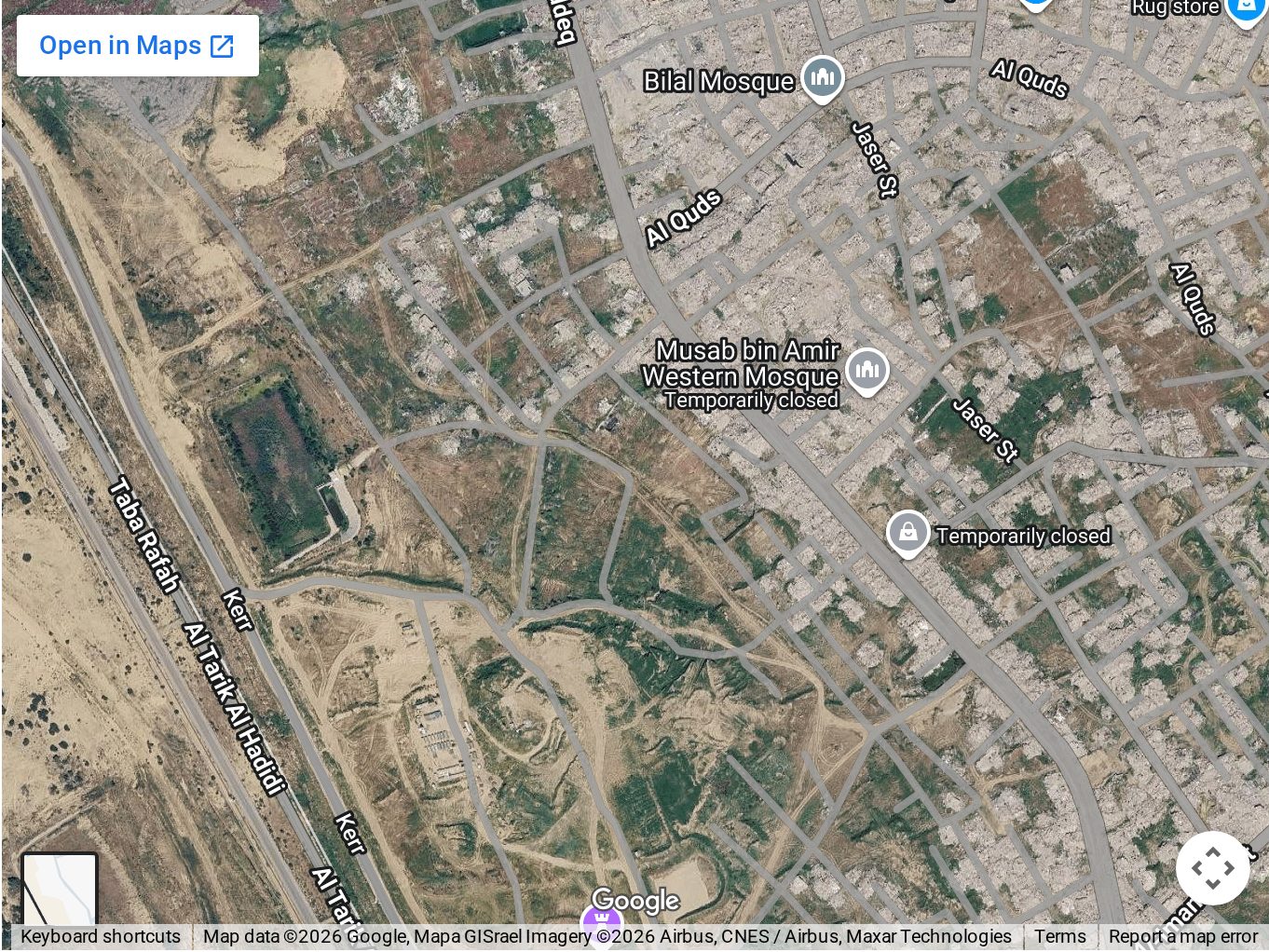
That took a while. From 1997 to 2020, US law capped commercial satellite imagery of Israel and the Palestinian territories at two meters per pixel. Gaza was a blur on every map app through three wars while Seattle was sharp enough to count cars. The cap lifted, the sharpness arrived, and this is what it shows. (NOAA on the 1997 limit; 2020 notice lifting it)
The UN’s satellite unit puts the damage at 82% of all structures in the Strip, just over 200,000 buildings, and counts 134,422 of them destroyed outright, more than half of everything that stood before the war. From a drone it stops being a percentage. (UNOSAT; UN News, Aug 13, 2026)

I wanted to know whether the worst-hit cities of the Second World War looked like this. They did.
| People | Share destroyed | How long | |
|---|---|---|---|
| Warsaw, 1939–45 | 1.3M | 85–90% | six years; nearly half of it demolished after the fighting stopped |
| Hamburg, 1943 | 1.7M | 75% | one week |
| Cologne, 1940–45 | 0.8M | 61% | five years; 262 raids |
| Dresden, 1945 | 0.6M | 59% | two nights |
| Berlin, 1940–45 | 4.3M | 33% | five years; 314 raids, then the ground battle |
| Gaza Strip, 2023–26 | 2.1M | 82% damaged, over half destroyed | three years, still rising |
Hamburg had about 1.7M people in 1939. Gaza had 2.1M in 2023, more people in half the space. Operation Gomorrah ran eight days and seven nights in July 1943 and killed somewhere between 34,000 and 40,000; a million people left the city that week. Gaza’s three years have killed 74,000 by the Gaza health ministry’s count, the only running tally there is; the UN uses it, and Israel has never published its own. 1.9M people are displaced. Hamburg’s happened in a week. Gaza’s has run three years, and more than 1,100 people have been killed here since the October 2025 ceasefire. (Hamburg; Gaza · Ground Truth)


The number of destroyed buildings kept climbing after the guns stopped too. The UN says destroyed structures rose 9% after the October 2025 ceasefire, and Al Jazeera’s satellite unit found demolitions in Shujayea, Tuffah and Rafah through mid-December 2025, inside the 58% of the Strip Israel holds behind the yellow line. The IDF says those demolitions fall within the ceasefire and answer active threats, mostly tunnels under buildings and risks to its troops. There’s a Gaza tab at the top of this site, updated daily, and in 213 of these notes I’ve never written about it. The map doesn’t need me to. (UN News; Al Jazeera Sanad, Dec 15, 2025)
The UN Development Programme ran the rubble clearance after the 2009, 2014 and 2021 wars: 2.8M tonnes, all three combined. This war has left 61M tonnes. The agency’s best case for clearing most of it is seven years, and in August 2026 the UN said its partners still lacked the permissions and equipment to remove the unexploded ordnance inside it. (UNDP; UN News, Aug 13, 2026)
More footage


Of Course We Have a Base There
Day 213. One of the places helping sustain America’s war against Iran is this dot in the Indian Ocean.
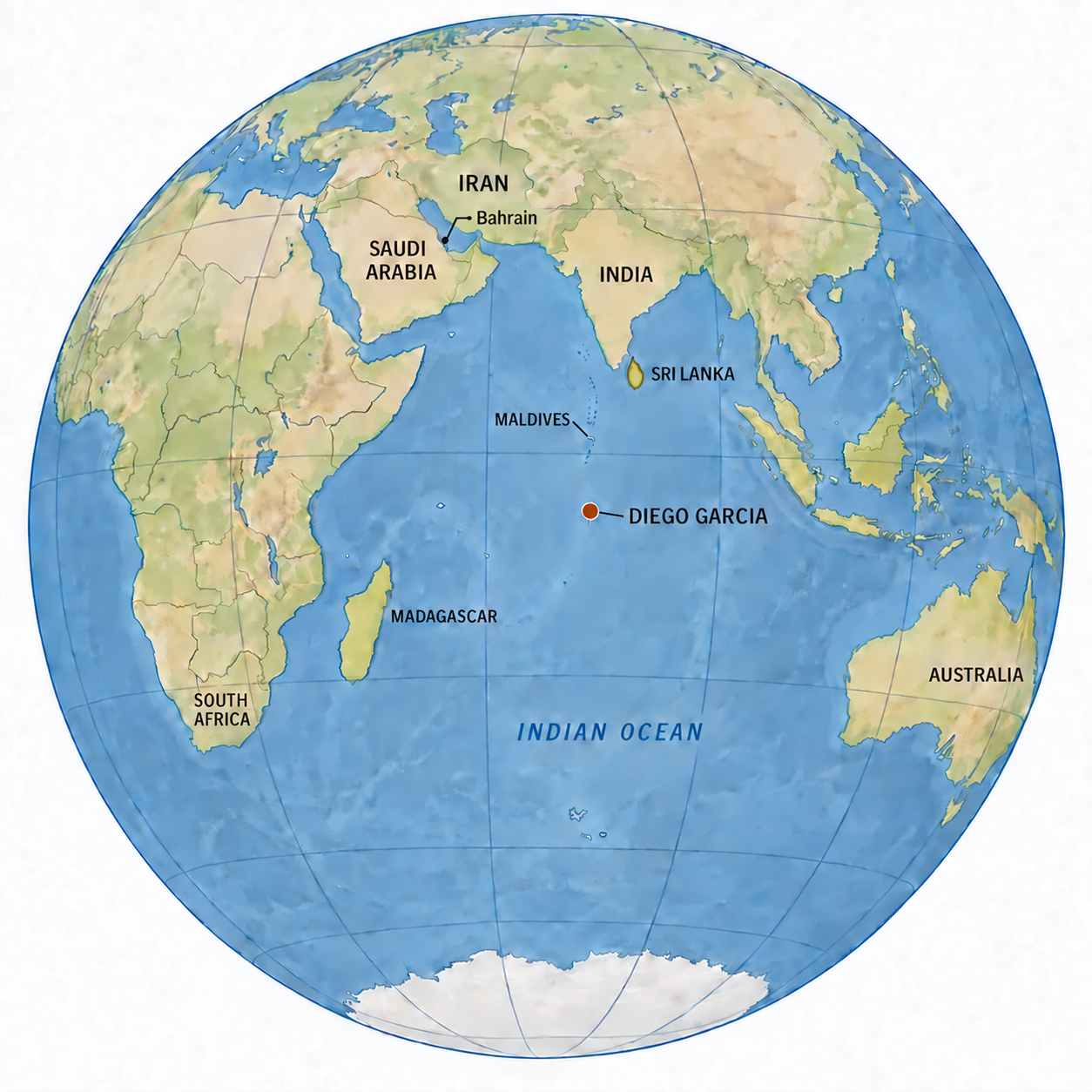
South of the Maldives, surrounded by an enormous amount of water, there’s an American military base on British-controlled territory.
Of course there is. A country that expects to fight almost anywhere has to spend a great deal of time arranging how to get there.
Britain acquired control of Diego Garcia from France in 1814. The American foothold came through a 1966 agreement with Britain. A 1970 Navy memorandum described the strategy as “stockpiling of islands for contingency use of the U.S.” (House of Lords; Navy memorandum)
Stockpiling islands. Securing useful places before the occasion to use them arrived.
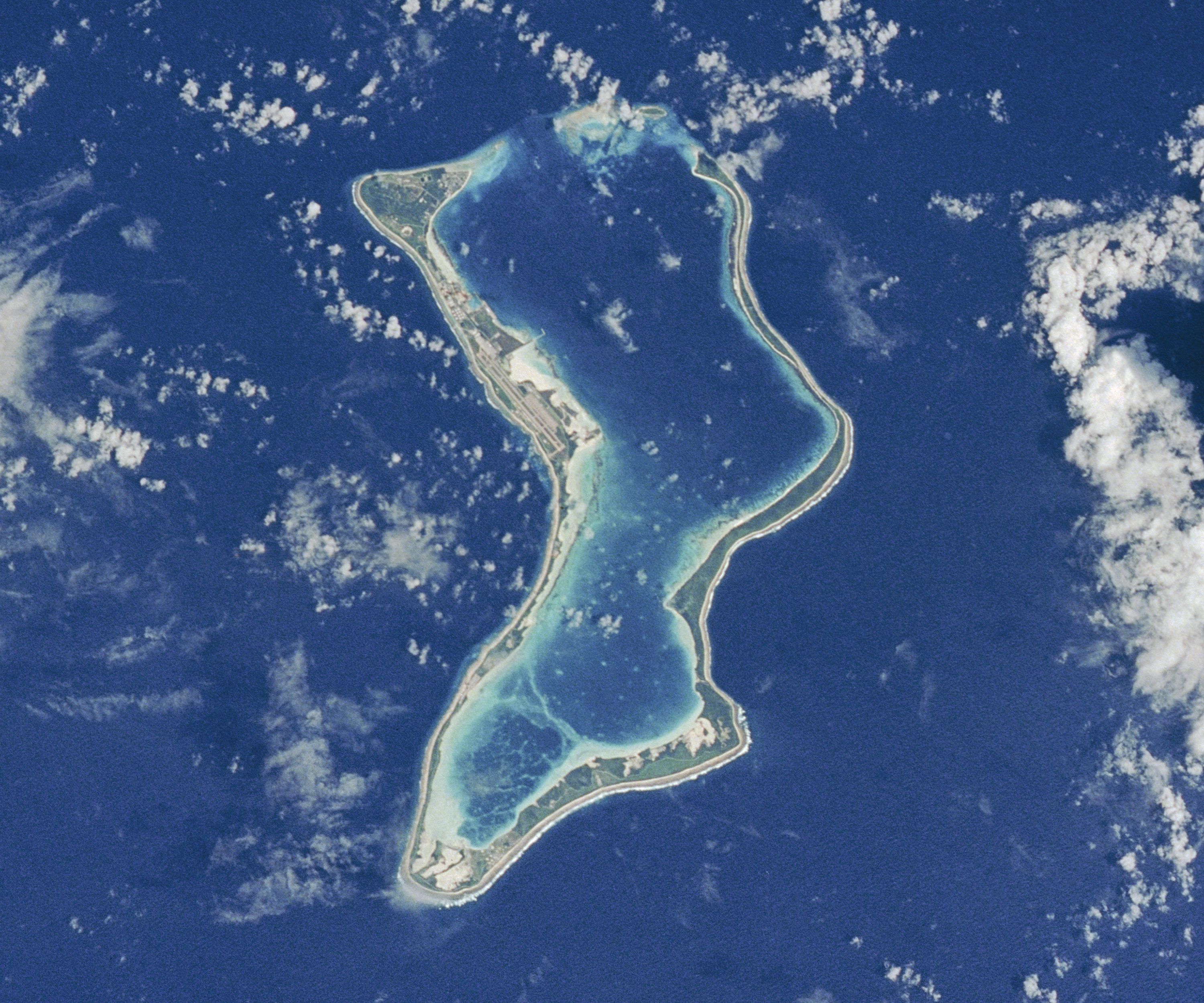
The island’s position mattered to planners concerned about Soviet naval activity and continued access to countries around the Indian Ocean. By 1977, a National Security Council assessment explicitly described its expansion as preparation for circumstances in which coastal facilities became unavailable. (NSC assessment)
Over time, the preparation took physical form.

This war has supplied one of those contingencies. After Iranian attacks badly damaged the Navy’s logistics hub in Bahrain (Navy 5th Fleet HQ), the fleet turned to Diego Garcia, more than 2,000 miles from the carrier forces it was supplying. The distance complicated replenishment, but the alternative hub already existed. (Navy Times)
A 2025 inventory by World BEYOND War counted 877 U.S. foreign military bases and sites. Diego Garcia is one of them.
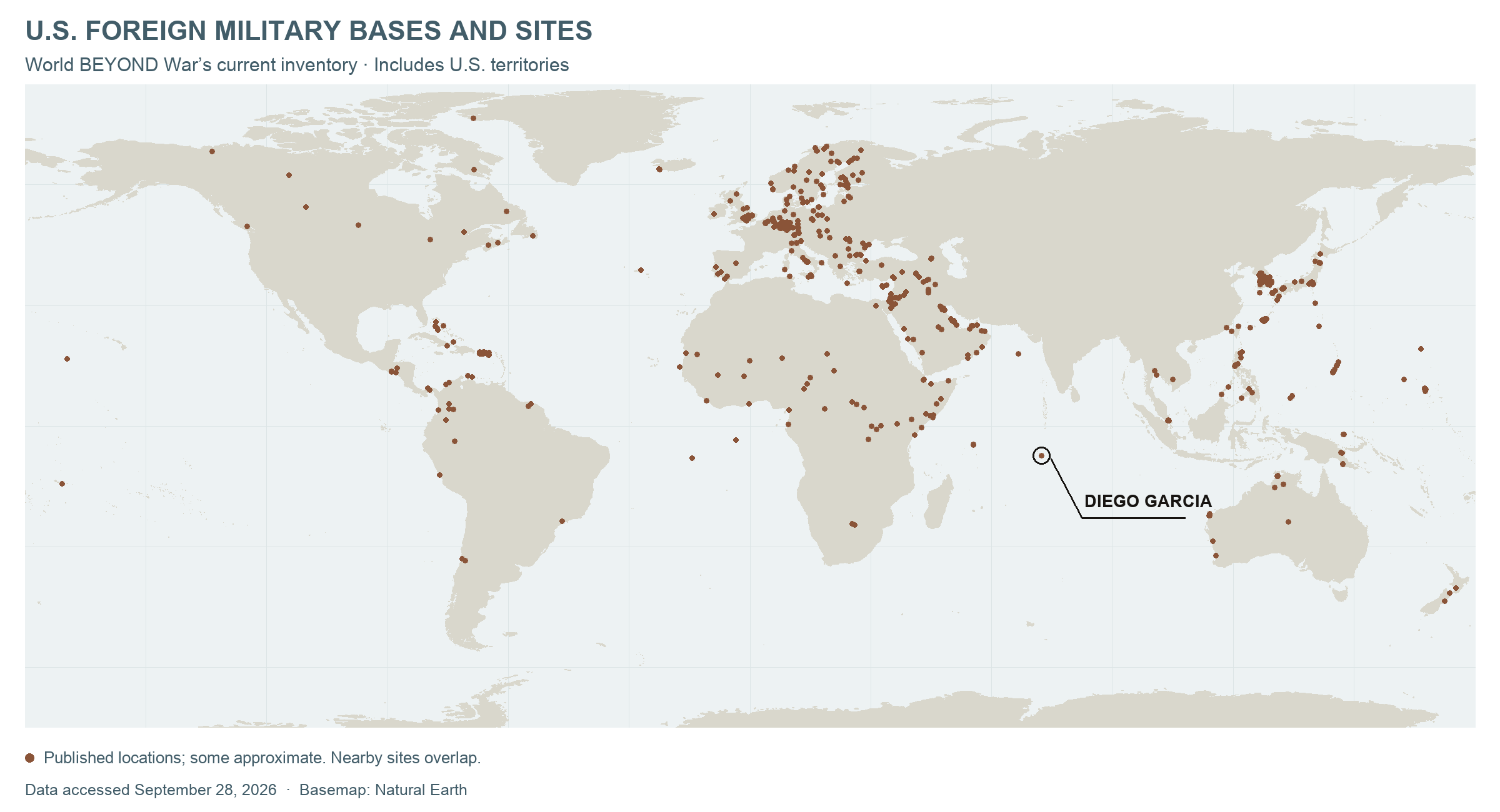
Presidents inherit all that preparation. Long before a particular crisis arrives, someone has secured access, built the runway and arranged the fuel. Using force becomes an option with an enormous amount of work already behind it.
That readiness can shape the choices we consider. Bombing a distant country starts to feel like an ordinary instrument of policy. The danger is a foreign policy with a hair trigger, because we’ve spent generations making sure the weapon can reach.
State Television Arrives at the 50-Yard Line
Day 212. There’s an unwritten pact between the American television viewer and Sunday football. For about three hours, the nation gets a ceasefire. We mute the culture war and route our collective blood pressure into arguing about defensive pass interference and missed field goals.
The commercials are supposed to honor that. Pickup trucks towing boulders up impossible cliffs. Light beer poured in high-definition slow motion. A gecko trying to save you 15%. Crass consumerism, sure, but harmless. It’s part of the ritual.
Then Fox breaks away from the Seahawks.
In black and white, Donald Trump walks a hallway toward the camera. The voice isn’t pitching low-interest financing. It’s his: “This is the final battle.” “We will cast out the communists, Marxists, and fascists.” “We will rout the fake news media.” If it sounds familiar, it should. The audio echoes his 2023 Veterans Day speech and nearly mirrors a campaign video he posted to Truth Social in January 2024. Your brain waits for the boilerplate: I’m Donald J. Trump, and I approve this message, then a PAC address in Alexandria, Virginia.
But, no, instead, a quiet strip of white text: Paid for by the U.S. Government.
Wait, did that ad just say it was paid for by the government?? The executive branch just ran a stump speech on the public tab between a beer commercial and a punt return. By AdImpact’s count, it’s the third one.
The White House calls it a public service announcement, “educational and unapologetically patriotic.” Defending an earlier spot, a spokesperson laid out the legal theory plainly: “The President is not on the ballot and the ads don’t have a call to action.” By that logic, a recycled campaign speech sits in the same civic drawer as Smokey Bear and a Medicare enrollment reminder.
It takes contempt to say that with a straight face. It also takes the wrong rulebook. “On the ballot” and “call to action” are campaign-finance tests, the magic-words standard that governs PACs and outside spenders. They don’t govern how an agency spends its appropriation.
The spending rule dates to 1951, when Congress began adding this restriction to appropriations bills: no appropriated money for “publicity or propaganda purposes” it hasn’t authorized. GAO reads that rider narrowly, and it’s flagged administrations of both parties under it. The test is whether the government is informing the public or promoting itself. A stump speech with no program, no deadline and no phone number isn’t informing anyone. It’s the self-aggrandizement the rule was written for, five weeks before a midterm.
The Washington Post reports more than $300,000 spent on “Final Battle,” citing AdImpact. Campaigns are paid for by people who choose to give. The government is paid for by everyone: the fan who reveres the man, the one who reviles him, and the one who just wanted to watch the game.
The Price of Passage
A ship paid $5.3M to secure a passage through the Panama Canal earlier this month. That was the auction premium for a reservation, on top of the ordinary toll. The gas carrier G. Spirit made its crossing on Sep 1. (Reuters, Reuters column)
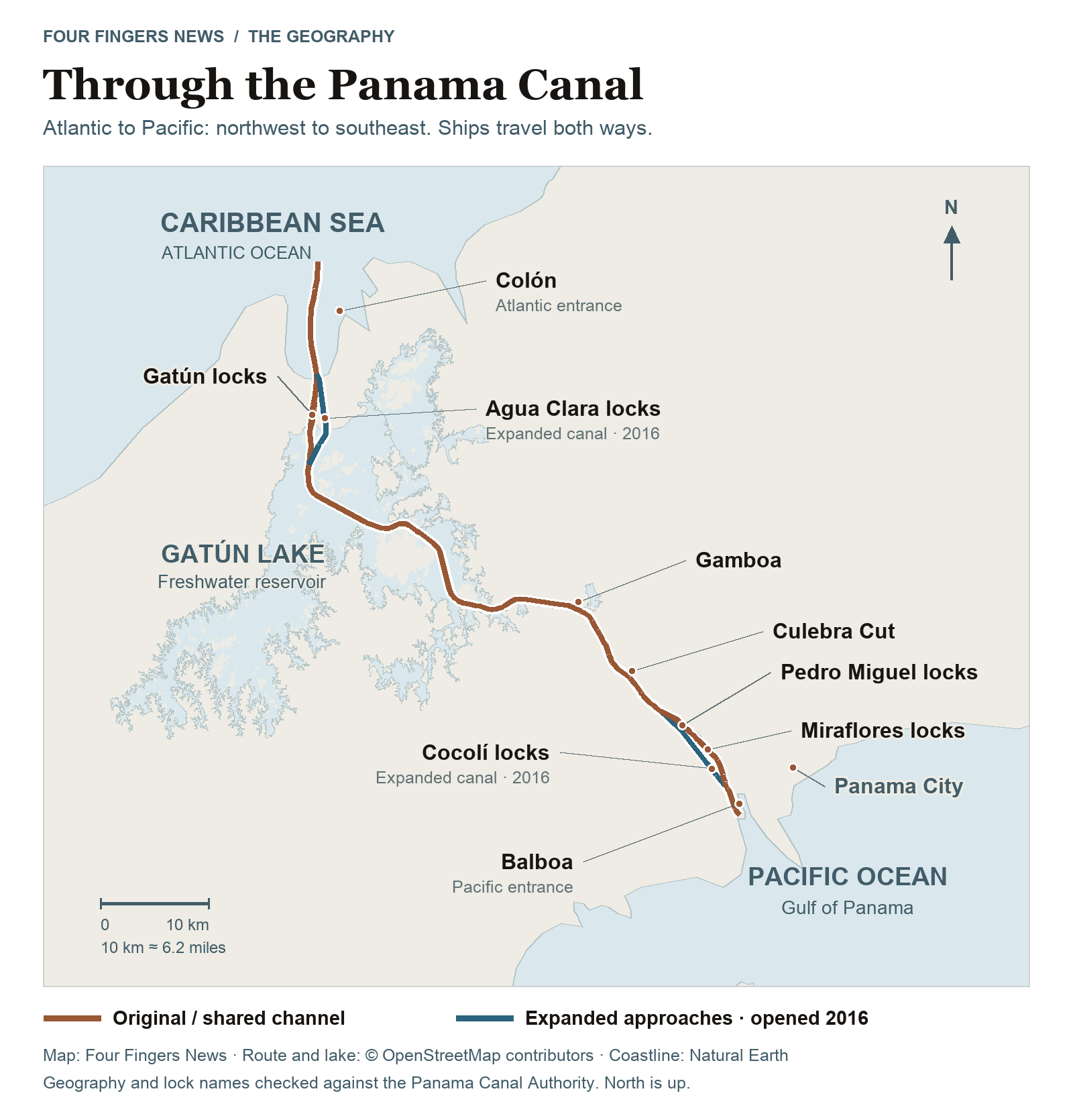
The Iran war helps explain the demand. Disrupted Gulf shipping has pushed more energy cargoes toward Panama, where low rainfall has constrained the freshwater supply the locks depend on. A route that offers relief from one crisis has limits of its own. (Reuters)
Panama also has a history worth keeping beside those shipping figures. The U.S. invaded on Dec 20, 1989, and removed Manuel Noriega. We already operated the canal. Its transfer to Panama, agreed under the 1977 treaties, wasn’t completed until Dec 31, 1999. (Army history, Canal Authority)
My film recommendation tonight is The Panama Deception, the 1992 documentary that won the 1993 Oscar for Best Documentary Feature. It examines the invasion’s civilian consequences and challenges the government’s explanation and American media coverage. With so much of today’s war discussed through the security of shipping routes, I think there’s value in revisiting what an American intervention looked like to the people living beside one.
Watch: The Panama Deception
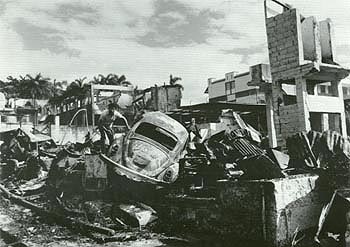
Play the official trailer · 3:36 · The Empowerment Project
Preview image: El Chorrillo after the invasion, Panama, December 1989. Photo: Julio Cesar Guerra D., via The Empowerment Project.
“In the End We All Die Anyway”
Day 210. Tucker Carlson says he went to the Oval Office days before the Iran war began to argue against it. In an interview NPR published September 24, he told Steve Inskeep that he’d warned the conflict would serve Israel’s regional ambitions at the expense of America’s position in the Gulf.
Carlson described three aims he believed Israel was pursuing:
- Establish regional dominance by removing Iran as a competing power and leaving it consumed by internal conflict.
- Weaken the six Gulf Cooperation Council states, whose growing power he viewed as a challenge to Israel’s position.
- Drive the United States out of the region, including eliminating American bases, because he argued that the US presence constrained Israel’s ambitions.
Carlson recalls Trump’s answer:
“Yes, you’re right. But in the end we all die anyway, so it doesn’t matter.”
Carlson says he pressed him about their children, grandchildren and the country’s future, and got no substantive answer.
NPR says the White House didn’t address the exchange specifically when asked for comment. Instead, it supplied a Trump social media post attacking Carlson and other critics and accusing them of wanting Iran to have a nuclear weapon.
WATCH · CARLSON ON TRUMP & IRAN
Conservative pundit Tucker Carlson recalls talking to President Trump days before the Iran war
NPR · September 24, 2026 · 1:54
The quoted response begins around 0:49.
“Yes, you’re right.” That’s the part I keep coming back to. In Carlson’s account, Trump accepts all three points, including that the war would weaken America’s position in the region.
What explains that acceptance? Did Netanyahu have leverage over him, or did Trump share the objectives Carlson was warning him about? Why would he hear that argument and agree to proceed?
And then this: “But in the end we all die anyway, so it doesn’t matter.”
What Are We Being Prepared For?
Britain’s chief of the defence staff, Sir Richard Knighton, says more families will come to know what sacrifice for the nation means. The language of preparation is becoming familiar: duty, readiness, resolve. The public is being asked to get used to the possibility of war with Russia.
Sir Richard Knighton
Chief of the Defence Staff
I can’t get used to it. The confidence of the language bears so little relationship to the consequences being contemplated.
Consider Oreshnik, Russia’s ballistic missile already used against Ukraine. A rocket carries multiple reentry vehicles on an arc through space before their payloads descend at hypersonic speed. One launch delivers multiple incoming objects. The speed compresses the time available to respond; the multiplicity complicates interception.
The United States once explored a weapon concept nicknamed “Rods from God”: dense metal projectiles released from orbit, striking with such speed that they wouldn’t need explosives to cause destruction. That idea helps explain the interest in Oreshnik’s non-nuclear payload. The missile launches from the ground, but its descending projectiles carry destructive energy in their motion.

This is the machinery behind the word “conventional.” It’s a classification, not a promise that the damage will be manageable.
Missile defense introduces another uncomfortable question. How long can it last? Every engagement consumes interceptors. Launchers have finite magazines, stockpiles have limits, and replacement missiles take time to manufacture and deliver. Even perfect interception wouldn’t resolve that arithmetic. A defense that stops one salvo still has to stop the next.
That’s before considering the reliability of the interceptions themselves. MIT professor emeritus Theodore Postol estimates that Patriot PAC-3’s success against Iranian ballistic missiles has been only a few percent. His assessment raises a fundamental question about how much protection these systems actually provide.
What’s the plan for sustaining that protection through a direct war with Russia?
The consequences extend beyond military installations. Electricity, fuel storage, railways, communications, and water treatment sustain civilian life. Damage to those systems spreads beyond the point of impact. Repairing them during continuing attacks becomes part of the war.
NATO would retaliate. Russia would respond. Each round would produce losses, demands for escalation, and another decision about how far to go. Nuclear weapons would remain available throughout.
What I can’t make sense of is the purpose of all this. Surely the people preparing these speeches know what a direct war with Russia would involve. They have military advisers, intelligence briefings, and information the rest of us don’t. They know there would be retaliation. They know the consequences could escape their control.
So what are they trying to accomplish?
Is the language meant to frighten Russia into backing down? Frighten Europeans into accepting higher military spending and sacrifices at home? Prepare the public for a confrontation officials genuinely expect? Those are different purposes, with very different implications for everyone being told to get ready.
The talk about duty and dying for your country is shocking. But underneath that reaction is real confusion. It’s difficult to believe these governments actually want the war they’re describing. It’s equally difficult to understand why they’re working so hard to make it feel inevitable.
What are we being prepared for?
What Backs the Promise?
After the 2008 crash, I started to believe the United States could borrow forever. Maybe the debt didn’t matter. ZIRP—zero interest rate policy—kept the Fed’s benchmark near zero through 2015, then again from 2020 to early 2022.
But financial confidence also rests on power. In January, U.S. forces seized Nicolás Maduro and his wife with CIA inside help. Washington later announced 100-year oil concessions and a 35% federal stake in the concession holder’s parent company. Rights to future Venezuelan oil income can become collateral for loans on American banks’ books. Another country’s resources become an American financial opportunity.
Maduro’s capture must’ve felt like an old formula working again. Mohammad Mossadegh’s government nationalized Iran’s oil industry in 1951, taking over the Iranian operations of the Anglo-Iranian Oil Company—today’s BP. In 1953, America’s CIA and Britain’s MI6 helped overthrow him. Hundreds died, but no Americans. Eisenhower wrote that it sounded “more like a dime novel than an historical fact.”
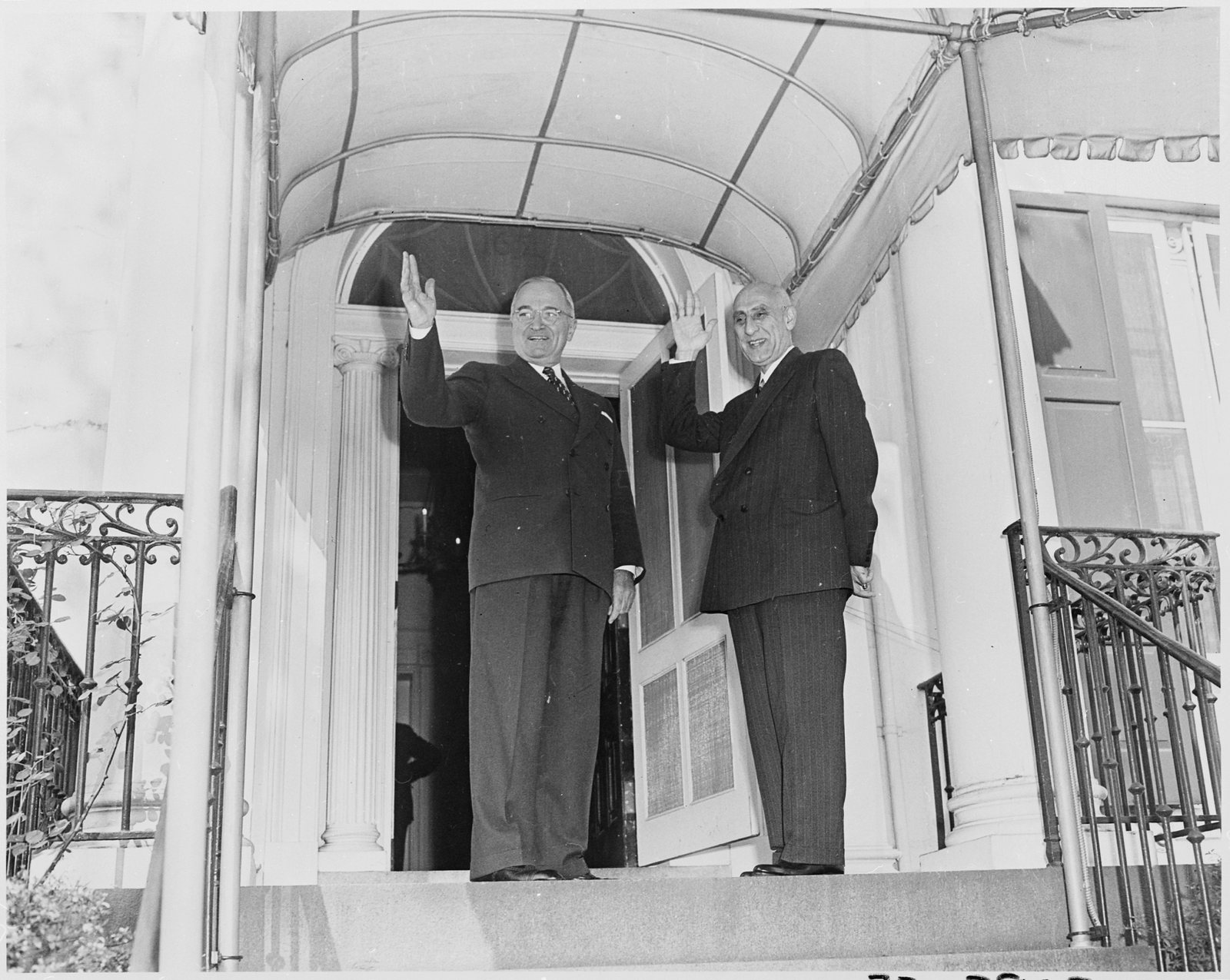
If $1 million could buy off a Venezuelan official or military insider, that’d be cheap beside the cost of missile defense. U.S. crews protecting bases in West Asia can fire two PAC-3 (Patriot) interceptors at one incoming ballistic missile to improve the chances of a hit. At the Army’s 2026 budgeted PAC-3 MSE cost, that’s roughly $7.7 million trying to stop a single missile. An insider might help secure a cooperative government. The interceptors don’t purchase Iran’s submission.
The U.S. and Israel assassinated Iran’s supreme leader. Iran kept resisting. I don’t believe Washington will secure Venezuela’s submission in Iran. Disruption at Hormuz is feeding inflation and raising borrowing costs, including the cost of financing the war itself.
The chaotic U.S. withdrawal from Afghanistan in 2021 should’ve challenged our assumptions about what American power could guarantee. I’m watching bonds because those assumptions reach into our finances. Loans backed by future income become vulnerable when the political arrangements producing it start to fail. The risk I see is Washington borrowing to finance both the war and the financial losses it leaves behind.
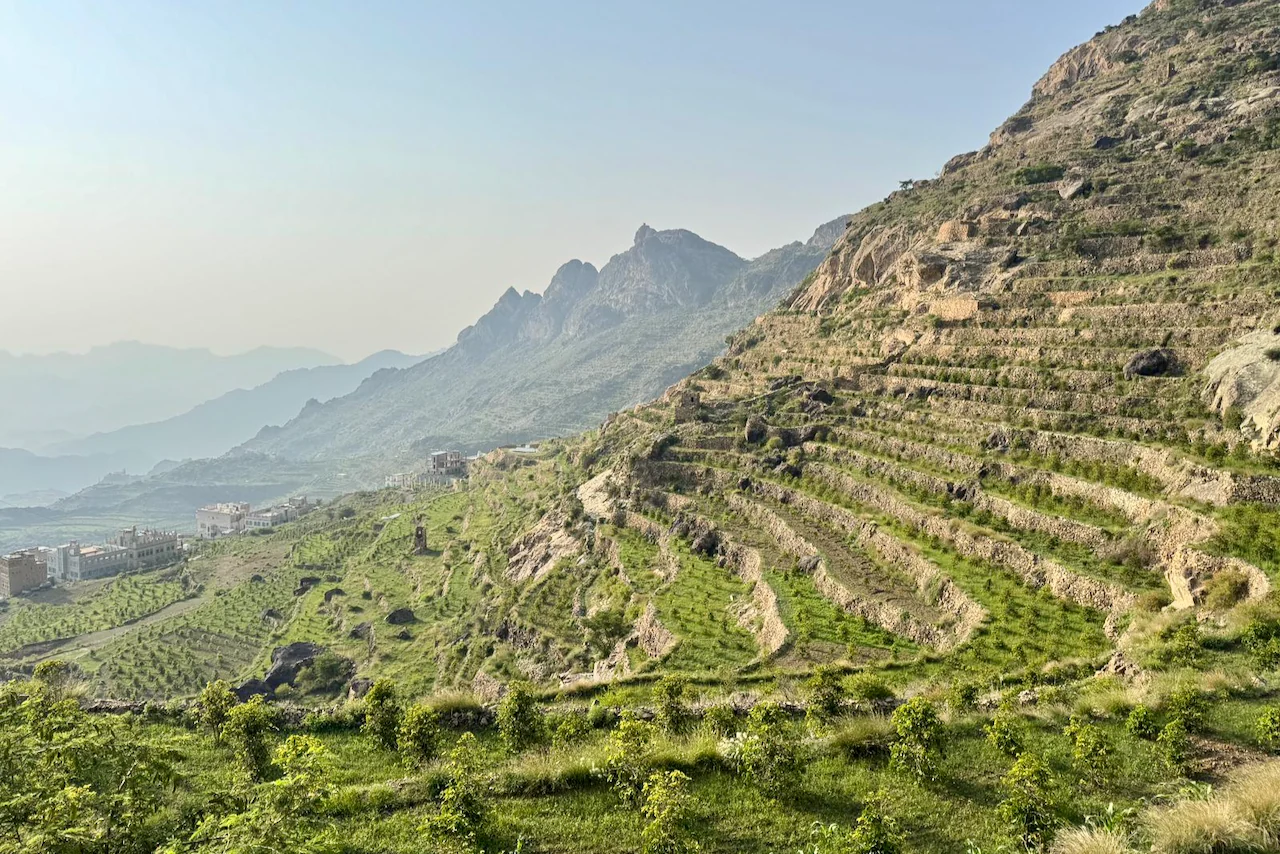
The Terraces
Day 207. I was watching two discussions about Ansarallah, which governs about 70% of Yemen’s population, and its conflict with Saudi Arabia when the photographs caught my attention. World Bank · April 2026
When I hear Saudi Arabia, I almost always picture desert. Yemen lies just to its south, across borderlands the two countries fought over and disputed for decades before reaching a settlement in 2000. I hadn’t pictured green terraces curving around steep mountains, with villages perched above them. Parts of Yemen looked more like Hawaii or Jamaica. Sana’a Center
Yemen’s western mountains rise beyond 10,000 feet. Seasonal winds, including the summer monsoon, bring moist air against their slopes. Forced upward, that air cools, forming clouds and rain. Generations of farmers have built stone terraces to hold the soil and slow the water’s passage downhill, giving it time to soak into their fields. Some cultivated strips are barely a metre wide. World Bank’s climate assessment · FAO’s field assessment
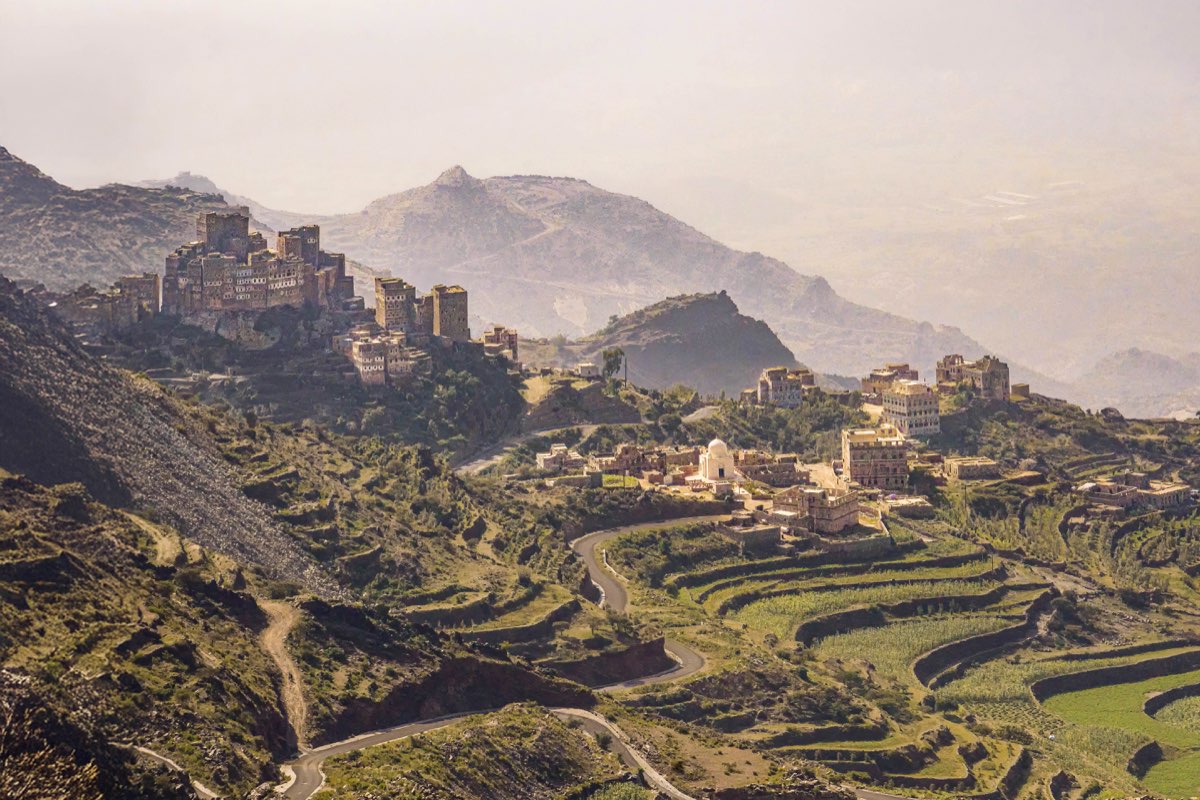
Those terraces are the work of generations, and families still depend on them. Giving up that land would mean giving up their fields, their livelihoods and the life they’ve built around them. Looking at those mountains, I can understand why people would fight to stay. In Haraz, villages were built on rocky heights both for defense and to leave more room for cultivation. Their sandstone and basalt houses blend into the mountain, with fields stepping down below them. Yemen’s UNESCO submission
Coffee grows in those terraced highlands too, which brings us to Mokha. Arabica’s wild home is in Ethiopia and South Sudan. Yemen became an early center of cultivation and a major source of the coffee traded abroad. Mokha, the port on Yemen’s Red Sea coast, became so closely associated with that trade that its name followed the beans around the world. The “mocha” on a café menu carries that history. Kew · FAO
WATCH · YEMEN IN 4K
Al-Shara’i, Ibb
Marwan al-Badani · 12:51 · Sep 23, 2024
Start at 2:34 for the green terraces and mountain villages. English subtitles and 4K playback are available on YouTube.
The discussions that prompted this note:
Eritrea, of All Places
I remember Eritrea from church.
Growing up at Sammamish Hills Lutheran, I remember collections and fundraisers for people in a country I knew almost nothing about. The details faded. The name stayed.
This week, seeing Eritrea in the news again, I finally asked the question that never occurred to me as a kid: why did a Lutheran church outside Seattle care about Eritrea?
The answer goes back to 1866, when Swedish Lutheran missionaries landed at Massawa on the Red Sea. They meant to push on into Ethiopia. Unrest changed their plans, so they stayed and built missions in what’s now Eritrea. Over generations, those connections grew into congregations, schools, clinics and relationships that later helped carry humanitarian relief.
My family has Swedish roots. So a childhood memory from a church near Seattle turns out to have a history stretching across continents and back more than a century. I still haven’t found the particular fundraiser I remember. But the connection makes sense.
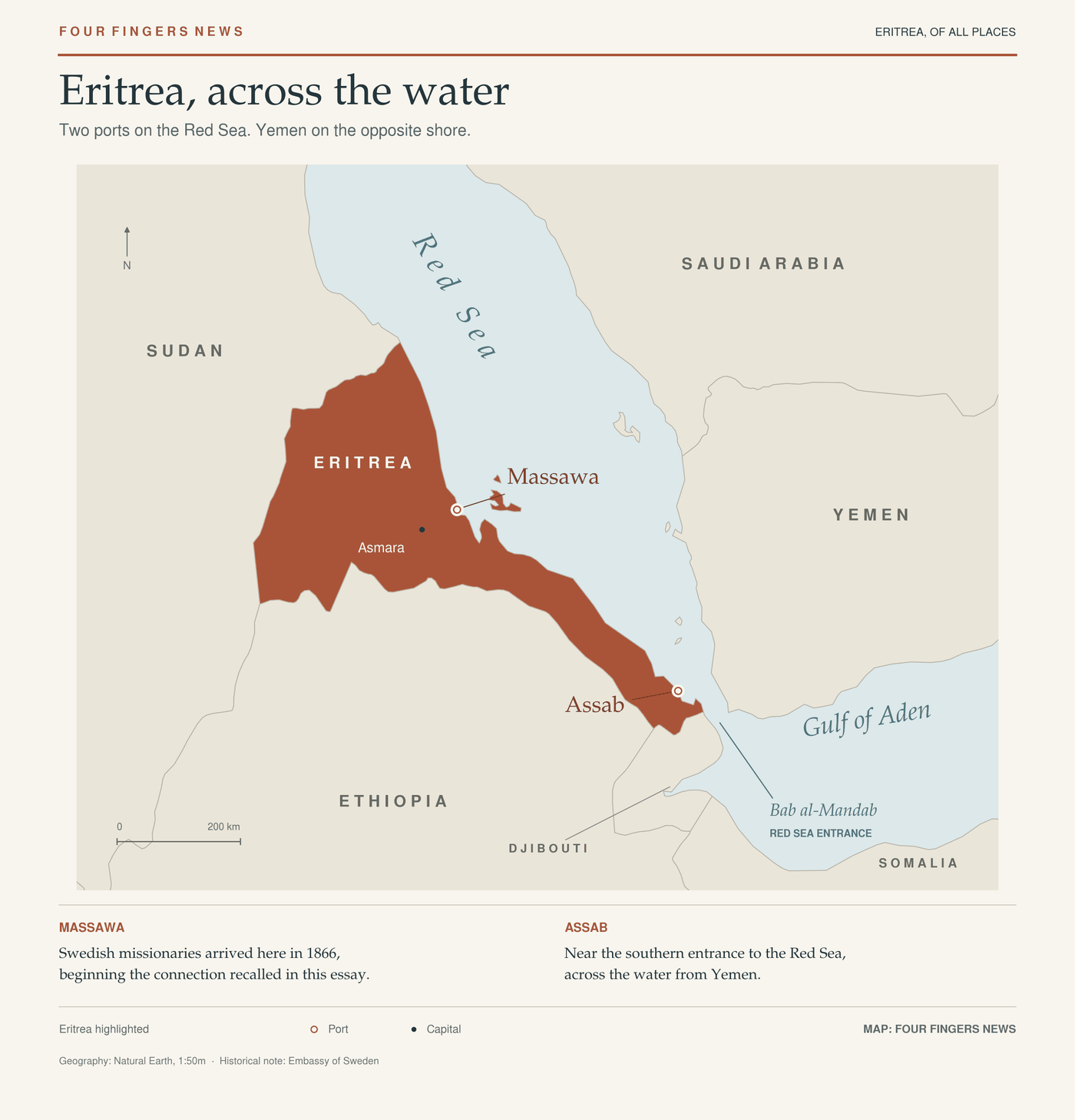
Now Washington’s got its own renewed interest in Eritrea, and the timing deserves attention.
For months, we’ve watched attacks on American bases in the Gulf expose the vulnerability of a military presence built over decades. Buildings damaged or destroyed. Personnel evacuated. Questions about what can be rebuilt, what can be defended, and where forces might have to operate instead. The geography that once helped the United States project power has become a source of exposure.
Against that backdrop, look at the opening toward Eritrea. The United States has lifted sanctions on the country’s military and ruling party. Officials have been discussing closer relations, including security cooperation. A government Washington sanctioned is now a government Washington’s courting.
Eritrea’s coastline faces Saudi Arabia and Yemen across the Red Sea. Its ports sit beside some of the most consequential shipping lanes in the world. The UAE previously used Assab to move troops and heavy equipment into Yemen.
There’s no confirmed American basing agreement in the reporting I’ve found. But you don’t need a signed lease to recognize why Washington’s interested.
Meanwhile, Britain’s agreed to provide aerial refuelling for Saudi aircraft responding to Houthi attacks. The problems around these waterways keep drawing in more countries, more resources and more commitments.
As existing positions become harder to defend, the search for alternatives can pull more places into the war. Moving the footprint doesn’t necessarily reduce the conflict. It can spread the commitments needed to sustain it.
Put these developments together and the question gets bigger than Eritrea: what’s the plan for making all of this smaller?
Every new commitment arrives with its own explanation. Protect the shipping. Support the partner. Keep the route open. Answer the latest attack. Find somewhere safer to operate. Each move has an immediate justification. Together, they deserve an explanation of where they lead.
A government should be able to say how its next military commitment brings the end of a war closer. It should tell the public what success requires, what obligations it’s taking on, and what happens if the next move produces another crisis that needs another response. We’re entitled to ask while the decisions are still being made.
Eritrea caught my eye because I’d heard the name in a very different setting, decades ago. What started as a childhood memory led me through Swedish missionary history and back to a country that powerful governments are once again weighing for its location.
A coastline that looks useful from Washington is somebody’s home. Any bargain over access, security or influence carries consequences for people who may have very little say in it.
The map keeps growing. Where’s the plan to bring the war to an end?
Never Let a Good Crisis Go to Waste
Day 205. After the financial crisis, institutional investors bought foreclosed homes in bulk and turned them into rentals. The Government Accountability Office identified a crucial advantage: they could raise capital while mortgage lenders were pulling back. The conditions that cost families their homes gave well-financed buyers an opening. GAO
“institutional investors had a funding advantage over smaller investors at a time when mortgage lenders were generally reducing lending.”
Read the original document
A crisis doesn’t leave everyone standing in the same place. Someone who needs to sell to stay afloat faces a different economy from someone with cash and time to buy. Falling prices can destroy a household’s savings while making the assets it once owned more accessible to somebody else.
That history is part of why I’m increasingly dissatisfied with incompetence as a complete explanation for this war. Decisions that look disastrous from where most people sit may be acceptable—even desirable—to some of the people with influence over them.
The danger to Hormuz was understood beforehand. In March, the director of national intelligence told the Senate that Iran using the strait as leverage had long been an intelligence assessment. Foreseeable risks were accepted. Understanding that choice means examining how its supporters weighed the costs, including costs they wouldn’t personally bear. Senate testimony
There’s a difference between taking advantage of a crisis and helping create or prolong one. The first is well documented in our economic history. Establishing the second means tracing decisions, money and influence; the outcome alone won’t do it.
For this war, I want to follow the people and institutions that supported the policies, the risks they expected to bear, and the opportunities they stood to gain. Their interests belong in the explanation of how these decisions were made.
I’m keeping the receipts.
Already in Orbit
Day 204. Air Force Secretary Troy Meink said Monday that the United States already has “on-orbit space control weapons.” Asked to elaborate, he answered, “No.” He explained that the phrase had been carefully chosen, then described the need to protect American space capabilities against threats from other countries. Conference transcript
Watch: Inside the Pentagon’s Black Budget | Cappy Army
The money behind classified space programs is poised to grow sharply. Space Force’s FY2027 budget request includes $17.33B for classified research and development, up from $6.56B in the FY2026 column of the same table. That’s a proposed increase of 164%. About 43% of its requested R&D funding sits under the label “Classified Programs.” The table doesn’t identify the individual projects or connect that increase to the weapons Meink described. Pentagon budget
Meink’s security argument deserves consideration. A military that depends on satellites needs ways to protect them. Revealing a weapon’s capabilities could help an adversary defeat it. But that leaves a substantial part of the discussion outside the engineering: what Washington intends these weapons to accomplish, what limits govern their use, and how another country might interpret an action described here as defensive.
The public has now been told that American weapons are already in orbit. It deserves an explanation of what would justify using them, and how Washington intends to keep a confrontation there from becoming a wider war. Those questions shouldn’t have to wait for the first use.
Who Pays When Diesel Runs Short?
Day 203. October’s diesel supply is being squeezed now. The Saudi pipeline attack has disrupted crude deliveries that European refineries were counting on for next month. Oil that doesn’t arrive can’t become diesel. Those lost cargoes have to be replaced, or the refineries have to cut production.
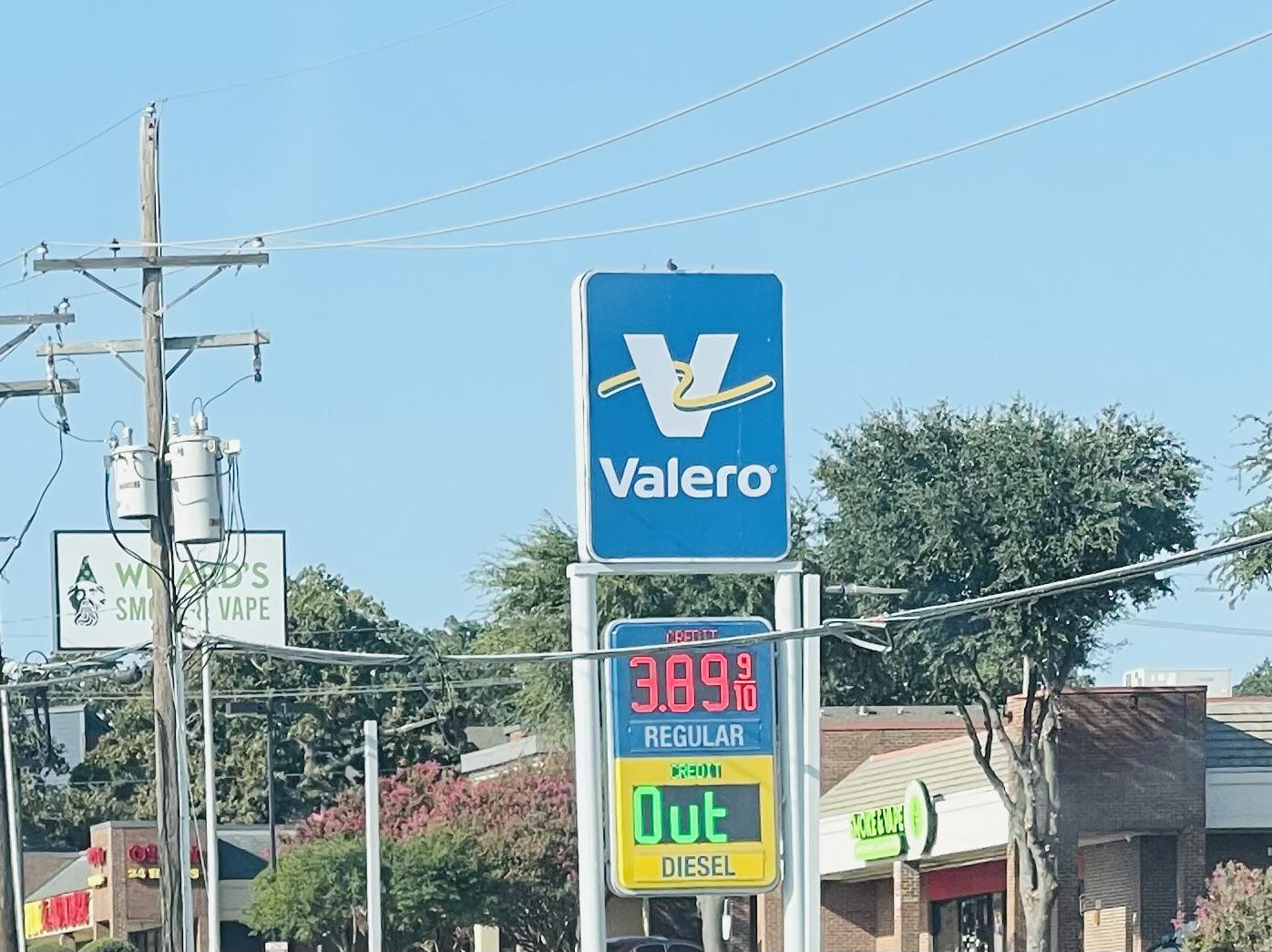
Some late-September cargoes to European refiners were cancelled or pushed into November. Bloomberg reported Friday that Aramco told at least two European customers they’d receive no October crude under their term contracts. The disruption reaches into the fuel those refineries were supposed to produce in October.
Russia has restricted diesel exports to protect its domestic market. I want to know what an American restriction would accomplish: how much fuel would stay here, whether it could reach the businesses that need it, and how quickly. That deserves a public answer now.
Higher diesel prices take money out of every business buying the fuel. High profits for oil companies won’t pay a farmer’s fuel bill or a builder’s equipment costs. A trucking company buying 200 gallons pays another $200 for every dollar added to the pump price, before it earns another dollar moving freight.
Fully Participating
Day 202. Thomas Massie (R-KY) spent an hour on the House floor Wednesday answering House Speaker Mike Johnson (R-LA), who had accused Massie of “not participating as a full member of the Congress.” The entire speech was extemporaneous.
Massie talked about Epstein, the Iran war, prices, debt, health care, campaign money and committee assignments. His charge was simple and scathing: voters elect the members, but party leaders decide who gets committee seats and what Congress gets to debate and vote on. Members who cooperate are rewarded. Members who force unwanted votes can be stopped by canceling Congress and declaring recess.
On Sep 1, Johnson called Massie’s prediction of an early recess “stupid” and said Republicans would work every day on the published calendar, “so long as people like him don’t stop the progress.”
Two days later, Johnson did exactly as Massie predicted and canceled the final two weeks of September voting.
Massie filed impeachment articles against Pete Hegseth on Sep 15. The next day, Johnson canceled the House’s last scheduled voting day. The House left without addressing them.
Johnson says the government is funded through Dec 11, the Senate hasn’t moved its budget plan and the House has done its job. It hasn’t voted on either matter. The House isn’t scheduled to vote again until Nov 9 unless Johnson calls it back.
Massie’s prediction was “stupid” for two days.
Pre-Existing Condition
Saudi Arabia is having a tough week.
The kingdom led a military intervention in Yemen in 2015, with American intelligence and logistical support.
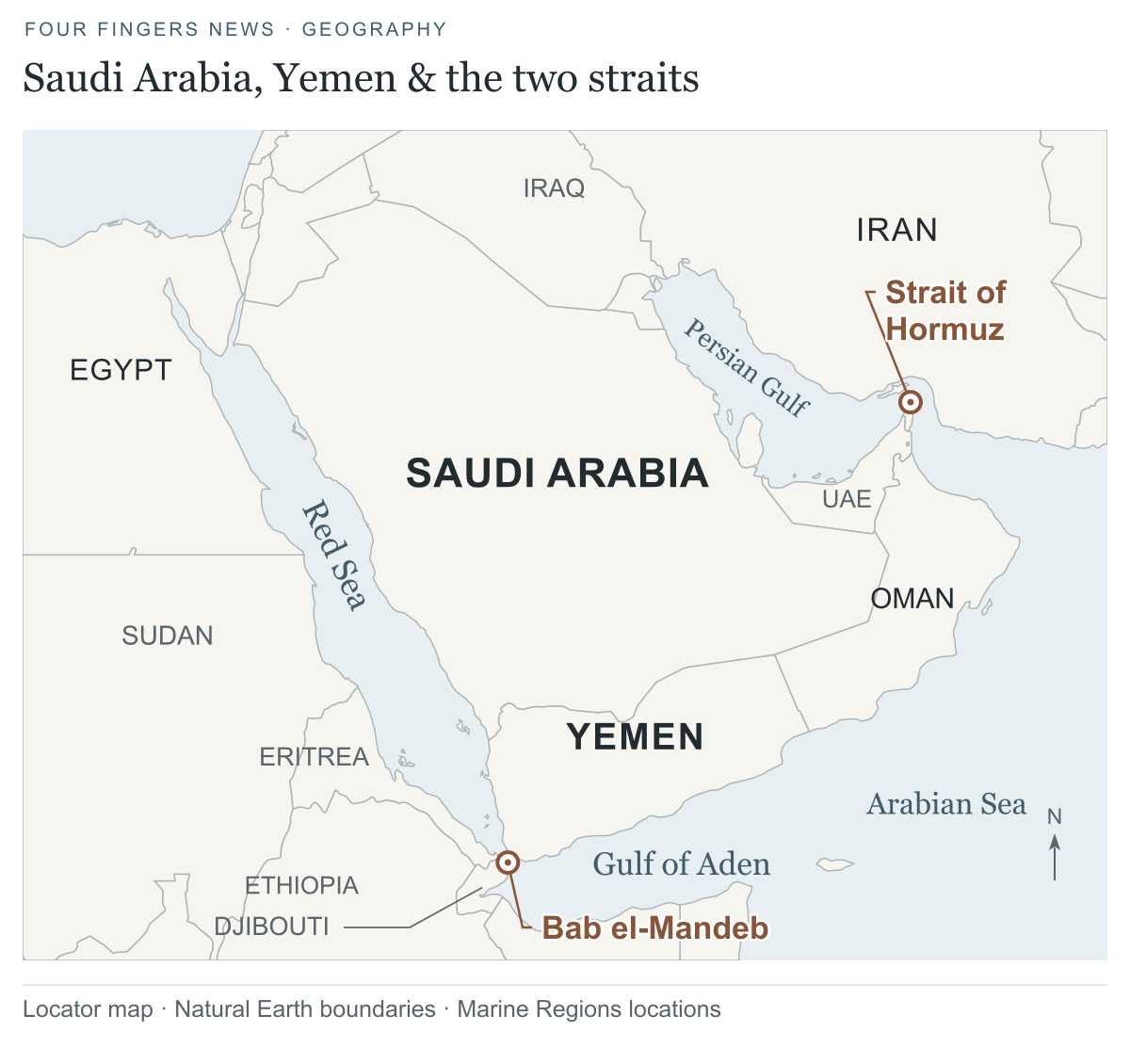
Today, Ansarallah, the Houthi movement, holds islands at the mouth of Bab el-Mandeb and the ground overlooking the shipping lane. Retreating Saudi-backed forces abandoned a sizeable stock of advanced American- and Saudi-supplied weapons, which the Houthis captured. A diplomat told Reuters the group had quietly assembled about 100,000 fighters and that “everyone, including the Saudis, missed this build-up.”
This week the group released footage of what it says is a Saudi F-15 shot down over Marib. Riyadh hasn’t acknowledged losing one.
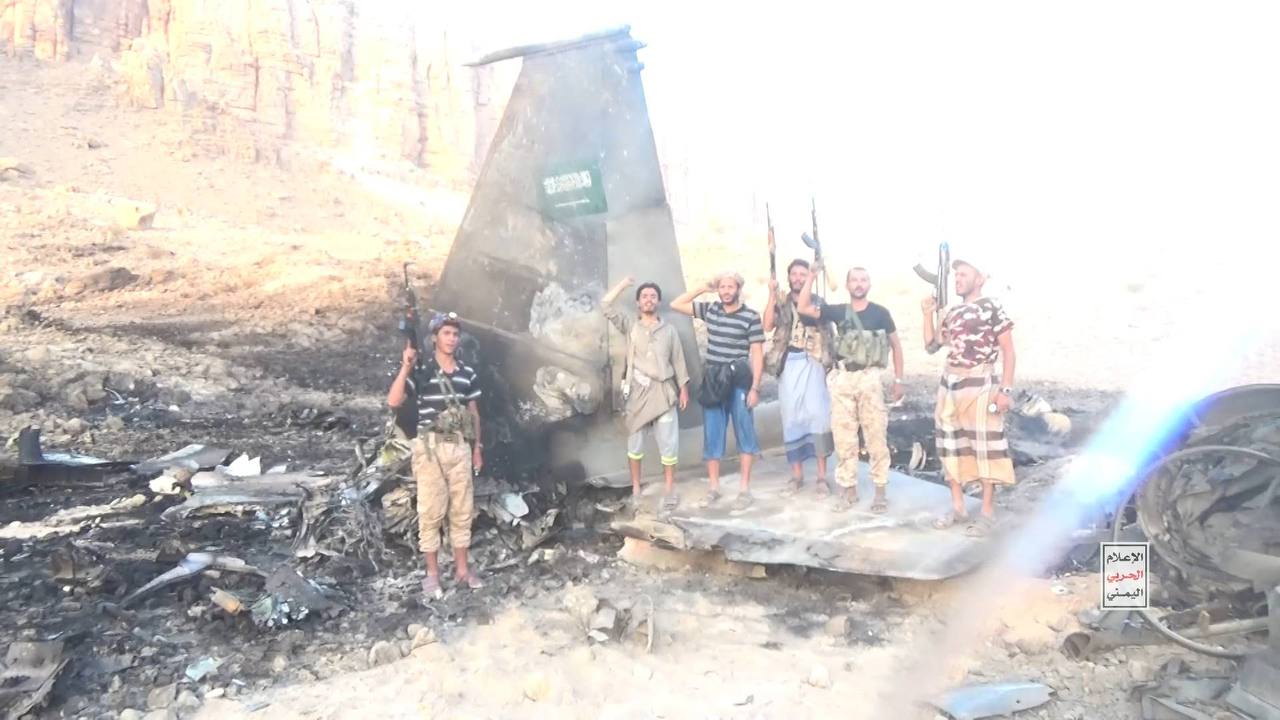
The Saudis have reason to worry. The Iran-aligned movement has fired missiles at Saudi cities and now holds territory overlooking a major oil shipping lane.
So the Saudi government is asking for outside military help again. Two Western officials told Reuters that neither the U.S. nor European countries are prepared to directly back a counteroffensive. MBS went to Cairo seeking an Egyptian role. Egypt’s Foreign Ministry didn’t respond to Reuters’ request for comment.
The Mecca Joint Defense Agreement, signed Aug 7 with Türkiye and Pakistan, says an armed attack on one is an attack on all. An unnamed Saudi source told Israel’s Channel 12 how that’s gone so far: “From Pakistan or Turkey nothing came except statements, and there was no cooperation. They only want to sell weapons.”
Apparently, Ansarallah is a "Pre-Existing Condition."
The Habit
Day 200. This website exists because two things happened the same week. The Iran war started, and I wanted to see whether a tax accountant who didn’t know how to code could build one.
Everyone was talking about vibe-coding and I wanted to try something. On the day the strikes began, I spent hours on World Monitor, refreshing the global situation board like it owed me money. It even monitors the pizza places around the Pentagon, on the theory that if they’re suddenly swamped late at night, something’s about to go down. My close friends were worried (probably still are). World Monitor was useful, but it wasn’t built around the questions I had or the things I’d already read.
I’m not sure Four Fingers News is any more useful, but I’ve learned a lot building it. I run it myself, with help from a process I mostly understand.
Some parts work better than others. The visitor counter froze at 39 in July and stayed there until I noticed in August. Nobody wrote in. The Iran cost tracker is still carrying numbers from July. I’ll fix it later. My wife keeps reminding me this is a choice and nobody asked me to do it (I’m aware).
I knew the Iran war, or whatever we’re calling it, wasn’t going to be over in “days” or “weeks,” but honestly I didn’t expect to hit Day 200.
Muawiya’s Hair
Day 199. Muawiya I (c. 602–680), who ruled from Damascus as the first Umayyad caliph, is remembered for describing politics as a single strand of hair stretched between himself and the people he governed. When they pulled, he loosened his end. When they loosened, he pulled. A strand could carry tension, but only if neither side insisted on winning every inch.
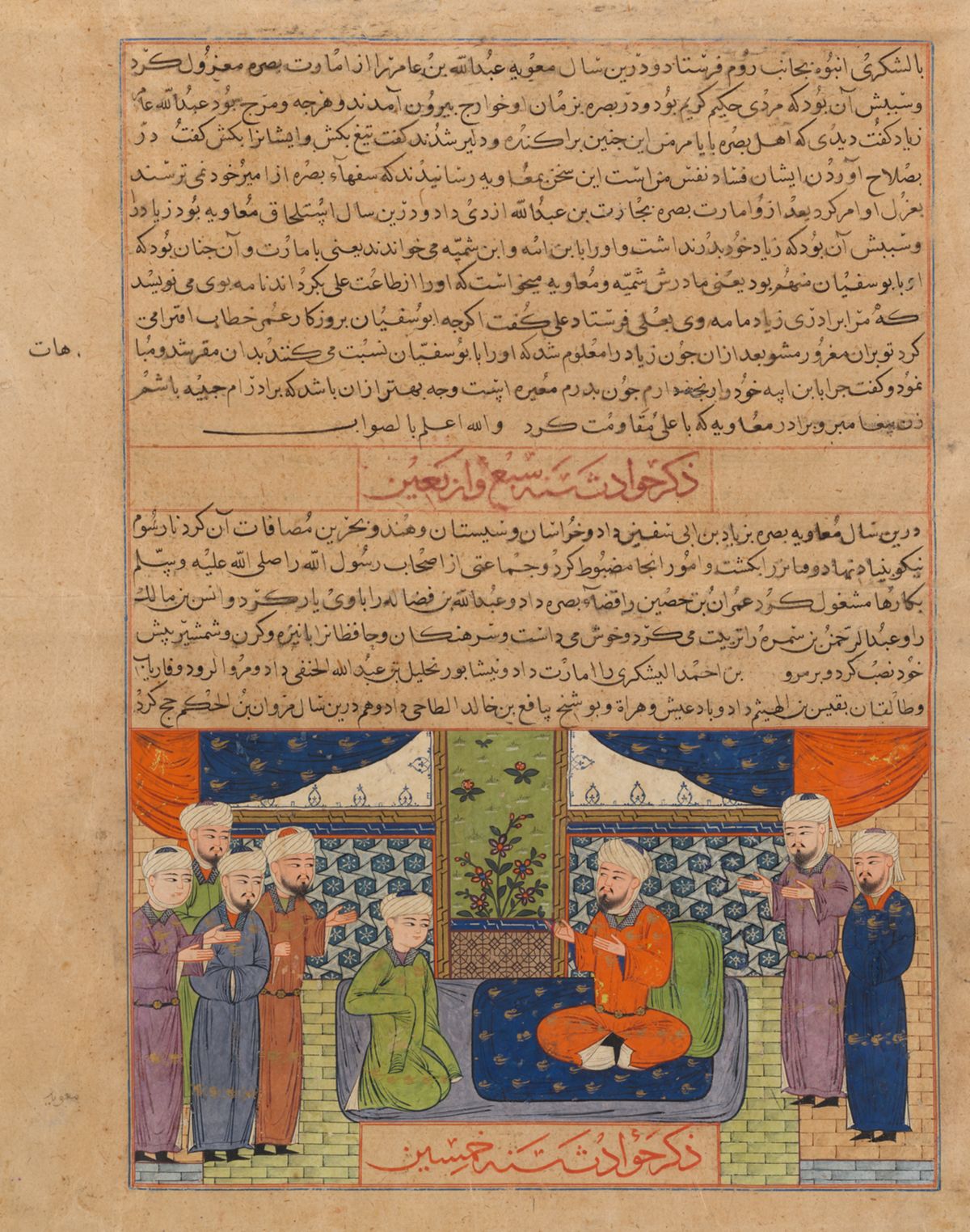
In a new interview, Chas Freeman — a retired career diplomat who served as U.S. ambassador to Saudi Arabia during Desert Shield and Desert Storm — reached for that image. Freeman applied it to adversaries: diplomatic contact isn’t an endorsement or a reward for good behavior. It’s the line that lets governments apply pressure, sense resistance and give ground before the relationship snaps.
That’s useful context for a meeting that was supposed to happen today in Salalah. Iran had called regional foreign ministers together to discuss the Iran-Oman shipping arrangement. They didn’t meet. Saudi Arabia submitted amendments, and Oman postponed the gathering “in the interests of consensus.”
Seen through Muawiya’s metaphor, postponement is the diplomacy. Muscat felt the line tighten and loosened its end before the meeting could snap it. The test comes next: whether Saudi Arabia and Iran use the room Oman created to keep hold of the same strand.
The Story We Were Told
Day 198. I've been following the story of “Dude 44” since the beginning. For months, I've checked for updates almost every day, not because I doubted there were American servicemen in danger, and certainly not because I wanted anything bad to happen to them. I kept checking because I couldn't shake the feeling that we were all being directed to focus on the wrong part of the story.
This weekend, 60 Minutes finally aired its interview with Bravo, the Air Force officer who spent nearly two days on the ground in Iran before being rescued. It's a compelling interview. Bravo endured something few of us can imagine, and the newly released rescue footage answers questions that had lingered for months. It answered almost none of the questions I'd been asking about the larger operation.
The interview asks us to admire the rescue. I never needed convincing that the rescue was extraordinary. If anything, watching what those pararescuemen and special operators accomplished only increased my respect for them. They did exactly what we expect America's military to do when one of its own is stranded behind enemy lines.
What I still don't understand is why they had to do it. How did an American F-15E end up shot down deep inside Iran? What was the larger operation? What strategic objective justified putting that aircraft there? What succeeded? What failed? What did the United States actually accomplish? Those are the questions that matter, yet they're barely addressed.
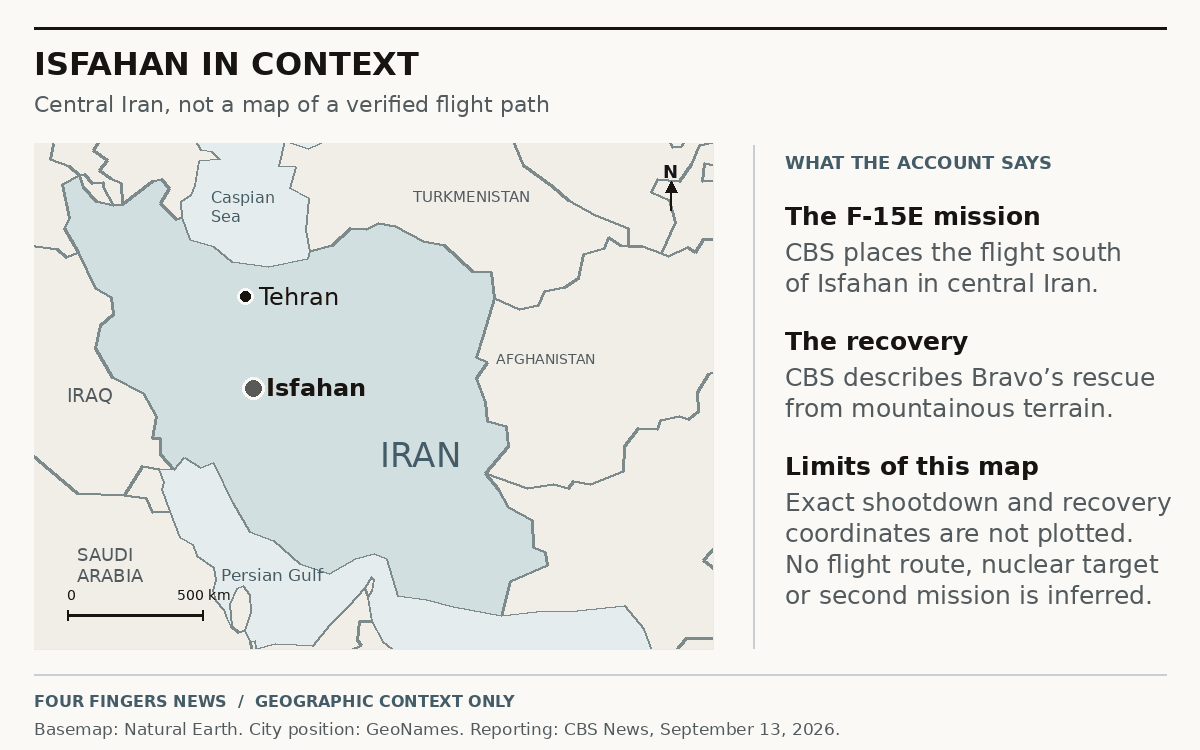
Instead, we've spent months immersed in a different narrative. We heard about Easter weekend. We heard about miracles. We heard about “Dude 44 Alpha” and “Dude 44 Bravo.” We heard about impossible odds, incredible courage, and what officials described as a rescue involving more than 150 aircraft. Pete Hegseth compared the story to the resurrection of Christ, then later recited a Pentagon prayer adapted from Pulp Fiction. It's an unforgettable story. It's just not the story I've been trying to understand.
A rescue isn't a strategy. It's what happens after a strategy has already placed people in extraordinary danger. Celebrating the rescue while ignoring the operation that made the rescue necessary feels like congratulating firefighters for pulling someone from a burning building while refusing to ask how the fire started. That's not a criticism of the firefighters. It's a recognition that they weren't the cause of the crisis.
The same is true here. Bravo deserves every ounce of respect he's receiving. So do the men and women who brought him home. Nothing in this diminishes what they accomplished. But courage on the battlefield doesn't answer questions about judgment in Washington.
As I watched the interview, I kept waiting for someone to pull the camera back. Not literally, but strategically. I wanted someone to stop asking what Bravo was thinking in those mountains and start asking what American policymakers were thinking before his aircraft ever crossed into Iran. Maybe those answers are still classified. Maybe they genuinely can't be discussed. Or maybe the rescue story became the story because it's the version everyone can rally around without having to wrestle with the much larger questions.
If that's the case, then we've mistaken the most emotional part of the story for the most important part. Bravo survived. That's something every American should be grateful for.
Now tell us why he was there.
The Oil Has to Get Out
Saudi Arabia’s main escape route around Hormuz is shut.
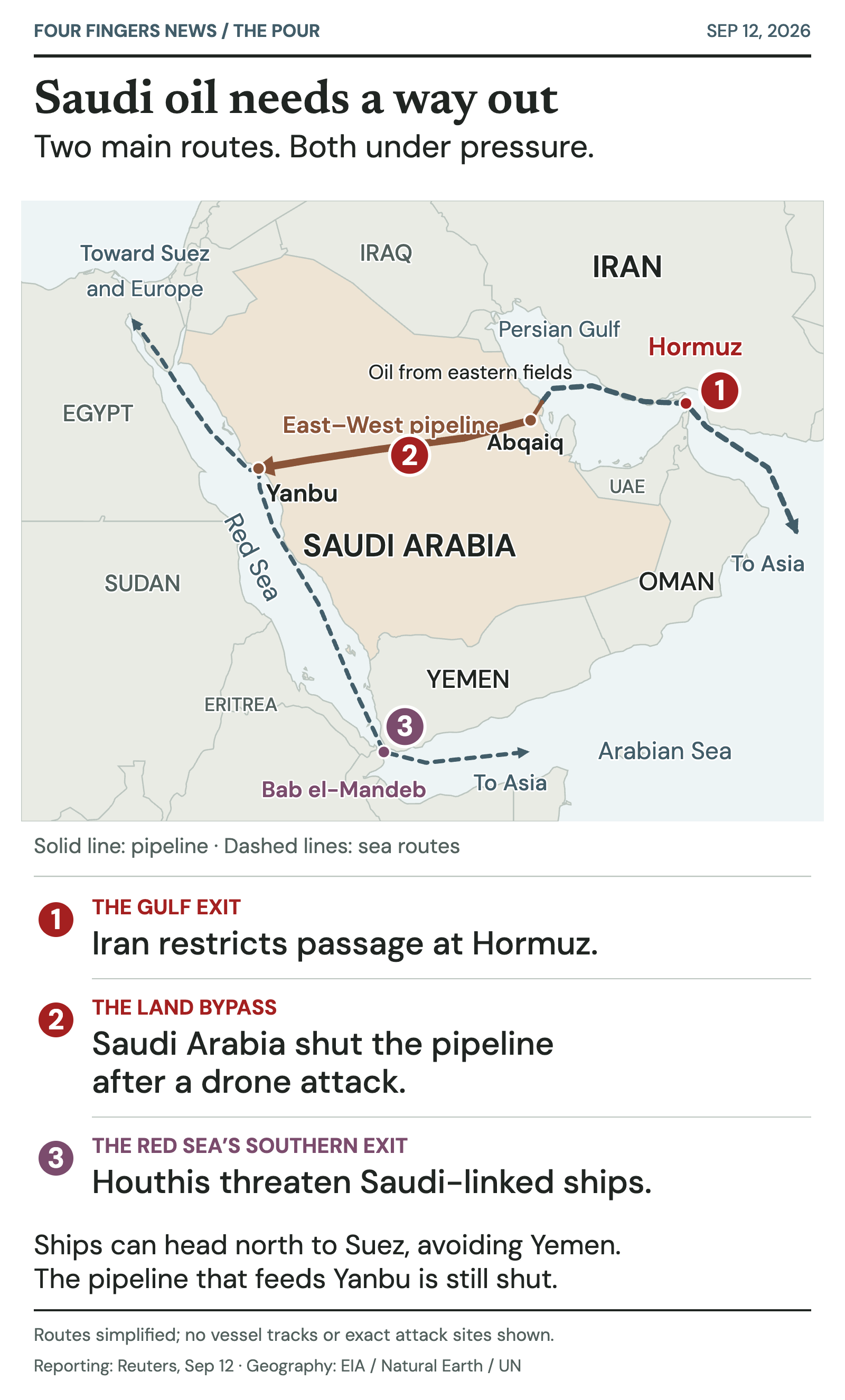
The East-West pipeline had been carrying four to five million barrels a day across the kingdom to the Red Sea. That’s roughly 4–5% of global oil supply. Saudi authorities closed it as a precaution after a drone attack. Meanwhile, the Houthis have seized Perim island at the Red Sea’s southern entrance.
Riyadh asked Washington for direct military help against the Houthis. Reuters reports that Washington offered intelligence and targeting assistance but declined direct action for now.
Yesterday’s note traced the relationship between Saudi oil and American protection. Here’s where that relationship meets a practical test: the kingdom needs to get its oil to customers, and its available routes keep getting more vulnerable.
Into that situation comes Iran’s proposed shipping arrangement with Oman. Pezeshkian says Arab ministers will meet Monday to sign it; Oman hadn’t immediately confirmed the meeting in Anadolu’s report. An Iranian security official says Tehran would control the corridor’s entrance and exit.
That’s a claim to power over the neighbors’ trade.
Getting tankers moving again would bring real relief. The terms could also require Gulf governments to accept authority they’ve spent decades trying to keep Iran from acquiring.
No such settlement has been established. But that’s the significance of these negotiations. An Iranian veto over its neighbors’ exports would change the region’s balance of power long after the damaged pipeline is repaired.
Bitter Lake
Twenty-five years ago today, 19 men seized four airliners. Three hit buildings. The fourth went into a field in Pennsylvania because the people on board fought back. 2,977 people died.
The story we settled on was terrorism. A cave, a madman, a hatred of freedom.
Calling it terrorism doesn't explain how we got there.
A better starting point is February 1945, aboard the Navy cruiser USS Quincy, anchored on the Great Bitter Lake in the Suez Canal. A dying Franklin Roosevelt sat across from King Ibn Saud.
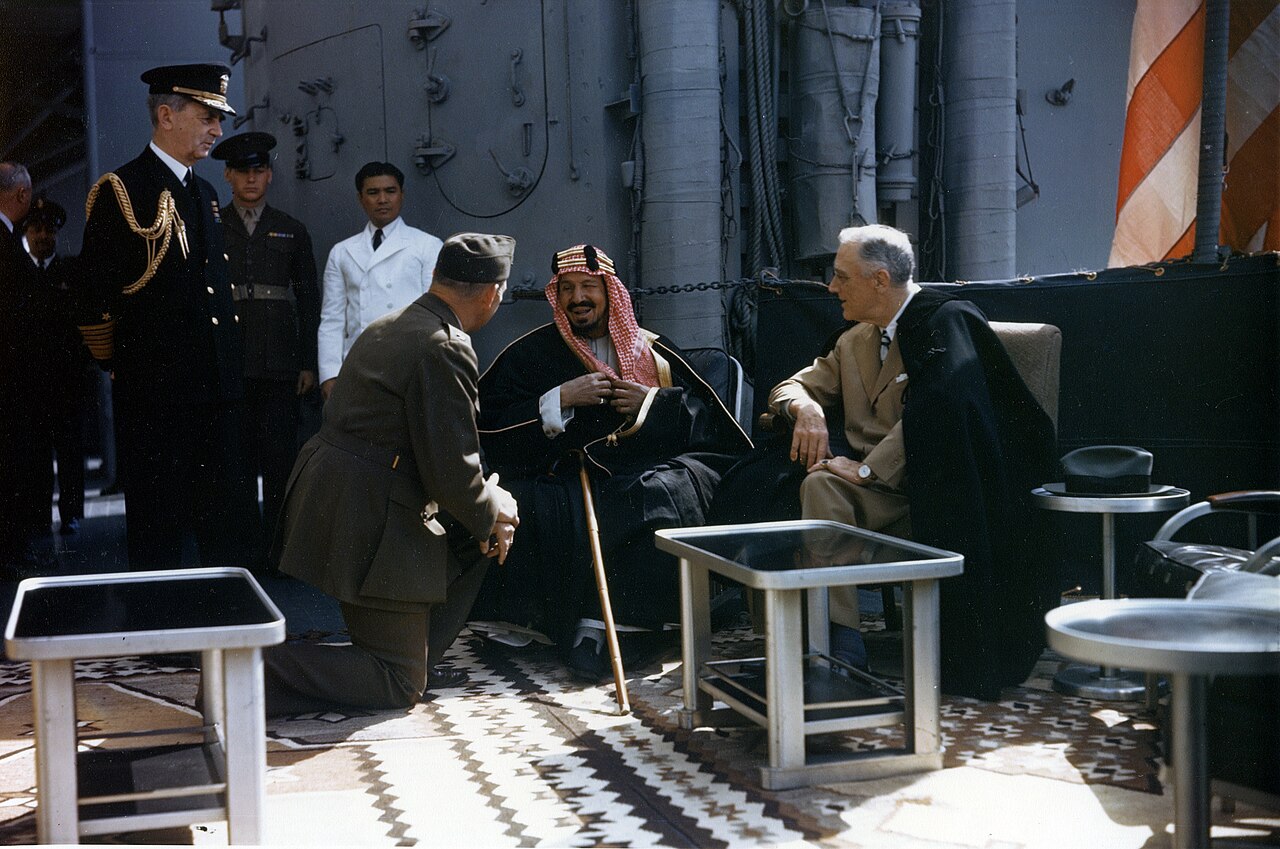
They signed a memo of the conversation, mostly about Palestine. There's no oil-for-protection clause. The broader understanding took shape over the next decade. America gets the oil. The House of Saud gets protection. What happens inside the kingdom is the royal family's business.
At home, the Saudis kept a bargain older than the United States. Since 1744, through two collapses and a reconquest, the Saudi family has ruled with the blessing of the Wahhabi clerics. The family holds the sword, the clerics hold the pulpit. Protect one and you protect both.
The export of that creed started before the money did. The Muslim World League was founded in 1962.
Then came 1973. Oil went from $3 to nearly $12 in a matter of months, and a modest missionary project became one of the best-funded religious movements in the world.
Riyadh spent tens of billions of dollars over the next three decades on mosques, schools and charities from Lahore to Sarajevo to Brooklyn. Not all of them preached the same thing. Plenty taught a narrow, brittle version of the faith. And the 9/11 Commission found that some of them became cover for people with worse intentions.
In 1979 gunmen seized the Grand Mosque in Mecca. The royal family responded by giving the clerics even more control over Saudi life.
That same year the Soviets went into Afghanistan. Washington and Riyadh split the bill for the Afghan resistance, dollar for dollar. America called it anticommunism. The Saudis called it religious duty.
The Arab volunteers who joined the fighting had their own networks and raised their own money. American aid mostly didn't reach them. Saudi private donors helped support them.
Osama bin Laden was one of those volunteers.
Wahhabism alone didn't produce him. The Saudi state clerics preached obedience and later condemned him by name. He drew on Saudi money and Saudi piety, but also on the revolutionary ideas that came out of Egypt's prisons. Muslim Brotherhood exiles brought those ideas into the kingdom, where Riyadh hired them to staff its universities in the 1960s and 70s.
He had a long list of grievances. When he declared war on the United States in 1996, the one in the title was American troops in the land of the two holy places.
Which is to say the Bitter Lake arrangement helped build the ideology and then handed it a target.
That doesn't require a conspiracy. For 56 years, both governments had reasons to keep the kingdom's domestic affairs largely out of the discussion.
That's harder to reckon with than a man in a cave. The story runs through 12 presidents of both parties, the Afghan program, and a relationship that's still the spine of American strategy in the Gulf.
Which brings us back to this week.
Saudi Arabia's watching the Houthis advance along the Red Sea. Hormuz is choked. Axios reports MBS called Trump twice Thursday to ask for American strikes on Yemen.
The same kingdom stripped its religious police of arrest powers in 2016. The prince has been clipping the clerics ever since. Whatever his reasons, the country that funded the export is now trying to change the product.
That meeting was 81 years ago. Roosevelt and Ibn Saud are long dead.
Their successors have updated the relationship plenty of times. Last November it got a fresh defense agreement with a price tag attached.
I don't think we've reckoned with what that relationship helped set in motion.
The Other Strait
Day 195.
Ansarallah has taken Mocha.
Saudi-backed PLC forces are falling back toward Dhubab, on the Bab el-Mandeb Strait. Houthi forces have also reached the Hanish Islands.
This isn’t another drone strike. It’s a territorial defeat for the Saudi-backed government.
And the timing could hardly be worse.
Hormuz is already badly constrained. Saudi Arabia’s alternative is to move oil west to the Red Sea. Now the force it spent a decade trying to destroy is advancing toward the southern exit of that sea.
Saudi Arabia bombed Yemen for years. The United States armed it. The Houthis survived.
Now they’re advancing, Saudi cities are again being struck, and Riyadh is watching the war move toward a chokepoint it can’t afford to lose.
Iran is supposed to be isolated.
Instead, the conflict is spreading outward from Iran into the Gulf, Saudi Arabia, Yemen and the Red Sea.
Washington may still have overwhelming military power.
But power and control aren’t the same thing.
Right now, control is getting harder to find.
Welcome to the Neighborhood
Day 194. Seattle has a particular way of welcoming people. Tonight, it involved falling behind New England, losing our starting quarterback, and making everyone wait until the final seconds to breathe. Seahawks 13, Patriots 10. Three fourth-quarter interceptions. Welcome, Khoslas. This is sometimes how we relax. AP
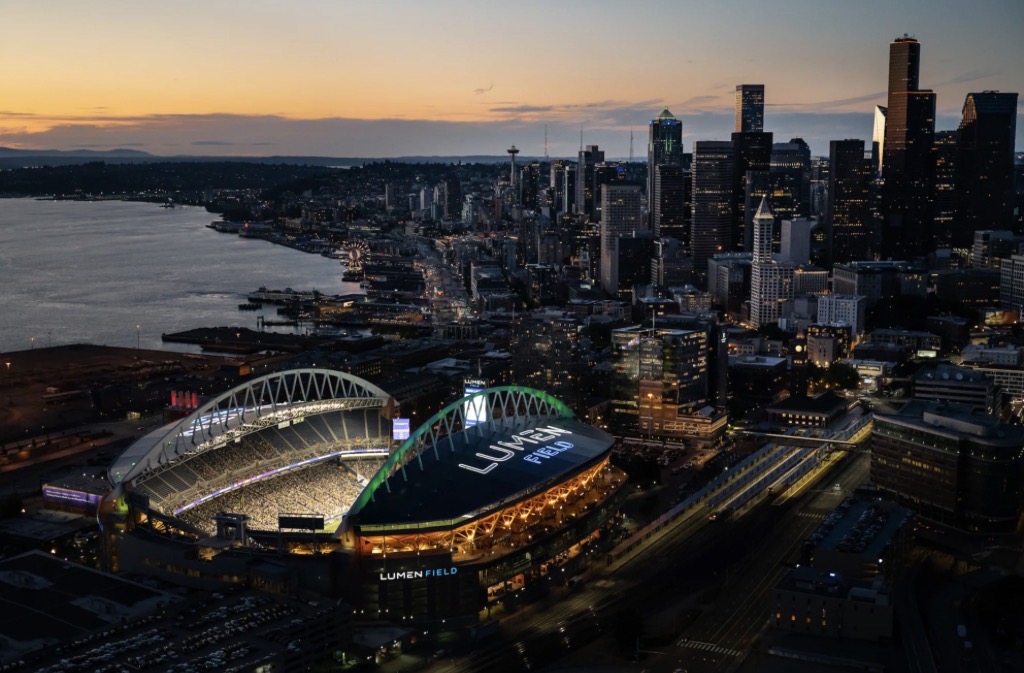
If you’re celebrating the win while wondering who exactly just bought the team, here’s the introduction.
The Khosla family’s ownership group closed its $9.612 billion purchase on September 3. Vinod Khosla is the chair, his wife Neeru is the controlling owner, and their son Neal is vice chair. That’s the family taking over from Paul Allen’s estate, at the highest price ever paid for an NFL franchise. Reuters
Their story comes through India and Silicon Valley. Vinod grew up in an Indian Army household and studied electrical engineering in Delhi before coming to the United States for graduate school at Carnegie Mellon and Stanford. He co-founded Sun Microsystems in 1982, became an investor at Kleiner Perkins, and started Khosla Ventures in 2004. His fortune grew out of building technology companies and backing others, with investments spanning computing, energy, healthcare, and artificial intelligence. Khosla Ventures
Neeru brings a different background. Raised in India and England, she studied molecular biology and co-founded the nonprofit CK-12 Foundation, which provides free educational resources. She’ll also lead the Seahawks Charitable Foundation. There’s a meaningful opportunity there to make the family’s arrival matter to children who may never get a ticket to Lumen Field. Biography, CK-12
Neal helped drive the family’s interest in buying the team. His mother credits his enthusiasm for football and desire to get involved. The family also arrives with previous ties to the 49ers, which I’m willing to treat as a correctable error in judgment. Introductory remarks
They’ve already announced white throwback uniforms for 2027. Somebody’s doing the homework. Announcement
Of course, the Allen name means something here. Paul helped keep the Seahawks in Seattle. Jody carried that stewardship forward after his death. The new owners are inheriting decades of attachment that no purchase agreement can fully describe. The ownership transition
I hope the Khoslas enjoy getting to know this place. Show up. Listen. Invest in the team and trust the people who know football. Let the community work become something families can point to.
Tonight, we got a win and a reason to introduce ourselves. Welcome to the neighborhood, Khoslas. Cheers to a good start. Go Hawks.
The Person Inside the Uniform
Day 193. Yesterday I wrote about my grandpa Harold and the life he built after World War II. Today I listened to Peter Pajakowski talk about his son Nigel, an Air Force staff sergeant who died at 24.
In a conversation with Daniel Davis, Peter Pajakowski describes Nigel, an Air Force staff sergeant who loved his work, his colleagues and the opportunities service had given him. He also describes isolation, repeatedly delayed homecomings and a growing struggle to reconcile what Nigel believed in with what he believed his country was doing.
Those feelings weren’t mutually exclusive. That’s the part worth sitting with.
We ask young Americans to develop judgment, integrity and a sense of responsibility. Their convictions don’t switch off when the mission becomes difficult to explain. For someone who joined partly to find purpose, questioning that purpose can reach well beyond a disagreement about policy.
Nigel died by suicide after returning from deployment, according to the discussion. His father explicitly resists reducing his death to one event or one explanation. His account deserves that same care from anyone repeating it.
It also deserves more than being absorbed into an argument about which side supports the troops. A person can remain devoted to the people beside him while struggling profoundly with the work they’ve been asked to do.
Yesterday’s note looked across the decades Harold had after the Navy. Nigel’s father describes the conversations he’d expected to have when his son came home.
The Uniform Is the Beginning
Day 192. My grandpa Harold Grigsby Johnson would’ve been 103 years old today. September 7 is also Labor Day this year, which makes the uniform only the beginning of his story.
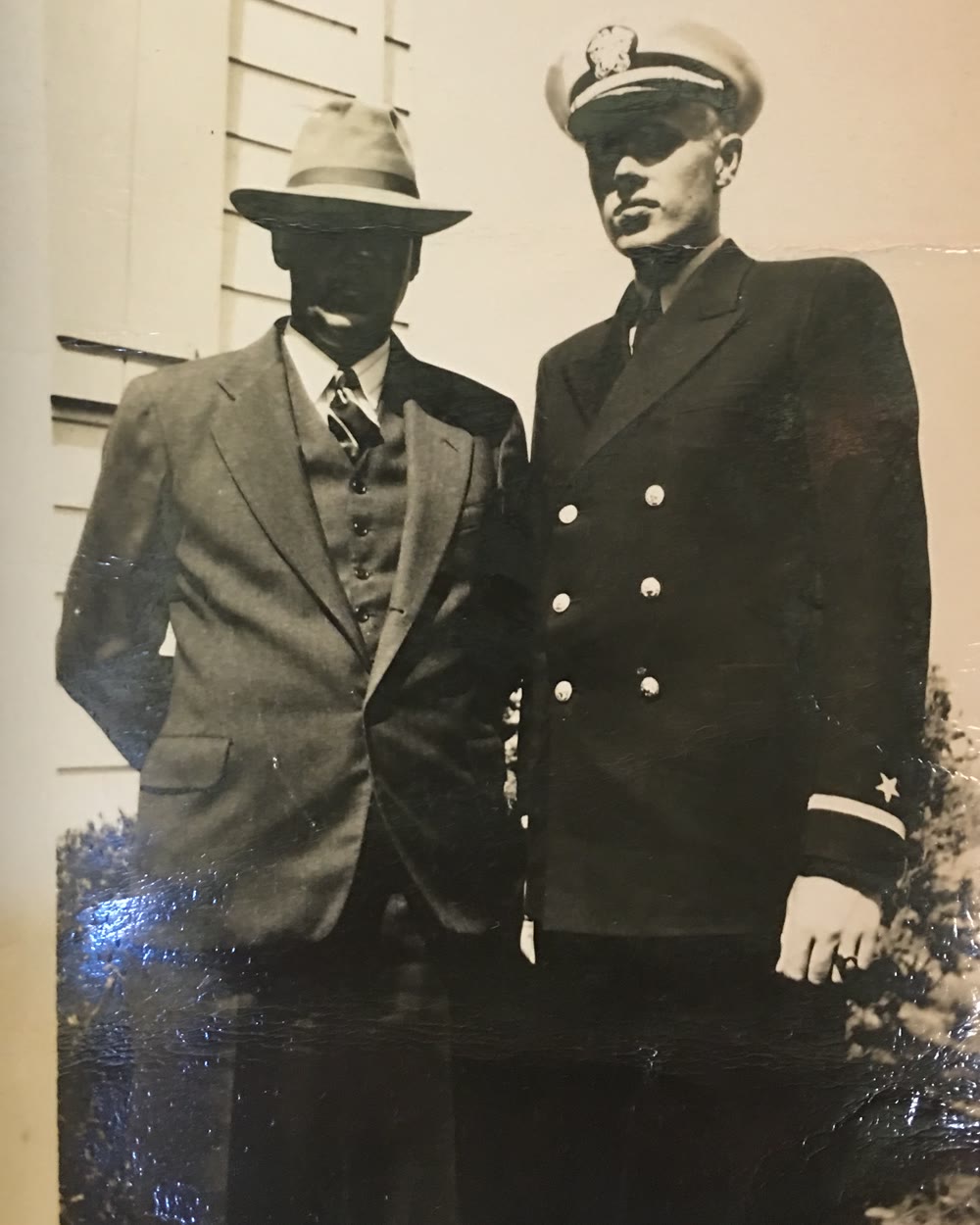
Left: Harold G. Johnson in his Navy uniform with his father, John Johnson. Right, from left: Tisinger, Stunkard, Mitchell and Harold. Family photos.
He left Washington State College for the Navy during World War II, served with the Amphibious Forces in the Asiatic-Pacific Theater and graduated from the Navy Midshipmen’s School at Columbia. Afterward he returned to college, spent 49 years at Aberdeen Federal and Anchor Bank, and served on the school board and through the YMCA, Red Cross, Lions Club and church.
World War II was neither clean nor simple, but the country acknowledged it as a national undertaking. Congress declared it, millions mobilized and a formal surrender marked its end.
Young Americans still stand watch on ships and at bases around the world. Today they’re carrying Day 192 of a war Congress hasn’t authorized, while most civilian life proceeds without having to call it a war. What’s changed sits with the country behind them: we’ve become less willing to say what we’re asking them to do, or what would let the mission end.
Most of Harold’s life came after the war. The people serving now are still at the beginning of theirs.
Tonight, a Manhattan for Harold.
The Exchange Rate
Day 191. Two American warships targeted. Three Iranian oil tankers struck. Washington’s latest explanation of the war comes with a ratio. Admiral Brad Cooper says attacks on two U.S. ships will be answered by taking out three Iranian vessels. CENTCOM says no American personnel were harmed. CENTCOM
Iran says it hit the warships. The damage is disputed. The question that survives either account: what happens when an exchange produces a result neither government can comfortably absorb?
There’s no stable exchange rate between a tanker and an aircraft carrier. You can count hulls. You can’t calculate in advance the political consequences of hundreds of dead sailors, an oil terminal burning, or commercial crews deciding the next voyage isn’t worth their lives. Announcing the price of retaliation doesn’t mean you control what the other side does after paying it.
CENTCOM’s statement contains an extraordinary sentence about the Iranian tankers: “Iran has no means by which to defend them.” The vulnerability of the targets is presented as an American advantage. But the ability to destroy another ship leaves the central question unanswered: how does this get us out of the war? CENTCOM
The same problem applies to reopening Hormuz. A successful passage gets a ship through. Restoring a trade route requires enough confidence to book the next voyage, insure it, crew it, and do it again next month. Every new exchange gives everyone involved another reason to reconsider. A naval escort can accompany a tanker. It can’t order its owner to believe the danger has passed.
That’s the danger in measuring success one exchange at a time. Each round can produce a favorable military report while making the next round harder to escape.
Two of ours. Three of yours.
The arithmetic works until the bill arrives.
Who Paid for Independence?
Day 190. Gloria Steinem died on September 2 at 92. Her death has prompted a reassessment of a life spent organizing, writing, and fighting for women’s equality. It’s also a reason to examine a part of that life she acknowledged decades ago: her work with the CIA. Death announcement and background.

Before she became a leading figure in women’s liberation, Steinem directed the Independent Research Service, a CIA-funded organization that sent American students to international youth festivals in 1959 and 1962. The connection was publicly reported in 1967. Contemporary reporting.
The Guardian’s obituary mentions the CIA connection in a paragraph about disputes over her prominence within feminism. The obituary.
It deserves a question of its own. What was an intelligence agency buying when it financed people who spoke the language of independence?
The agency’s own history provides an answer. Supporting the non-Communist left became a foundation of its political operations. Through the Congress for Cultural Freedom, it secretly supported publications and conferences that brought influential intellectuals together. Political credibility was something it could cultivate and finance. The CIA’s account.
Former CIA official Thomas Braden explained the mechanics in 1967. Use existing organizations. Disguise the American involvement. Allow recipients to disagree with aspects of American policy.
And, crucially: “Limit the money to amounts private organizations can credibly spend.” Braden’s account.
As an accountant, that last instruction caught my attention. Someone had to calculate how much independence would look reasonable in the budget.
A conference needs airfare. A publication needs printing. An organizer needs a salary. Financing those things helps determine whose ideas travel, whose arguments get published, and who can afford to keep working.
The people involved can believe every word they say. Concealed sponsorship still deprives their audience of information needed to judge the enterprise.
Steinem’s involvement belongs in our assessment of her political judgment. She knowingly participated in a project whose public identity concealed the institution paying for it. Her later achievements don’t answer the questions that decision raises.
Remembering someone means allowing the facts of their life to complicate the story we prefer.
We can recognize what Steinem helped women accomplish and examine what she helped the CIA accomplish. A serious account of her life has room for both.
The funding was concealed at the time. Its significance shouldn’t disappear in remembrance.
Who Polices Whom?
Ukraine’s security services brought an internal dispute into a residential courtyard.
Day 189.

Gunfire broke out in a Kyiv apartment courtyard Wednesday during a confrontation between Ukraine’s domestic security service, the SBU, and its military intelligence agency, GUR. Three GUR members were reported wounded. The video captures the confrontation but doesn’t establish who fired first.
The dispute centered on Stepan Kaplunov, a deputy commander in a Russian volunteer unit fighting for Ukraine under GUR. The SBU says it was searching his apartment while investigating an assassination plot directed by Russia’s Federal Security Service. Kaplunov says the SBU abducted him, held him for nine days and pressured him to confess.
The Prosecutor General’s Office initially echoed the SBU’s account of officers facing armed resistance. Investigators have since named a suspect from each service.
On Friday, Ukraine’s National Anti-Corruption Bureau, known as NABU, and specialized anti-corruption prosecutors conducted a separate operation at the Prosecutor General’s Office. They allege that an official there led a group protecting fraudulent call centers and laundering assets. No public evidence connects that case to the shooting.
The bureau’s ability to investigate senior prosecutors was itself contested last year. President Volodymyr Zelensky signed a law placing the anti-corruption bodies under the prosecutor general’s authority, then restored their independence nine days later after street protests and European Union criticism.
An investigation into prosecutors can show that oversight is working. The courtyard raises a more immediate concern about who can contain a dispute once armed agencies stop cooperating. Reporters from Suspilne, Ukraine’s public broadcaster, found police had cordoned off the area while representatives of the two services negotiated inside.
A conference room would have been easier on the neighbors.
No Random Craters
The Post found 228 damaged assets and no manipulated images. Tonight’s strike at Camp Titin remains unseen.
Day 187.
GPS disruption affected Iranian missile and drone guidance during the June 2025 war. China granted Iran military access to BeiDou in 2021, though the U.S.-China Economic and Security Review Commission says open sources still can’t establish how broadly Tehran uses it. Current defense reporting describes Iranian missiles using GPS, BeiDou and Russia’s GLONASS together, with some steering optically or by heat on descent.
The public evidence can’t assign BeiDou its share of the improvement. It can show what arrived.
The Washington Post authenticated 109 satellite images released by Iran, found none manipulated and documented 228 damaged or destroyed structures and pieces of equipment at 15 American military sites through April 14. A retired Marine colonel who reviewed the images put it plainly: “There are no random craters indicating misses.” Central Command disputed calling the damage extensive, then declined to address the findings in detail.
That doesn’t mean Iranian missiles never miss; many are intercepted before accuracy matters. It means the old photograph of an intact base surrounded by Iranian craters no longer describes the weapons that get through.
Less than two weeks into this war, the two largest American commercial satellite providers began limiting, delaying or withholding regional imagery at the U.S. government’s request. The Post verified Iran’s pictures against lower-resolution imagery from Europe’s Copernicus system.
The latest claim arrives through the same narrow opening. The IRGC says it killed American personnel at Camp Titin in Jordan. U.S. officials told Reuters their initial assessment found no casualties. No independent high-resolution image of the base has yet entered the public record.
The 2,000-Mile Workaround
The fleet stayed on station. Its supply line moved to Diego Garcia.
Day 186.
The Navy’s Bahrain plan now begins with a question smaller than strategy: how sailors can get their belongings back.
At Monday’s worldwide town hall, a sailor asked about household goods left behind after Iran struck Naval Support Activity Bahrain on February 28. Adm. Daryl Caudle answered plainly: “We’re not getting back in there anytime soon.” Six months later, the Navy’s top officer is describing a plan to retrieve those possessions as a “scheme of maneuver.”
The operational map changed with the locks. Navy Times reports that logistics shifted to Diego Garcia, more than 2,000 miles from carrier forces in the region. One littoral combat ship sailor said food orders had to be placed 30 days ahead—a lead time imposed on operations whose schedule could change overnight.
The Pentagon’s first public measure was continuity: no fatalities at the base, no significant effect on military operations. Continuity records whether ships keep moving. It doesn’t record the distance, lead time and improvisation consumed to keep them there.
The ships stayed on station.
The next pour comes from Diego Garcia.
August 2026 31 notes
The Imaginary Strike
Kharg Island wasn’t hit. Its destruction became an official message anyway.
Day 185.
Kharg Island wasn’t attacked Sunday night. The president posted its destruction twice.
During the exchange that began with an American strike on two launchers at Larak Island, Trump published an AI-generated video showing explosions across Kharg, the oil hub that handled 90 percent of Iran’s oil exports before the war. The caption said it was “being blown to smithereens.” A minute later, he posted a second view without a caption.
By Monday, a U.S. official had confirmed that American forces hadn’t targeted Kharg. JD Vance supplied the purpose: Trump was sending Iran a message.
That makes the videos more than synthetic spectacle. They place an event that didn’t happen inside the signaling of a war that did. Governments routinely use ambiguity to threaten what they haven’t yet done; what’s new is that the commander-in-chief supplied the finished footage.
Kharg remained intact.
That wasn’t the point of the videos.
The Green Photo
Five years ago tonight, the last C-17 lifted from Kabul. The picture supplied a clean ending. Policy rarely does.
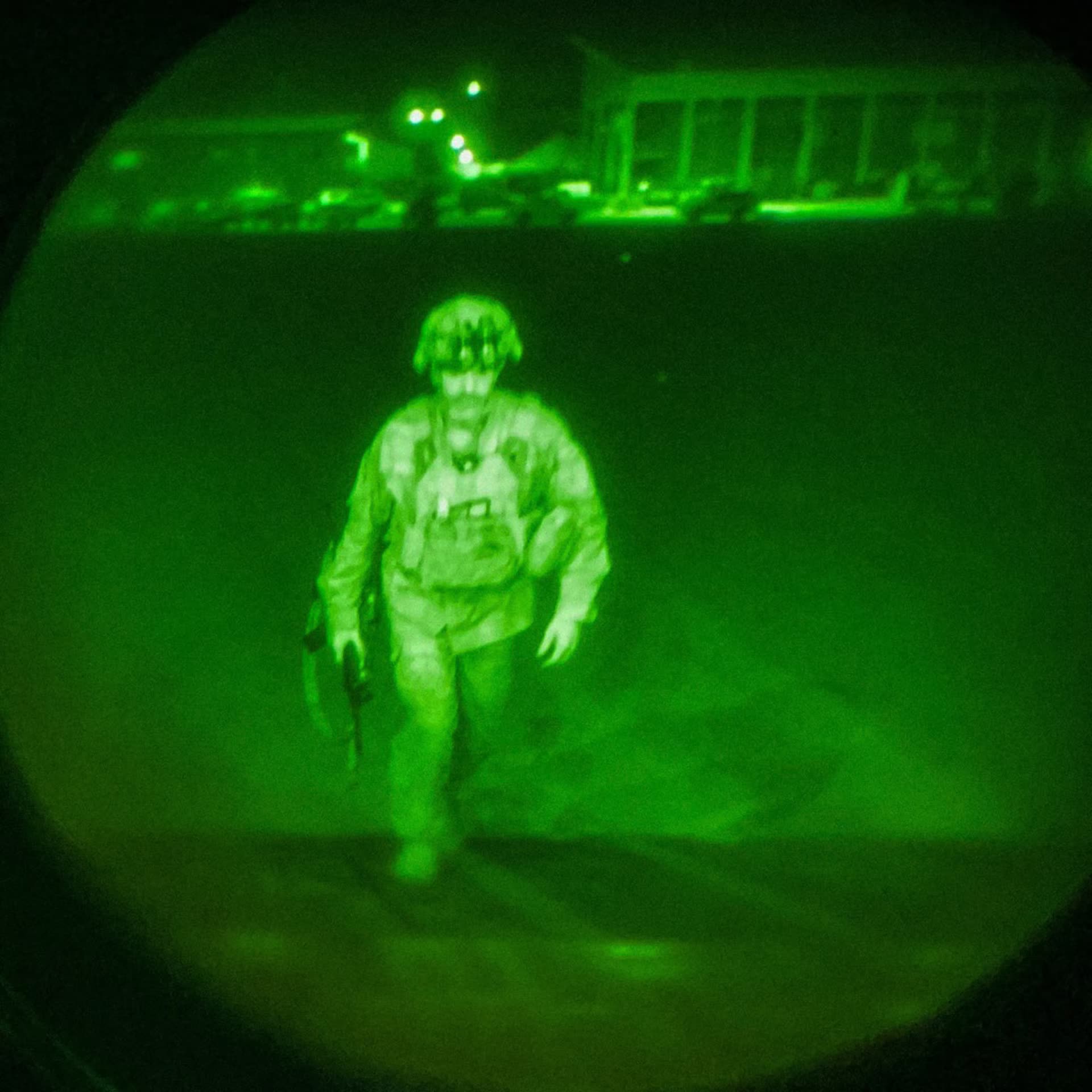
Day 184.
Five years ago tonight, a green-tinted night-vision camera captured Maj. Gen. Chris Donahue crossing the tarmac at Hamid Karzai International Airport, rifle down, walking onto the final Air Force C-17 out of Kabul. The aircraft left at 3:29 p.m. Eastern — 11:59 p.m. in Kabul.
The picture gives the ending a precision policy rarely achieves: one soldier, one aircraft, one minute before midnight.
At the Pentagon, Gen. Frank McKenzie announced that the withdrawal was complete and the nearly 20-year military mission was over. In the same briefing, he acknowledged: “We did not get everybody out that we wanted to get out.”
The next day, President Biden widened the claim. Afghanistan’s end, he said, marked the end of an era of major military operations intended to remake other countries.
Five years later, the green image reads differently. The United States did leave Afghanistan. Iran isn’t Afghanistan: there’s no American occupation, no nation-building project and no honest comparison of scale or purpose.
But on Day 184, the claim attached to the photograph looks narrower than it did. The picture proved Washington could end a deployment. It couldn’t prove Washington had learned to demand a stopping rule before entering the next one.
The green photograph was a period at the end of Afghanistan.
It wasn’t a policy.
Pour something anyway.
Clear on Paper, Severe at Sea
The Navy cleared the lanes. The mariners kept the threat at severe. Declarations move faster than fleets.
Day 183.
Adm. Brad Cooper said Thursday night that U.S. forces cleared Iranian mines from Hormuz’s recognized shipping lanes. That’s narrower than declaring the strait mine-free: he named the traffic separation scheme, not every mile between Oman and Iran.
The Joint Maritime Information Center kept its threat assessment at severe in its latest published advisory, warning of drifting or uncharted mines near those lanes and saying survey work continued. It recorded 37 U.S.-facilitated transits over two days against a 2025 baseline near 138 a day. The Navy says it cleared a route. The commercial market hasn’t treated that as normal.
Tehran’s answer came earlier, after President Trump issued a broader all-clear Tuesday. Deputy Foreign Minister Kazem Gharibabadi said only Iran knows where the mines were laid and maintained that traffic still requires Iranian terms. Iran and Oman announced a temporary corridor and joint mine-clearing project that afternoon. Washington says the lanes are clean. Tehran is still negotiating who cleans them.
The insurance ledger is less theatrical. Lloyd’s Joint War Committee still lists the Gulf as an enhanced-risk area, with coverage priced vessel by vessel. Its own guidance says insurance remains available; owners and masters are holding back because the risks to crew and hull, sanctions exposure and passage terms remain unsettled.
That’s the geometry of Day 183. A navy can clear known mines. It can’t sweep an insurer’s uncertainty, an owner’s liability or Iran’s ability to threaten the next transit.
A military victory requires destroying the weapon. A blockade only requires keeping the voyage in doubt.
Pour something.
We Were Lied To
Six months of deadlines, victories, endings, and renamed hostilities. The record was never secret.
Day 182: Six months.
In Peter Davis’s Hearts and Minds (1974), former Pentagon analyst and Pentagon Papers whistleblower Daniel Ellsberg sits for an on-camera interview about how the administrations of Truman, Eisenhower, Kennedy, Johnson, and Nixon gave Americans five versions of the Vietnam War. Then he says this about the American people:
“…their leaders perceived that they had to be lied to. It’s no tribute to us that it was so easy to fool the public.”
Davis then cuts to Nixon promising the complete withdrawal of American combat ground forces on an orderly schedule. It sounded like a promise to end the war. But “complete withdrawal” was limited to “combat ground forces,” and American aircraft kept bombing Indochina for another three years and nine months, ending over Cambodia in August 1973.
Six months ago today, on February 28, the U.S. and Israel began bombing Iran. By late July, roughly two-thirds of Americans said the war hadn’t been worth fighting. In an August 21–24 poll, just 31% supported U.S. military action against Iran. The president now says there’s no timetable for ending it, and the war continues.
This isn’t Vietnam. There’s no draft, no American ground occupation of Iran, and the duration and scale of the killing aren’t comparable. The parallel’s narrower: how a government sells a war, keeps it going as the reasons shift, and lets each new promise cancel the last.
Ellsberg revealed a classified history showing the gap between what successive administrations knew in private and what they told the public. There’s no equivalent archive for Iran, but the public record’s enough to compare what the administration said with what it did.
Day 1: President Trump described a massive, ongoing operation. He promised to “destroy their missiles and raze their missile industry to the ground” and “annihilate their navy.” Iran’s terrorist proxies, he said, “can no longer destabilize the region,” and Iran would “never have a nuclear weapon.” He told Iranians that when America was finished, they should rise up and take over their government.
Day 3: He repeated the administration’s first estimate: “We projected four to five weeks,” followed immediately by the qualification that America could go much longer. Pete Hegseth said this wasn’t Iraq. It wouldn’t be endless.
Day 10: “The war is very complete, pretty much.”
Day 25: “This war has been won.”
Day 33: The objectives would be completed “shortly, very shortly,” after another two or three weeks of strikes. Earlier that day, Trump said Iran had asked for a ceasefire and that he’d consider it “when Hormuz Strait is open, free, and clear.” Tehran denied asking. Then: “Until then, we are blasting Iran into oblivion or, as they say, back to the Stone Ages!!!” That night, he repeated it: “We’re going to bring them back to the Stone Ages, where they belong.”
Day 37: A deal should take “days, not weeks.”
Day 39: Hours before his 8 p.m. deadline for Iran to reopen the Strait of Hormuz, Trump wrote, “A whole civilization will die tonight, never to be brought back again. I don’t want that to happen, but it probably will.” Later that night, he announced a ceasefire.
Day 40: The next morning, the Pentagon declared that 38 days of major combat had achieved the president’s military objectives. In the same briefing, Gen. Dan Caine supplied the next definition: “A ceasefire is a pause.” American forces would remain ready to resume.
Day 48: Hegseth said the blockade would remain “as long as it takes.”
Day 53: During the first ceasefire, Trump said, “We’re totally loaded up. We have so much ammo.” The pause had made the U.S. military stronger, he said: “We’ve used this to restock.” In the same interview, he said he expected to resume bombing.
Day 63: The War Powers deadline arrived. Congress hadn’t declared war or passed an authorization. The president sent a signed letter saying the hostilities that began on February 28 had terminated. The carriers and blockade remained. CENTCOM kept enforcing the blockade and interdicting ships. Hegseth argued that the ceasefire ended the hostilities covered by the 60-day limit. The administration didn’t ask Congress to approve the war. It changed the word on which the deadline turned.
Day 67: Marco Rubio declared Operation Epic Fury over and its objectives achieved, then said the administration was now “on to” Project Freedom, a separate operation to guide commercial shipping through the Strait of Hormuz. The Pentagon said Epic Fury had ended and filed later American casualties under “Overseas Operations,” placing them in a different reporting category.
Day 110: Before signing, Trump said, “If it doesn’t get done in 60 days, that’s all right, we go back to bombing.” Hours later, at the Palace of Versailles, where defeated Germany signed the 1919 peace treaty, he signed the Islamabad Memorandum of Understanding (MOU). Iranian President Masoud Pezeshkian signed electronically. Clause one declared the “immediate and permanent termination of military operations on all fronts” and pledged no further threats or force; clause three gave the parties 60 days for a final deal.
Day 117: The White House asked Congress for $21 billion for munitions and additional money “to rebuild stocks expended” in Operation Epic Fury, one week into a MOU promising a permanent end.
Day 123: Vance said Trump had told the administration to use the MOU to “sort of refill the world’s oil economy,” “refill some stocks,” and “see where the hand is.” If Iran didn’t meet Washington’s terms, the other option was “banking our wins” and “doing things on top of that.”
Day 131: The U.S. blamed Iran for attacks on three commercial ships. CENTCOM said American forces struck more than 80 Iranian targets, and Iran answered with attacks on American bases in Bahrain and Kuwait. Asked whether the MOU was dead, Trump said, “To me, I think it’s over.” The “immediate and permanent termination” had lasted 21 days.
Day 145: Central Command said more than 50,000 American service members were operating across the region as strikes continued for a twelfth consecutive night.
Day 167: Hegseth said the blockade could continue “indefinitely” and added that there was “no timeline.”
Day 180: Trump said, “I have no time schedule, none.” Then: “Whatever it takes.”
Four to five weeks. War complete. War won. Objectives achieved. Hostilities terminated. Operation concluded. Permanent end. Indefinitely. No schedule.
Each claim came with its own explanation. The Pentagon declared “major combat” over, but the blockade began. The president told Congress that “hostilities” had terminated while CENTCOM kept enforcing the blockade. Rubio declared Epic Fury over, and the Pentagon filed later casualties under another heading. Trump signed an agreement promising a permanent end before American strikes resumed.
We were lied to.
Calling the war pointless doesn’t mean it was inconsequential. American and Israeli forces struck and substantially degraded Iran’s air defenses, naval capacity, and missile infrastructure and killed much of its senior leadership. The U.S. blamed Iran for attacks on commercial ships, and Iran attacked U.S. bases in neighboring countries. But Washington never told the public what all that destruction was supposed to produce, or what would count as enough.
So where are we now?
The question of Iran’s enriched uranium still isn’t resolved. Hezbollah hasn’t disarmed. Iran’s government survived and turned the Strait of Hormuz into leverage it didn’t possess while the waterway was open on February 27. Reopening that strait, an objective the war itself created, is now one of Washington’s prime goals. Saudi Arabia, Pakistan, and Türkiye signed a mutual-defense pact. A U.S. defense official and a NATO official told the Associated Press that Patriot stocks in Europe were “beyond critical” after interceptors moved east; Pentagon and NATO spokespeople disputed that assessment.
Hegseth put the Pentagon’s direct estimate at $37.5 billion in July. By late August, Pentagon databases recorded 18 American service members dead and 757 wounded. Iranian and Lebanese death tolls run into the thousands, though the totals remain disputed and incomplete. Those deaths and wounds, along with civilian suffering from the bombing, the blockade, and damaged water and energy systems, didn’t happen inside a vocabulary exercise.
That’s why the lies about time matter. A finite war asks the public to accept a known risk for a stated purpose. This one began without congressional authorization or a stopping rule, then continued as its stated purpose, method, and deadline kept changing.
Congress never authorized the war. It did tell the president to end it: the House passed a war-powers resolution on June 3, and the Senate adopted the same measure 50–48 on June 23. The administration called it nonbinding; its legal force was disputed, and the war continued. Congress still hasn’t cut off funding or passed a limit with the force of law, leaving the constitutional check intact on paper but absent as a practical limit.
The press covered each declaration separately, producing accurate stories that added up to a false history. “War won” gets one headline. “Hostilities terminated” gets another. “Permanent end” gets a third. “No time schedule” arrives months later as fresh news, detached from the promises it cancels.
Four Fingers News did this too. I kept the day count. I published the quotes, linked the documents, and archived the reversals. But a counter isn’t accountability unless it remembers what was promised on those days. Journalism can get every day right and still get the war wrong if it never adds the days together.
People have jobs, children, mortgages, and lives that don’t pause for Pentagon briefings, which is why a democracy builds institutions whose job is to remember. We help the forgetting when we treat each contradiction as “content” instead of evidence, excuse our side’s failed promise as strategy while treating the other side’s as proof of evil, or reduce disapproval to a poll result instead of a limit on power.
From Truman through Nixon, five administrations lied because they believed public consent could still constrain them. The Iran war presents an uglier possibility: it hasn’t needed majority consent, only enough party loyalty to keep Congress from stopping it, enough language to rename what continues, and enough new headlines to bury the last promise.
The Pentagon Papers showed that officials knew one thing and told the public another. This time, the public knows; most of us don’t support the war, but most of us don’t care enough to make that opposition matter. Ellsberg had to risk prison to give Americans the receipts. Ours weren’t hidden; they came in Truth Social posts, White House memes, television interviews, Pentagon briefings, and the occasional letter to Congress, with no declassification required.
At the end of Hearts and Minds, Peter Davis asks Vietnam veteran Randy Floyd whether Americans have learned anything.
“I think we’re trying not to.”
The Option
Day 181. Read Treasury’s designations and the threat is scoped to people and entities in five Iranian sectors. Read Bessent’s prepared remarks and the audience widens to countries—Iran’s partners, handed a timeline, told the clock is ticking. The gap between legal instrument and political warning is standard coercion design: write the authority narrowly enough to use, announce the consequence broadly enough to travel. Scott Bessent was on the Soros team that shorted sterling in 1992, then ran the fund’s 2013 yen short as chief investment officer. Few Treasury secretaries have arrived with more direct experience of the moment a currency defense stops working. He has now made access to the U.S. dollar system conditional on behavior.
Set that against the ledger he inherited. Gross federal debt crossed $40T five weeks before the Joint Economic Committee’s June projection. At the latest IMF count, the dollar held 57.13% of world foreign-exchange reserves, down from 71% in 2000. Treasury carries its 8,133 tonnes of gold at $42.22 an ounce—$11B on paper, roughly $1.2T at Wednesday’s market price.
A trader wouldn’t call this a short on the dollar. He’d call it an option. Every threat to dollar access makes the reserve asset with no issuer easier to see. No public proposal says Bessent plans to revalue Treasury’s gold, and Congress would have to change the statutory price before Treasury could monetize the difference. But the machinery isn’t imaginary. The 1934 revaluation supplied $2B to create the Exchange Stabilization Fund. Last fall Bessent used it for Argentina’s $2.5B draw on a $20B swap line; Argentina repaid it in January.
The threat is denominated in dollars. The hedge is booked at $42.22.
Two Ways to Dissolve
Day 180. The Syrian Democratic Forces dissolved Tuesday and joined Syria’s army.
They were the Kurdish-led, U.S.-backed force that helped defeat the Islamic State and then governed much of northeastern Syria. HTS was an Islamist rebel group descended from al-Qaeda’s Syrian affiliate. It led the offensive that toppled Bashar Assad in December 2024.
HTS leader Ahmad al-Sharaa—formerly known by the insurgent name Abu Mohammed al-Jolani—became president. HTS and dozens of other armed groups then formally dissolved into a new national army.
That army isn’t simply HTS under a new flag. It also contains Turkish-backed and other former rebel factions, some with a longer history of fighting the SDF. But former HTS figures hold the presidency and senior military and security posts. Former HTS commanders have the largest share of division commands.
The SDF remained outside. Its merger agreement with Damascus stalled; government forces attacked in January, captured most of the northeast and negotiated the remaining SDF units into the army. Damascus has since recognized Kurdish language rights, restored citizenship and made Nowruz a national holiday. Whether those guarantees preserve Kurdish political autonomy—or the SDF’s all-female units—remains unsettled.
Washington once offered $10 million for al-Sharaa. It later removed the bounty and formed close ties with his government.
HTS gave up its name after winning the state. The SDF gave up its name after losing the power to remain outside it.
You Can’t Undissolve the Salt
Day 179. The latest official number is 289.7 million barrels.
That’s how much crude oil remained in the United States Strategic Petroleum Reserve as of Friday, August 21. It sounds enormous because it’s enormous. It’s also barely 40 percent of the reserve’s authorized 714-million-barrel capacity.
I’ve heard presidents talk about “releasing oil from the Strategic Petroleum Reserve” my entire life. I pictured giant steel tanks somewhere in Texas. Maybe a government-owned refinery with a fuel gauge on the side.
I never stopped to ask the most obvious question:
Where, physically, is the oil?
It isn’t stored in one place, and it isn’t spread across the country. America’s emergency crude is concentrated at four sites along the Texas and Louisiana Gulf Coast: Bryan Mound, Big Hill, West Hackberry and Bayou Choctaw.
The oil sits thousands of feet underground inside roughly 60 caverns carved directly into natural salt domes.
They aren’t natural caves. Engineers made them by drilling into ancient deposits of rock salt, pumping down fresh water, dissolving the salt and pulling the resulting brine back out. By controlling where the water enters and leaves, they can shape an enormous storage chamber underground.
A typical cavern is about 200 feet across and 2,500 feet tall. It holds roughly 10 million barrels of crude oil. The Department of Energy says Chicago’s Willis Tower could fit inside one with room to spare.
That’s the scale we’re talking about: underground skyscrapers filled with oil.
Fresh water pumped into the bottom forces the lighter crude back to the surface. Repeated drawdowns enlarge and reshape the salt cavern.
THE RESERVE AT A GLANCE
The mechanism for getting the oil out is wonderfully simple.
Operators pump raw water into the bottom of the cavern. Oil floats above water, so the incoming water pushes the crude upward through a well and into the surface pipeline system.
That also corrects one of the more dramatic versions of the story now circulating.
The cavern doesn’t become an empty, unsupported hole when the oil leaves. Water and brine take its place. The oil isn’t holding up the ceiling like a support column, and I haven’t found a Department of Energy or Sandia document establishing one national inventory level at which all the caverns suddenly become unsafe.
The claim that the entire reserve crosses a structural cliff at 300 million barrels is too simple.
The underlying warning isn’t.
Fresh water dissolves salt.
Every drawdown changes the container itself. It enlarges the cavern, alters its shape and reduces the amount of salt separating it from neighboring caverns. The oil can be replaced later. The dissolved salt can’t be put back into the cavern walls.
That distinction matters now because this year’s emergency release is being executed through exchanges. Companies receive government oil during the disruption and promise to return more oil later as a premium. The first 45.2-million-barrel tranche, for example, is supposed to bring 55 million barrels back to the reserve. DOE later said its completed exchanges had secured a 26 percent premium in returned barrels.
That’s a good trade if the returned oil arrives as promised. It can restore the inventory count and may eventually leave the government with more barrels than it released.
It can’t restore the cavern to its previous shape.
You can replace the oil.
You can’t undissolve the salt.
That doesn’t mean each withdrawal does catastrophic damage. The caverns built by DOE were designed to remain geomechanically stable through as many as five full drawdowns. Sandia found that the huge 2022 release affected most caverns in the expected way and left the majority in very good condition. In some cases, the drawdown actually improved cavern shape by removing internal salt bridges.
This isn’t a simple countdown in which every use subtracts exactly one life.
Partial drawdowns can be more awkward than deep ones because fresh water may repeatedly attack the same portion of a cavern. Each cavern has its own geometry, pressure history, location within the salt dome and record of previous use. The national barrel total can’t tell us any of that.
At the end of 2024, Sandia estimated that 47 of the reserve’s 60 active caverns still had at least four available drawdowns remaining. All but one had at least one.
That’s reassuring.
It’s also finite.
The problems aren’t distributed evenly. At Bayou Choctaw in Louisiana, three of the six caverns had only one expected drawdown remaining. Two may have developed a pathway between them that could limit how they’re safely used.
And the caverns may not even be the weakest part of the system.
The wells are the straws that let the government move oil into and out of these underground chambers. According to the Government Accountability Office, well integrity is currently a bigger concern than cavern integrity.
The vast majority of SPR wells are already beyond the normal 20- to 30-year design life of an oil or gas well. The second-newest well is 38 years old. At Big Hill in Texas, a 2023 assessment found moderate to severe casing deformation in more than 70 percent of the wells.
At West Hackberry, most caverns have only one access well. If that well fails, the oil may still be sitting safely underground, but the government can’t reach it without drilling another way in.
That’s the difference between oil that exists and oil that’s available.
Then there’s everything above ground.
Oil leaving a cavern still has to move through pumps, pipes, heat exchangers, brine-disposal systems, commercial pipelines, marine terminals and refineries. Some of the crude may need to be cooled, blended or degassed before it can be delivered safely. A barrel underground isn’t a gallon of gasoline waiting behind a single valve.
At the end of 2025, before the current emergency release, DOE estimated that the reserve’s effective drawdown capability was about 2.7 million barrels per day. That was 61 percent of its original design rate. More than a quarter of the oil then in the reserve was unavailable for withdrawal because of construction and cavern outages.
That was a snapshot, not a permanent condition. Construction ends. Wells get repaired. Caverns return to service.
But it reveals the problem with treating the SPR like a bank account.
A bank balance tells you how much money is there. The SPR inventory number doesn’t tell you how much oil can be reached, which caverns it can come from, how quickly it can move, whether the access wells will hold, whether the surface equipment is operating or whether commercial pipelines and refineries have room to receive it.
Even “full” isn’t one number. The reserve has about 714 million barrels of authorized capacity, but DOE estimates that it can effectively hold closer to 680 million.
The barrel count is real.
It just isn’t the whole reserve.
None of this means the SPR is broken or that using it was a mistake. An emergency reserve exists to be used during an emergency. The system successfully handled the historically large 2022 drawdown without a major equipment failure or crude oil spill, even while workers were triaging leaks, repairs and construction around it.
The point isn’t that we should fill the caverns and preserve them forever.
The point is that using the reserve consumes two assets:
The oil itself and part of the machine’s remaining life.
For years, the political argument has focused on whether presidents release oil for the right reason. Was it a genuine emergency? Was it an attempt to lower gasoline prices before an election? How much will it cost to refill?
Those are legitimate questions.
But they begin one level too high.
Before arguing over how the reserve should be used, we should understand what it physically is: four aging industrial sites, roughly 60 underground salt caverns, old wells, pumps, pipes, brine systems and commercial connections concentrated along the Gulf Coast.
The current official number is 289.7 million barrels.
The more important number may be the one we don’t have: how much usable emergency capacity remains after the condition of every cavern, well and delivery route is taken into account.
America can buy the barrels back. It can’t put the salt back into the cavern walls.
Behind the bar or beneath the Gulf Coast, a refill isn’t a reset.
The Same Strategy, Different Reserves
Day 178. Ukraine marked 35 years of independence Monday, its fifth Independence Day under Russia’s full-scale invasion. Volodymyr Zelensky put the day’s wager into eight words: “Putin hopes that we are tired. But we know that he is mortal.”
Britain promised support “for as long as it takes.” Moscow’s wager runs the other way: keep fighting while waiting for Ukrainian capacity and Western attention to thin. That can sound like two equal bets on endurance. The arithmetic isn’t equal.
Ukraine extended general mobilization for another 90 days in July. Its defense ministry says the army needs new personnel so people who have served for four years can eventually leave.
Russia says about 200,000 people signed military contracts in the first half of 2026 and another 16,000 joined volunteer formations. The figures aren’t independently verifiable, but budget data broadly supports the recruitment pace. Meduza found that enlistment returned to the Kremlin’s target of roughly 1,000 people a day during the second quarter and that the army currently has no shortage of new recruits. The pressure is on the price: regions are paying larger bonuses to keep the flow moving.
Outside weapons can change the battlefield arithmetic. Air defenses keep people alive. Drones substitute for some troops. Long-range weapons impose costs behind the front. None enlarges Ukraine’s recruitment pool.
Russia is filling a larger pool with paid contracts. Ukraine is compelling service from a smaller one. An attritional war does not treat those systems equally.
Everyone’s plan is for the other side to tire first. The reserves aren’t equal.
Monday’s Sanctions Announcement Isn’t Addressed to Tehran
Day 177. Treasury Secretary Scott Bessent will hold a press conference Monday at 2 p.m. to detail what he has called “the toughest sanctions in history” on Iran. He has also urged China to cooperate. Hold onto the second sentence. It’s the announcement.
Iran has lived under American sanctions for nearly five decades. Washington can still blacklist ships, banks, refiners and officials; Monday’s package may add plenty of names. But Bessent has already threatened secondary sanctions against countries and companies that continue doing business with Iran. The larger remaining lever therefore sits outside Iran: the buyers, traders and banks that keep its commerce moving. The press release names Tehran. The demand letter is addressed to Beijing.
Mohsen Rezaei, secretary of Iran’s Supreme National Security Council, answered Saturday with a threat of his own: countries joining the American campaign—especially Iran’s neighbors—would be treated as enemies and could have their interests targeted. That is a threat, not proof of capability. But it identifies the same audience. Washington needs third countries to make the sanctions bite. Tehran needs them to keep trade moving. Same audience, same message, opposite letterhead.
China’s Foreign Ministry said Thursday that sanctions and pressure would not resolve the issue and called for diplomacy. Beijing has not accepted Washington’s assignment.
The test of Monday’s sanctions won’t be how tough Washington says they are. It’ll be the answer from Beijing.
Every Palace Has a Side Door
An unverified report alleges that Washington used its confirmed backchannel to Iran’s Revolutionary Guard to offer billions of dollars to senior commanders if they’d break with Tehran.
According to the report, the offer reached IRGC commander Ahmad Vahidi through intermediaries in Iraqi Kurdistan. Vahidi reportedly refused.
The backchannel isn’t rumor. President Trump has confirmed that his administration established direct contact with the IRGC. The money is another matter. That claim comes from a single unnamed source described as close to Iran’s leadership, and it hasn’t been independently verified.
That distinction matters.
But the strategy itself isn’t hard to believe.
In Venezuela, the United States didn’t reach Nicolás Maduro by defeating every unit loyal to him. It spent months learning his routine, rehearsing the raid and cultivating an agent inside his circle who helped track his movements. Maduro also had a $50 million reward hanging over him, although there’s no public evidence that the inside source collected it.
American force didn’t find the door. Intelligence opened it.
Washington may now be assuming Iran has the same door.
Maybe it does. Every government has rivalries. Every security service has ambitions, grudges and people who’d rather survive than become martyrs. Money, immunity and a comfortable future after the regime are standard tools of statecraft.
But Iran isn’t Venezuela.
The IRGC isn’t merely a presidential guard protecting one man. It’s a military, an intelligence service, a business empire and a political network woven into the state itself. Asking its commander to betray the government isn’t asking him to abandon a patron. It’s asking him to help dismantle the institution that gives him power.
That’s a much higher price.
There’s another danger. Success in Caracas may have taught Washington that regime change is a transaction: find the right insider, name the right number and let special operators handle the rest.
But removing a leader isn’t the same as controlling what follows. Maduro was captured while much of his system remained. Iran’s system is larger, better armed, more ideological and deliberately built to survive the loss of individual leaders.
If the bribery allegation eventually proves true, it won’t show that America found Iran’s weak point.
It’ll show that America is still looking for a shortcut.
Every palace has a side door.
That doesn’t mean every country is for sale.
The Debt Didn’t Shrink. The Clock Did.
Day 175. Washington’s latest debt maneuver makes thirty years disappear.
This week Treasury Secretary Scott Bessent said the government will double certain long-term bond buybacks from $2 billion to as much as $4 billion per operation. The announcement came after the 30-year Treasury yield climbed above 5.3%, its highest level since 2007.
When yields rise, government borrowing becomes more expensive. So do mortgages and business loans. Treasury’s response is to become a buyer.
By purchasing older debt in the 10-to-30-year range, Treasury removes some of it from the market. Reduced supply supports bond prices, and higher prices mean lower yields. The announcement worked briefly. Long rates fell, stocks rose and Washington got a few hours of relief.
Then yields climbed again.
Treasury isn’t buying the bonds with a surplus. It’s borrowing. Alongside regular bill auctions, it uses cash-management bills that can mature in as little as a few days.
The accounting isn’t a neat one-for-one exchange, and Treasury hasn’t said that the proceeds from a particular short-term auction funded a particular 30-year purchase. But its own documents say new issuance replaces the securities it repurchases. The practical effect is clear: Washington is raising money toward the short end while retiring debt at the long end.
The debt doesn’t disappear. Its maturity changes.
A 30-year bond locks in an interest rate for a generation. A short-term bill must soon be repaid or replaced at whatever rate the market demands. If rates fall, borrowing short may save money. If they remain high—or rise—the government must keep refinancing the same debt on increasingly expensive terms.
That makes this a wager that today’s long-term rates are temporary.
The operation is small beside a national debt exceeding $40 trillion, and it isn’t quantitative easing. The Federal Reserve isn’t creating money; Treasury must borrow every dollar it spends.
But the direction matters.
The administration wants lower long-term rates without reducing the borrowing that helped drive them higher. The bond market is warning Washington about inflation, deficits, war spending and the volume of debt investors are being asked to absorb. Buybacks can mute that warning at one end of the yield curve. Short-term issuance moves the risk elsewhere.
Washington didn’t solve the debt problem. It agreed to renegotiate more of it every few weeks.
The Weapon Works Until the World Builds Around It
Day 174. President Trump is calling it “ECONOMIC D-DAY.”
The threat is aimed at countries still doing business with Iran: continue trading with Tehran and risk losing access to the American economy.
That’s not an empty threat. The United States controls the world’s largest market, and the dollar remains the central currency of international banking, trade and reserves. Losing access to either can be devastating.
But Iran has been under some form of American sanctions since 1979. Economic D-Day is supposed to happen once. For Tehran, this is another escalation in a campaign it’s spent decades learning to survive.
The sanctions still hurt. They restrict investment, complicate transactions and make nearly everything Iran imports more expensive. But they haven’t eliminated Iranian trade. They’ve rerouted it.
Oil moves at a discount. Payments pass through intermediaries. Ships change names, flags and ownership records. Goods travel through countries willing to accept the risk—or capable of conducting the transaction outside Washington’s reach.
The pressure doesn’t make commerce disappear. It changes its price, its route and eventually its currency.
Iranian Foreign Minister Abbas Araghchi called Trump’s announcement economic terrorism and a distraction from America’s own debt and interest burden. Araghchi isn’t a neutral observer, and his language is intended to provoke.
But underneath the rhetoric is a point Washington should take seriously.
The threat works because most of the world still conducts business through financial infrastructure the United States can influence. Every time access to that infrastructure becomes a weapon, another government gains a reason to invest in an alternative.
China has already built part of that alternative.
Its Cross-Border Interbank Payment System—CIPS—clears and settles international payments in renminbi. This isn’t a proposal waiting for a conference or a pilot program. It’s operating financial infrastructure.
During the first half of 2026, CIPS processed 4.4 million payments worth nearly 101 trillion yuan (about $15 trillion). Its network reaches thousands of banks around the world.
CIPS isn’t about to replace the dollar or the Western financial system. The renminbi remains constrained by Chinese capital controls, and investors don’t enjoy the same openness, liquidity or legal protections available in American markets.
But replacement is the wrong standard.
CIPS doesn’t need to become the dominant global system to weaken the reach of American sanctions. It only needs to provide enough countries with a usable route around them.
That’s the strategic contradiction inside “Economic D-Day.”
Washington wants to isolate Iran. Instead, it’s making China more necessary to Iran. Beijing can provide a customer for Iranian energy, a currency for settlement and a financial network that’s less exposed to American pressure.
China isn’t doing this out of generosity. An isolated Iran sells oil at a discount and negotiates from weakness. Beijing gains cheap energy, political leverage and another large participant in the financial architecture it wants the world to use.
The United States supplies the pressure. China collects the customer.
None of this means the dollar’s about to collapse. Its advantages remain enormous, and credible alternatives remain limited. Predictions of its imminent death have been wrong for decades.
The danger is slower.
One bilateral trade agreement moves into local currencies. One sanctioned bank joins another network. One central bank reduces its exposure. One country decides it needs financial insurance against the possibility that Washington may target it next.
No individual decision overturns the dollar system. Together, they begin constructing something outside it.
Trump is counting the immediate pain his threat might inflict on Iran. American policymakers also need to count what happens after the thousandth day—when Iran is more dependent on China, CIPS has more participants and another part of world trade has learned to operate without the dollar.
The sanctions can punish Iran today and still weaken American leverage tomorrow.
A weapon is most valuable when adversaries fear it. It becomes less valuable when every use helps build the world around it.
The Map Was Never Regional
Day 173. I’ve given you two long notes in two days, so today I’ll keep it to one point: the map is getting bigger.
The Financial Times reports that Iranian planners have examined U.S. military facilities in Bulgaria and Cyprus as possible targets if the war escalates further. They’ve separately studied attacks on the subsea fibre-optic cables running through the Strait of Hormuz.
The reporting doesn’t tell us whether a strike has been ordered. It tells us something important enough on its own: Iranian planners are studying how to carry the war into Europe and how to attack the communications infrastructure beneath Hormuz. An actual attack plan wouldn’t arrive with a press release. The planning is the threat.
Iran had already warned Bulgaria about the temporary deployment of American KC-135 tankers at Bezmer Air Base. It had already pressed Cyprus over the use of foreign military facilities on the island. RAF Akrotiri had already been struck by an Iranian-made drone. Until now, those could be read as separate warnings, diplomatic pressure and proxy action. The new reporting says Iranian planners are considering how the pieces fit together.
That’s the part that matters.
The war is still described as regional, but the machinery sustaining it was never regional. American tanker aircraft supporting Middle East operations can be based in Bulgaria. British bases in Cyprus become pressure points whether London wants them to or not. Civilian communications and markets depend on cables beneath the Strait of Hormuz. The battlefield may be concentrated around Iran and the Gulf, but the infrastructure behind it stretches much farther.
Iran’s reported answer is to consider expanding the battlefield until it resembles the support network.
Planning isn’t execution. But it’s how execution begins. The distinction between the battlefield and everything behind it is beginning to erode.
The war has already touched Cyprus. Iranian planners are reportedly drawing a map on which Europe is no longer safely behind it.
What Are You Willing to Die For?
Day 172. Realists ask what a state wants, what it can afford and how much force it can bring. There’s another question I haven’t given enough weight: what are you willing to die for?
This week, Itamar Ben-Gvir proposed killing 30 to 40 people in Gaza every night. Not only people presenting an immediate threat. He said there are people there “who are not worthy of life.” Then he finished the thought: “They’re not even people.”
Ben-Gvir doesn’t command the Israeli military. He does control the national police and prison system. That distinction matters. So does the office.
Al-Aqsa Mosque has been on my radar since the beginning of this war. Not because I’m predicting Israel will destroy it. I haven’t seen evidence of such an order or plan, and I’m not reporting one. I’m watching the distance between an idea and the people who now have the authority to execute it.
Muslims know the wider sanctuary as Al-Haram al-Sharif, home to Al-Aqsa Mosque and the Dome of the Rock. Jews know the same platform as the Temple Mount, the site of the First and Second Temples and the holiest place in Judaism.
Those aren’t simply two names on a map. They describe two sacred histories and, for some believers, two incompatible futures.
Under the longstanding status quo, the Islamic Waqf administers the compound under Jordanian custodianship. Muslims pray there. Jews may visit but officially may not pray. Israel controls security and access.
The status quo works only while everyone agrees to postpone the ultimate question of what should stand on the Temple Mount.
Ben-Gvir is no longer pretending that nothing is changing.
Three weeks ago, he entered the Temple Mount on Tisha B’Av, the Jewish day mourning the destruction of the ancient Temples. He celebrated Jewish prayer there and said visitors were “feeling like they’re the owners of the place.”
In May, Ben-Gvir stood on the Temple Mount waving an Israeli flag alongside Yitzhak Kroizer, a member of his Jewish Power party. Kroizer later wrote: “The time has come to get rid of all the mosques and work to construct the Temple!”
Ben-Gvir declared: “The Temple Mount is in our hands.”
Last year, Finance Minister Bezalel Smotrich told Jerusalem’s mayor, “I will give the money, you will build the Temple.” People present said it was a joke. There wasn’t an appropriation, construction order or demolition plan.
The joke still had an audience.
Before becoming the American secretary of defense, Pete Hegseth told an Israeli conference that the reestablishment of the Temple on the Temple Mount could become another Zionist “miracle.” He said he didn’t know how it would happen, but he believed that it could.
None of those statements is an Israeli demolition order. Benjamin Netanyahu continues to insist that the status quo hasn’t changed. They don’t establish that most Israelis want Al-Aqsa destroyed.
They establish that the restoration of the Temple is being discussed by men who control the police, the purse and the Pentagon.
A belief doesn’t need a majority once its believers have keys.
The other side has been equally explicit about what the site means to it. Hamas named the October 7 attack Operation Al-Aqsa Flood. Ismail Haniyeh said the group was fighting “for the sake of Al-Aqsa Mosque, our sanctities, and our prisoners.”
That doesn’t justify the murders or hostage-taking. It doesn’t make the attack a defense of anything. It tells us the religious frame wasn’t incidental branding. Hamas wanted Palestinians and the wider Muslim world to hear Al-Aqsa in the name of the operation.
Jordan now warns that Israeli actions on the Temple Mount present an “imminent” threat and could ignite a religious conflict across the Muslim world.
“Jerusalem is a tinderbox,” its foreign minister said.
Here’s where realism has to become more realistic.
All three religions represented in this struggle prohibit idolatry. All three distinguish the Creator from the things created.
Solomon dedicated the First Temple by acknowledging that even the highest heaven couldn’t contain God, “much less this house.” The Christian scriptures say the God who made the world doesn’t live in temples built by human hands. The Quran says east and west belong to Allah, and that righteousness isn’t found merely by turning toward either direction.
Their own texts warn against mistaking a place for the God worshipped there.
The Temple Mount can be holy without being God. Al-Aqsa can be sacred without containing God. The people standing around it are also part of the creation these religions say belongs to God.
That’s what makes Ben-Gvir’s statement so revealing. The people must become “not even people” before the stones can become more valuable than their lives.
Hamas performs the same inversion when it places Al-Aqsa’s name over murder and hostage-taking. A sanctuary becomes the language through which human sacrifice is made righteous.
Each side insists it worships the Creator, not the creation. Yet each can make the same platform the thing to which human beings must be sacrificed.
At what point does defending a holy place become worshipping it?
Realism should be built for this question. It asks us to see the world as its participants see it, not as we think rational people should see it. Sacred belief is an interest. Prophecy can become policy. Once people organize around a belief, vote around it, arm themselves around it or kill under its name, the belief becomes a material fact.
You don’t have to believe any of it. Neither do I.
Disbelief doesn’t put us outside the blast radius.
On a spreadsheet, every price has a ceiling. The Temple Mount is where people insist it doesn’t.
I’m not predicting that Israel will destroy Al-Aqsa. I’m saying the rhetoric around the Temple Mount has moved from fringe aspiration into government office, while its threatened defense has already been used to name and justify a massacre.
The realist question isn’t which side is right about what God wants.
It’s what each side is willing to die for.
Then what it’s willing to kill for.
And finally, how many people who believe none of it are they willing to make die with them?
The War That Was Waiting
Day 171. The event that triggered the Iran war wasn’t an Iranian attack. It was an Iranian meeting.
Go back to February 26, two days before the war began. Oman said the nuclear talks had made significant progress and would continue. The next afternoon, President Trump gave the order. Early Saturday, intelligence found Supreme Leader Ali Khamenei in a room with his senior advisers and moved the joint American-Israeli operation forward.
Most Americans woke up inside a war and waited to hear what Iran had done. The answer came as a list of everything it’d done over 47 years, followed by another list of what it might someday do. Nothing had happened Friday except that the target was available.
The White House says this war followed “47 years of Iranian aggression.” That number is a choice. It begins the story in 1979, with the revolution and the seizure of the American embassy. It includes the 444 days of hostages, Hezbollah, attacks on American troops, armed proxies, threats against Israel and the long nuclear dispute. All of that belongs in the record.
It also removes the preceding 26 years.
In 1953, the CIA and British intelligence helped overthrow Mohammad Mossadegh after Iran’s elected prime minister nationalized the country’s oil. Washington restored the Shah’s authority and spent the next quarter century arming and supporting his government as it eliminated meaningful political opposition. For Iran, that’s where the clock starts.
Iran performs the same edit in reverse. Its official history begins with the coup and tends to skip past the embassy, the hostages, the militias, the bombings and the use of foreign civilians as bargaining chips. Each country begins the story with the injury committed against it. The difference is that only one version is currently being used to explain American bombs.
The years between the two starting dates matter. Saddam Hussein invaded Iran in 1980. When Iran recovered and threatened to win, the United States tilted toward Iraq, sharing intelligence and supporting Baghdad even as Saddam used chemical weapons. American and Iranian forces eventually fought directly in the Gulf. In 1988, the USS Vincennes shot down Iran Air Flight 655 and killed all 290 people aboard.
Iran came out of that war with a lesson: no ally was coming, international law wouldn’t protect it, and conventional weakness had to be offset somewhere else. The missiles, militias, proxies and strategic depth that Washington now cites as proof of Iranian aggression were also the instruments Tehran built to prevent another invasion.
That doesn’t make Iran innocent. It makes the history reciprocal.
There were exits. After September 11, Iran helped the United States against the Taliban and helped construct Afghanistan’s post-Taliban government. Weeks later, George W. Bush placed it in the “axis of evil.” America then invaded Iraq and removed Saddam, Iran’s principal regional enemy. Washington eliminated the Taliban and Saddam for Tehran, surrounded Iran with American forces, and then watched with alarm as Iranian influence expanded into the space it’d created.
Around that time, retired Gen. Wesley Clark says a Pentagon officer told him about a five-year campaign involving seven countries: Iraq, Syria, Lebanon, Libya, Somalia, Sudan and Iran. The alleged memo hasn’t surfaced. Clark didn’t read it. His earlier written account even listed the countries in a different order. It’s not proof of a master plan faithfully executed across 25 years.
It’s evidence of a way of thinking.
Iraq was invaded. Libya’s government was overthrown. Syria became a battlefield. Somalia became a permanent target set. Lebanon was treated as an arena in which other states settled their accounts. The timetable failed, the methods changed and administrations came and went. Iran remained.
The most inconvenient piece of this history arrived in 2015. The United States and Iran reached a nuclear agreement. Iran reduced its stockpile, removed centrifuges and accepted inspections. International monitors repeatedly found it complying. In 2018, Trump withdrew the United States and restored maximum pressure.
The withdrawal didn’t expose a secret Iranian bomb. It removed the agreement designed to keep one from being built. Iran waited a year, then began exceeding the limits Washington had abandoned. Pressure produced more enrichment, fewer inspections and the danger it was supposed to prevent.
By February 2026, there were legitimate reasons for concern. Iran possessed highly enriched uranium that inspectors couldn’t fully account for. Its missile program was real. Its regional network had killed Americans. But concern isn’t imminence. Capability isn’t an attack. A 47-year charge sheet isn’t a triggering event.
The administration said Iran was rebuilding the nuclear program supposedly obliterated the previous summer. American intelligence later said it hadn’t made any effort to rebuild its enrichment capability. Pentagon officials told Congress there was no intelligence Iran planned to attack American forces first.
So why are we at war?
Because Iran became a genuine adversary, and Washington repeatedly chose policies that enlarged the adversary, removed the available restraints and preserved war as the final answer. By February, Iran was weakened, its regional network was damaged, its air defenses had been penetrated and its leadership could be found. A preventive war Washington had kept available for a generation suddenly looked cheap.
Most Americans didn’t miss the explanation. It wasn’t given to them. They went to sleep during negotiations and woke up during major combat operations. Washington made the decision first. The history came afterward.
The war didn’t begin with a triggering event because, by then, it no longer needed one.
Nobody Is Using the Extra Day
Day 170. The Memorandum of Understanding (MOU) was supposed to die today. Yesterday, I reported that it would. So did most of the wires. Count it again, and the weekend reporting now says Monday: 60 days from a June 17 signature, counted the way lawyers count instead of headline writers. When nobody can agree on what day a war’s own deadline falls, the paperwork has stopped being a schedule. It’s become another front.
The date isn’t the point. Nobody used the time. No extension is on the table. Araghchi acknowledges that messages still pass through intermediaries, then strips them of the one word that might give them weight: “This is not called negotiations.” A senior official in Tehran adds reparations and an end to the fighting in Lebanon to the price of restarting talks. Washington’s counteroffer comes from its Treasury secretary: sanctions “never seen,” arriving “next week.” Both capitals are bidding up the cost of talking while refusing to be caught wanting a conversation.
Then Tehran put a price on the alternative. Iran’s army chief, Maj. Gen. Amir Hatami, announced 5 billion tomans, about $30,000, for anyone who kills or captures and turns over an “invading American” service member. An Iranian woman gets twice that. The army guarantees the payment.
Hatami gave no location. The adjective matters: “invading” isn’t “any American, anywhere.” The missing boundary matters too. I won’t make the threat broader than Hatami did. Commanders don’t have that luxury.
Washington speaks escalation in a different register. This month, Pentagon policy chief Elbridge Colby told STRATCOM that the department is seeking “credible, rational nuclear options” and “rationally employable, limited options.” The reported scenarios involve regional wars with Russia or China, not Iran. That isn’t evidence of a U.S. nuclear plan for Iran. It’s evidence that Washington is again teaching itself to put the word “limited” in front of nuclear war.
The strait, meanwhile, had its first quiet night of the week. No new UKMTO warning after four ships in three days. Quiet is data now. So is this: the only Hormuz diplomacy to produce a result this month was a navigation map agreed by Iran and Oman, without Washington in the room.
Saturday offered another measure of the cost. CENTCOM’s new chief flew to the Abraham Lincoln, now more than 250 days from home. Wire reports about her crew read less like readiness updates than triage notes. The admiral called the mission one of the most consequential of the modern era. The visit said the rest.
The MOU expires tomorrow, not today. I had the date wrong. Nobody is using the extra day.
Remote from the Oregon Coast
Day 169. Washington’s Lebanon policy now has two parts, and the distance between them is the policy. In January, Israeli reports said Trump had given Netanyahu a conditional green light for an attack plan against Hezbollah; the army said preparations were complete, leaving timing as the question. This week, a State Department official rebuked Defense Minister Israel Katz after he said the IDF was “here to stay” in Lebanon’s security zone.
Read together, the message is simple: America will license the demolition, but not the tenancy. Strike the ridge, kill the commanders, collapse the tunnels, fine. Say permanent occupation out loud and the phone rings.
Ali al-Taher is where that distinction stops working. It isn’t a border post. It’s a chain of heights rising roughly 600 meters north of the Litani, between Kfar Tebnit and Nabatieh al-Fawqa, overlooking Nabatieh and the approaches toward Iqlim al-Tuffah and the Rihan heights. Israel maintained three outposts there before its 2000 withdrawal. It now says a Hezbollah command complex sits underneath. Stretch the buffer to Ali al-Taher and it isn’t just a belt along the border anymore. It’s high ground over deeper Lebanon.
At about 2:30 Saturday morning, the IDF says a Hezbollah explosive drone struck near Yahalom combat engineers operating on the ridge, wounding an officer and two soldiers, all initially listed as serious. The drone didn’t cross into Israel. It hit Israeli troops inside Lebanon.
Israeli strikes then hit Ali al-Taher, Nabatieh, Ansar and Deir al-Zahrani. Eleven people died across the south. Seven were killed at Ansar, including three children and two women. The IDF says its target there was Ali Samir al-Haj Hassan, a Radwan Force battalion commander; it says Hassan’s family was inside and wasn’t the target.
Netanyahu spokesman Doron Spielman said the strikes should “jumpstart” the talks. Israel calls Ali al-Taher part of a security zone. Lebanon calls it occupied territory. Washington objects when Israel calls the arrangement permanent.
The paperwork still calls it a ceasefire. On Ali al-Taher, the negotiating positions have coordinates.
The war’s goal is the day before it started.
Day 168. The war has restated its purpose. “Goal number one,” Vice President Vance told Fox News on Thursday, is to “keep oil and gas cheap for Americans.” Keeping Tehran from a bomb—the stated reason the first missiles flew—now officially runs second. Wars revise their aims all the time. This revision came neat and numbered.
Here’s the number the new mission chases. On Feb. 26, two days before the war, AAA’s national average was $2.98 a gallon. Operation Epic Fury opened Feb. 28. Four weeks later, on March 26, the average was $3.98—exactly a dollar higher. AAA’s latest reading, dated Aug. 13, is $4.07. WTI crude sits near $81. The strait the new goal runs through is moving roughly a dozen tracked crossings a day against about 130 before the war.
Last night, drones struck two tankers owned by the UAE’s state oil company as they crossed that same strait. Abu Dhabi blames Iran; Tehran hasn’t responded. The damage was minor; war-risk underwriters take attendance anyway.
Cheap fuel is a real interest. Wars have been fought for worse ones, usually stated less plainly. Goal number one isn’t new. It was the last week of February: gas below $3, the strait open, the missiles not yet flying. The war’s goal, 168 days in, is to reach the day before it started.
The carrier is presence. At home, it’s absence.
Day 167. USS Abraham Lincoln left San Diego Nov. 21 on a scheduled seven-month deployment. It’s now in month nine, carrying more than 5,000 sailors and Marines, after more than 200 days without a port call and with no public return date. A U.S. official told CNN one sailor went overboard last month and was quickly rescued; the circumstances aren’t clear. Families and crew have separately described deteriorating conditions aboard.
The Navy’s response is specific about what it disputes: it says it hasn’t observed an increase in suicidal ideation or attempts. That’s a claim about direction, not absence. It also says clean water and air conditioning remain available and acknowledges mail and resupply disruptions. Institutions don’t announce that the water’s clean. Someone’s been asking.
There’s precedent, and it’s recent. Eisenhower’s 2023–24 Red Sea deployment lasted nearly nine months and was extended twice. Its crew had only two chances for liberty; Lincoln hasn’t touched a pier since December. More than 200 days of replenishment at sea is a logistics achievement and a human problem, and both statements are true at once.
The strategic logic isn’t mysterious. A carrier in the Arabian Sea is one of the few pieces of military power Washington can move without a new vote and Tehran can’t ignore. That’s exactly why it’s so difficult to order home now: withdrawing the ship reads as a strategic signal whether or not Washington means it as one.
From Washington, the carrier is presence. At home, it’s absence.
The syllabus has moved on to chemistry.
Day 166. The Treasury secretary set a horizon for the strait. “What we are going to see over the course of the next two years,” Scott Bessent said Friday, “is the strait is going to become irrelevant.” Planned pipelines will carry Gulf oil overland to ports beyond Iran’s coastline. Grant him the crude. Oil was never the strait’s only cargo.
At Ras Laffan on Qatar’s Persian Gulf coast, the world’s largest LNG export complex ordinarily supplies roughly a fifth of global LNG. QatarEnergy’s force-majeure notices now reach September for some customers. The Persian Gulf accounts for a third of the world’s urea exports. Urea more than doubled from about $400 a ton to above $850 in April, then fell to $453 by June. Those swings reach American farms in the fertilizer spread on cornfields and the exhaust-fluid tanks of modern diesel trucks.
Qatar supplies a third of the world’s helium, extracted at Ras Laffan from natural gas processed alongside LNG. Spot prices doubled after the shutdown. Chip fabs use it to cool wafers, MRI machines to keep magnets cold, and some high-capacity hard drives are sealed with it. India makes urea with imported LNG, so the strait enters the fertilizer chain twice. None of it fits in a crude pipeline.
By late April, U.S. natural gas had fallen nine percent from pre-closure levels; Europe’s benchmark was up 35%, Asia’s 51%. From a Treasury window, where abundant domestic gas sits behind finite export capacity, the strait can look irrelevant. Europe and Asia buy the scarcity. The map decides who pays first. It doesn’t decide what matters.
On Day 150, I wrote that war teaches Americans geography, one chokepoint at a time. The syllabus has moved on to chemistry. You can build a pipeline around a strait. You can’t build one around the periodic table.
Both are meant to be framed.
Day 165. Tehran’s price for reopening the Strait of Hormuz, restated Monday by Foreign Ministry spokesman Esmaeil Baqaei: end the blockade, lift sanctions, release frozen assets and pay compensation for war damage.
Trump mocked the demand, then adopted the category. In a social post, he called compensation “an interesting idea” and instructed his representatives to put his counterclaim into future negotiations. His itemization reaches across 50 years—from roadside bombings and the families of the 17 sailors killed in al-Qaida’s 2000 attack on the USS Cole to “the damages and death caused to the people of Lebanon, Syria, Yemen, and Gaza.”
Tehran’s reparations claim starts with this war; its sanctions and security grievances don’t. Trump’s ledger starts half a century earlier. Neither comes with a payment mechanism.
The UN’s Iraq–Kuwait mechanism did. The UN Compensation Commission distributed $52.4 billion to roughly 1.5 million successful claimants for losses arising from Iraq’s invasion of Kuwait. The money came from a UN-administered share of Iraqi petroleum-export revenue. The final payment was made January 13, 2022—nearly 31 years after the commission was established.
Collection required a defeated state, Security Council authority and three decades of access to its oil money. No equivalent exists here.
Without that machinery, a reparations demand issued mid-war isn’t a bill. It’s a draft of the war’s story with a total at the bottom—addressed to the enemy, written for home. Neither invoice is meant to be paid. Both are meant to be framed.
Same government, different filing cabinet.
Day 164. Last week, Trump established a Military Spouse Commission, stating in the Federal Register that spouses are “intrinsically linked to the good order, readiness, and retention of our military.” Sunday, more than 60 Democratic lawmakers opened an investigation after AP found immigration authorities had detained more than 50 spouses and parents of active-duty troops. Separately, DHS reported detaining 125 military veterans and arresting more than 150 immediate family members from Jan. 20, 2025, through Jan. 26, 2026.
DHS says military service doesn’t automatically grant relatives lawful status or exempt them from immigration law. That’s the legal answer. The operational answer is already in AP’s reporting: service members taking leave and, in at least one case, halting an imminent deployment to care for children after spouses were detained.
One office calls military spouses essential to readiness. Another opens detention files on military families. Same government, different filing cabinet.
The charge arrived a year later—apparently barrel-aged.
Day 163. Israeli prosecutors have charged settler Yinon Levi with reckless manslaughter in the killing of Palestinian teacher and activist Awdah Hathaleen. The indictment says Levi’s first shot struck Hathaleen while he stood 20 meters away filming. Levi says he acted in self-defense. His lawyer calls the charge mistaken.
The filing arrived just over a year after the shooting and nearly six months after prosecutors first said it was coming. B’Tselem says it’s the first indictment of an Israeli for killing a Palestinian in the West Bank since Oct. 7, 2023. The family’s lawyer credits several videos and a year of pressure on police and prosecutors.
An indictment isn’t a conviction, and one charge isn’t a trend. The evidence was recorded in real time. The charge arrived a year later—apparently barrel-aged.
The clock expired. The discretion remained.
Day 162. By the time Trump’s Russia deadline expired one year ago today, India had been assigned an additional 25 percent tariff. China had not. What arrived on deadline day was a new date: Trump would meet Vladimir Putin in Alaska one week later. The summit ended without a ceasefire.
Friday, the Senate passed a new Russia sanctions bill, 86–11. It would allow the president to impose tariffs on the five largest buyers of Russian energy, including India and China. It would not impose those tariffs itself. The House won’t return until the end of August.
That is what changed in a year: the threat moved from a presidential deadline to congressional legislation. What did not change is who decides whether the consequence arrives.
The clock expired. The discretion remained.
Day 161. For decades, Saudi Arabia bought American weapons and treated American power as its final defense. Friday it added two more names. Under the Mecca agreement, an attack on Saudi Arabia, Türkiye or Pakistan will be treated as an attack on all three. When you sign a pact, who do you envision fighting?
Riyadh won’t say. It insists the pact isn’t a military axis, isn’t nuclear and doesn’t replace existing partnerships. It doesn’t have to replace Washington to send Washington a message. Pakistan has already moved 8,000 troops, a fighter squadron and air defenses into the kingdom. Türkiye offers defense technology and industrial capacity. Those are capabilities, not communiqués.
The United States remains Saudi Arabia’s most powerful security partner. But exclusivity ends before dependence does. Riyadh has spent this war watching Washington pause, resume and redefine its campaign while attacks reached Saudi infrastructure.
Washington still fills most of the glass. Riyadh just added two more fingers.
Day 160. “Iran-backed” is doing too much work in Yemen.
Ansarallah (“the Houthis”) says it used ballistic missiles and drones Thursday against government camps in Marib and Hadramout, calling the strikes a response to a buildup of Saudi-backed forces. Yemeni officials say at least 30 troops were killed. Ansarallah claims “hundreds” were killed or wounded; that larger figure hasn’t been independently verified. The attack is a major escalation from the de facto truce that quieted Yemen’s main front in 2022.
Iran supports Ansarallah, and the movement identifies with its Axis of Resistance. It also seized Sana’a in 2014, governs much of northern Yemen and retains its own domestic command. Calling it a proxy makes Iran the subject and Yemen the scenery. Thursday’s targets weren’t American, Israeli or Saudi. They were Yemeni.
The regional war gave Ansarallah a larger stage. It didn’t erase its original fight. The label points to Tehran. The weapons pointed at Marib.
Day 159. Trump says a deal to reopen the Strait of Hormuz could come within 48 hours. U.S. defense officials estimate that clearing mines from the waterway could take up to six months. Both numbers describe the same water, and the distance between them is where this week actually sits.
Iranian and Omani negotiators have drafted an arrangement routing ships into the Gulf through an Iranian-controlled lane and back out through an Omani one. Two regional officials told the AP it still awaits approval from Iran’s supreme leader, a detail Tehran hasn’t publicly confirmed. A signature can assign lanes and responsibilities. It can’t remove a mine or guarantee safe transit.
Navies send warships; underwriters send emails. A convoy can be escorted and a lane can be swept, but no fleet can insure a hull or persuade a risk committee that tomorrow will resemble today. Before the war, war-risk coverage cost about a quarter of a percent of hull value. Recent quotes have reached the high single digits. Insurers don’t price announcements. They price months without incidents.
The war didn’t set out to decide who administers this strait. It may end up deciding it. The signing and the sailing are separate events, and only one of them has a date.
Day 158. The largest movement in Iraq this week was peaceful and on foot. Millions walked to Karbala for Arbaeen, the fortieth day after Ashura and the martyrdom of Husayn ibn Ali, grandson of the Prophet Muhammad. Husayn was killed in 680 AD after refusing allegiance to the Umayyad caliph Yazid. His stand became a defining Shiite story of sacrifice, justice and resistance to unjust rule. Along the road, mawākib—volunteer stations—gave pilgrims food, water, shelter and medical care.
Arbaeen isn’t a military deadline, and pilgrims aren’t proxies. But the story of Karbala remains part of the political vocabulary of Iran and its allied factions.
Iran’s foreign minister joined the walk. Kataib Hezbollah marked the day by rejecting disarmament. Mourners in Tehran called for retaliation for Khamenei. No faction has announced a post-Arbaeen response against Saudi Arabia.
Arbaeen ends forty days of mourning. It doesn’t settle what gets done in its name.
Day 157. The MLB trade deadline is 6 p.m. Eastern. By tonight Skubal will be a Dodger, Arraez a Phillie, and two dozen other players will belong to teams they didn’t wake up expecting. It works because both sides agreed on the clock, the rules, and the price of walking away.
Now count the other deadlines in the news. Aug 8: Trump tells Russia to cut a deal or face 100 percent tariffs. The Kremlin says it’s immune. Ten-day ceasefire window for Tehran. Tehran says it’s not negotiating. Five days on one clock, ten on the other, zero takers on either.
A deadline is just a date until somebody believes it. Baseball figured that out decades ago. Diplomacy is still working on it.
Pouring one for the waiver wire.
Day 156. For five months, we’ve followed maps of missile ranges, shipping lanes and evacuation warnings issued thousands of miles away. This morning, the red lines are in Spokane.
Three wind-driven fires have burned an estimated 600 structures and put roughly 5,000 homes under evacuation orders. One crossed the Spokane River. The state declared an emergency; the National Weather Service used the phrase “particularly dangerous situation.” This time, the official language matches the danger.
Maps make distance look tidy. Then the warning arrives on a neighbor’s phone and geography becomes an address.
The news, neat. The neighbors, first.
Source: Associated Press
Day 155. The State Department didn’t issue one regional warning Saturday. It issued ten.
Americans in Bahrain, Israel, Iraq, Jordan, Kuwait, Lebanon, Oman, Qatar, Saudi Arabia and the United Arab Emirates were told to prepare for canceled flights, temporary airspace closures and other disruptions as tensions with Iran escalate. That’s not social-media speculation. It’s the administration’s own map of the war’s reach.
A warning isn’t a prediction. It’s risk made official. Trump says the United States will hit Iran “very hard” until it can’t take it anymore. His State Department is telling Americans across the region to prepare for the routes out to close. One voice sells the force going out. The other inventories the consequences coming back.
The White House is ordering another round. The State Department is pointing out the exits.
Source: Associated Press
July 2026 32 notes
Day 154. The war filed an earnings report.
ExxonMobil and Chevron just posted $26.6 billion in combined quarterly profit. Exxon’s profit more than doubled. Chevron’s nearly quintupled. Regular gas is averaging $4.11 a gallon, about a dollar more than last year. The same disruption squeezing households and rerouting tankers has been very good to companies with oil outside the Gulf and refineries running near full capacity.
Oil companies don’t declare wars or set the world price of crude. They don’t need to. The strait closes, supply tightens, prices rise and the market sorts everyone into winners and customers. Washington talks about resolve. Tehran talks about resistance. The quarterly statement uses cleaner language: revenue, margin, return.
The war isn’t paying for itself, but it’s paying very well.
Pour two fingers. Charge for four.
Day 153. Washington can pause a bombing campaign, resume it overnight, move the carriers and eventually declare the mission complete. Saudi Arabia still wakes up in the same neighborhood. Iran sits across the Gulf. Ansarallah (“the Houthis”) controls territory across the southern border. Between them lie Saudi oil fields, desalination plants, airports and the East–West pipeline.
Iraq is where Riyadh’s new posture becomes hard to dismiss. Saudi forces struck Sanaa and Hodeidah, then joined American aircraft against PMF sites while Baghdad was still investigating the drones Riyadh blamed on Iraqi factions. Prince Khalid reportedly told the White House that Saudi Arabia wants de-escalation and can manage Ansarallah without direct American intervention. American power can punish an attack. It can’t move the kingdom or choose who governs Sanaa. Washington, Riyadh and Tehran are reading the same map.
Washington can close the tab and fly home. Riyadh is left with the neighbors and broken glass.
Day 152. Welcome to Iraq. Overnight, U.S. and Saudi jets struck bases belonging to the Popular Mobilization Forces, or PMF—a state-funded umbrella of mostly Shiite armed groups formally incorporated into Iraq’s security forces. Several powerful factions nevertheless retain their own commands and close ties to Tehran’s Axis of Resistance. CENTCOM says the strikes answered more than 30 IRGC-directed drone attacks over 72 hours. The Islamic Resistance in Iraq denies the Saudi attacks. Iraq’s president says the targets were official security institutions and the strikes violated Iraqi sovereignty.
That disagreement isn’t semantics. It’s a sovereignty crisis built into the Iraqi state. The government recognizes and pays the PMF but can’t reliably decide where every faction points its weapons. The autonomous Kurdish north has its own government and Peshmerga, and hosts American troops and Iranian Kurdish opposition groups. The fight isn’t simply Iraq against an outside power. It’s also a fight inside Iraq over who gets to decide when the country is at war.
The arsenal didn’t appear overnight. Washington covertly armed Iraqi Kurdish rebels in the 1970s, tilted toward Saddam’s Iraq as a counterweight to revolutionary Iran in the 1980s, then spent billions arming Iraqi forces after the 2003 invasion. Iran expanded and embedded its militia network in the order that followed. That doesn’t prove who launched this week’s drones; the attacks remain disputed. It explains why armed actors serve overlapping governments, parties and foreign patrons.
Meanwhile, Iran has fired missiles at American positions in Jordan again. The pause is over. The map is crowded.
Washington stocked one shelf. Tehran stocked another. Iraq got the bar fight.
Day 151. The Pentagon’s casualty count didn’t go down. It moved sideways.
Four soldiers killed after fighting resumed in July disappeared from the Operation Epic Fury total, then reappeared under a new heading: “Overseas Operations.” The government now asks the public to consult two ledgers to count the dead from one war.
Army 1st Lt. Tyler James Feehan, 25
Army Pvt. Isabella Gonzales, 19
Army Staff Sgt. Angel S. Rampersad, 28
Army Sgt. Michael Emmanuel Swinton, 30
Before receiving their remains at Dover, President Trump said all four had told him, “We cannot let Iran have a nuclear weapon.” No public evidence has been offered that all four said it. Respect means letting fallen soldiers keep their own voices. It also means keeping their names in the record of the war that killed them.
July 7—the starting date for the new casualty category—is also the date the administration uses to argue that a new conflict began and a new War Powers clock started. The accounting and the legal theory now share a calendar.
At the bar, a floater is poured as a separate layer. It’s still part of the drink. Call “Overseas Operations” the Bacardi 151 floater: different line, same glass, full proof.
Day 150. All quiet on the Western Front. The problem is, the war moved farther west.
War has a way of teaching Americans geography, one chokepoint at a time. Hormuz is where Gulf oil gets out. Bab el-Mandeb—the Gate of Tears—is where much of it goes next, north through the Red Sea and Suez. Close the first, and the second becomes the detour.
While Washington and Tehran hold fire, Ansarallah (“the Houthis”) has declared a maritime embargo on Saudi-linked shipping, attacked tankers and said it struck Aramco facilities at Jizan and Yanbu. Saudi Arabia answered with strikes on Hodeidah. Ship traffic through Bab el-Mandeb fell Sunday. Saudi Arabia’s workaround for a closed Hormuz now has missiles pointed at it.
That’s the map on Day 150: one chokepoint under negotiation, another under fire. The bombing paused in Iran, but the war didn’t end. It followed the bypass. Same tab, different bar.
Day 149. Every war eventually finds its honest narrator. In this one, it may be the inventory sheet.
Washington has spent five months telling the story in verbs: dominate, destroy, control. An inventory sheet speaks in nouns: Patriots, interceptors, production lines, replacement time. One vocabulary wins a press conference. The other decides what happens when the missiles come back.
The reported debate inside the White House wasn’t over whether American forces could strike Iran again. They can. It was over what might be left to defend American troops, ships and allies afterward. That’s more than a logistics problem. It’s a limit on strategy, revealed by arithmetic rather than imposed by the enemy.
That makes the pause neither peace nor prudence. It makes it an invoice. The administration can keep ordering rounds, but it’s finally accounting for the return fire.
The sword is still sharp. It’s the shield they’re rationing.
Hegseth says the bar is fully stocked. Caine is counting the bottles.
Day 148. President Trump told the White House Correspondents’ Dinner last night that “the show must go on.” Over Iran, for the first time in fourteen nights, it didn’t. CENTCOM announced no new strikes. No ceasefire, stand-down or explanation followed.
The timing may be coincidence. It probably is. But this war has been conducted by threat, deadline, Truth Social post and nightly press release, which makes an unexplained silence feel like a message—even when no one will say what it means. The ballroom got an hour of grievances, jokes about a third term and one brief mention of Iran. The country got no explanation for the quiet.
Maybe diplomacy bought the night. Maybe the bombers were resetting. Maybe it meant nothing at all. After thirteen straight nights, those are materially different possibilities, and Washington left all three on the table. One dry night does not make a sober war.
Day 147. Trump told Axios that Iran “hasn’t received enough pain yet.” Strip away the briefings and there it is: an objective replaced by a sensation.
After thirteen consecutive nights of U.S. strikes, Tehran has rejected two truce proposals. Iran’s foreign minister says continued attacks will bring Trump a “heavier price.” Washington reads Iran’s refusal as proof it hasn’t used enough force. Tehran reads each new strike as a reason to hit back harder. Both sides call the cycle leverage.
A strategy needs a condition under which it has worked, and another under which it has failed. “Enough pain” supplies neither. It can justify the next strike forever while explaining nothing about the morning after.
Thirteen rounds in, both sides keep ordering doubles. The furniture should probably start getting nervous.
Day 146. The most revealing American deployment this week may not be a bomber or a special operator. It may be the more than 150 medics newly sent to Landstuhl, the hospital in Germany where Americans wounded in the Middle East are brought first.
Special Operations forces are moving toward the region. Fighter squadrons are staging closer. Bombers are on alert. None of that proves a larger operation has been ordered. It does mean somebody has been told to make one possible—and to prepare the beds if it goes badly.
Pete Hegseth keeps reaching for the same reassurance: the best military in the world. Fine. “Best” is capability. “Enough” is inventory. Twelve consecutive nights of strikes have already consumed weapons that cannot be available somewhere else until production catches up. The precise stockpile is classified, which makes the swagger easy and the arithmetic impossible for the public to check.
Surging medics is prudent. It is also an admission that the next set of “options” may put more Americans in hospital beds. Weapons advertise capability. Medical capacity anticipates consequences.
The label says best in the world. The question is how much remains in the bottle when unexpected company arrives.
Day 145. Washington has found a way to make escalation sound administratively tidy: one Iranian attack on a ship in Hormuz, one Iranian bridge or power plant destroyed. The math fits on a bar napkin. Deciding what can lawfully be destroyed doesn’t.
The US military completed its 11th consecutive night of airstrikes early Wednesday, while Iran’s return fire kept the exchange alive. Trump’s formula assigns each turn a number but offers neither side an exit. A limit on each response is not a limit on the war.
Bridges and power plants can be lawful military objectives. But the judgment has to begin with what the object is doing, not with a quota waiting to be filled. If the chosen object is civilian, that’s not deterrence; it’s a war crime dressed as bookkeeping. Keep the receipt. At $37.5 billion, the Pentagon can pick up this round.
Day 144. Mediators passed Tehran a 10-day ceasefire proposal on Monday. The Pentagon carried out its tenth consecutive night of strikes the same evening. Ten days offered. Ten nights delivered.
The proposal would reopen both Hormuz lanes — southern corridor free of Iranian fire, northern route free of the US blockade. Meanwhile the Air Force has been moving dozens of fighters and refueling aircraft into the region, the kind of assembly you build when you want the option to go bigger, not smaller.
Both tracks landed on the same desk on the same day. Washington says it’s exploring the offer. Washington also says strikes continue until the President decides otherwise. The word for that used to be “negotiating position.” Lately it just looks like two policies running in parallel and hoping nobody asks which one is real.
Still pouring. Still watching.
Day 143. Nine nights. And now both routes have a problem.
The southern corridor through Hormuz — the US-facilitated safe lane — took its first confirmed hits this weekend. Greek operator Dynacom says two of its tankers were struck by projectiles in the corridor. The Kavomaleas caught fire and was abandoned; the Acheloos, a supertanker carrying two million barrels, limped to anchorage. The ship-to-ship transfer system rigged to keep Gulf oil moving is drying up too: satellite imagery showed one tanker pair transferring oil on Jul 18, down from three pairs a week earlier. Supertanker crossings have dropped to two a day from eight in late June.
And now the backup. Yemen’s Houthis declared an immediate maritime embargo against Saudi Arabia on Sunday. Saudi Arabia has been routing oil through its East–West pipeline to Yanbu on the Red Sea, bypassing Hormuz entirely. If the Houthis can make that route dangerous too, the cushion under global supply disappears. Brent held near $88 — calm enough to suggest the market hasn’t priced in what happens when both doors close.
Secretary Rubio went on the Sunday shows to say Washington is “open to diplomacy.” Tehran’s answer: Khamenei called Trump’s signature “utterly worthless” and suspended the MOU. The word and the metal keep moving in opposite directions.
The back bar’s empty too.
Day 142. Two Americans dead. One missing.
Eight nights of US strikes deep into Iran — Jask, Bushehr, Bandar Abbas, Yazd. The return fire found Jordan. Iranian ballistic missiles hit Muwaffaq Salti Air Base in the eastern desert. First US deaths since March. Jordan hosts the bases by choice. That’s the deal. The deal has a price, and Friday it came due.
The president responded from his golf course in New Jersey. “Very sad thing. We hate to see it happen.” Then the pivot to nukes. Then “I couldn’t care less” about Iran walking away from the MOU. Two families just got the worst phone call of their lives and the answer came between holes.
Muscat opens today. The World Cup final kicks off at MetLife. The distance between the two has never felt wider.
Not every pour is a toast.
Seven consecutive nights. Jask, Bushehr, Bandar Abbas, Ahvaz, Yazd, Qeshm Island—the target list reads like a geography final with no good answers. CENTCOM calls them “degradation operations.” The bridges into Bandar Abbas are cut. Hormozgan counts three dead and a tunnel gone. The Pentagon says the strikes are degrading Iranian capability. Tehran says they are hardening Iranian resolve. Both can be true.
The return fire lands on countries that didn’t start this. Friday, IRGC missiles hit Kuwait’s Shuaiba desalination complex—fire chewed through power generation units while crews fought it for hours. Ninety percent of Kuwait’s drinking water comes from desal. That number turns every missile into a different kind of weapon. Ali Al Salem took drones. Bahrain took drones. Jordan’s Azraq base took enough to injure US service members, per CBS. Shrapnel from an Al Udeid intercept wounded four in Qatar, one of them a child.
The Muscat room is still booked. Talks open tomorrow with Oman, Qatar and Pakistan mediating. A senior IRGC adviser floated a “full-scale offensive” if strikes continue through the weekend—the kind of statement designed to be walked back or built upon, depending on what the room in Muscat produces. File it where you file every pre-negotiation threat.
Brent pushed past $88. Hormuz is still closed. The war is 141 days old and the people paying the highest price per capita are the ones whose only offense was geography.
Some rounds you don’t order. They just show up.
Day 140. The Saudi-Yemen truce held for four years. It is coming apart the way these things do — not with a declaration, but with a runway. Jul 3, an Iranian airliner tried to land at Sana’a, reportedly carrying a Khamenei funeral delegation. The Saudi-backed Yemeni government bombed the tarmac before it could touch down. Ten days later, Houthi missiles and drones hit Abha airport. Yahya Saree declared the “de-escalation phase” over — the phrasing you reach for when you’re the side ending it. Jul 14, Trump gave MBS a green light for military action, per WaPo and Axios. By the 16th, the Houthis had threatened every Saudi oil installation and vital facility on the peninsula. Bab el-Mandeb is a closure threat again. This is the second front of the Iran war — different geography, different chokepoints, different actors, and a target set that now includes desalination. Saudi Arabia draws 70% of its drinking water from desal plants. Those plants were hit in March. They were not hit this week. That gap is the frame. Last call’s a ways off.
Day 140. Eighty-one years ago this morning, out in the New Mexico desert, we set off the first bomb and turned the sand to glass — the anniversary lands a little heavier from inside a war. The war found a second coastline this week. A Liberian-flagged bulk carrier took fire southwest of Hudaydah on the 5th — first Red Sea attack since 2024 — and the IRGC’s Quds Force is now talking about a “security belt” from Hormuz to the Bab el-Mandeb. That’s two straits, a third of the world’s seaborne oil, and Tehran making it official: the Houthis aren’t freelancing, they’re the second front. Hormuz was a chokepoint. Now the Red Sea is another. The geometry of this thing just changed. Top shelf can wait.
Day 139. Eighty-one years ago this morning, out in the New Mexico desert, we set off the first bomb and turned the sand to glass — the anniversary lands a little heavier from inside a war. So forgive me if I’m not buying the optimism. Strikes are into their sixth day, the Strait is still shut, and there are envoys in Oman sketching a “two-lane plan” for a waterway that right now moves almost nothing. Washington says June’s deal is over, then keeps negotiating the corpse of it. I’ll believe the lanes are open when a tanker actually uses one. Brent’s climbing, the S&P just printed another record, and the distance between those two numbers is the whole story. Glasses up.
Day 138. Trump formally declared the ceasefire over, which mostly ratified what the ordnance had already settled. CENTCOM is running daytime strikes now — fifth straight day, 30-plus Iranian civilians killed in the latest wave — and Tehran is hitting back across Kuwait, Bahrain, and Jordan, targeting US military infrastructure on three fronts. Hormuz traffic collapsed to 17 vessels; a normal day carries a hundred. After the Mombasa B and Al Bahiyah hits earlier this week, commercial shipping is pricing the Strait as closed whether anyone in Washington says so or not. The war has a shape now, and it isn’t the shape of a deal. The tab’s still open.
Day 138. Three consecutive nights of US strikes hit Iranian coastal defenses, missile sites, and maritime infrastructure from Bushehr to Bandar Abbas — CENTCOM’s word: “degrade.” Tehran answered into the strait itself: cruise missiles struck two UAE-flagged supertankers in Omani waters, killing one Indian crew member and wounding eight. The blockade reinstates at 4 PM ET today. Brent jumped 4.8% to $87. Both sides are hitting things that burn and sink now, and neither is pretending otherwise. Leave the bottle.
Day 136. They traded fire again overnight, and by morning the war had shrunk to an argument over one waterway. Washington says the Strait of Hormuz is open and CENTCOM is escorting ships through. Tehran says nothing gets past. Both can’t be true, and here’s the trouble: I can’t verify either from my desk. A strait isn’t settled at a podium — it’s settled by hulls that actually make the crossing, and the tally is exactly what nobody will show me. We’re told we’re halfway through a 60-day window to reach a deal, though Trump already called June’s version “over.” A deal you keep burying isn’t a deal. Oil isn’t guessing — Brent’s near $79, up about four percent. Watch the water, not the microphone. Four fingers, neat.
Day 135. So the deadline came — and here’s the answer Washington got back: the strait declared closed, some 140 targets hit before dawn, Iranian missiles falling on Qatar, Bahrain, the Emirates. Yesterday I said I wanted a ship’s wake, not a statement. Today I’d settle for a morning without a launch. Trump’s calling the June deal “over” now; I stopped calling it a deal months ago, back when the ink was still wet. You don’t get to keep re-signing a thing and call it settled. And still the negotiators sit in Muscat, still “keeping technical talks going.” Talking is not the same as stopping. Oil’s up five percent on the week — and that was Friday, before any of this. Leave the bottle.
Day 134. Deadline day. Washington wants Tehran to stand up today and say the words — Hormuz open, toll-free, safe — and Iran’s foreign ministry is already floating that it’s “accepted a clear responsibility” for shipping. Forgive me if I don’t exhale. A responsibility accepted on paper in Muscat isn’t a tanker moving through the strait, and the traffic’s been thin as a rumor since midweek. Trump says a thousand missiles are locked and loaded; Iran says compliance runs both ways. Everyone’s got a script for today. What I want isn’t a statement — it’s a ship’s wake, a carrier turning for home, an oil price that finally means it. Words are cheap on deadline day. Wakes aren’t. Bring the flask.
Day 133. Two nights of fire, and then nothing. They’re calling it calm; I’d call it the pause between rounds. Calm is just quiet that hasn’t been interrupted yet, and I’ve learned not to mistake one for the other. Diplomats are shuttling to Doha, Qatar and Pakistan leaning on both sides to honor a June memorandum that Trump still, in the same breath, calls ‘over.’ Meanwhile Iran’s new supreme leader hasn’t shown his face once — hard to shake a hand that won’t come to the window. Oil eased, the coast stopped smoking, everyone breathed out. I’m keeping mine held. Quiet isn’t a deal. It’s an intermission. Four fingers, neat.
Day 132. They buried Khamenei in Mashhad this morning while the coast was still smoking from a second night of our missiles — Bandar Abbas, Bushehr, Jask, Chabahar, one city after another. CENTCOM counts ninety targets in the latest round; an Iranian official counts fourteen dead, and I’ll hold that number loosely until someone outside Tehran confirms it. Here’s what keeps me up: barely a day after Trump called the June deal ‘over’ and Iran’s leaders ‘scum,’ he’s on Air Force One saying they ‘called,’ wanting to talk. So we’re already sketching the next document. Forgive me if I don’t buy the second act — I’ve watched this one before, and the sequel never ends the way the trailer promises. Leave the bottle.
Day 131. For weeks I’ve written that paper is paper until the ships stop burning. This morning they’re still burning — and now the shooting is ours too. US strikes hit eighty-plus targets down the Iranian coast overnight; Tehran answered with missiles and drones against US bases in Bahrain and Kuwait. Trump, in Ankara, pronounced June’s memorandum ‘over’ and the whole thing ‘a waste of time.’ So the deal I never bought is gone, and I take no comfort in being right — the signature I doubted turns out to have been the only thing between here and this. The casualty claims are already outrunning the confirmations; I’ll wait for the count. Oil isn’t fooled: WTI near $75, Brent about $79, both up six percent. The receipts matter most on the ugly mornings. Pour one out.
Day 130. Yesterday I called it a truce with the hard part deferred. This morning a Qatari gas tanker is burning off Oman and a Saudi crude carrier is limping home, both hit by Iranian missiles in the same strait everyone swore was calming down. So much for the week of quiet. Doha called its round ‘positive progress’ — progress that apparently includes setting ships on fire. Trump says make a deal or he finishes the job; Tehran says no talks while he’s threatening. And the Dow closed above 53,000 for the first time, the S&P a whisker from its own record — Wall Street pricing in a peace the Strait of Hormuz plainly hasn’t signed. I’ll keep saying it: paper’s paper until the ships stop burning. This morning they’re burning. Neat, and make it a double.
Day 129. The largest crowd of the whole war filled Tehran this morning, and none of them came to fight. They shut the airspace and marched a procession the city puts at twenty million down a ten-kilometer road to bury the man whose killing started all of this in February. Staggering to watch. It also tells you nothing about whether the peace holds. The talks are frozen until the funeral ends Thursday, the stand-down’s into its second week, and oil’s back to $72 like the war never happened. But the strait still runs a third full, and Washington and Tehran aren’t haggling over a price — they’re fighting over whether Iran can charge a dime at all, with Trump vowing to ‘blow up’ Oman for holding the door open. That’s not a deal yet. It’s a truce with the hard part deferred. Bring the flask.
Day 128. Five ships cleared Hormuz today — a gas-and-container convoy, hugging the Omani coast, Gulf flows back near where they sat before any of this began. For weeks I’ve said I’d believe it when the metal moved. The metal moved, and I’ll give the day its due. But read the fine print: they passed by permission, along an approved route, inside a 60-day window where transit is free only because Tehran agreed not to bill yet. That isn’t an open strait. It’s a tollbooth with the arm raised and the meter off. The funeral runs to Jul 9, the talks are frozen until it does, and the question that actually settles this — what happens when the free days lapse — is still bobbing out there unanswered. A real day. A provisional one. Leave the bottle.
Day 127. America turns 250 today — fireworks on the Mall, a birthday two and a half centuries in the making. Tehran spends the same day opening six days of funerals for the man killed on day one. I won’t pretend the split-screen doesn’t sit heavy. Everyone’s quoting the Doha readout: ‘positive progress.’ Maybe. But the same government’s negotiator is telling millions of mourners to turn out and ‘avenge’ Khamenei, and its armed forces are promising a ‘swift response’ to anyone near Hormuz. That’s not how a deal sounds when it’s closing. Rubio says no country can toll an international strait; Tehran says it’ll start charging once the 60 free days lapse. Same water, two stories, and only one side controls the shoreline. I’ll believe the strait is open when the tolls never come. Save me a pour.
Day 126. It’s the Fourth here — flags out, grills going, markets closed for the holiday. Tomorrow Tehran begins six days of state funerals for the man killed on day one. Same weekend, opposite rituals, and I won’t pretend the symmetry isn’t heavy. They’re calling Doha ‘positive progress.’ Here’s what stuck with me instead: Iran’s own speaker admits inspectors now reach two sites — not the ones we bombed. A deal you can’t verify isn’t a deal, it’s a press release. Oil keeps sliding, Brent under $71 and the lowest since February, because traders are betting the paper holds. Maybe it does. But on a day about independence, I’d rather trust what I can count than what I’m handed. Bring the flask.
Day 125. Doha wrapped, and Qatar’s calling it ‘positive progress.’ Read the fine print: two days of talks to re-settle what a memo already ‘settled’ two weeks ago — and our people never once sat across from theirs. Progress. The number I keep circling is 60: the days Iran promised free passage before it can start charging tolls. That’s not peace, it’s a layaway plan with a due date, and the bill comes in mid-August. Now the whole file pauses a week for state funerals in Tehran. Meanwhile the tape shrugs — Brent down a third on the quarter, WTI at $67.95, traders pricing a strait that stays open. I hope they’re right. I’ll believe it when the toll booth’s still dark and the carriers turn for home. Leave the bottle.
Day 124. There’s a memo somewhere saying the fighting stopped. Out in Hormuz, a container ship ran aground this morning after drifting from Iran’s lane, and the shipping warnings are still live. That’s the stand-down in one image: peace on paper, mines in the water. It took until today to open the first mediated session — our envoys shaking hands with Qataris in Doha, not one Iranian in the room. Ghalibaf calls Hormuz Tehran’s “greatest instrument of power,” and I believe him — it’s the most honest line in this whole negotiation. Q2 closed with Brent down thirty percent, traders pricing an open strait that just grounded a ship. I’ll trust the peace when Tehran clears the mines, not its throat. Bring the flask.
June 2026 28 notes
Day 123. Remember yesterday’s question — which lands first, the stand-down ending or the wired funds clearing? Funds, apparently: Tehran’s trip to Doha got reframed as a six-billion-dollar errand. The talks? Witkoff and Kushner flew all the way to Qatar and shook hands with mediators, not Iran. Trump says Tehran asked for the meeting; Tehran says it never spoke to us. They can’t agree on whether the meeting they didn’t have was even requested. That’s the deal in miniature. Meanwhile Iran says it alone clears the mines in Hormuz, waves off French help, and keeps ‘oversight’ for thirty days — while Israel’s defense chief says the war could be back inside two. Crude shrugged; WTI’s drifting toward seventy. Stand-downs hold until they don’t. Pour one.
Day 122. The guns went quiet this morning — a stand-down, they’re calling it, which is the kind of word you reach for when ‘ceasefire’ has already failed twice. A weekend of strikes both ways, a tanker holed near Hormuz, a man in Qatar dead from shrapnel that wasn’t aimed at him, and now Monday calm because everyone needed a breath. Tehran’s supposedly getting six billion of its money back from Qatar today. That part I believe — money moves. What I don’t believe yet are the talks: Washington’s sending Witkoff and Kushner to Doha tomorrow, and Tehran’s already calling the meeting ‘not confirmed.’ Stand-downs end. Wired funds clear. Watch which one lands first. Glasses up.
Day 121. Second night of it now. We struck ten targets near Sirik and Qeshm — close enough to the strait you could throw the question at it — after a drone put a hole in a tanker hauling two million barrels through the very water the deal was supposed to make safe. Iran answered on Kuwait and Bahrain again. Trump wants to ‘complete the job.’ Eleven days ago they signed a paper promising exactly none of this. Here’s what keeps me up: the tankers are still moving — demining’s underway, traffic’s back — so crude closed Friday at sixty-nine dollars, its lowest since February, while the missiles flew over the cargo. Same strait honoring the deal and breaking it in the same breath. I’ll keep the receipts on both. Leave the bottle.
Day 120. I woke up to two facts that can’t both be the morning’s truth: there’s a 60-day road map on the table, and there were drones over Bahrain at dawn. Iran answered Friday’s US strikes by hitting Manama — a woman dead in a tower from falling debris, dozens hurt, some of them by our own Patriot coming down. Asked if the truce holds, Trump said ‘you’ll find out,’ which is the most honest line anybody offered all week. And crude fell four percent Friday while the missiles flew, because Wall Street decided this war ended weeks ago and won’t be argued with. I’ll believe the road map when a week passes without a funeral. Until then it’s paper, and paper doesn’t intercept anything. Glasses up.
Day 119. They keep calling the strait ‘open.’ Tell that to the Ever Lovely, which took a projectile off Oman yesterday — bridge damage, no claim from Tehran, no denial either. Hours earlier the IRGC had told ships to run a route it controls or not run at all. Then the UN quietly paused the very program meant to escort trapped vessels out. And the market? Oil fell anyway — Brent under $75, a third straight weekly drop — because crossings rebounded and Wall Street decided the war was over. Here’s what I keep seeing: the toll didn’t disappear. It changed currency. Iran stopped charging dollars and started charging risk, collectible whenever it likes. A waiver enforced by a drone isn’t peace — it’s a quieter kind of leverage. Leave the bottle.
Day 118. The strait’s open — 57 ships through since Monday, oil sliding back toward pre-war lows, the headlines practically glowing. Here’s what I keep circling: Iran didn’t give up the tollbooth. It waived the fees. Sixty days, then we’ll see. A waiver isn’t a surrender — it’s the arm of the tollgate raised, not removed, and it comes back down whenever Tehran decides. Rubio says no tolls, ever. The tell is that even Iran’s own neighbors won’t back the fee — Oman ruled it out to his face in Manama. So the strait flows today because Iran chose not to squeeze, not because it can’t. I’ll believe it’s permanent when the choice stops being theirs. Bring the flask.
Day 117. Somebody asked the three men running this whether inspectors will actually walk into the sites we bombed, and got three different answers. Trump says Iran ‘completely agreed,’ and threatened to end the talks if it turns out they didn’t. Tehran’s spokesman says nothing’s scheduled. Grossi — the one who’d do the actual walking — says it’s happening, firmest he’s sounded yet. The whole deal leans on what you can verify, and verification is the one thing none of them can agree exists. I keep a little checklist taped by the desk: inspector at the gate, report on the wire. Neither’s ticked. Until they are, it’s a line in a memo, not a fact in the world. Pour yourself a short one tonight.
Day 116. Today the paperwork caught up to the promises: Treasury signed a sixty-day license letting Iranian crude move again, good through August. On paper, the embargo’s off. On the water, I’m still waiting. Tehran took the deal and kept calling Hormuz ‘closed’ over Lebanon, pledged inspectors but barred them from the sites that actually got hit, and told anyone listening it had made no new commitments. So forgive me if ‘major milestone’ lands like marketing. Oil’s sliding anyway — traders pricing barrels that exist mostly in a Federal Register notice. The market believes the supply’s coming. I’ll believe it when a tanker clears the strait and an inspector files a report. A license isn’t a cargo. Glasses up.
Day 115. They came out of Switzerland with a “roadmap” — sixty days to a deal, an oversight committee, a hotline so the ships stop pointing guns at each other. Progress, Vance says. Maybe. But a roadmap isn’t a deal; it’s a promise to maybe make one, and even that got handed over while Trump threatened from afar to hit Iran “very hard again” and Tehran kept Hormuz declared shut over the Lebanon strikes. The principals flew home; a technical team stayed to argue the rest of the week. Wall Street already cashed the check — S&P up better than a percent, oil down 17% on the month, everyone betting the disruption’s done. I’m not there. Show me a final signature and a tanker wake, not a committee. Bring the flask.
Day 114. Father’s Day, and I keep hearing my old man: a handshake’s worth nothing till the other guy actually does the thing. The MOU’s barely a week old and Iran’s military is already calling it breached over the Lebanon strikes — declaring Hormuz closed even as its own foreign ministry says shipping’s normal and CENTCOM logged 55 ships through the strait Saturday. Closed, open, breached, holding: take your pick. I still only trust the metal, and the metal’s moving, so the strait’s working whatever the generals announce. But a deal that’s “breached” this fast was never much of a deal. I’ll keep counting ships. Pour one for the old man.
Day 113. Longest day of the year — the sun refuses to quit, and so, apparently, does this war. I’ll give the deal the one thing that’s ever mattered to me: the tankers are moving. CENTCOM counted twenty-five crossings through Hormuz on Thursday, and that’s a number I can’t argue with. Ships move — that was always the test, and they passed it. Everything else is still paper: a “signed MOU” that’s really a 60-day window to a maybe-end, a Lebanon truce the US and Qatar had to re-broker through Tehran before it took the whole thing down, a formal signing that already collapsed once and now needs Witkoff and Kushner flying to Switzerland to revive it. I’m glad the oil’s flowing. Not glad enough to call it over. Leave the bottle.
Day 112. The deal works exactly where it’s convenient and nowhere it costs anyone anything. Tankers move through Hormuz, oil sits around $77, and Wall Street has already filed the war under “resolved.” Meanwhile south Lebanon just had the deadliest day of the whole war — eighteen dead, four Israeli soldiers including a battalion commander — and the two sides still can’t agree whether the paper they signed covers any of it. Tehran says a Lebanon ceasefire was always part of the bargain; Israel says it never read that clause. So Friday’s talks slipped to next week, which is what a “breakthrough” does when it meets the ground. I keep saying paper becomes a deal when ships move. Ships moved. Men are still dying. Four fingers. Neat.
Day 111. So it’s signed. Trump and Pezeshkian put pen to the 14-point MOU over dinner at Versailles, and it’s now “in effect” — a phrase doing heroic work. The formal ceremony is tomorrow in Switzerland, which tells you how settled the first one was. I’ll give the deal its due: Iranian crude is moving through Hormuz again, and the market believes it — oil slid under $76. But here’s the part nobody’s underlining. Israel says the deal doesn’t bind it in Lebanon and that it hasn’t even seen the details; Iran says the same paper requires Israel out. A deal whose signatories can’t agree on what it says isn’t a deal, it’s two press releases sharing a room. Free passage runs sixty days. Then we renegotiate. Leave the bottle.
Day 110. Honest update: yesterday I said I’d celebrate when a tanker cleared the strait and lived to tell it. Two did today — the Diona and the Hero 2, first Iranian crude out of Hormuz since the blockade clamped shut. Credit where it’s due; that’s metal moving, not paper, and I don’t get to wave it off. But I’m not pouring the good stuff yet. Lebanon is doing exactly what it did in April — Israeli strikes, four dead, Iran tallying breaches and warning of a ‘harsh response,’ Israel digging in — and Friday’s signing in Geneva papers neatly over the fault line that already snapped one ceasefire. Oil’s sliding to $76, so the market believes the easy half. I’ll believe the rest when Lebanon stays quiet for a week. Top it off.
Day 109. Three days to Friday, when the pens come out in Geneva and the war ends — on paper. Forgive me if I’m watching the shipping lanes instead of the podiums. Here’s what the headlines skip: even on the rosy timeline, Hormuz doesn’t open Friday — it opens for mine-clearing Friday. Mines first, ships later, oil whenever. And the hardest question, Iran’s nuclear program, didn’t get answered; it got punted to ‘further talks,’ which is how frameworks quietly die. Oil isn’t buying it either — WTI’s parked at $80, down but not diving, holding its breath rather than celebrating. I’ll celebrate when a tanker clears the strait and lives to tell it. Bring the flask.
Day 108. For three months “imminent” kept slipping its leash; this morning it finally has a date and an address — Friday, in Switzerland. A deal’s reached: blockade lifted, Hormuz reopening toll-free, the ceasefire stretched another sixty days. I’ve been the skeptic in this chair since February, so forgive me if I wait for the ink to dry Friday before I believe it. Israel already says the memorandum “does not bind” it and won’t leave Lebanon — proxies don’t sign anything. But oil believes: crude down almost six percent overnight, the market finally pricing the strait open instead of shut. That’s the tell that’s mattered all war. Glasses up — carefully.
Day 107, and we’re all staring at the same blank line. Trump says the memorandum gets signed today. Tehran says not today. Somewhere a pen waits while the Strait of Hormuz stays shut and the blockade holds for one more Sunday. I’ve learned to distrust the word “imminent” — it’s done a lot of heavy lifting since February. The terms are real: open the strait, lift the blockade, $25 billion unfrozen, no new enrichment. But it isn’t a deal until the ink dries, and overnight Israel put missiles into south Beirut — exactly the kind of thing that turns a signature into a stall. Oil’s shrugging, Brent in the high 80s, betting the paper beats the proxies. I’m not betting either way. I’m just keeping the receipts. Save me a pour.
Day 106. The text is done — or Pakistan says it is. Geneva has offered a table. Vance is ready to fly. And somewhere in Tehran, the Supreme Leader is reading a document that could reopen the strait and end the shooting. Twenty-four hours, they say. I’ve stopped counting hours in this war. What I’ll say is that there’s a difference between wanting a deal and having a draft. We had wanting. Now we have paper. The rest of the world isn’t waiting. SpaceX went public Friday and closed up 19% — biggest IPO in history. The Dow nudged past 51,000. Somewhere a trader and a diplomat are both staring at the same clock, for very different reasons. It’s Saturday. The war doesn’t take weekends. Neither does hope, apparently. Save me a pour.
Day 105. The strikes stopped overnight, and the selling of the peace began. Trump says there’s a settlement “approved by all parties” — 14 points, Hormuz reopened within 30 days, maybe a signature Sunday in Switzerland before the G7 sits down Monday. Except Tehran says no decision has been made, and Israel says it isn’t a party at all. Markets didn’t wait for the fine print: stocks jumped, oil gave back another slice of its war premium. I want it to be real. But the same news cycle brought two Iranian drones downed over the strait and three Indian sailors dead off Oman — a paused war still kills people. Yesterday I was watching the Qatari door. Today there’s a date and a city. After 105 days, that’s something. Don’t pour the good stuff yet.
Day 104. Two nights of strikes, and the president says tonight makes three — “very hard,” plus talk of seizing Kharg Island, which is where Iran’s oil actually leaves the country. Tehran’s answer: the ceasefire is “meaningless” and Hormuz is closed to everything that floats. And yet oil eased — Brent near $92 — partly because the strikes have so far spared energy infrastructure, partly because we’ve been draining the Strategic Petroleum Reserve at the fastest clip since the 1980s: 70 million barrels in five weeks to keep the pumps quiet. That’s not calm; that’s a tab running. Qatari mediators are still in Tehran — the one door nobody has closed yet. I’m watching that door. Leave the bottle.
Day 103. Yesterday Trump had the deal “two or three days” out. This morning Iran has “taken too long” and “will have to pay the price.” That’s not me editorializing — that’s the same feed, twenty-four hours apart. Tehran says it’s reassessing; Brent heard all of it and ticked back toward $93. And the war landed on your kitchen table today: May CPI came in at 4.2%, the hottest in three years, with energy doing most of the pushing — gas up 40% on the year. The blockade isn’t an abstraction anymore; it’s a line item. The Fed meets next week and is expected to hold still and look concerned. I’ll keep the receipts either way. Save me a pour.
Day 102. The halt held a second day, and this morning Trump is using a phrase I haven’t heard from him before — “final throes.” He says the deal is two or three days out, and that Hormuz reopens the moment ink hits paper. I want to believe it. I’ve also watched this war reset to zero enough times to keep my coat on. The catch is buried in Tehran’s own statement: the guns stay quiet only as long as Israel stops hitting southern Lebanon — and Israel just vowed to hit it harder. That’s the thread the whole thing hangs on. Yesterday the barrels were shouting; today they’ve gone quiet, Brent back under $93, the S&P near another record. Markets are pricing the handshake. I’m watching Lebanon. More in the morning.
Day 101. We crossed the hundred-day mark and the war marked it for us — over the weekend Israel and Iran traded direct strikes again, petrochemical plants burning on both sides of a ceasefire that mostly exists on paper. Trump went to Truth Social and told both sides to stop shooting, immediately, and — oddly — they mostly did. Tehran says it’s standing down; Israel is holding fire on Iran while it keeps pounding Hezbollah in Lebanon. So Monday lands quieter than Sunday, but nobody’s exhaling. Oil isn’t fooled: Brent jumped four percent, back above $97 on the strikes. Yesterday I wrote that the only thing crossing Hormuz freely was the money. Today it’s the barrels doing the talking. More in the morning.
Day 100. A hundred days since the first strikes, and the Strait is still a ghost lane — barely a ship moving, both sides trading drones and missiles over a ceasefire neither one believes in. Today the talks hit what Tehran calls a deadlock: Iran wants its frozen billions back, and Washington is quietly drafting plans to spend those same billions rebuilding the Gulf allies Iran just fired on. You couldn’t make it up. Wall Street finally flinched, too — the S&P had its worst day since October, rate-cut hopes buried under a jobs report nobody asked for. A hundred days in, and the only thing crossing Hormuz freely is the money. I’ll keep counting. More in the morning.
Day 97. Yesterday I wrote that Wall Street and the oil market couldn’t both be right. Overnight made the argument for me — Iranian missiles hit Kuwait and Bahrain, Washington answered on Qeshm Island, the biggest exchange since the April ceasefire — and the S&P finally flinched, down three-quarters of a percent while oil pushed toward $96. Trump still promises a deal ‘this weekend.’ Araghchi says there’s been no real progress. The House voted to end the war; the president called the vote meaningless, and on the mechanics he’s probably right, which is the depressing part. Ninety-seven days in, the pattern is almost reliable: the louder the talk of deals, the worse the nights get. I’m still watching the frozen funds, not the podiums. Back tomorrow.
Day 96. Twenty-four hours ago Tehran said it was done talking and a commander called round two ‘inevitable.’ Now Trump says a deal lands ‘next week’ — while Tasnim, Iran’s own wire, won’t confirm the memo exists. Both can’t be true, and I’ve stopped trying to pick. What 96 days have taught me: the loud statements are for the room, not the table. The quiet tell is the $24 billion in frozen funds Tehran wants unlocked before it signs anything. That’s a number, and real negotiations run on numbers. Markets have already picked a side — ninth straight winning week for the S&P, records like clockwork — while oil holds in the mid-$90s, refusing to commit. One of them is wrong. More in the morning.
Day 95. Yesterday the talks just went quiet; today an Iranian commander said the quiet part out loud — a return to fighting is ‘inevitable,’ and his country will ‘never surrender.’ That’s not negotiating language. That’s a man describing the exit. Trump says all the shooting in Lebanon will stop; Netanyahu says his troops will ‘operate as planned.’ When one ceasefire has two narrators telling opposite stories, believe the one with soldiers on the ground. Markets keep doing their split-screen thing — the S&P touched 7,600, another record, while oil sits stubborn near $92 with Hormuz and now Bab el-Mandeb both back on the table. I’ve stopped waiting for Wall Street to flinch. It won’t, right up until it has to. Back tomorrow.
Day 94, and the talks are off. Iran’s negotiating team suspended all exchanges with Washington this morning after Israel ordered strikes on Beirut’s southern suburbs — the heaviest escalation in the capital since the truce began. The MOU that was “two signatures away” on Friday now has no return date. Oil read the room before equities did: WTI jumped six percent past $92 before the opening bell while the S&P barely flinched. That gap between what crude sees and what stocks see has been the tension underneath every week of this war. Today it widened. June opens harder than May closed.
May 2026 8 notes
Day 93. The last Sunday of May, and the month closes on a familiar note — loud talk, no signatures. In Singapore the defense ministers wrapped three days of summitry, with Hegseth assuring the room that the Gulf force is “more than capable” of going back to work. And yet the one document that matters — sixty days, two blank lines — sat untouched all weekend: Trump’s signature, and Mojtaba Khamenei’s, whose adviser says the President “is not inclined toward negotiation.” Three months in, that’s the shape of it — everyone narrating the war, no one closing it. Oil just booked its worst month since 2020, which means the money, at least, is betting on calm. A fresh round of talks lands Tuesday. I’ll be right here for it. More in the morning.
Day 92. Saturday, and the wire goes quiet even when the war doesn’t. Here’s what stuck with me this week: the market has decided the peace is real. The S&P just booked a ninth straight up week and Brent slid toward $91 on “optimism” — all of it priced on a deal nobody has actually signed. Trump walked out of Friday’s Situation Room without putting pen to paper, and now there’s a second name needed on the dotted line: Mojtaba Khamenei, who inherited his father’s chair and, it seems, his caution. Two men, two signatures, neither one moving. Meanwhile south Lebanon empties out north of the Zahrani and almost no one’s watching. Wall Street believes in this deal more than the negotiators do. That gap is the whole story. See you Monday.
Day 91. The MOU is sitting in Doha and Trump is “not satisfied.” Vance says his signature is “TBD” — three letters doing a lot of work. I keep refreshing the wire and the deal stays just out of reach: a couple of language points, a couple of red lines, a couple of strikes overnight that probably moved a couple of words on a couple of pages. Meanwhile the Pentagon hosts Lebanon round four today, Bessent is squeezing Iran’s airlines down to the refueling, and Brent won’t sit still under $96. The strait is still half-blockaded; tens of thousands of seafarers still can’t go home. I started this site because the receipts matter. Ninety-one days in, they still do. Stay close.
Day 90. Three months in. I keep waiting for this to feel like a normal length of war — long enough that the headlines blur, short enough that the urgency stays — and it just doesn’t. Last night CENTCOM hit Bandar Abbas again, the IRGC says it answered against a US base, and Kuwait spent the morning lighting up its air defenses against something it won’t name. Brent up three percent. Treasury sanctions another Iranian agency. Trump tells his cabinet Iran is “negotiating on fumes.” Tomorrow the Pentagon sits down with Lebanon. The MOU still isn’t signed. I think about the round numbers — Day 90, Hormuz Day 46 — and what they actually mean to the families on both sides of this. Round numbers are just calendars. The receipts are the work. Stay close.
Day 89. The strikes near Bandar Abbas, Sirik and Jask are still going, the IRGC says it fired on a US F-35 and means to answer, and Rubio keeps telling cameras the MOU is days out. I've been hearing “days out” for three weeks now. Meanwhile the S&P closed above 7,500 and Brent slid back under — Wall Street has quietly decided the Strait is someone else's problem. Maybe it's right. Or maybe it's just a market that's stopped flinching. What stays with me tonight is the newer thread: Tehran tying any reopening of Hormuz to a halt in Lebanon. This war keeps finding new rooms to spread into. I keep the receipts because one day “days out” will turn out true, or it won't. Stay close.
Day 88. The ceasefire held for seven weeks. Then, overnight, US missiles hit launch sites and mine-laying boats near Bandar Abbas, Sirik and Jask — three explosions heard before dawn — while Iranian negotiators were still in Doha talking to Qatari mediators. CENTCOM calls it self-defense with restraint. Tehran calls it a grave violation. The IRGC says it downed a Reaper and reserves the right to respond. This is a ceasefire in which both sides are shooting and both sides insist they want a deal. It landed the day after Memorial Day, which feels like something worth noticing. The talks continue anyway; the MOU is still unsigned. If the pen is going to beat the missile, it needs to move faster than this. Stay close.
Day 87, and it’s Memorial Day — which makes the timing of all this hard to ignore. Yesterday the deal was ‘largely negotiated.’ This morning Trump is telling his own people not to rush. Same week, opposite gears. The framework is real enough: sixty days, Hormuz cleared, twelve billion in frozen assets unlocked, the blockade lifted. But nobody has signed anything, and the nuclear question — the one that started all of this — just got punted to ‘later.’ Oil believes the optimists; Brent fell under $99 and Tokyo printed a record. Markets are pricing peace. I’m pricing a signature I haven’t seen yet. On a day set aside for the cost of wars that did end, that feels like the only honest place to stand. Stay sharp.
Day 86. Sunday, and for the first time in a while the news actually moved. Trump says the deal’s ‘largely negotiated’ — the strait reopens, sanctions ease, a 30-day clock starts ticking on the nuclear talks nobody’s solved yet. Read the Iranian press, though, and you get a different paper: Hormuz stays under Tehran’s management, the whole thing ‘incomplete and inconsistent with reality.’ Two announcements, one event, and the gap between them is where the next month lives. I’ve learned to hold these moments loosely — Brent settled near $104, calmer than a memo that hasn’t been signed. Forty-two days of blockade and the first real exit ramp I’ve seen. Maybe it holds. I’ll be here either way, writing down which version turns out true.