
The AI Boom Has a Landlord
New Mexico has a history with chain reactions. This one comes with lease payments.
A data center is a building that makes money only when the power arrives. Oracle’s New Mexico site, Project Jupiter, learned that the hard way: the 17.8-mile gas pipeline that feeds the plant lost its state right-of-way twice, got rerouted across federal land, and now arrives in February 2027 instead of August 2026 — a longer wait for electrons, and an unchanged stack of bills (CryptoBriefing, Aug 18; Reuters, Sep 24). The building keeps costing whether or not the lights are on. That’s what it means to be the landlord.
Oracle’s the AI boom’s landlord. It borrows like a utility, builds like a developer, and rents compute to the companies having the boom. And the landlord’s problem is old and unforgiving: the rent has to cover the mortgage. Here’s the mortgage. Debt past $125 billion. Free cash flow last year near negative $24 billion. Capital spending that ran $56 billion last fiscal year and $28 billion in the latest quarter alone. And in an SEC filing, $288 billion of lease commitments — nearly all data centers — that start between this quarter and fiscal 2029 and then run 15 to 19 years each, none of it on the balance sheet yet (company filings). In July, S&P cut Oracle to BBB-, one notch above junk. A further downgrade doesn’t just raise the interest bill; it could force some institutional holders to sell, whether they like the AI story or not.
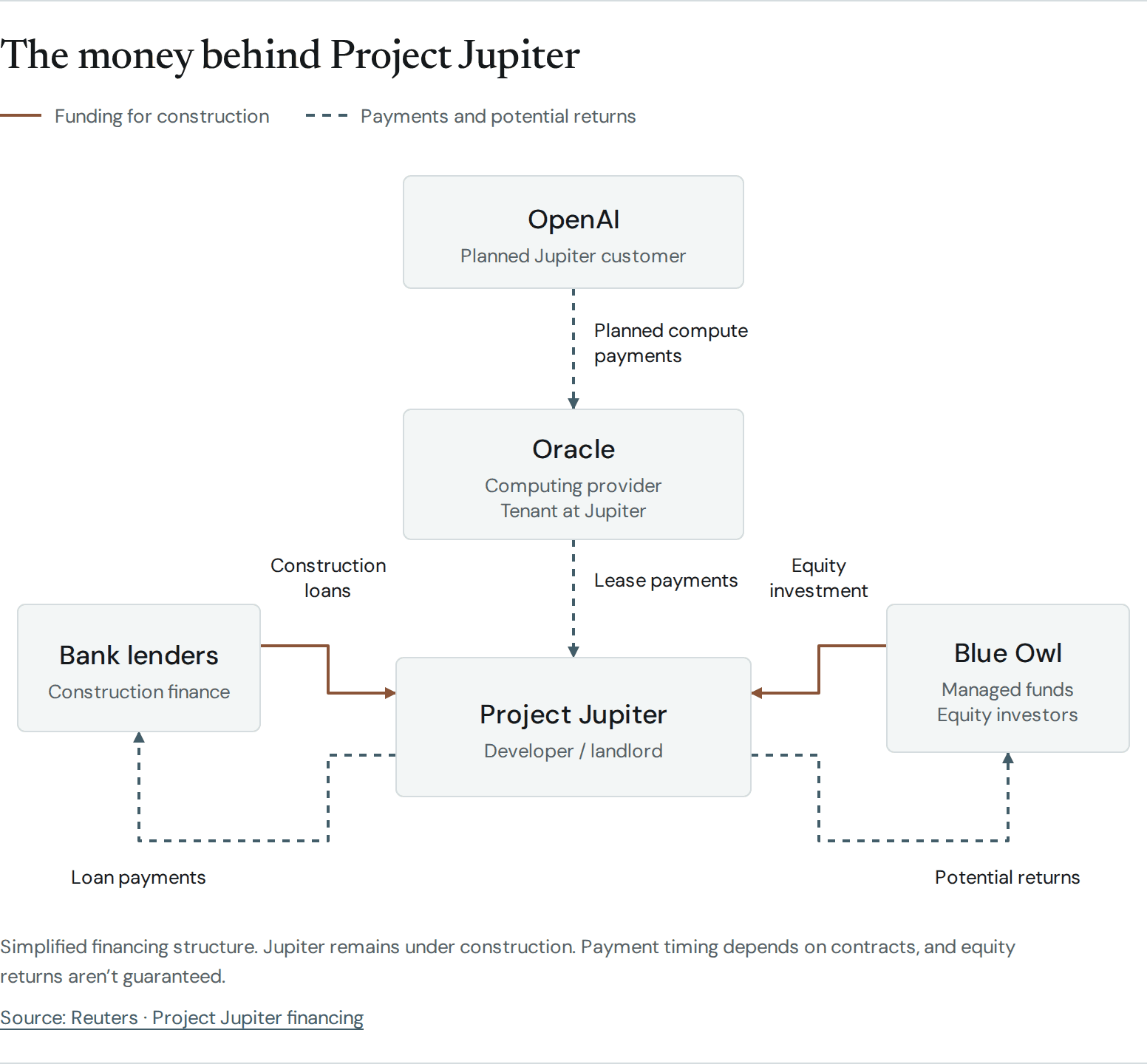
Here’s the rent. Oracle sold $18 billion in bonds in September 2025, the same month a cloud contract with OpenAI worth roughly $300 billion over five years was reported. OpenAI burns cash rather than producing it, reportedly expects to burn $278 billion from 2026 through 2030, and has pushed its listing out of this year (FT via Reuters, Sep 18; Fortune, Sep 12). A lease is a promise about the future, and the future tenant’s still raising the deposit. Bondholders sued in January, saying the full scope of the financing needs wasn’t disclosed when they bought in.
And here’s the meter. On Sep 24, five-year credit default swaps on Oracle traded at 227.5 basis points — a record — meaning it costs $2.28 a year to insure $100 of Oracle debt, more than four times the investment-grade index (Barron’s, Bloomberg data; Reuters). Trading in tech-name CDS reached nearly $650 million in the second quarter, up almost 600% from a year earlier, and in February JPMorgan began selling a basket of swaps on five hyperscalers — Alphabet, Amazon, Meta, Microsoft and Oracle — as a standalone product (DTCC; Reuters; CryptoBriefing, Aug 12). Oracle also sent a force majeure notice on Project Jupiter, its flagship build — the clause you invoke when you need the contract to forgive what physics or finance won’t. Look at who got the notice: Blue Owl, the asset manager that owns the developer building Jupiter. Oracle is landlord to OpenAI and tenant to Blue Owl, and this is the tenant asking to defer the higher rent that kicks in once the building is running. Oracle says the project remains on schedule. Ask who’s writing the other side of all that insurance, and you have the only question in this story that matters.
The exposure isn’t one company’s spreadsheet: the five biggest spenders are on pace for combined 2026 capital spending near three-quarters of a trillion dollars, much of it bond-financed, and Alphabet last quarter posted the first negative free cash flow in its 22 years as a public company. The boom’s landlord is leveraged, its biggest tenant is unprofitable, its power is late, and its insurance bill just hit a record.
The boom has a landlord. The landlord has a mortgage. The mortgage doesn’t wait for power.