
Stealth Tax
Day 223. No matter what anyone wants out of this war, the tab is running. And it’s running fast and high.
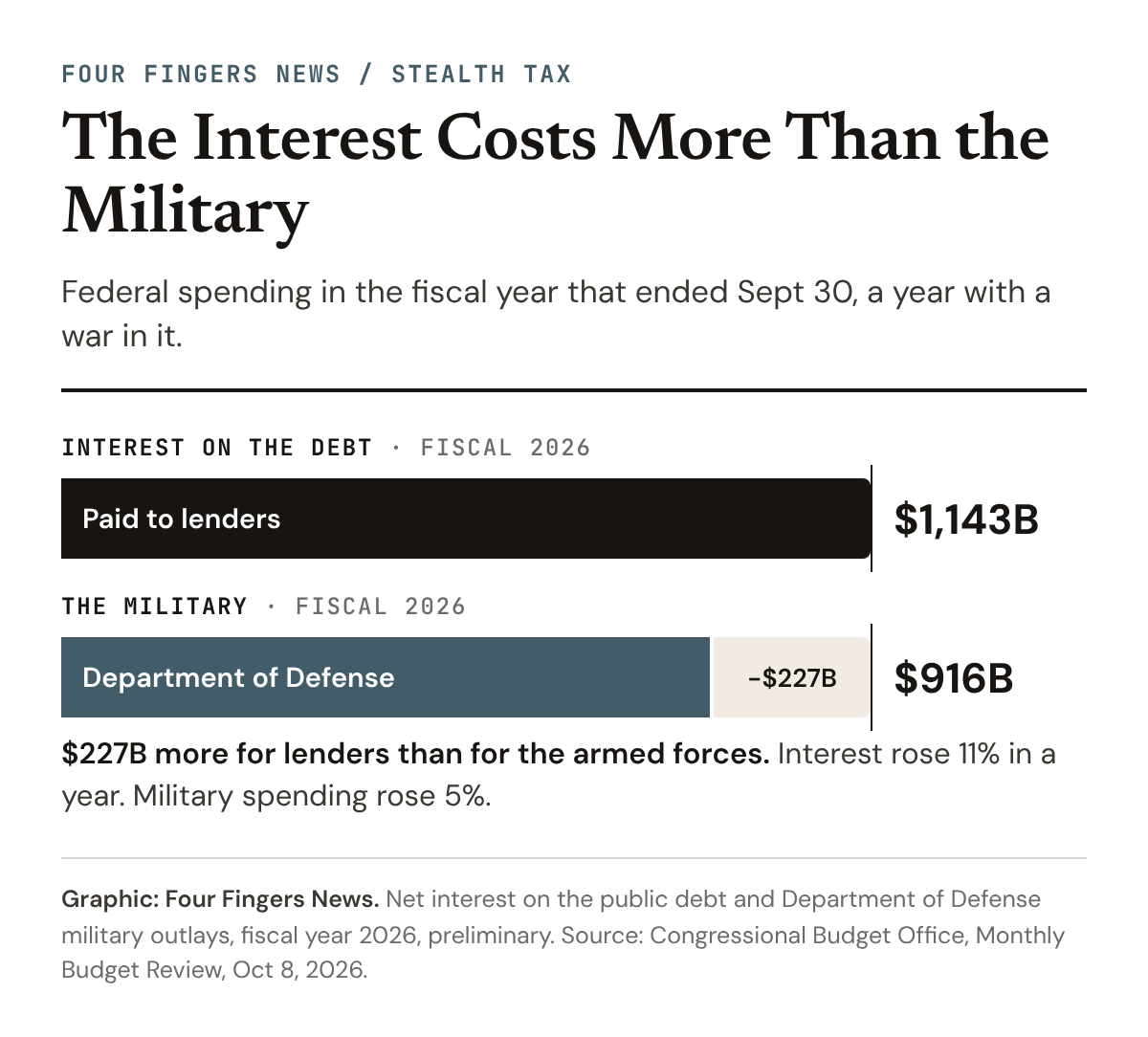
The Congressional Budget Office (CBO) closed the books on the fiscal year Thursday. The deficit was $2T. Interest on the debt came to $1.14T, a record. That’s $3.1B a day, and $227B more than the military cost in a year with a war in it. (CBO · Monthly Budget Review, Oct 8)
Three nights earlier the Treasury secretary told a business dinner in Hershey, Pennsylvania, that the debt curve is about to bend, and “very, very quickly.” (BBH · Bessent, Oct 5; CBS 21 · Chamber dinner)
“What is important is the debt-to-GDP, and we will start bending that curve and bringing it down … I think it could happen very, very quickly.”
Nobody’s been asked to pay for the war. The Pentagon’s count was $11.3B after six days, $25B by late April, $37.5B in July and $43.6B by Sept 3. It lists $32.4B of that as unfunded: munitions and aircraft it hasn’t been given the money to replace. CBO adds $2B to $3B a month. The White House asked Congress for $87.6B in June. Congress hasn’t passed it. Asked in March whether taxes would rise to cover the war, Scott Bessent said they wouldn’t. “We have plenty of money to fund this war.” (New York Times via Fox · First six days; Air & Space Forces · April 29; Roll Call · Pentagon ledger, Sept 18; CSIS · Supplemental request; Reuters · Bessent, March 22)
That’s how the last ones were paid for too. Brown University’s Costs of War project puts the wars since 9/11 at about $8T through 2022, counting veterans’ care still owed. They ran through four presidents, two from each party. There was no war tax and no bond drive. Of that total, $1.1T is interest. The first of those wars began 25 years ago Wednesday. The debt was $5.8T then. It’s $40.3T now. (Brown · Costs of War; Treasury · Historical debt; Treasury · Debt to the Penny)
Niall Ferguson, a historian at the Hoover Institution, has a rule for this. A great power that spends more on debt service than on defense risks ceasing to be one. Habsburg Spain crossed that line. So did Bourbon France, the Ottomans and Britain between the wars. America crossed it in 2024. This year, with a war on, it wasn’t close. The lenders have noticed. This week the 10-year Treasury yield hit its highest since 2002. About $9.2T of the debt is owed abroad. (Hoover · Ferguson’s Law; Treasury · Daily yields; Treasury · Foreign holders)
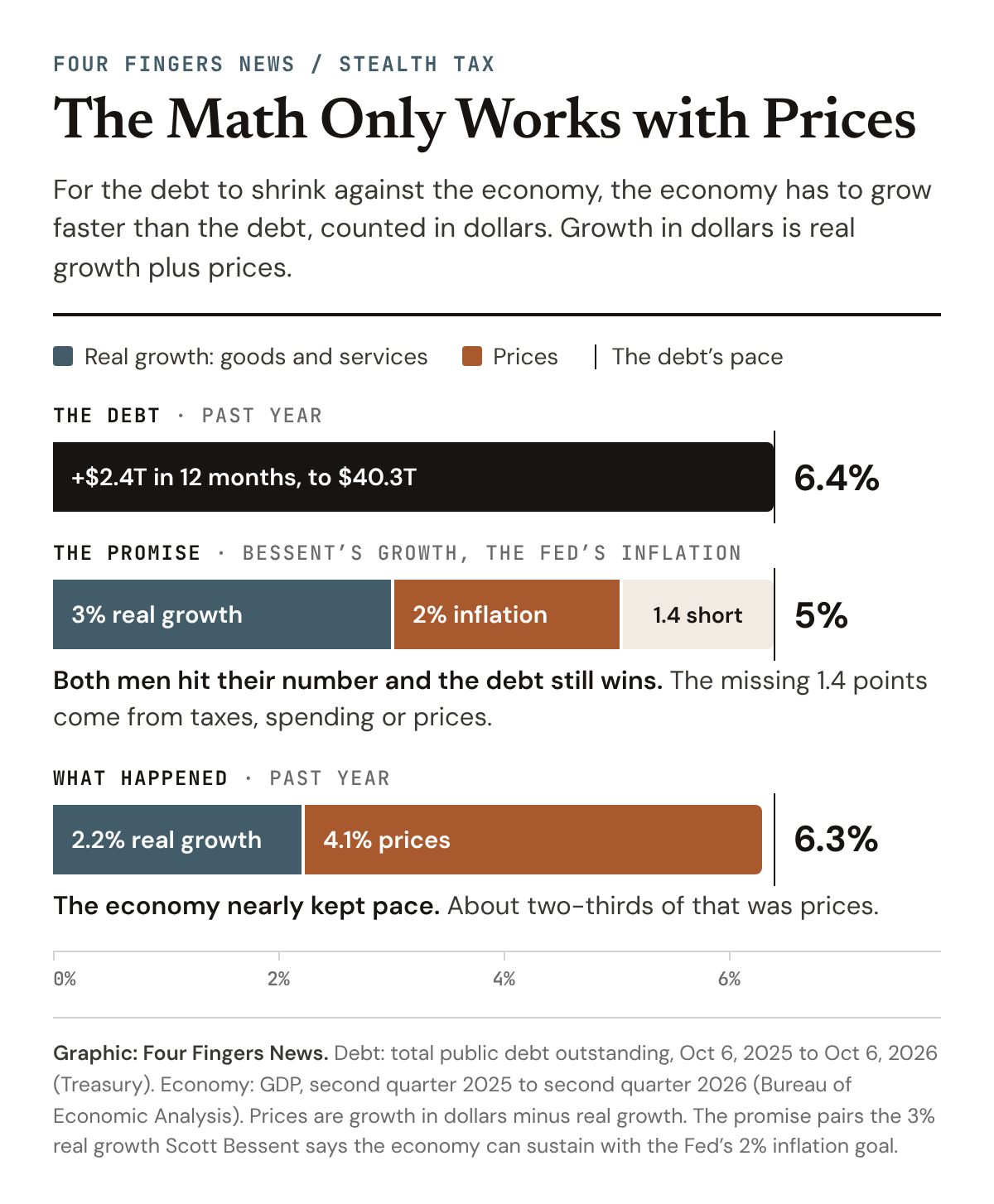
A debt this size gets carried one of three ways: tax for it, cut for it or let prices shrink it. The debt grew 6.4% in the past year. That’s $6.6B a day. For the curve to bend, the economy has to grow faster than that, counted in dollars. Give Bessent the 3% real growth he says the economy can sustain. Give the Federal Reserve the 2% inflation it voted 12-0 last month to get back to. That’s 5%. The other 1.4 points have to come from taxes, spending or prices. (Treasury · Debt to the Penny; Federal Reserve · Sept 16 statement)
The first two take a vote. The third doesn’t, and it’s already doing the work. Over the past year the economy grew 6.3% in dollars, nearly matching the debt. In goods and services it grew 2.2%. The rest was prices. (BEA · GDP in dollars; BEA · Real GDP)
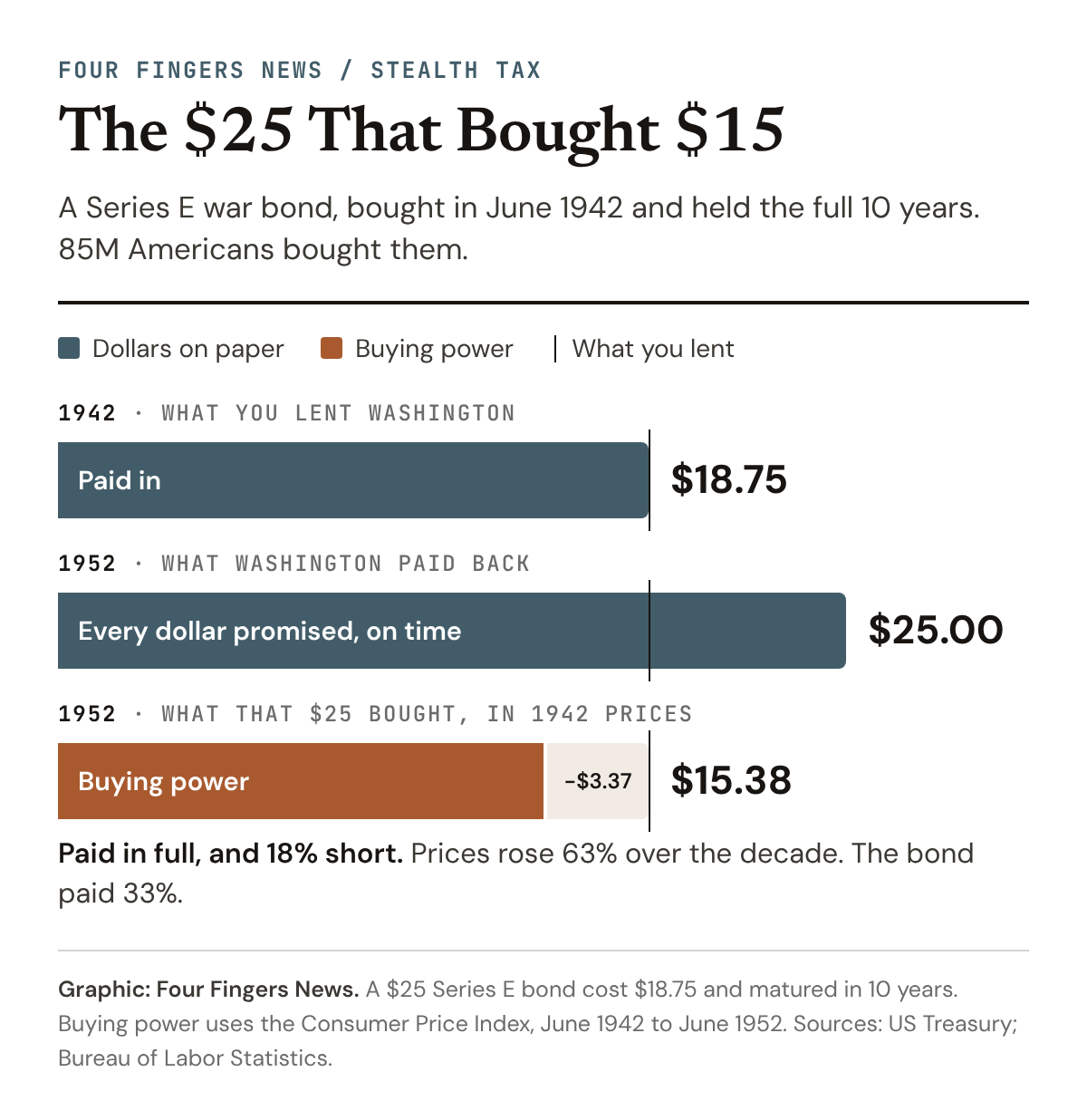
It’s been done before. In World War II, 85M Americans bought war bonds, $18.75 in and $25 back after 10 years. When a 1942 bond came due, the $25 bought about what $15 had. From 1946 to 1955 the debt went from 119% of GDP to 64% without being paid down. Growth did part of that. Prices did the rest. (USHMM · War bonds; BLS · Consumer prices; Treasury · Historical debt; FRED · Debt to GDP)
Today it’s collected from people who are paid in dollars and save in dollars. Real hourly earnings fell 0.3% over the year to August. Lenders can raise their price. A paycheck can’t. (BLS · Real earnings)
I’d love to go back to debating tax policy. Who should pay more, who should pay less. That argument assumes somebody gets a bill. For 25 years, under both parties and now in another war, nobody has.
Mr. Secretary: who pays for this one?
Somebody already is. It just isn’t called a tax.