
The Contract of the Century
October 22, 2026 · Day 237 · 900 words
The Contract of the Century
The Contract of the Century, read aloud · 6 minutes.
Israel has almost no oil of its own, and nearly half of the crude it buys from abroad reaches it through Türkiye. That’s the same Türkiye whose president, Recep Tayyip Erdoğan, calls Israel’s war in Gaza a genocide, and whose government says it hasn’t traded a single thing with Israel since June 2024. Both of those are true at the same time, and how they can both be true is a far better story than the plain hypocrisy most people would assume.
The oil itself comes from Azerbaijan, a small former Soviet country on the Caspian Sea, just north of Iran. It travels by pipeline west across the neighboring country of Georgia and then all the way across Türkiye to a Turkish port on the Mediterranean called Ceyhan, where it’s loaded onto tankers. From there it’s a short trip to Israel, and some of the tankers make it in a way that’s hard to miss once you know to look. Researchers following one of them, the Kimolos, found it would leave Ceyhan listing Egypt as its destination, switch off the tracking signal every large ship is supposed to broadcast, and disappear for a few days. It never showed up in Egypt. Satellite pictures caught it unloading at Ashkelon, on Israel’s southern coast a few miles up the beach from Gaza, ten times in a single year, and on Jan 4, 2026 it was there again.
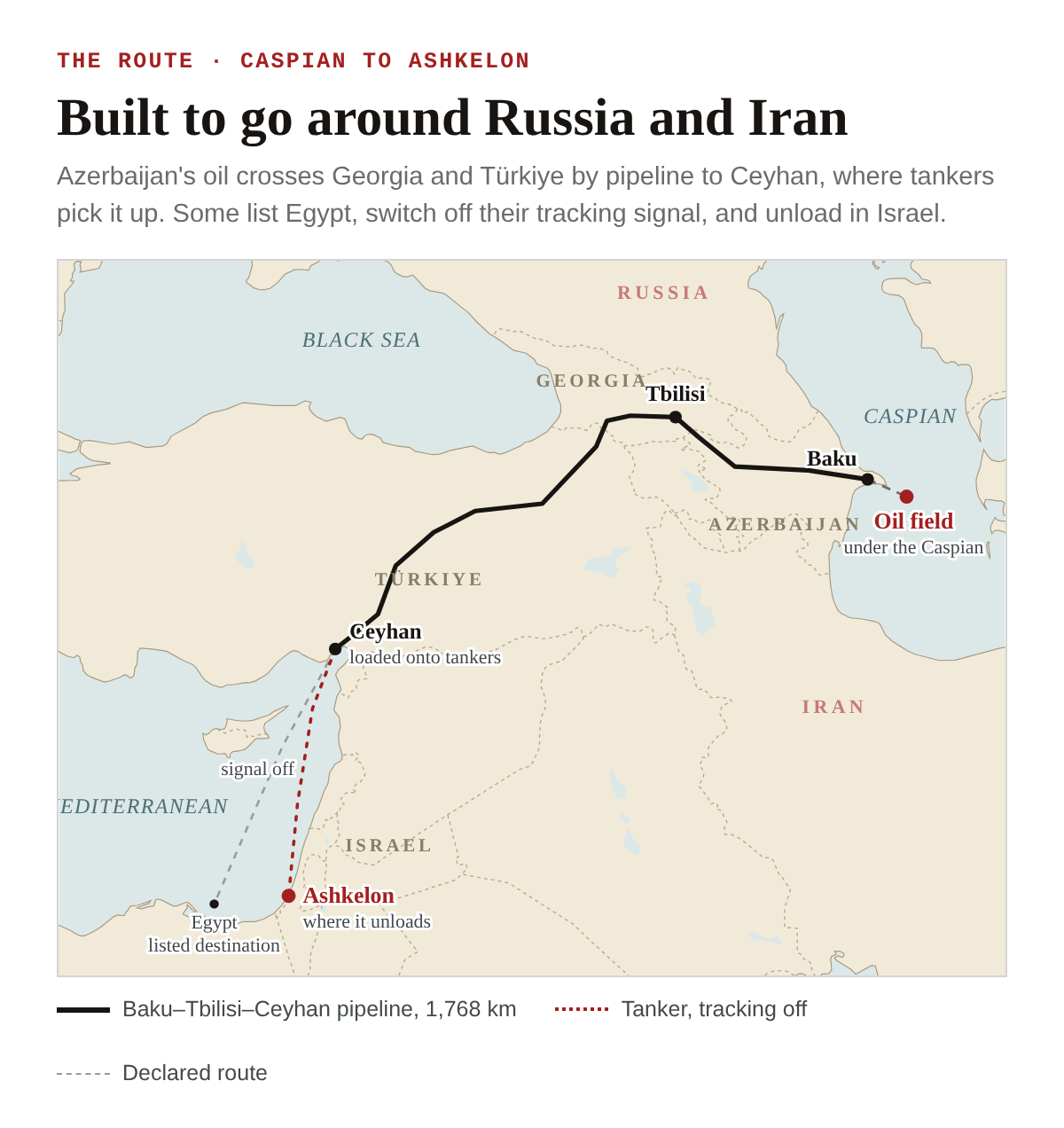
To see how that works, you have to start where the oil does, about 100 kilometers, or 60 miles, off the coast of Baku, Azerbaijan’s capital, where the oil sits a mile or two beneath the Caspian. In 1994 Azerbaijan was three years out of the Soviet Union, broke, and fresh off losing a war with Armenia. Its president, Heydar Aliyev, was a former KGB general who’d once sat on the Soviet Politburo, and he did something no one expected from a man with that résumé: his government signed what Azerbaijanis still call the Contract of the Century, handing the development of that offshore field to a group of Western oil companies led by BP. He was buying himself Western friends with the one thing he had.
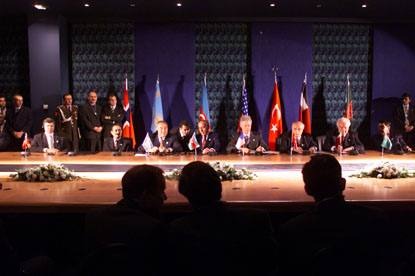
The oil was only worth something if it could get out, and the Caspian is landlocked. The obvious routes ran north through Russia or south through Iran, and Washington DC didn’t want either one holding the valve on a new source of the world’s oil. So the Clinton administration pushed for a pipeline that went the long way around, west through the mountains of Georgia and then across Türkiye to the Mediterranean. Bill Clinton was in the room in Istanbul in November 1999 when Azerbaijan, Georgia and Türkiye signed the deal. The Baku-Tbilisi-Ceyhan pipeline runs 1,768 kilometers, about 1,100 miles, and it was built to do one thing: get Caspian oil to the world without passing through Russia or Iran. Türkiye was chosen because it was the only country that could make that possible.
That history is why Türkiye’s “zero” trade with Israel is technically accurate. Under the 1999 deal, Türkiye agreed to let the oil pass and not interfere with it. The pipeline belongs to the consortium, mostly BP and Azerbaijan’s state oil company. When a cargo is loaded at Ceyhan, it’s Azerbaijani oil being sold by its owners to a trader, and Türkiye’s trade ban covers Turkish trade. As one Turkish official put it to Middle East Eye, BP sells to intermediaries Ankara can’t control, and the tankers collect the oil “without declaring their final destination.” Türkiye’s books show nothing going to Israel because, on paper, Türkiye isn’t selling anything. It’s the landlord collecting a transit fee, about $1.27 a barrel, on oil that belongs to somebody else.
Türkiye could still shut the valve, and the reasons it doesn’t are bigger than Erdoğan. It would be breaking a treaty, inviting years of international arbitration, and torching its whole pitch to be the energy crossroads between Asia and Europe, the corridor that never closes. And it would be hurting Azerbaijan, which isn’t just a customer. The two countries speak closely related languages, call themselves “one nation, two states,” and signed a mutual defense pact in 2021. No Turkish government is going to cut off Baku’s best oil buyer to make a point.
Azerbaijan, for its part, has every reason to keep selling. Israel has been one of its main arms suppliers for years, and when Azerbaijan went to war with Armenia over Nagorno-Karabakh in 2020, Israeli-made loitering drones, the kind that circle a battlefield and then dive into a target, were part of how it won. Both countries also share the same worry, which sits on Azerbaijan’s long southern border: Iran. When this year’s war started, an adviser to the commander of Iran’s Revolutionary Guard threatened to strike the pipeline.
So the oil runs from a field signed away by a former KGB general, through a pipe Washington DC designed to keep Russia and Iran out, across a country that officially trades nothing with Israel, onto tankers that go quiet for a few days, and into a port a few miles from Gaza. Nobody in that chain is lying about the paperwork. Türkiye’s numbers really are zero, and the Kimolos really did unload at Ashkelon in January. In a war, the official records tell you who’s allowed to be seen doing business together, and the ships tell you who actually is.
Sources (11), on the site.