
Soldier of Fortune
October 21, 2026 · Day 236 · 800 words
Soldier of Fortune
Soldier of Fortune, read aloud · 5 minutes.
I spent my entire young adult life hoping there’d never be a draft. So I’m honestly floored by what’s happening in Ukraine, where thousands of men from countries that aren’t at war have signed up, on purpose, to fight in a place most of them had never set foot in before. No government is drafting them, and some of them crossed an ocean to get there.

Alexander Ante and José Aron Medina are from Popayán, a colonial city in the mountains of southwest Colombia. They signed up to fight for Ukraine, served through 2023 and into 2024, and in July 2024 started home through Venezuela. They were stopped in Caracas still wearing Ukrainian uniforms, and since Venezuela is one of Moscow’s closest friends in the hemisphere, about a month later Russia announced it had them. In November 2025 a Russian-run court in occupied Donetsk gave each of them 13 years. Russia calls them mercenaries, Ukraine calls them volunteers, and from here there’s no way to know which word they’d use themselves.
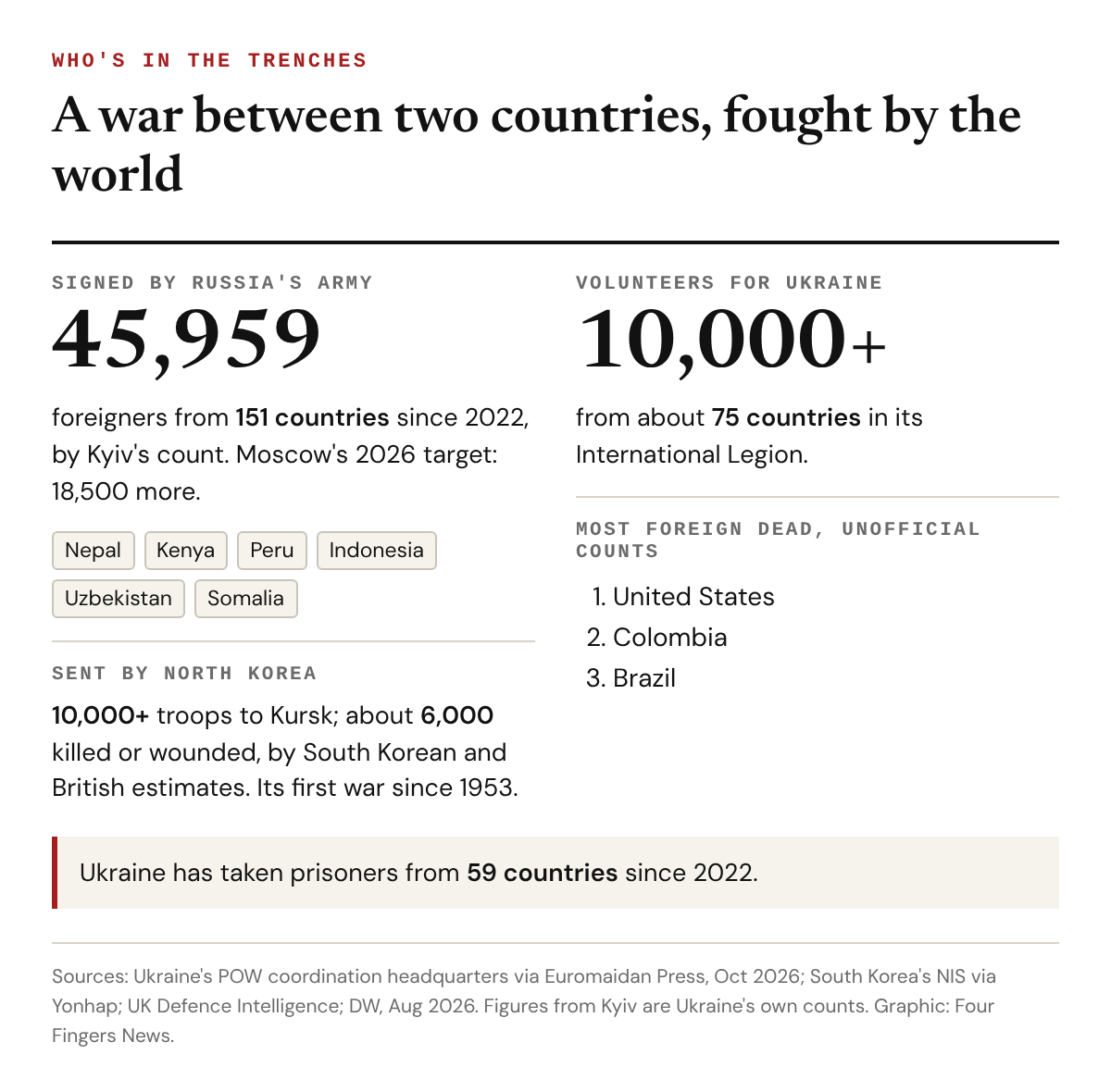
They’re two of a crowd. By Kyiv’s count, Russia’s Defense Ministry has signed nearly 46,000 foreigners from 151 countries since 2022, from Nepal and Kenya to Peru and Uzbekistan, and North Korea sent whole units on top of that. Ukraine’s International Legion has taken more than 10,000 volunteers from about 75 countries, and unofficial counts of foreigners killed on that side put Americans first, Colombians second and Brazilians third. Some of these men went for the money, some went because they believed in a side, and some were lied to: a Somali man captured by Ukraine told the Kyiv Post he’d signed with Russia expecting a job as a security guard, with “No shooting, no killing.”
Men fighting other people’s wars for pay is as old as war. What’s new is what they bring home. Ukraine is the biggest drone war ever fought. A drone built from about $400 worth of parts and flown by somebody barely out of high school can destroy a tank that cost millions, and both sides now have so many of them in the air that a soldier near the front lives with the sound of propellers overhead. The tactics change every few weeks, as one side finds a new way to jam the other’s drones and the other finds a way around it, and no army on earth has ever fought like this before, and every one of them wants to know how. Germany and the US have brought Ukrainian veterans in to teach their own soldiers. The Financial Times has reported that Colombian armed groups and criminal organizations want the same skills to use against Colombia’s own army, and the State Department says it’s working with law enforcement to limit the risk of what it calls “battlefield skills transfers.”
North Korea is the plainest case of all. Its army is one of the largest in the world, and until two years ago it hadn’t fought a war since the Korean War ended in 1953. In late 2024 it sent more than 10,000 troops to Russia’s Kursk region, and South Korea’s intelligence service and Britain’s defense intelligence both estimate roughly 6,000 of them were killed or wounded. Seoul’s spies also say that despite those losses, the North Koreans came away with modern combat tactics and battlefield data they couldn’t have gotten anywhere else, and that soldiers who rotated home in December 2025 may be sent back. Ukraine says Pyongyang has now started sending drone operators. A country that hasn’t seen combat in 70 years is putting its army through school, and the tuition is paid in its own soldiers.
Israel figured out the commercial version of this a long time ago. Its arms companies sell their missiles, rockets and air-defense systems as tested and improved in real combat, and buyers pay for it: Israel’s weapons exports hit a record of nearly $15B in 2024, more than double five years earlier. Israel’s Defense Ministry denies using battlefields as testing grounds, but the sales pitch says the rest. The same logic now applies to people. A man who’s survived a year of Ukraine’s drone war has the most valuable military résumé in the world, and plenty of buyers want him, governments and otherwise.
That’s what makes these men so hard to read. Looking at a single prisoner, you can’t tell whether you’re seeing a believer, a paycheck, a duped laborer or a student some government or gang sent to learn, and nothing suggests Ante and Medina were anything but what they said they were. But the war doesn’t care which one a man is. It’s being fought between two countries and taught to the world, and every one of these men who makes it home takes the lesson with him.
Sources (11), on the site.