
Out of Stock
October 20, 2026 · Day 235 · 1,310 words
Out of Stock
Out of Stock, read aloud · 8 minutes.
Tonight I was at Target with my daughter, hunting for something orange. Her school does Unity Day tomorrow, the anti-bullying thing where everybody wears orange, and she wanted to know why they’d pick such an odd color. I told her the choice is the whole trick, and that it’s the same trick behind what the news calls a color revolution: you have to pick something that stands out and that nobody wears anyway. You can’t declare the black revolution, because then everyone in black is your ally, including all the people who just own black. We searched the store and found exactly one orange thing, a burnt-orange sweater she loved. The shelf proved the point. The reason there was only one orange sweater in the store is the reason orange works.
The phrase gets thrown around about Ukraine and the Middle East and almost never explained. The history runs 40 years, and once you know it you see it all over this month’s news. Orange is already the color we use when the whole point is to be impossible to miss: hunting vests, traffic cones, life jackets. Nobody owns it, everybody sees it. And in the fall of 2004 a presidential campaign in Ukraine did the same shelf math my daughter’s school did.
That year’s election came down to the government’s man, Viktor Yanukovych, against the challenger Viktor Yushchenko, who spent the campaign’s final weeks with his face scarred from a dioxin poisoning he barely survived. Yushchenko’s campaign needed a color. Blue and white belonged to the government’s campaign, red belonged to the Communists, and yellow and blue together are the national flag, which is everyone’s and so no one’s. What was left was orange, and it glowed against a gray Kyiv November. When the runoff count came in rigged in Yanukovych’s favor, hundreds of thousands of people stood in Independence Square in orange scarves and orange ribbons through freezing weeks, until the Supreme Court threw the result out and ordered a revote, which Yushchenko won. The world named it the Orange Revolution.
Ukraine didn’t invent it. The modern original is the Philippines, which by 1983 had spent two decades under Ferdinand Marcos, much of it under martial law. The regime’s most famous critic, a senator named Ninoy Aquino, had spent seven years in Marcos’s prisons before being released to America for heart surgery, and he’d stayed on in Boston for three years. In August 1983 he boarded a flight home to Manila to challenge Marcos anyway, knowing he’d probably be arrested the moment he landed. To welcome him home, his supporters tied yellow ribbons on trees across the city, an idea borrowed from a corny 1970s pop song in which a man coming home from prison asks for a yellow ribbon around the old oak tree if he’s still loved. Aquino never saw one, because government soldiers shot him dead on the tarmac before he reached the bottom of the aircraft stairs. The ribbons stayed up, and wearing yellow quietly became the way ordinary Filipinos said they were done with Marcos. Three years later Marcos stole an election from Aquino’s widow, Corazon, and two million people in yellow filled the main highway through Manila, a road called EDSA. Nuns knelt in front of the tanks, and the soldiers wouldn’t fire. Marcos had been Washington DC’s ally for 20 years, host to America’s two biggest overseas military bases, but a client who steals an election in front of two million people stops being worth the trouble. On the fourth day the White House told him to go, and the helicopter that flew him out was American. Yellow had become a language.
The lesson traveled with teachers. In 2000 it reached Serbia, the largest piece of broken-up Yugoslavia in Europe’s southeast, where Slobodan Milošević had spent the 1990s dragging the Balkans through wars and had just lost an election he refused to concede. The students who’d been organizing against him for two years called themselves Otpor, which means resistance, and their symbol was a clenched fist, a mocking steal of the old communist salute, stenciled on walls all over the country. When he tried to hang on, hundreds of thousands of Serbs poured into Belgrade, a construction digger rammed the doors of state television, which is why Serbs call it the Bulldozer Revolution, the police decided not to fight the crowd, and within a day he conceded. Then the graduates went into business. Otpor’s veterans started teaching what they’d learned, drawing on the handbook of Gene Sharp, an American academic whose core idea is that a regime runs on obedience, and obedience is something people can stop giving. They trained the students of Georgia, the country on Russia’s southern border, not the American state, who marched into parliament carrying roses in 2003 until their president, Eduard Shevardnadze, once the Soviet Union’s foreign minister, resigned. And they spent months advising the Ukrainian youth movement before the orange winter of 2004. After that came tulips in Kyrgyzstan in Central Asia, a cedar tree in Lebanon, green in Iran in 2009, yellow umbrellas in Hong Kong, and the old white-red-white flag in Belarus, Russia’s neighbor.
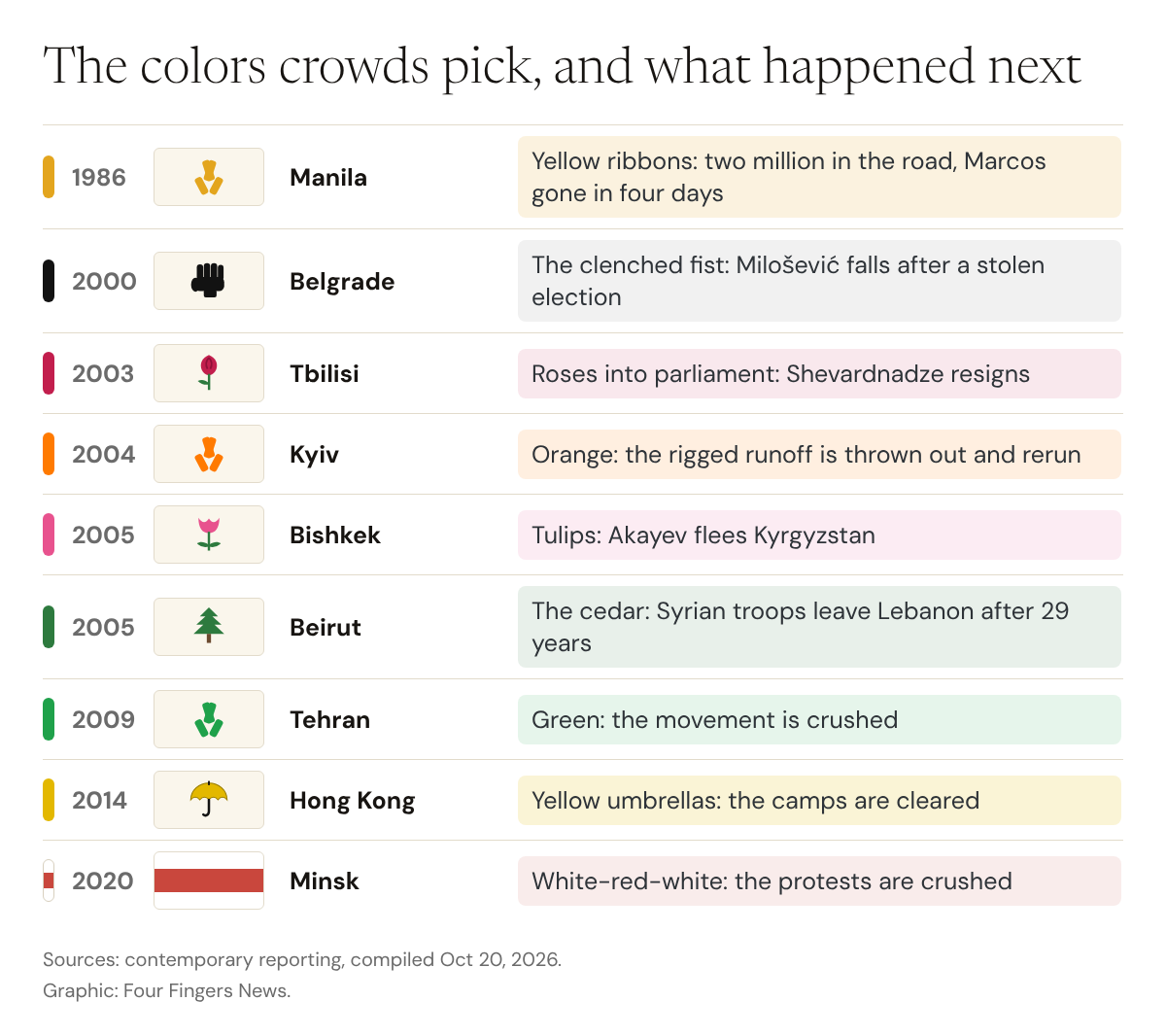
The technology underneath is always the same, and it’s the shelf at Target. A government can ban a rally, arrest a leader and shut a newspaper, but it can’t ban a color. A color has no membership list and no headquarters. What it does is let a frightened majority count itself: you wear a ribbon to the market and discover the butcher wears one too, and so does the woman at the bank, and suddenly everyone knows what until that morning each person only privately suspected. The cost is low enough that millions dare, and the signal is loud enough that the millions see each other. The one requirement is scarcity. It has to be a color nobody wears by accident, which is why it’s never black and never blue, and why the store shelf is nearly empty where it lives.
Say “color revolution” in Moscow, Beijing or Tehran, though, and you’ve said something different: not a people counting itself but a Western technique wearing local clothes. Putin called the protests that swept Iran this past January a “color revolution” scenario run from abroad. Russia’s foreign minister, Sergey Lavrov, said on Friday that “absolutely any country” can fall victim and that Russia has already “obstructed” such attempts among its neighbors. China’s Xi Jinping tells fellow governments the thing must be prevented, the way you’d talk about a disease. And the suspicion isn’t invented from nothing: Otpor took American government money and concealed it, and its trainers really did go from Serbia to Georgia to Ukraine. Both things are true at once. The anger in those squares was real and homegrown, and the technique had teachers, and the teachers had sponsors. Forty years on, the argument between those two truths is still what half the world’s propaganda is about.
A color revolution, the real thing, is the whole package: the stolen election, the weeks in the square, a state deciding whether to shoot. The color trick on its own is the lesser thing, and it escaped into ordinary life long ago: pink ribbons in October for breast cancer, orange at school for the bullied. The technique stopped caring what it’s for. But whether a crowd in one color gets called a movement or an operation has always depended less on the crowd than on which side of the barricade the person naming it stands.
Tomorrow morning my daughter puts on the one orange sweater in the store. She picked it for the same two reasons every crowd in this story picked its color: it stands out, and nobody else is wearing one. From a school hallway to Independence Square, that’s the whole trick. Once you see it, you’ll see it everywhere.
Sources (10), on the site.