
Spoken Here
October 19, 2026 · Day 234 · 960 words
Spoken Here
Spoken Here, read aloud · 6 minutes.
France is having its worst riots in years. On Saturday hundreds of thousands of people marched in more than 140 cities against the cost of living and the state of the country’s schools, and in Paris, Lyon and Marseille the marches turned into looting and fires. Almost 1,000 police officers were hurt and about 2,400 people were arrested. The interior minister, Laurent Nuñez, said the police had lost control and offered to resign, and President Emmanuel Macron told him to stay and put an end to the looting instead. In Paris, crowds partly pulled apart the base of the statue of Marianne, the figure that stands for the French Republic itself.

All of it started a month ago at one high school. On Sep 17, 2026, a few teachers at the Lycée Saint-Exupéry in Créteil, a working-class suburb southeast of Paris, went on strike because the school didn’t have enough teachers. The nurse was out and the classrooms were packed, so the students piled bins in front of the gates and joined in. The school got its extra staff and the strike ended, but by then videos of it were all over social media and high schools across the Paris suburbs were blockading their own gates. The universities followed, then the unions, and by Saturday it was the whole country. The last time French students set off something this big was May 1968, which ended with 10 million workers on strike and President Charles de Gaulle secretly flying to the French army in West Germany to make sure it would back him.
The kids in those schools are a big part of this story, and almost nobody outside France knows how they got there. A lot of them are the children and grandchildren of people France brought over from its own empire in North and West Africa, which is why they speak French, why they live where they live, and why their schools are the ones short of teachers.
In Seine-Saint-Denis, the suburbs just north of Paris where some of the first school blockades spread, about 32% of residents are immigrants, against about 10% for France as a whole. More immigrants in France were born in Algeria and Morocco than anywhere else, and almost half were born somewhere in Africa. People argue about why they pick France, welfare and everything else, but the biggest reason is simple: they already speak French. About 396 million people in the world speak French, and 65% of them live in Africa, including more than 15 million in Algeria and nearly 14 million in Morocco. That’s because France ran the schools, courts and government offices of its colonies in French, in Algeria’s case for 132 years. By 2050, nine of every ten French speakers are expected to be African.
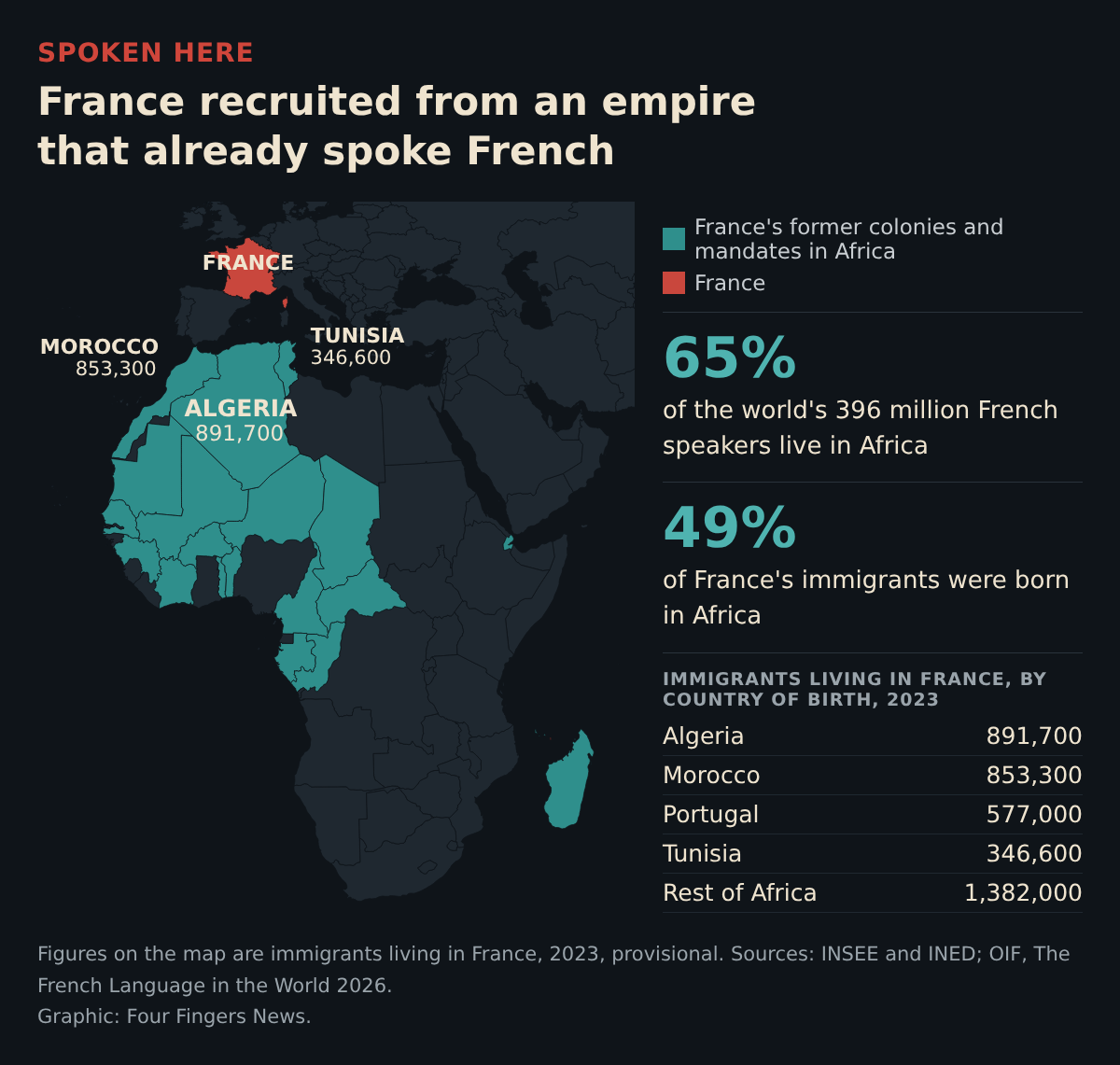
France didn’t just wait for workers to show up, either; it went and recruited them. Algeria was legally part of France until it won its independence in 1962, so Algerians could move to the mainland, and about 350,000 Algerian workers and their families were already living there by 1945. After the war France needed workers to rebuild, so in the 1960s it signed deals to recruit them from Morocco, Tunisia and a newly independent Algeria, as well as from Spain, Portugal, Türkiye and Yugoslavia. The men lived first in shantytowns on the edge of Paris and later in huge public housing towers built on cheap land outside the cities. When the oil shock hit and France stopped recruiting in 1974, about 3.5 million migrants were living in the country, around 7% of the population. Most of those workers stayed and brought their wives and children over, and when the government tried to ban that too, France’s top administrative court struck the ban down in 1978.
Those men are the grandparents of the kids in Créteil. Most of the kids are French, born in France, and a lot of them grew up in the same towers their grandfathers helped build. A third of France’s population is an immigrant or has an immigrant parent or grandparent, according to the country’s national statistics agency.
That relationship has had uglier moments, and the worst was 65 years ago this past Saturday. On Oct 17, 1961, with Algeria’s war for independence in its seventh year and Algerian fighters killing Paris police officers, about 30,000 Algerians marched into Paris to protest a curfew that applied only to them. The city’s police chief, Maurice Papon, had told his officers they’d be covered for any violence, and they beat and shot the marchers and threw some of them into the Seine. The official toll the next day was three dead; historians now say at least 48 people were killed that night, and many believe it was well over 100. Papon had helped send Jews to the Nazi death camps during the Second World War, and in 1998 he was finally convicted for that, but never for the Seine.
Nobody marching on Saturday was talking about 1961. They want teachers, school buildings that aren’t falling apart and prices people can afford, fuel included. But the schools that are short of teachers are in the towns France built for the people it recruited and then stopped spending on, and it’s no accident that it started in Créteil. Even students at Henri-IV, one of the most elite high schools in Paris, have been careful to say they’re marching in solidarity with schools that have less.
The kids in those classrooms aren’t arriving from anywhere; they’re French, and they speak French because France taught it to their grandparents in their own countries first. The empire didn’t so much end in 1962 as move into the towers at the edge of Paris, and its grandchildren are the ones still waiting on a teacher.
Sources (19), on the site.