
Red Handed
October 16, 2026 · Day 231 · 870 words
Red Handed
Red Handed, read aloud · 6 minutes.
Pull up to the diesel pumps at a farm co-op and you’ll find two kinds of fuel. One’s clear, and it carries 24.4 cents a gallon in federal tax plus whatever your state adds. The other is the exact same fuel with a splash of red dye in it, and it’s tax-free, because it’s meant for tractors, bulldozers and generators that never touch a public road. The dye is the whole difference. It’s the cheapest, dumbest, most effective piece of tax enforcement this country’s ever come up with, and we have the mob to thank for it.
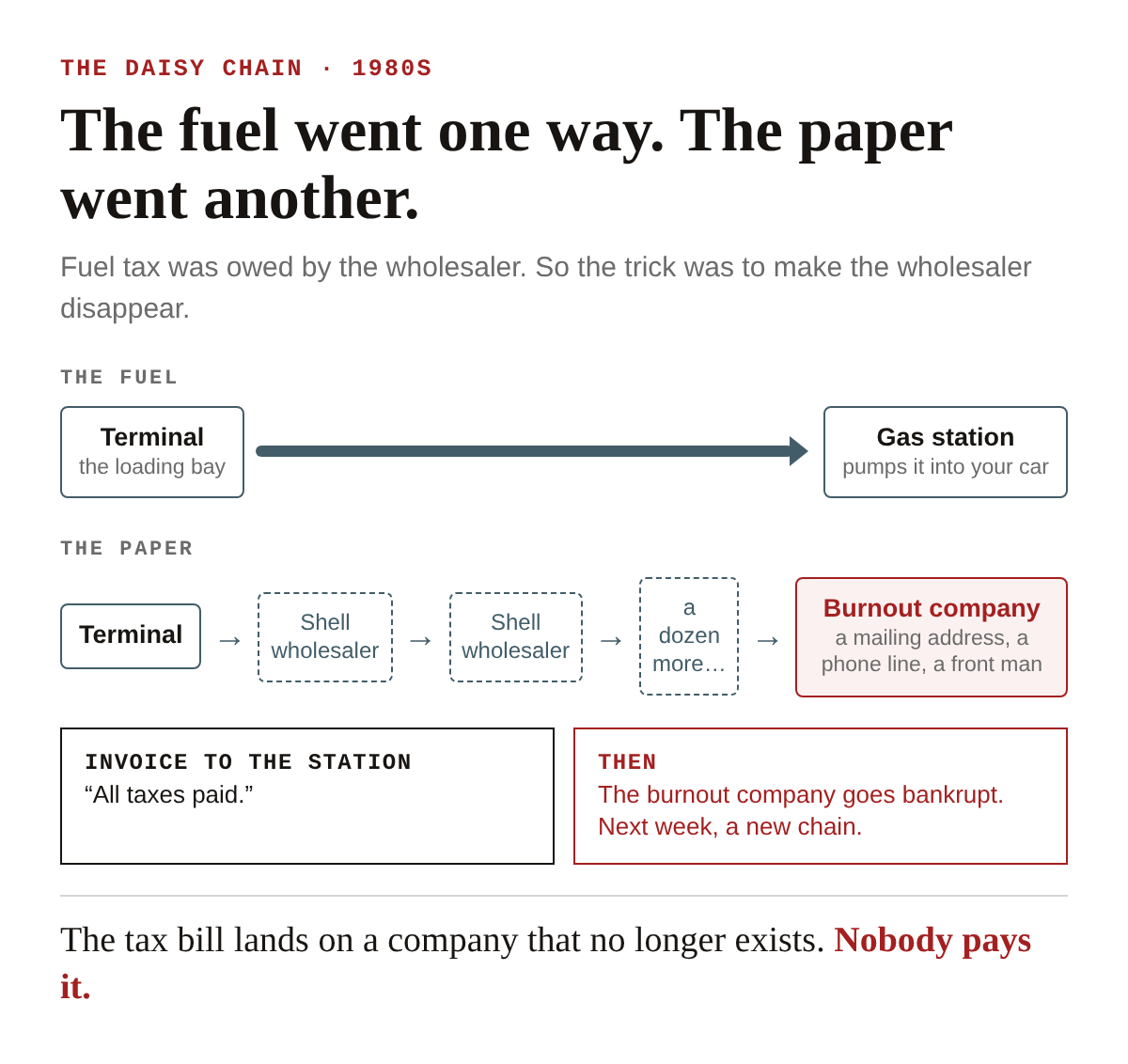
In the early 1980s, a few émigrés from the Soviet Union working the fuel business in New York noticed that the federal fuel tax was collected from wholesalers, and wholesalers could vanish. The trick was called a daisy chain. Fuel got sold on paper from one company to the next, a dozen or more times, until the tax bill landed on a firm that was nothing but a mailing address, a phone line and a front man. That firm, the “burnout company,” sold the fuel to gas stations on invoices stamped all taxes paid, then went bankrupt before anyone came to collect. Next week, a new chain.
The Italians noticed. Michael Franzese, a captain in the Colombo crime family, got pulled in around 1980 to lean on someone over a $70,000 debt from one of these swindles, and before long he was running chains of his own through shell companies in Panama. An associate testified Franzese was clearing $1 million a week. Fortune put him 18th on its 1986 list of the country’s 50 biggest mob bosses. New York figured it was losing $250 million a year in gas tax to the racket. Years later Franzese summed up his conscience on the matter: “I didn’t have a moral issue with taking tax from the government.”
Congress plugged gasoline in 1986 by moving the tax up to the terminal rack, the loading bay where fuel pours into tanker trucks, which cut down the number of hands the tax passed through. So the crooks switched to diesel. Diesel had a hole gasoline didn’t: a huge share of it is legitimately tax-free. Farms, boats, trains, construction sites. Nobody could tell a gallon headed for a combine from one headed for an 18-wheeler. By the early 1990s the Federal Highway Administration put combined federal and state fuel tax losses near $3 billion a year.
On Jan 1, 1994, the government quit chasing paper and marked the fuel instead. Diesel got taxed at the rack, and any gallon leaving tax-free had to leave red. Diesel tax collections jumped about $1.2 billion that first year, and Treasury figured $600 million to $700 million of it was people simply paying what they owed.
I’ve always had a soft spot for this one. When I was learning the Internal Revenue Code, the most useful trick was to ask two questions of every section: what loophole was somebody abusing that this closes, or what behavior is the government trying to get out of us? Nearly every rule answers one or the other. The dye answers the first, and it’s the only one I know of that’s a color. Enforcement is gloriously low-tech: an IRS compliance officer, or here in Washington State a state trooper, slides a long straw into your fuel tank and looks at what comes up. If it’s pink, the fine is $10 a gallon or $1,000, whichever’s more, and it climbs with every repeat. They’ll check the storage tank you filled from, too. In 2005 the Washington State Patrol dipped more than 25,000 vehicles and caught 95. One street-sweeping company turned out to have bought roughly 98,000 gallons of red since 2003, and the fine was figured at $10 a gallon, plus extra for the storage tank and its fleet of 25 trucks.
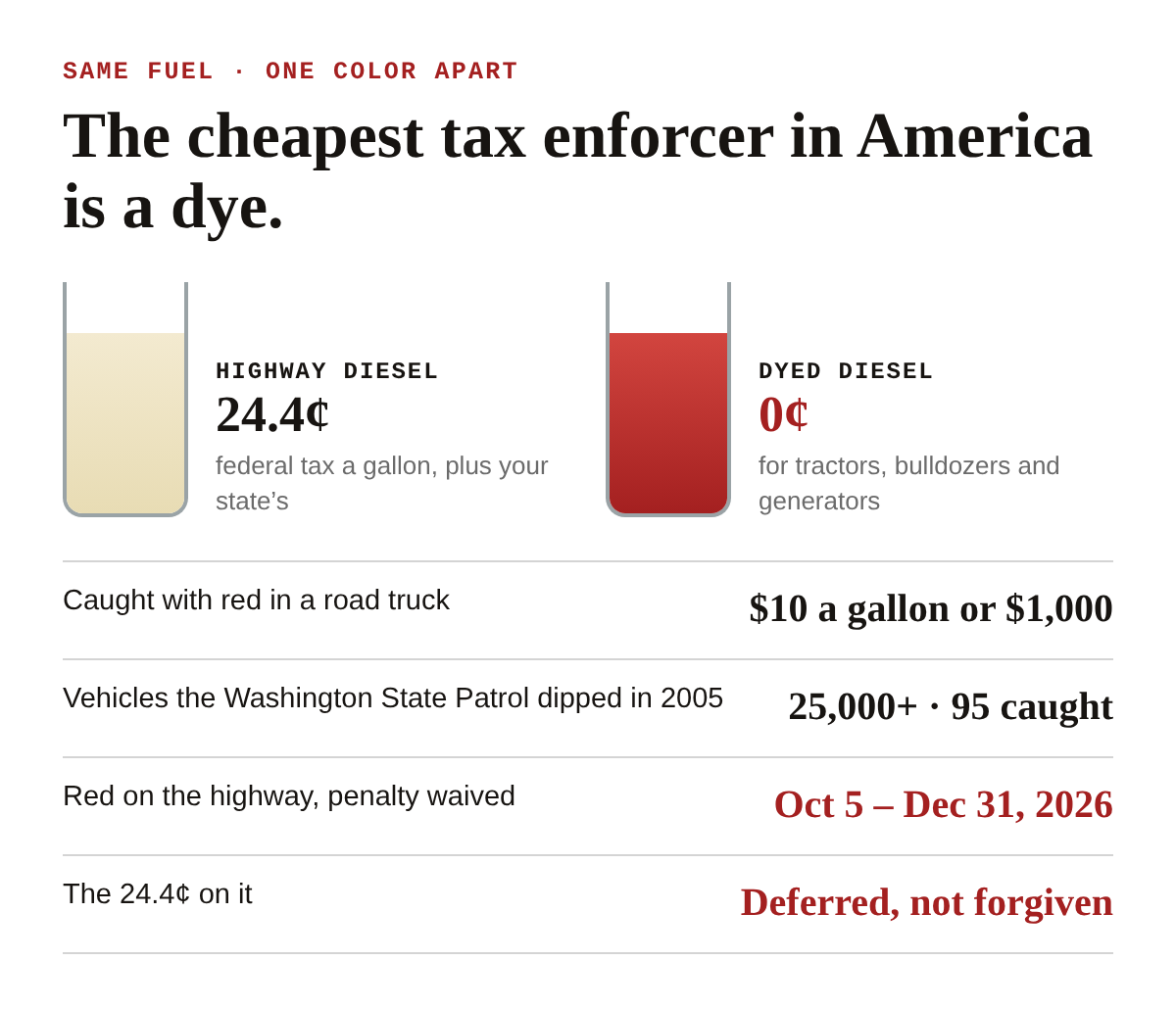
Since Oct 5, 2026, the straw’s been in the trunk. With diesel hitting a record $6.53 a gallon on Sep 22, 2026, against about $3.76 before the war, an executive order out of Washington DC told the IRS to stop penalizing red diesel on the highway through Dec 31 and to hold off collecting the 24.4 cents on it. Ten states, Texas, Oklahoma, North Carolina and Alabama among them, had already waved it through in the days before. California still hasn’t.
Read the fine print, though, because that’s where the tax guy gets interested. The order defers the tax. It doesn’t cancel it; Treasury’s only been told to look into forgiving it. “Deferred” is the most misunderstood word in the tax code, because people hear “free.” A deferred tax is a bill with the date left blank.
For 32 years the dye answered the first question. This fall it’s answering the second: keep the trucks moving. The government built a system on the idea that nobody can be trusted with cheap fuel, and the first time fuel got expensive enough, it trusted everybody for 88 days. On January 1 a lot of tanks out there will still be pink. The fuel won’t change color at midnight. What the color means will. And on January 2, somewhere on I-90, a trooper’s going to get the straw back out.
Sources (12), on the site.