
Dark Fiber
October 15, 2026 · Day 230 · 1,330 words
Dark Fiber
Dark Fiber, read aloud · 8 minutes.
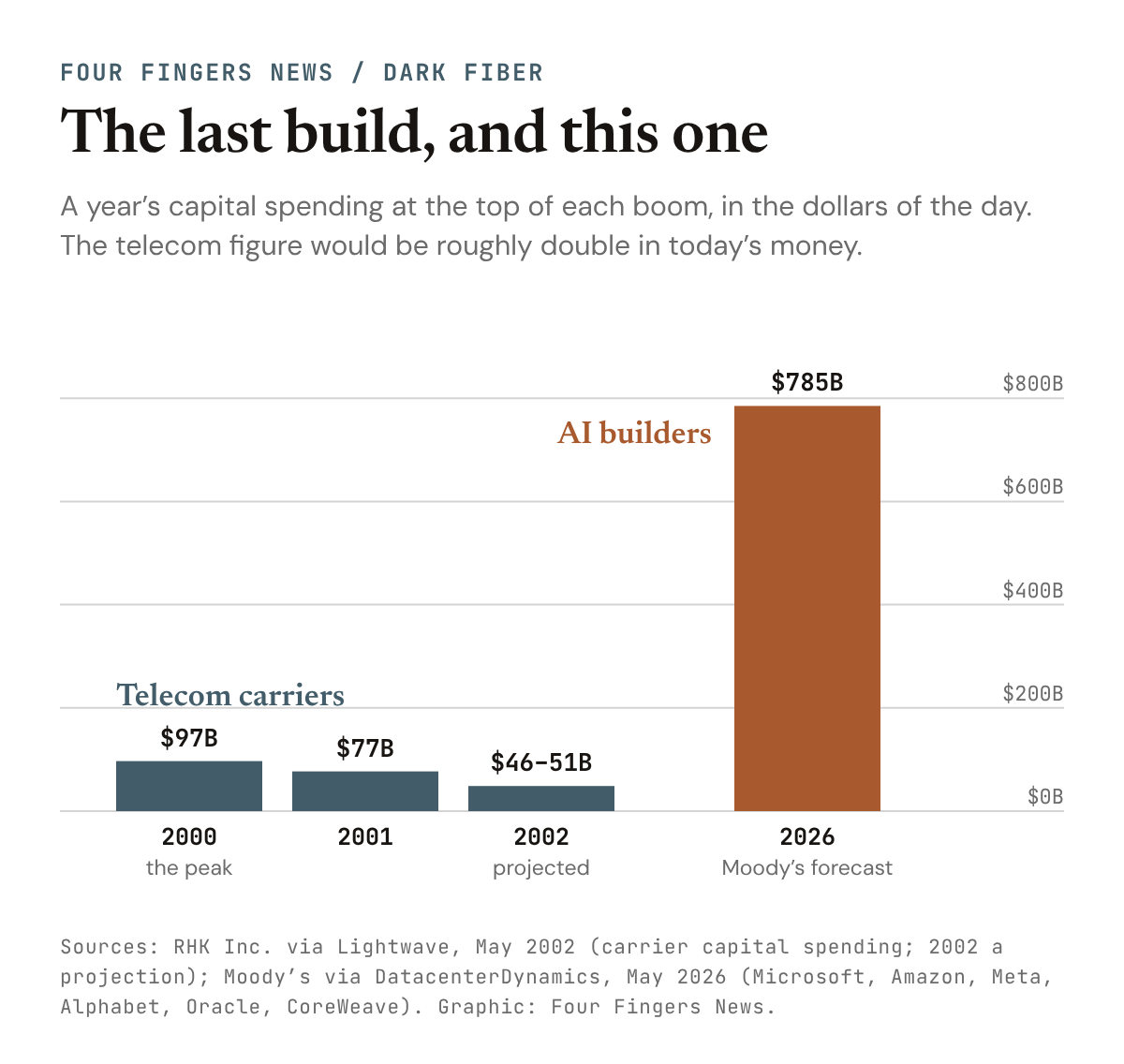
In 1996 Congress passed the Telecommunications Act, which broke open the old phone monopolies and let anyone build a network and compete for local, long-distance and internet traffic. A story went around the business that internet traffic was doubling every 100 days. Gary Winnick, whose Global Crossing was worth $47 billion by 1999, two years after he founded it, told it to anyone who’d listen, and the banks listened. A mathematician at AT&T’s own research labs, Andrew Odlyzko, went and measured the traffic and found it was roughly doubling once a year, fast, but nowhere near the story, and nobody wanted his number. In the five years after the Act, hundreds of new carriers and the old ones alike borrowed and spent more than $500 billion, most of it on fiber optic cable, trenched along railroads and highways and laid across the floor of the Atlantic, enough glass to carry every phone call and web page on earth many times over. By 2002 most of that cable had never been switched on. The industry called it dark fiber: glass in the ground that had never carried a single pulse of light.
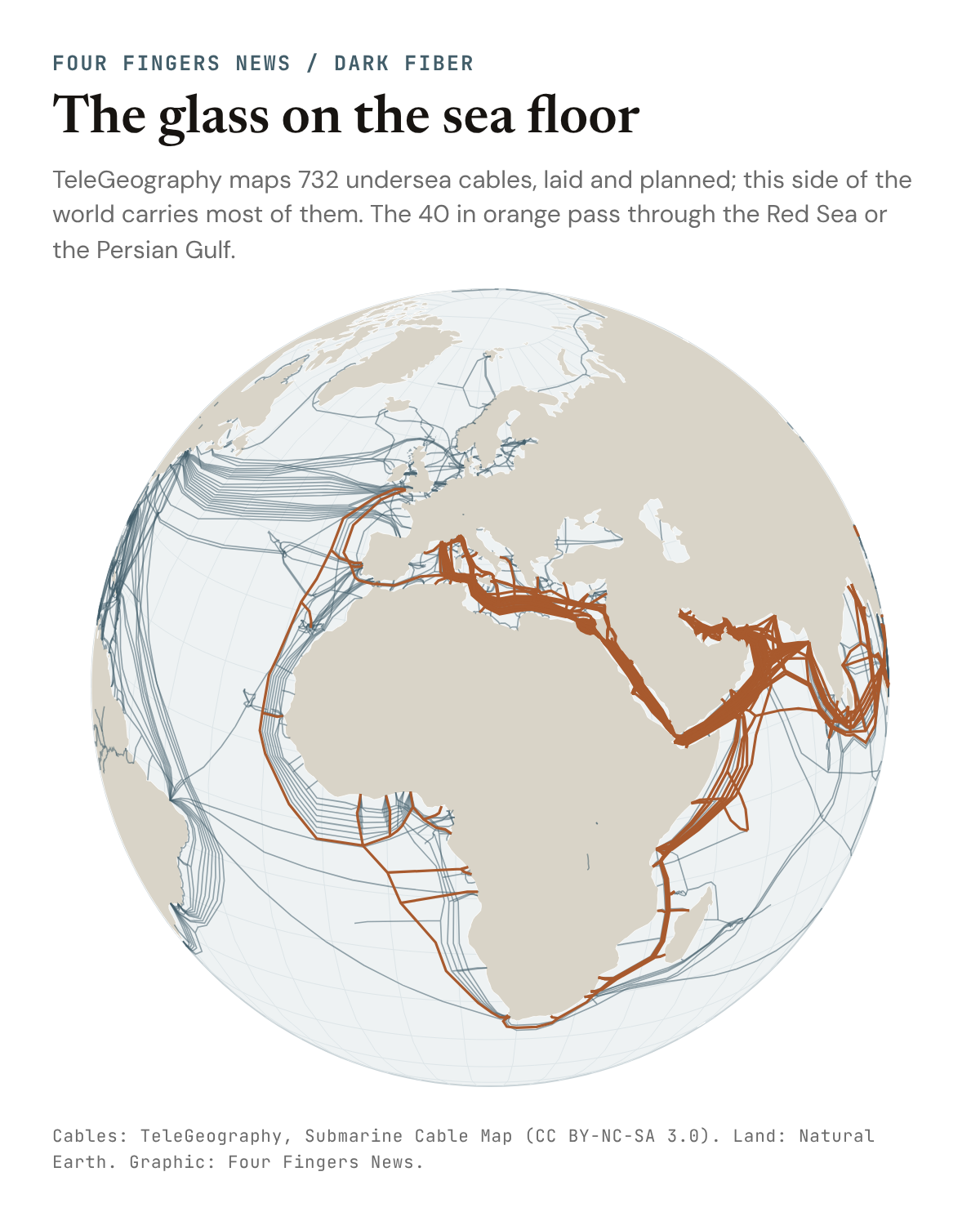
Then the bill came. Everyone had laid cable along the same routes at the same time, so just as the glass lit up, the price of carrying traffic fell through the floor. Global Crossing had never turned a profit; it owed $12.4 billion, about $600 million a year in interest alone, and in its last quarter it lost $3.4 billion on $793 million of sales. It filed for bankruptcy in January 2002, and by then Winnick had sold about $420 million of his own shares, and his fellow executives about $900 million more. WorldCom, which owned the biggest internet backbone in the world, followed in July with $107 billion in assets, at the time the largest bankruptcy in American history, and its chief executive went to prison over an $11 billion accounting fraud that had dressed up the numbers while the traffic didn’t come. More than 60 telecoms failed between 2001 and 2003, the industry owed about a trillion dollars, and the bondholders who’d financed the build got back a little over 20 cents on the dollar. The Nasdaq lost 78 percent of its value from the top. The fiber itself didn’t go anywhere; creditors sold the networks for a fraction of what they cost, the buyers lit them up over the next decade, and that dead glass is what Netflix, YouTube and the cloud ran on when they arrived. The engineers were right about the future, but the people who paid for it weren’t the people who got rich off it.
That’s the shape of every one of these, and it’s old. Britain did it with railways in the 1840s; America did it with canals, then railroads, then radio. The technology is real, the build runs ahead of the money that can pay for it, the builders borrow against a future that does arrive, just later and cheaper than they promised, and the debt lands on whoever’s holding it when the music stops. The infrastructure survives; the balance sheets don’t.
This morning in Seoul the Kospi fell 7.6 percent, its seventh straight loss, hard enough to trip the circuit breakers that halt trading; Samsung lost 9.5 percent and SK hynix 11.1; foreign investors pulled about $2.5 billion out of Korean stocks in a single session, while Tokyo’s Nikkei fell about 5 percent. Those two Korean companies make most of the world’s memory chips, including the high-bandwidth memory every AI data center is stuffed with, so they’re the picks and shovels of this boom the way the fiber makers and Cisco were of the last one. That one started with a change in the law that made everyone sure the market was theirs to win; this one started with a chatbot in November 2022 that did the same. The desks in Seoul pointed at three things: doubts about what all that AI infrastructure will ever earn, the bonds of CoreWeave, which rents out AI computing and now has to pay about 15 percent to borrow, and a 10-year Treasury yield near 5.3 percent. Then September’s wholesale prices came out in the United States, up 6.3 percent on the year, the steepest since 2022.
Korea is where it cracked first, and it’s the country most exposed to this year’s two wars while being party to neither. About 70 percent of its crude comes through the Strait of Hormuz, so the Iran war hit its fuel and its currency in March, when the won broke 1,500 to the dollar for the first time since 2009. Its own enemy, North Korea, has spent the Ukraine war sending men and shells to Russia, and the American general who commands US troops in Korea said this week that Pyongyang came out of it knowing how to move an army across a continent and keep it supplied. And in March the Pentagon pulled THAAD interceptors and Patriot launchers off the peninsula for the Gulf; President Lee Jae-myung said Seoul had “voiced an opposing view” but couldn’t “fully have our way.” A country with its oil in one war, its enemy learning from another, and its protector’s missiles packed for the first, put a huge share of its savings into two chip stocks riding a third boom. In 1998, when the Asian crisis broke Korea’s currency, 3.5 million people lined up to hand in their own gold, wedding rings and baby rings, to help pay off the IMF. Korea knows what it costs when the money leaves first.
So where’s the dark fiber this time? The data centers will still be standing in 2035, like the cable. The question is whose money turns out to have paid for them. In 2000 it was junk bonds and stock, owned by people who knew they were gambling, but this build is financed differently. Oracle has signed about $288 billion of data center leases that don’t sit on its balance sheet yet, and its credit rating is one notch above junk. Meta’s Louisiana campus was paid for with about $27 billion of debt, roughly two-thirds of it bought by the bond giant Pimco, through a company set up so the debt wouldn’t sit on Meta’s books either. I was finishing an accounting degree the year Enron and WorldCom went down. Enron, the Houston energy trader, had hidden its debts in companies just like that, and the law Congress wrote in answer, Sarbanes-Oxley, was supposed to make debt like that impossible to hide; I went to work under it. Twenty-four years later the biggest build in history is being financed through companies set up so the debt doesn’t sit on the builder’s books, and it’s all disclosed and all legal. Much of the rest has gone through private credit, the funds that lend outside the banking system, and some of the biggest buyers of private credit are life insurers and pension funds, which means some of it may sit, a long way down the chain, in an ordinary annuity or pension, owned by people who never bought an AI stock.
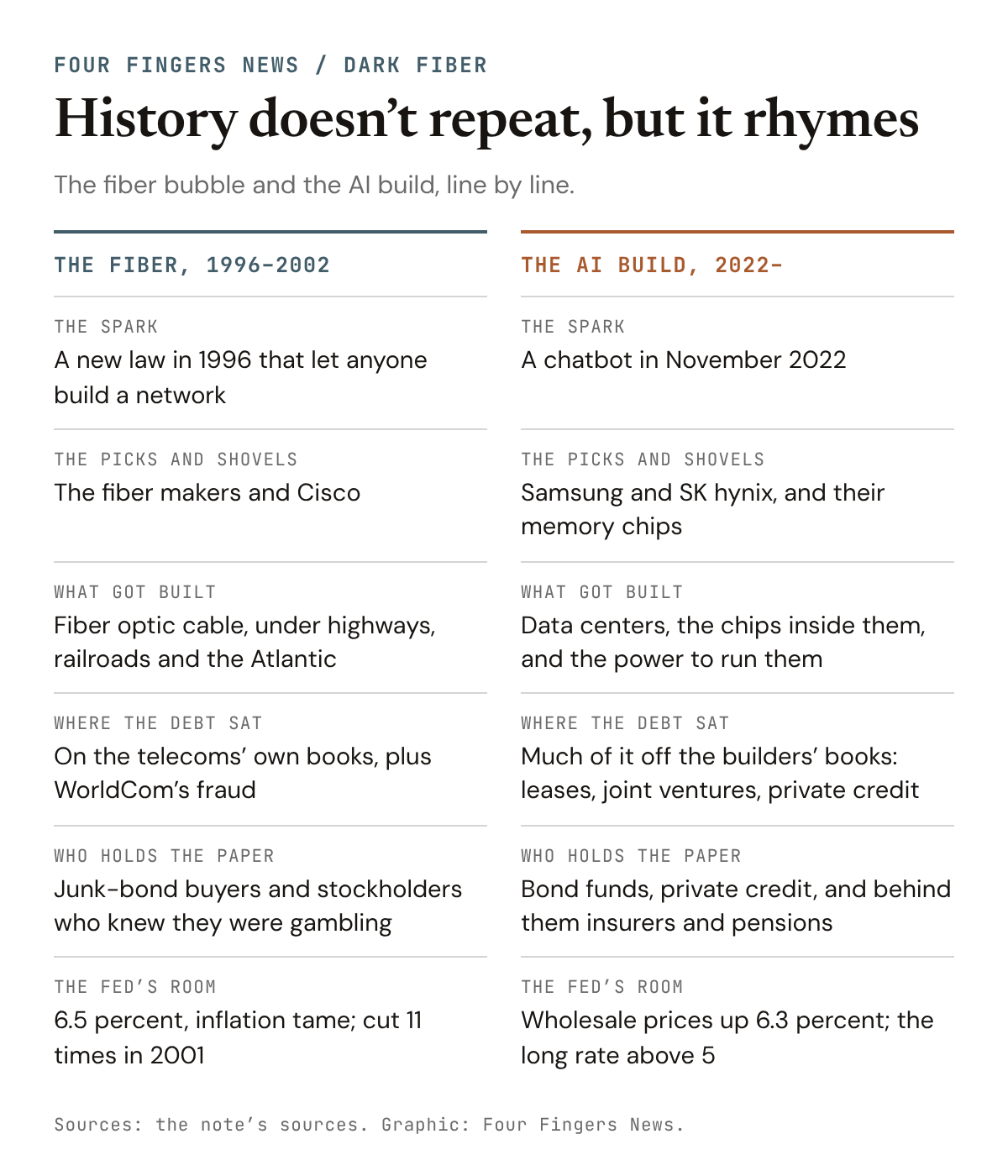
And the catcher looks different this time: when the fiber bubble burst, the Federal Reserve was sitting at 6.5 percent with inflation tame, and it cut 11 times in 2001 to break the fall. Tonight wholesale prices are rising 6 percent a year, the long rate is above 5, there’s a war on with oil above $100, and the Fed can’t cut into that without lighting the inflation it’s supposed to be fighting. One bad day in Seoul isn’t a crash, and nobody knows whether this is the top. But the last time the world built the future on borrowed money, the future showed up right on time and the lenders got 20 cents on the dollar. It’s a fair thing to wonder, before the lights come on in all those buildings, whose dollar it is.
Sources (24), on the site.