
Somebody Always Knows
October 14, 2026 · Day 229 · 2,100 words
Somebody Always Knows
Somebody Always Knows, read aloud · 12 minutes.
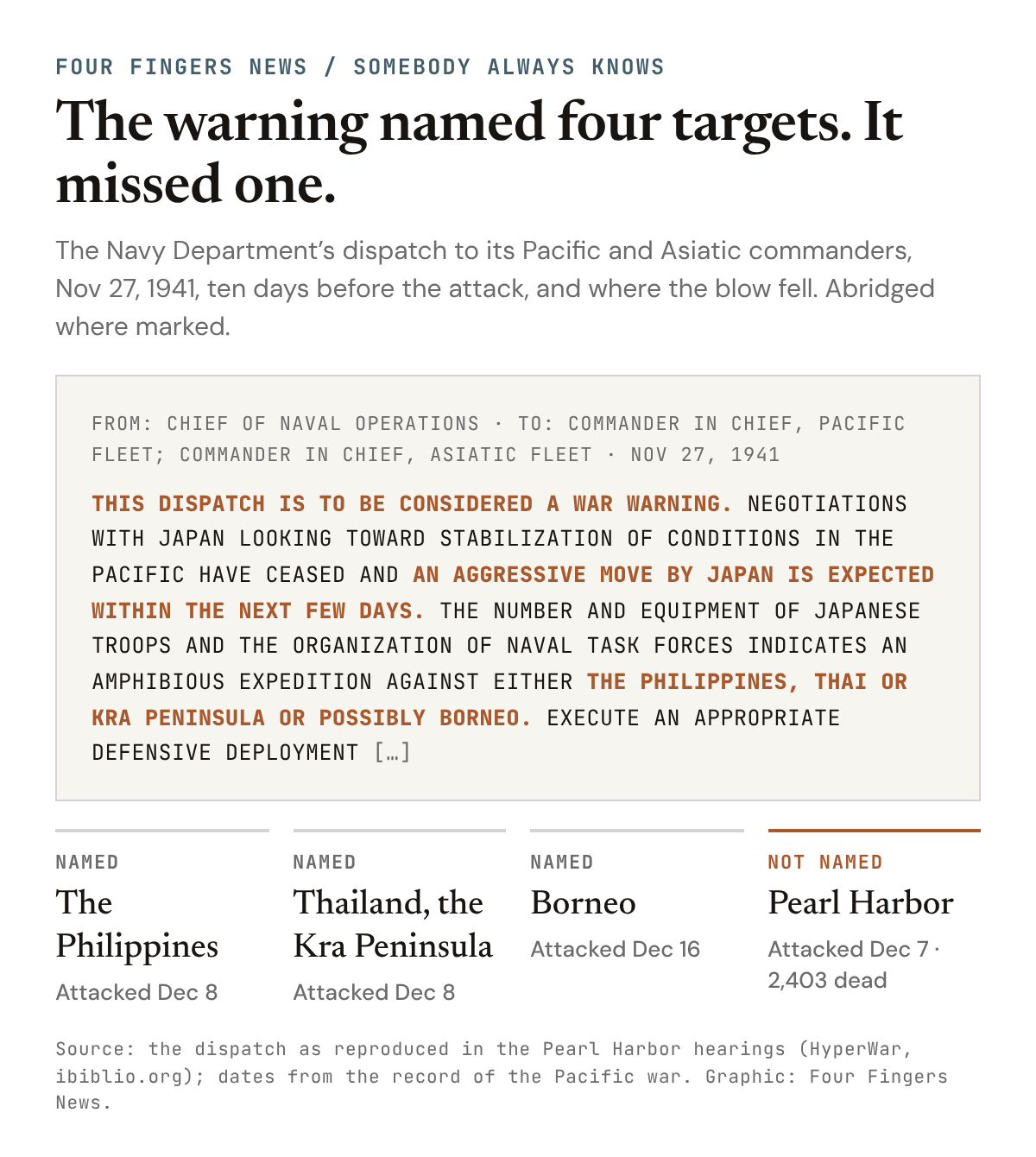
On Sunday morning, Nov 30, 1941, the Honolulu Advertiser, the morning paper of record in Hawaii since 1856, landed on the porches of Oahu with a banner across the top of the front page: JAPANESE MAY STRIKE OVER WEEKEND. Of the men aboard the USS Arizona that morning, 1,177 had a week to live, and that was the paper on the porch. Here’s the part none of us got in school. Japan bought about 80 percent of its oil from the United States, and on July 26, 1941, the United States froze Japan’s money, and within days the oil stopped, with Britain and the Dutch following. From that day Japan had about 18 months of fuel for its navy and no way to buy more, and everyone in Washington DC who signed the order understood that a country in that position fights or folds, and that Japan wasn’t going to fold. On Nov 26 the Secretary of State, Cordell Hull, handed Japan’s envoys the note that carries his name, which told them to pull every soldier out of China and Indochina; Tojo, Japan’s prime minister, read it as an ultimatum, and so would anyone. The day before, the Secretary of War, Henry Stimson, wrote in his diary that the question was how to “maneuver them into the position of firing the first shot without allowing too much danger to ourselves.” American codebreakers were reading Japan’s diplomatic cables, and they’d read the one that set a deadline of Nov 29 and said that after it “things are automatically going to happen.” On Nov 27 the Navy sent its Pacific commanders a dispatch that opened, “This dispatch is to be considered a war warning,” and named four places Japan would hit, and Pearl Harbor wasn’t one of them. The next Sunday 2,403 Americans were dead, and the Pacific Fleet’s three aircraft carriers were elsewhere, two of them at sea delivering planes to the outposts at Wake and Midway and the third in the shipyard at Bremerton, across the water from Seattle. Congress spent the spring of 1946 on it and found errors of judgment, “interdepartmental misunderstanding,” and no evidence the administration had “tricked, provoked, incited, cajoled, or coerced” Japan into attacking; two senators called that illogical and signed a dissent. Read the sequence again and make up your own mind. The war was chosen in July, written down in November, and printed on Sunday. The only people it surprised were the ones who died in it.
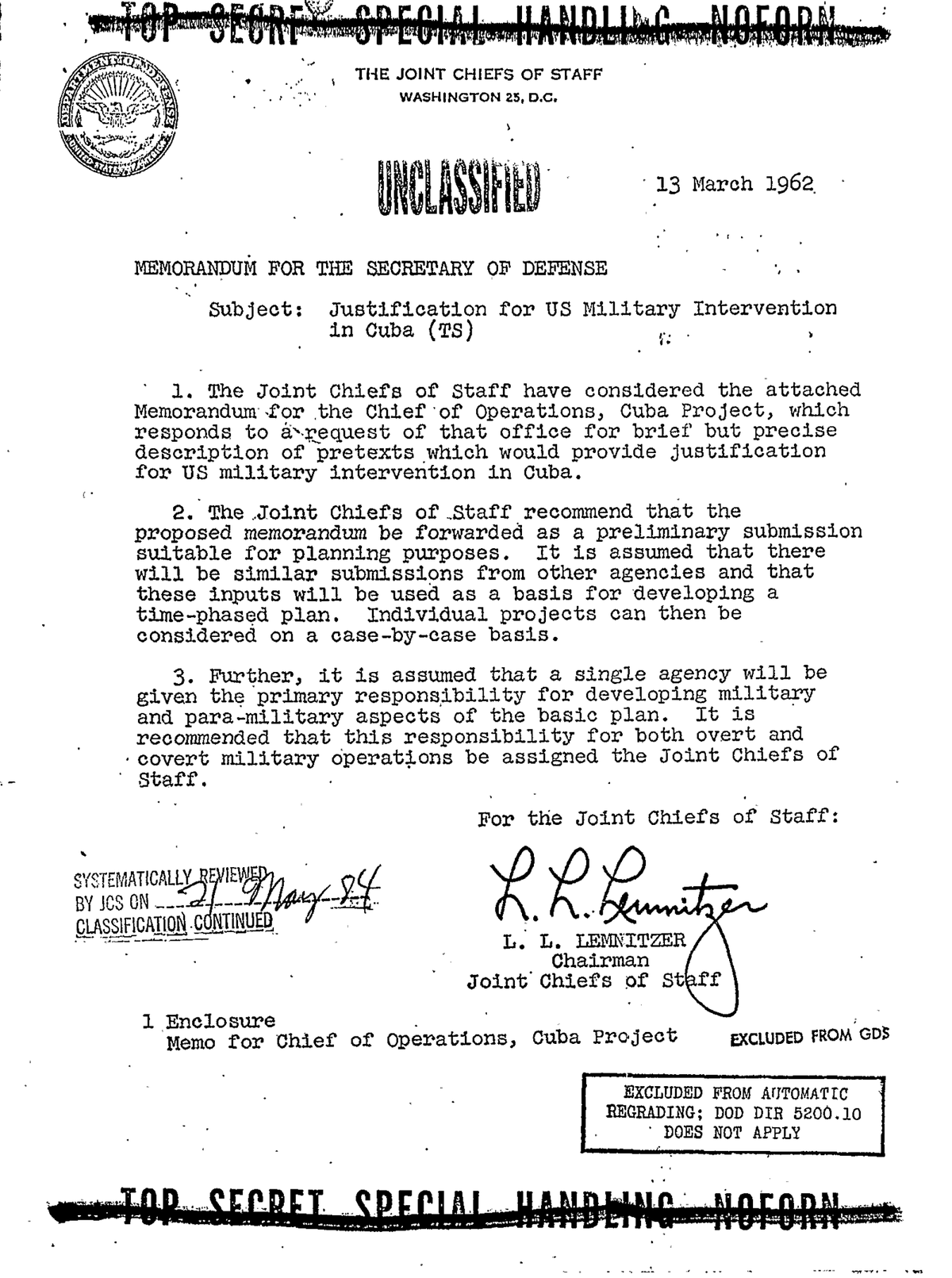
If it’s hard to believe a government would do that on purpose, there’s a document for that. In 1962 the Joint Chiefs of Staff put their names to a plan called Northwoods: stage attacks on Americans, sink a boat, shoot down a plane, blame Cuba, and go to war. It was declassified in 1997 and you can read it. President Kennedy’s administration declined to follow through, which is the only reason it’s a footnote and not a war. Now read the signature at the bottom of that page. Lyman Lemnitzer, the chairman of the Joint Chiefs, put his name to a plan to kill Americans and blame it on Cuba, and nothing happened to him. Nobody was fired, nobody was charged, nobody was asked to explain. Within a year he was Supreme Allied Commander of NATO, in charge of every soldier the West had pointed at Russia, and he held the job for six years. That’s the career of a man who proposed a false flag against his own country, and it tells you exactly how the people in the room think about the people outside it. That’s the whole point of this note, and it’s the thing nobody in charge will ever say out loud: war is a decision, made by a few people, for reasons they know and you don’t, and a decision leaks. It leaks into a newspaper a week early, it leaks into a diary, and it leaks into money, because the people in the room have brokers.
In the week before Sep 11, 2001, somebody bought an unusual number of put options, a bet that a stock will fall, on United Airlines on Sep 6 and on American on Sep 10, the two airlines whose planes would be flown into buildings. The SEC and the FBI spent years on it and the 9/11 Commission put the answer in a footnote: “Some unusual trading did in fact occur, but each such trade proved to have an innocuous explanation.” Read the next sentence slowly, because it’s the one everybody skims. Ninety-five percent of the bets that United Airlines would fall, placed five days before United’s planes were flown into the World Trade Center, came from a single buyer. One institution, American, unnamed then and unnamed now. The Commission said it had “no conceivable ties to al Qaeda” and that the puts were part of a strategy that also had it buying 115,000 shares of American Airlines four days later, and on that basis the matter was closed. Nobody has ever said who it was, and that part is a choice. The SEC and the FBI know the name; it’s in their files, and when some of those files were pried loose under a records request in 2009 it was blacked out on every page. Twenty-five years, two agencies, a dead-certain answer sitting in a folder, and no interest, ever, in letting the country see it. Think about what it means that one desk, somewhere in this country, owned 95 percent of the market’s bet against United on Sep 6, 2001, and that the official answer is a footnote with the name cut out. A finance professor at Illinois, Allen Poteshman, ran the same numbers in 2006 and found the put volume “consistent with informed investors having traded in the option market in advance of the attacks.” Both sentences are in the record and the record stops there, which is where it always stops. After the Hamas attack of Oct 7, 2023, two law professors found a spike in short selling of a fund of Israeli stocks five days before it; they’d botched one figure, the Tel Aviv exchange made sure everyone knew, they corrected it and stood by the spike, and nobody’s been named. Three wars, three records, and the same shape in all of them: somebody knew. Not everybody; somebody. Money runs from a war before the war arrives, and it always has: the First World War moved the world’s banking from London to New York because that’s where the money ran, and by 1945 the United States held two-thirds of the world’s monetary gold. Nobody voted for that; the money just left Europe first.
So the question underneath all of it is why they decide, and the oldest answer in the record comes from a Roman named Sallust, who watched his Republic come apart from the inside and wrote it down around 40 BC. Carthage was the enemy Rome grew up on: the rival city across the Mediterranean, in what’s now Tunisia, whose general Hannibal had marched elephants over the Alps and spent 15 years loose in Italy, the monster every Roman child was raised to fear. Rome finally burned it to the ground in 146 BC. Before that, Sallust said, the senate and the people governed together, with restraint, because “fear of the enemy preserved the good morals of the state.” Then Carthage was gone, and with it the fear, and prosperity did what prosperity does: “the nobles began to abuse their position and the people their liberty,” and “the community was split into two parties, and between these the state was torn to pieces.” The Republic didn’t fall to an enemy; it fell to the absence of one. Sallust’s phrase for the glue was metus hostilis, the fear of the enemy, and it’s the most practical thing a politician ever learned: a state that wants to stay in one piece keeps something to fear outside the walls, and when it runs out, it finds something. Nobody starts a war fat and happy; they start one when the house is coming apart, because an enemy at the gate is the only thing that’s ever made a divided people stop looking at each other. Four centuries after Sallust an emperor tried the other trick. In 376 Valens, who ruled the eastern half of an empire already split in two, let the Goths, a Germanic people running from the Huns, across the Danube, the river that was Rome’s northern wall, to settle them and fill his army with their sons. Roman officials starved and cheated them, they rose, and in 378 at Adrianople, in the corner of Europe that’s now Türkiye, they killed Valens and most of his army, the worst defeat Rome had taken since Hannibal, nearly six centuries before. Import your enemy or invent one; both are the same bet.
Now watch it happen, this week, in Berlin. Germany’s governing party is polling at 18 percent, 12 points behind the AfD, the hard-right party the rest of German politics has spent a decade refusing to sit with, and 79 percent of Germans are telling the pollster they’re dissatisfied with the chancellor. The same government raised its growth forecast for 2026 last week and said in so many words that the reason was borrowed money for the army. Europe has pledged about €800 billion to rearm, and the person who speaks for its foreign policy, Kaja Kallas, Estonia’s former prime minister, said in Tallinn in May 2024 that Russia’s defeat “is not a bad thing” and that if the country came apart into its smaller nations, “it’s not a bad thing if the big power is much smaller.” Her mother was six months old when the Soviets sent her to Siberia; she has her reasons, and they aren’t Europe’s. Russia isn’t communist anymore, it has nothing to gain west of its border, and it is, right now, a country on a full war economy with the largest nuclear arsenal on earth, which could do to Europe whatever it decided to do. Europe knows that, and chose it as the enemy anyway, because the alternative is a union of 27 countries with nothing to fear but each other, and Sallust already told us how that ends. The question isn’t whether Russia is dangerous; it’s what Europe is willing to pay to keep its own house from splitting, and the answer so far is €800 billion and a frontier.
And then there’s us, running the same play. The United States has had Iran under sanctions since 1979, has been at war with it since Feb 28, and has had its ports under a naval blockade since the spring, which is the Japan playbook with the words changed: freeze the money, stop the oil, wait for the first shot. Iran knows the playbook better than we do, because it wrote the other half. The hostages taken in 1979 were released on Jan 20, 1981, the minute Ronald Reagan finished his oath, and the men in Tehran who did that understood American elections better than most Americans. This week Iranian officials told Reuters their attacks on shipping are paced to the Nov 3 vote, and on Oct 8 the White House posted that it wouldn’t attack Iran before the midterms, so both sides are working the same calendar. Meanwhile Alberta votes Monday on whether to start the legal road out of Canada, Germany is at 18 percent, and the United States is running a war with 3.7 percent inflation and gasoline up 34 percent on the year. Everybody’s house is coming apart, and everybody’s reaching for the one thing that’s ever held one together.
So, somebody always knows, and the record says who. The people who choose the enemy know why they chose it, and the money that sits next to them moves before the speech is written, which is why the headline was on the porch a week early and the puts were in the book before the planes. You and I don’t get to sit in that room. What we get is the pattern, and the pattern is enough: when a government tells you who to fear, the useful question isn’t whether the enemy is real, because it usually is, in part. It’s what was happening inside the walls the week they started pointing, and who turned the valve, and when. The men on the Arizona had the answer in the Sunday paper and didn’t know it was for them. That’s the one advantage we have over them, and it’s the only one.
Sources (24), on the site.