
Routes and Resources
November 23, 2026 · Day 269 · 1491 words
Routes and Resources
Routes and Resources, read aloud · 9 minutes.
A Russian warship, the Merkury, blew up at its pier in Benghazi, Libya, on Sunday. What was it doing there? Guarding cargo ships, and the cargo was weapons for Russia’s other war, the one it’s fighting in the middle of Africa. That war isn’t a sideshow to the war in Ukraine, and the war in Ukraine isn’t really Ukraine’s alone. The countries that care about what happens in that harbor are the ones paying for Ukraine’s side: the United States, Britain, France, Germany, the rest of NATO. Ukraine can’t run a drone base on the far side of the Mediterranean by itself. Somebody lets it. The map below shows the road the weapons take. This note is about what’s at the other end of it, and why Russia cares.
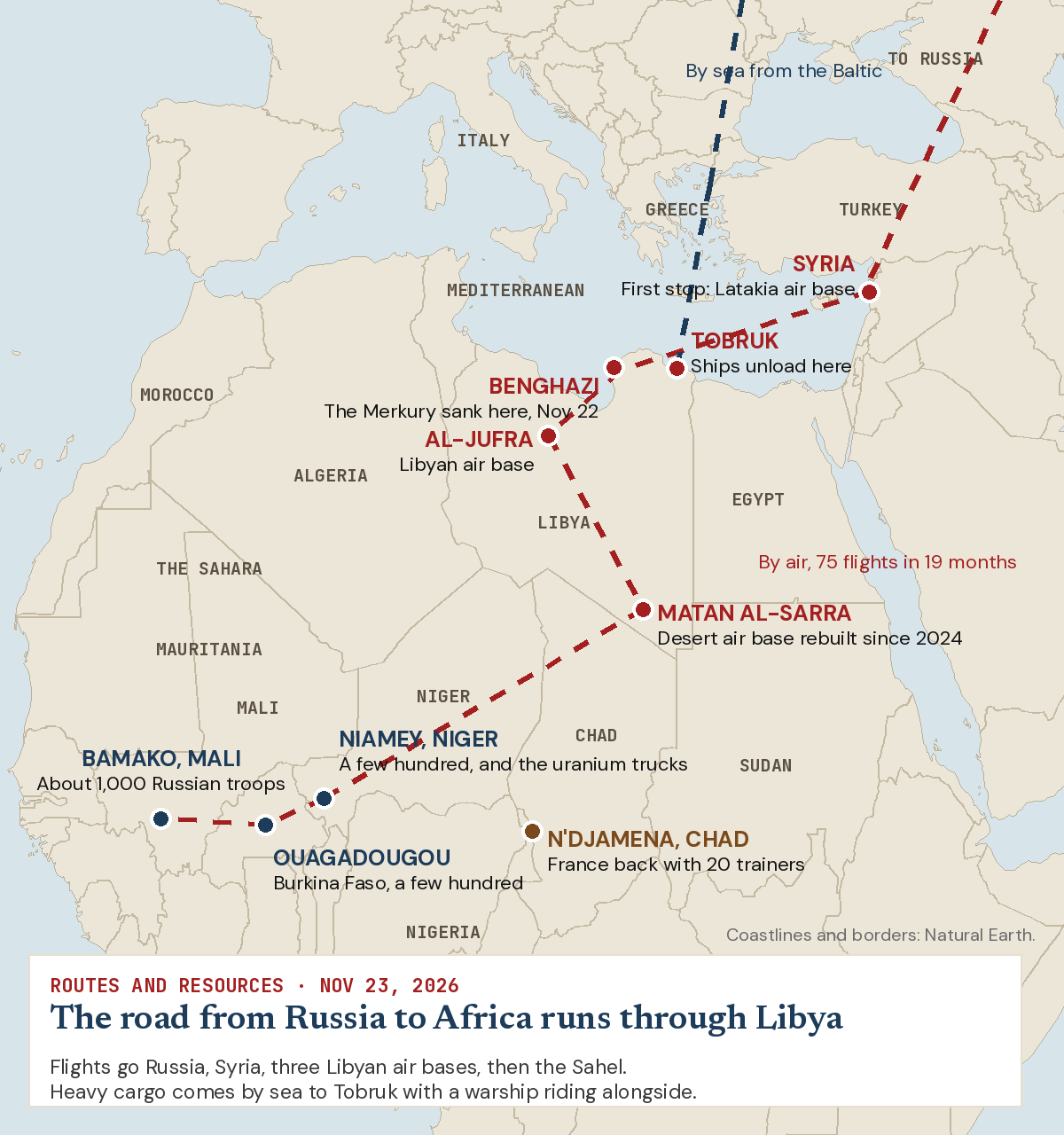
Start with why. The first reason is money that sanctions can’t reach. Russia is cut off from Western banks, and gold doesn’t need one. In Mali, Sudan and the Central African Republic, Russian mercenaries guard the gold mines, take a cut, and fly the gold out to the Emirates, where it turns into money Moscow can spend on anything. One investigation put it at about two and a half billion dollars in the first two years of the Ukraine war. That’s the first thing Russia wants from Africa. The second is uranium: Niger has a thousand tons of it sitting on trucks at an air base, seized from the French company that mined it for fifty years, and Russia has been trying to buy it. The third is votes: fifty-four African countries sit at the United Nations, and a third of them abstained when the world voted to condemn the invasion. A few thousand mercenaries protecting a general is a cheap way to keep those votes. And the fourth is Libya itself: whoever holds its coast holds the migrant route to Italy, which Russia can open or close, and a foothold on the Mediterranean to replace the one it lost when Syria fell. Gold, uranium, votes and a coast. That’s why.
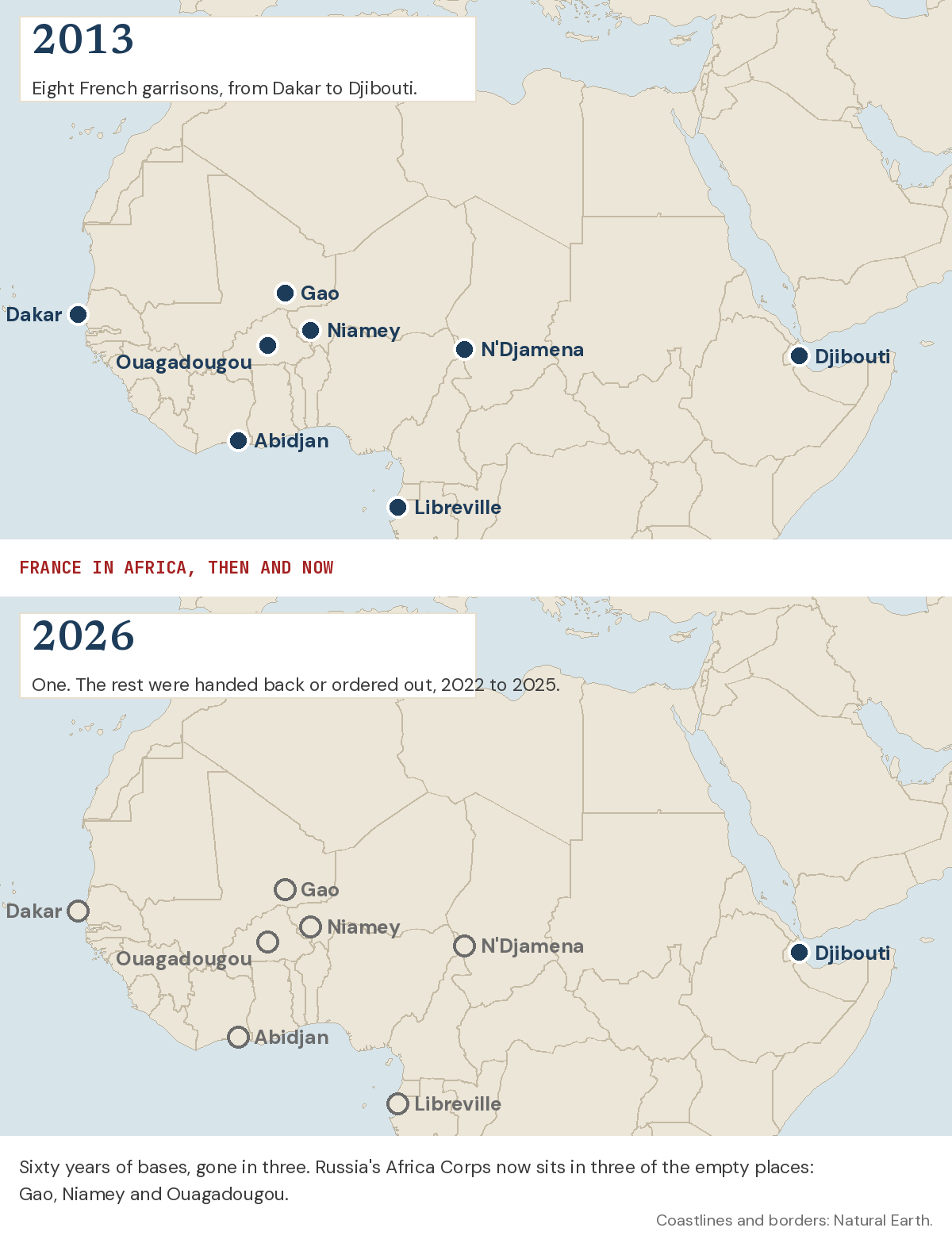
Now how Russia got in, because it didn’t walk into an empty room. The strip of dry country south of the Sahara is called the Sahel, and the countries there, Mali, Niger, Burkina Faso and Chad, were French colonies until 1960. Their governments, their courts and their schools run in French, because France built all three, and sixty years after independence France never really left. It kept soldiers and air bases there, ran their money through a currency printed in Paris, and sent in troops whenever a friendly government was in trouble. The French call that arrangement Françafrique, and in France the word is an accusation, not a boast. In 2013 France sent its army into Mali to drive out the jihadists who had taken the north, and it did. But it made a choice Malians never forgave: it let the Tuareg rebels who had marched in alongside the jihadists keep the northern town of Kidal, and kept Mali’s own army out. From then on, to a lot of people there, France looked less like a protector than like a foreign power deciding who won.
Then, between 2020 and 2023, soldiers took over the governments one after another, and every one of them told the French to leave, saying out loud that France had been in league with the jihadists all along. France denies it and nothing has ever proved it. But it’s what people there believe, and the crowds that cheered the coups waved Russian flags. Within three years France was out of all of them. For the first time since 1960 it has no base of its own anywhere in West or Central Africa.
Russia took the job, and it took it for the gold. The outfit it sent is worth a minute, because it’s the strangest army in this story. Wagner began as a private company, a mercenary army owned by a man named Yevgeny Prigozhin, who’d made his fortune cooking for the Kremlin. For years Russia could send Wagner anywhere and say it hadn’t sent anyone. Wagner guarded presidents, fought rebels, took its pay in gold and mining rights, and did things an army with a flag can’t: in 2022 the UN found that Mali’s soldiers and “foreign military personnel,” meaning Wagner, killed about five hundred people in one village in five days. Then in 2023 Prigozhin marched his men on Moscow, called it off, and died two months later when his plane fell out of the sky. The Defense Ministry kept the business. The same men work the same countries under a new name, the Africa Corps, and now they answer to the Russian state directly. About a thousand of them are in Mali, a few hundred each in Burkina Faso and Niger, and about a thousand in Libya. Getting men and weapons to the middle of Africa is the hard part, and that’s where Libya comes in. The flights run from Russia to Syria, then to Libyan air bases, including one deep in the desert that Russia has been rebuilding, then on to the Sahel. The heavy cargo comes by sea to the eastern Libyan port of Tobruk, with a warship riding alongside. That was the Merkury’s job, until Sunday.
And here’s the bridge back to the war you know. In the summer of 2024, Tuareg rebels ambushed a Russian column in the far north of Mali and killed dozens of Wagner men, the worst loss the mercenaries have ever taken in Africa, and Ukraine’s military intelligence said afterward that it had given the rebels what they needed. Mali broke off relations with Kyiv. Since last year Ukraine has had sea-drone crews in western Libya, hitting the Russian ships that feed the other side of the country. Be clear about what that means. A country fighting for its life at home doesn’t send drone crews to Africa on its own account. It gets there because the people paying for its war want Russia’s gold line cut too. The Associated Press has described the Libya arrangement as one with Western backing, the United States included, and the satellites, the intelligence and the money behind those boats are NATO’s. So Sunday wasn’t the war wandering into a strange new place. It was NATO’s side cutting the line that pays for Russia’s shells, with Ukrainian hands, at the one spot where the line touches the sea.
It isn’t going well for the Russians either. The jihadists they were hired to beat have taken a major northern town this year, killed Mali’s defense minister, and kept the capital under a fuel blockade on and off for more than a year, burning the tanker trucks that try to get through. The security the generals bought isn’t working.
Which is where France comes back in, quietly. I write a lot about the CIA. France has one too. It’s called the DGSE, and inside it sits a unit called the Service Action, the part that doesn’t collect information but does things: sabotage, rescues, snatches, the training of friendly armies and the quiet removal of unfriendly people. It’s the unit that sank the Greenpeace ship Rainbow Warrior in a New Zealand harbor in 1985. French-speaking Africa is where it’s always done most of its work, and the three juntas know it, which is why every Frenchman they catch is a spy. This year Mali convicted a Frenchman from the embassy as a spy, sentenced him to twenty years, and then pardoned him and put him on a plane after the king of Morocco intervened. Burkina Faso did the same with four French “computer technicians” a year earlier. And Chad, which threw France out two years ago, has let about twenty French soldiers back in to train its army and signed a new defense agreement in Paris last month. No bases. A foot in the door.
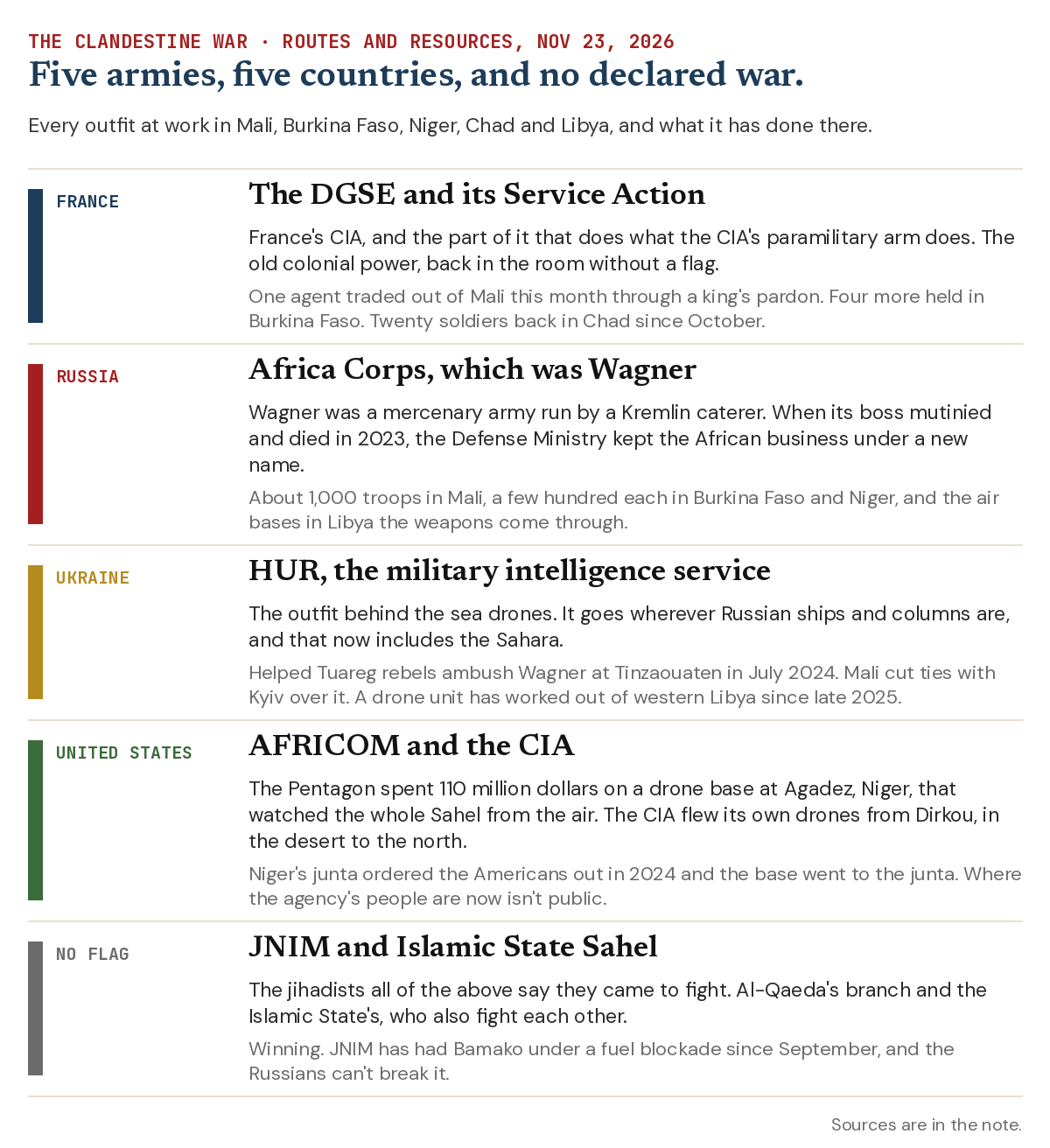
So here’s the shape of it. A region France ran for sixty years and lost in three. Generals who threw France out and hired Russia. Russia, there for gold, uranium, votes and a coast, supplying its men through Libya. Jihadists beating the Russians the way they beat the French. Ukraine reaching in to cut the supply line because the gold pays for the shells falling on Kyiv, and NATO behind Ukraine, because the line is Russia’s. And France, the whole time, working its way back in through the side door. We hear “Russia in Africa” the way we heard “Russia attacks a democracy” about Ukraine, as if the story started the day the Russians arrived. It didn’t. There was already a war in that room. Russia joined it, and NATO followed, with Ukraine out front.
That’s the route, and those are the resources. And that’s why a warship in a Libyan harbor is part of the war between Russia and NATO. Ukraine is where that war is fought. Africa is one of the places it’s paid for.
Sources (28), on the site.