
What Are We Being Prepared For?
Britain’s chief of the defence staff, Sir Richard Knighton, says more families will come to know what sacrifice for the nation means. The language of preparation is becoming familiar: duty, readiness, resolve. The public is being asked to get used to the possibility of war with Russia.
Sir Richard Knighton
Chief of the Defence Staff
I can’t get used to it. The confidence of the language bears so little relationship to the consequences being contemplated.
Consider Oreshnik, Russia’s ballistic missile already used against Ukraine. A rocket carries multiple reentry vehicles on an arc through space before their payloads descend at hypersonic speed. One launch delivers multiple incoming objects. The speed compresses the time available to respond; the multiplicity complicates interception.
The United States once explored a weapon concept nicknamed “Rods from God”: dense metal projectiles released from orbit, striking with such speed that they wouldn’t need explosives to cause destruction. That idea helps explain the interest in Oreshnik’s non-nuclear payload. The missile launches from the ground, but its descending projectiles carry destructive energy in their motion.
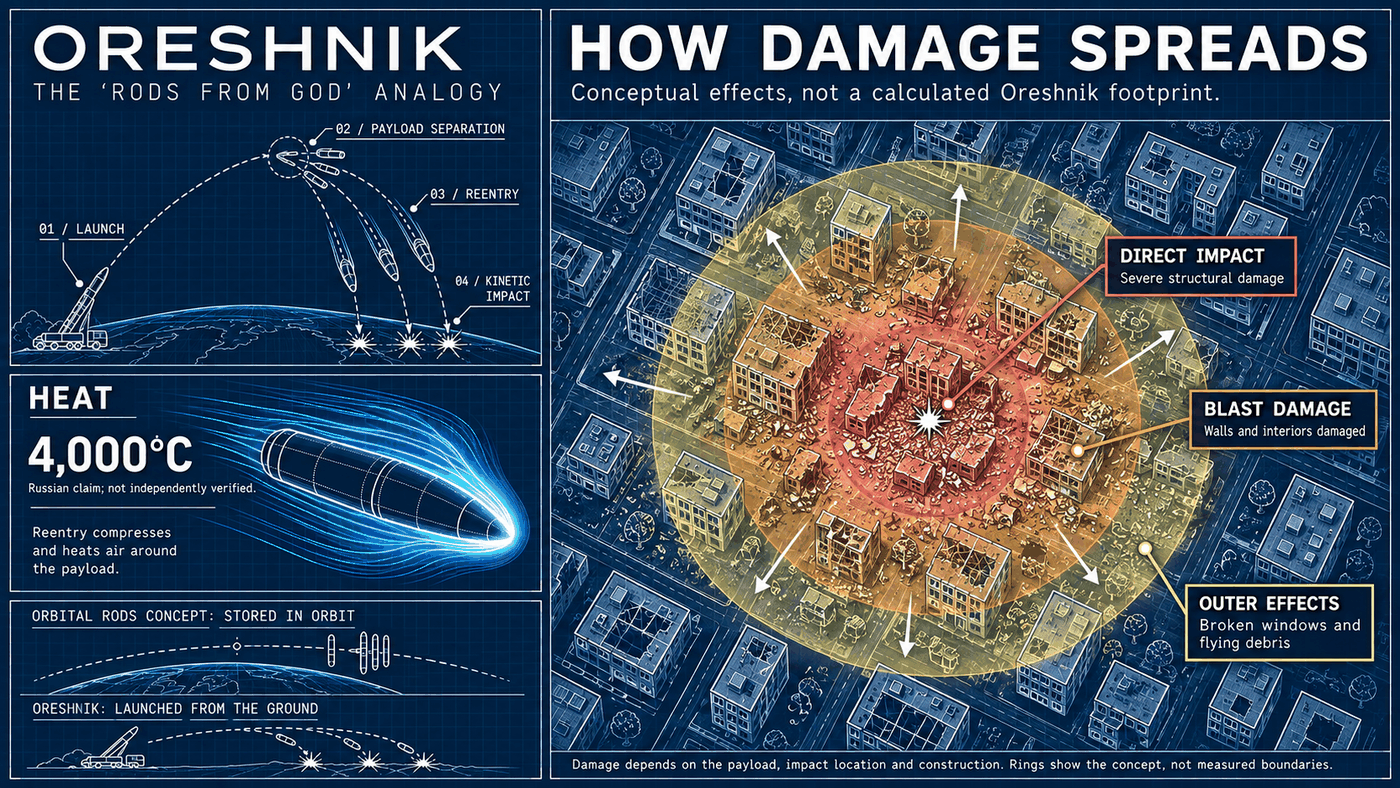
This is the machinery behind the word “conventional.” It’s a classification, not a promise that the damage will be manageable.
Missile defense introduces another uncomfortable question. How long can it last? Every engagement consumes interceptors. Launchers have finite magazines, stockpiles have limits, and replacement missiles take time to manufacture and deliver. Even perfect interception wouldn’t resolve that arithmetic. A defense that stops one salvo still has to stop the next.
That’s before considering the reliability of the interceptions themselves. MIT professor emeritus Theodore Postol estimates that Patriot PAC-3’s success against Iranian ballistic missiles has been only a few percent. His assessment raises a fundamental question about how much protection these systems actually provide.
What’s the plan for sustaining that protection through a direct war with Russia?
The consequences extend beyond military installations. Electricity, fuel storage, railways, communications, and water treatment sustain civilian life. Damage to those systems spreads beyond the point of impact. Repairing them during continuing attacks becomes part of the war.
NATO would retaliate. Russia would respond. Each round would produce losses, demands for escalation, and another decision about how far to go. Nuclear weapons would remain available throughout.
What I can’t make sense of is the purpose of all this. Surely the people preparing these speeches know what a direct war with Russia would involve. They have military advisers, intelligence briefings, and information the rest of us don’t. They know there would be retaliation. They know the consequences could escape their control.
So what are they trying to accomplish?
Is the language meant to frighten Russia into backing down? Frighten Europeans into accepting higher military spending and sacrifices at home? Prepare the public for a confrontation officials genuinely expect? Those are different purposes, with very different implications for everyone being told to get ready.
The talk about duty and dying for your country is shocking. But underneath that reaction is real confusion. It’s difficult to believe these governments actually want the war they’re describing. It’s equally difficult to understand why they’re working so hard to make it feel inevitable.
What are we being prepared for?