
State Television Arrives at the 50-Yard Line
Day 212. There’s an unwritten pact between the American television viewer and Sunday football. For about three hours, the nation gets a ceasefire. We mute the culture war and route our collective blood pressure into arguing about defensive pass interference and missed field goals.
The commercials are supposed to honor that. Pickup trucks towing boulders up impossible cliffs. Light beer poured in high-definition slow motion. A gecko trying to save you 15%. Crass consumerism, sure, but harmless. It’s part of the ritual.
Then Fox breaks away from the Seahawks.
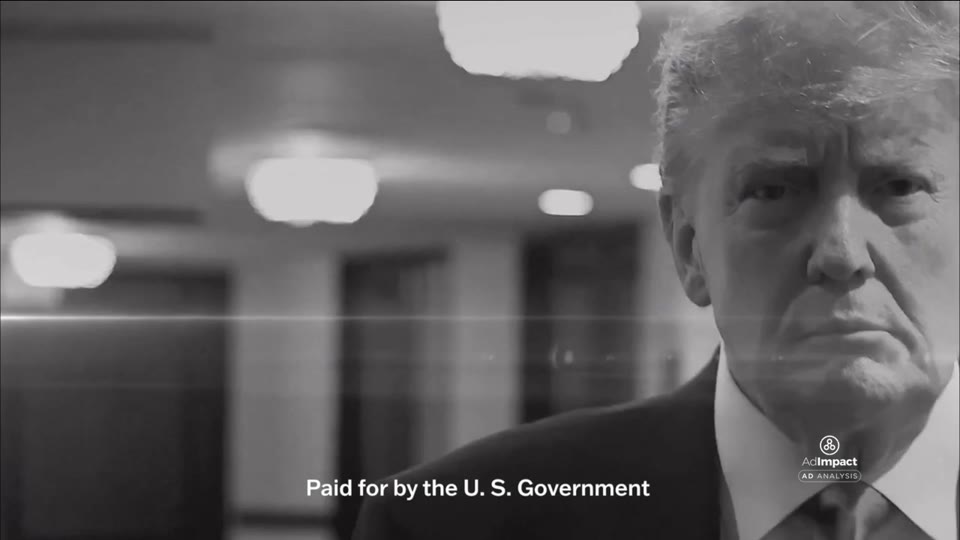
In black and white, Donald Trump walks a hallway toward the camera. The voice isn’t pitching low-interest financing. It’s his: “This is the final battle.” “We will cast out the communists, Marxists, and fascists.” “We will rout the fake news media.” If it sounds familiar, it should. The audio echoes his 2023 Veterans Day speech and nearly mirrors a campaign video he posted to Truth Social in January 2024. Your brain waits for the boilerplate: I’m Donald J. Trump, and I approve this message, then a PAC address in Alexandria, Virginia.
But, no, instead, a quiet strip of white text: Paid for by the U.S. Government.
Wait, did that ad just say it was paid for by the government?? The executive branch just ran a stump speech on the public tab between a beer commercial and a punt return. By AdImpact’s count, it’s the third one.
The White House calls it a public service announcement, “educational and unapologetically patriotic.” Defending an earlier spot, a spokesperson laid out the legal theory plainly: “The President is not on the ballot and the ads don’t have a call to action.” By that logic, a recycled campaign speech sits in the same civic drawer as Smokey Bear and a Medicare enrollment reminder.
It takes contempt to say that with a straight face. It also takes the wrong rulebook. “On the ballot” and “call to action” are campaign-finance tests, the magic-words standard that governs PACs and outside spenders. They don’t govern how an agency spends its appropriation.
The spending rule dates to 1951, when Congress began adding this restriction to appropriations bills: no appropriated money for “publicity or propaganda purposes” it hasn’t authorized. GAO reads that rider narrowly, and it’s flagged administrations of both parties under it. The test is whether the government is informing the public or promoting itself. A stump speech with no program, no deadline and no phone number isn’t informing anyone. It’s the self-aggrandizement the rule was written for, five weeks before a midterm.
The Washington Post reports more than $300,000 spent on “Final Battle,” citing AdImpact. Campaigns are paid for by people who choose to give. The government is paid for by everyone: the fan who reveres the man, the one who reviles him, and the one who just wanted to watch the game.