
Hold My Bag
Anthropic’s prospective IPO could invite ordinary investors into a company valued above $2T. That’s the figure Reuters reported last week after reviewing its confidential prospectus. In March 2025, a private financing round valued Anthropic at $61.5B. By May 2026, another round put it at $965B. A tremendous increase in the company’s valuation has already happened before its shares reached a public exchange. Reuters, Anthropic’s March announcement, May announcement
There’s also a tremendous amount left to pay for. Reuters reported more than $8B in operating losses in 2025, even as revenue grew twelvefold to nearly $4.6B. Separate reporting put Anthropic’s computing and infrastructure commitments at $518B over a decade. About 80% is noncancelable or payable regardless of usage. Those obligations will belong to the business public investors are being offered a stake in. Financial reporting, infrastructure commitments
The debate will concentrate on whether Anthropic deserves that valuation. Congress helped change how much of a company’s growth could happen before ordinary investors had a chance to buy its shares.
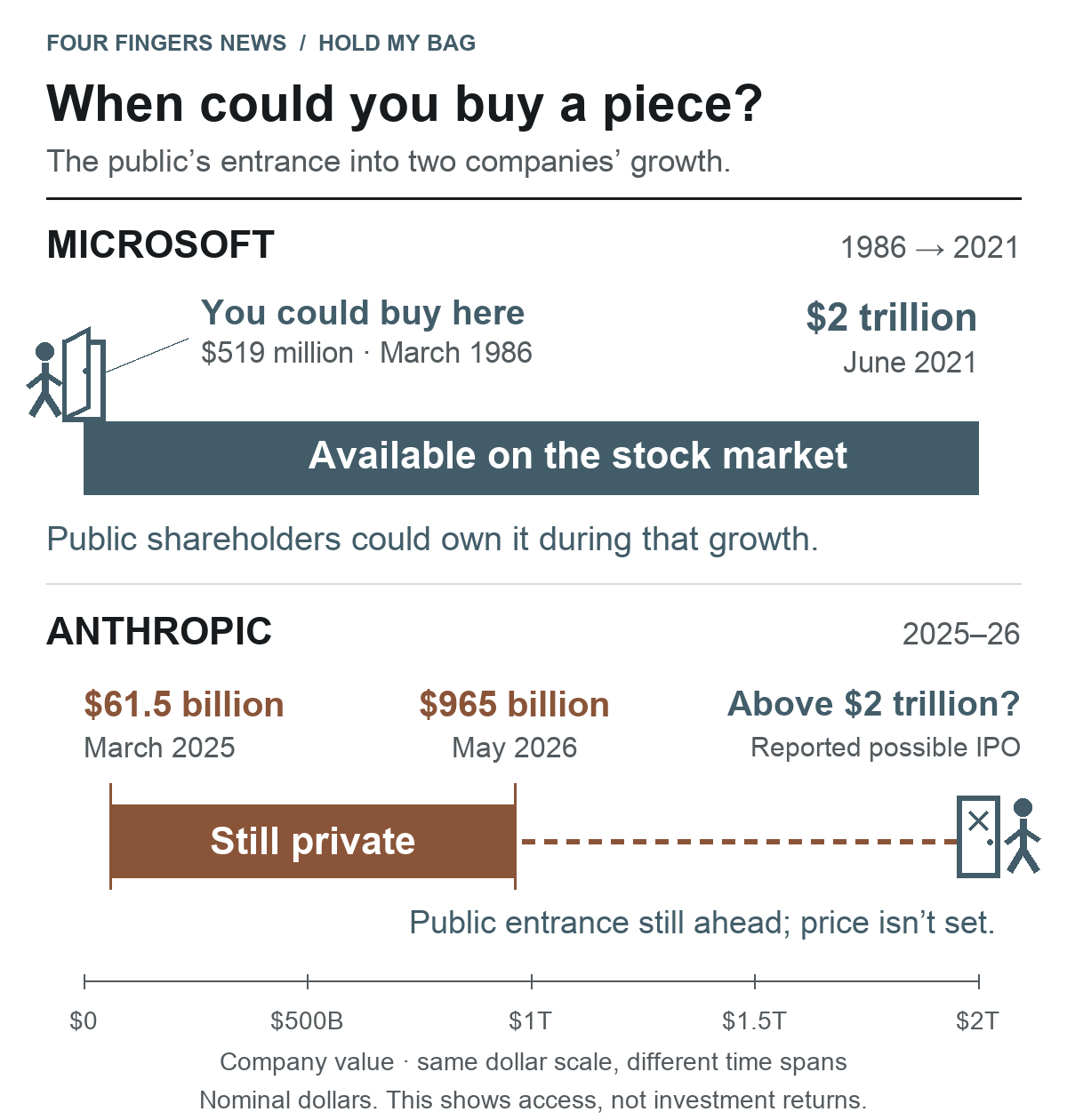
Microsoft’s 1986 offering priced the company at about $519M, in that year’s dollars. Public shareholders could own it through decades of expansion. They had to recognize the opportunity, take the risk and keep holding. Plenty of other investments disappointed people. But someone with a brokerage account could buy Microsoft while much of the business we know today was still ahead of it. Original prospectus
That opportunity wasn’t simply a gift from generous founders. Rules helped bring companies into public ownership.
In 1996, Congress passed the National Securities Markets Improvement Act. Among its changes, it created a private-fund exemption that removed the existing 100-investor ceiling for funds whose investors met the more demanding “qualified purchaser” standard. Institutions had already been investing in venture capital. The change gave private funds more room to assemble large pools of money. SEC’s contemporary explanation
That mattered to a growing company’s choices. Raising serious money increasingly became possible without selling shares to the public. Research by Michael Ewens and Joan Farre-Mensa identifies the law as one of several changes that expanded late-stage private financing and helped companies stay private longer. Research
Then came the JOBS Act in 2012.
That’s the Jumpstart Our Business Startups Act. Somebody in Congress must’ve been very pleased when they got the letters to spell JOBS.
For companies with more than $10M in assets, the old threshold of 500 shareholders of record became 2,000 overall, or 500 who weren’t accredited investors. Qualifying shares issued through employee compensation plans were excluded from the count. A growing workforce could receive equity without pushing the company toward public reporting in the same way. SEC
The old rule required registration and financial reporting, rather than an IPO. But that requirement created pressure: once a company had to disclose its financial results anyway, an important advantage of remaining private had diminished. Goldman Sachs, which helped take Microsoft public, describes the approaching shareholder threshold as a factor in its decision. Goldman Sachs
Private share sales also give employees and early investors ways to turn equity into cash without a listing. Those transactions existed before the JOBS Act. Alongside larger pools of private capital and looser reporting thresholds, they reduce another reason to enter the public market.
The advantages for a company are understandable. Founders gain flexibility. Employees can get paid. Investors can negotiate deals without the full obligations of public ownership.
The consequence for someone building wealth through public stocks deserves equal attention. More of a company’s development can happen within a market they can’t readily enter. By the time an IPO arrives, years of financing rounds have established a much higher starting valuation for their investment.
Some ordinary savers have indirect exposure through pensions or funds. That’s different from being able to choose a company and buy its shares during that earlier period.
“Socialize the losses” is the concern this arrangement brings to mind. An IPO alone doesn’t establish a taxpayer bailout, and private investors have borne real losses along the way. But an offering can broaden who bears the next stage of risk. Where existing owners sell, it can also let them realize gains while new buyers take their place.
The offering’s terms will tell us how much money goes into Anthropic and how much goes to existing shareholders. Calling both “investment in the future” would obscure an important distinction.
Anthropic may build a business that rewards its public shareholders. That possibility doesn’t erase what changed in the meantime. Congress gave companies and private capital more freedom to decide how long early ownership would remain private. Ordinary investors’ access depended on those decisions.
For someone saving out of a paycheck, the March 2025 entry point won’t be available at the IPO. Their decision could begin above $2T, with a decade of computing bills still ahead.