
The Guest List
Day 226. Three times last year, in April, September and December, leaders of a group that wants Alberta (the Canadian province north of Montana) to become its own country met American officials at State Department headquarters in Washington DC. One of them, a former heart surgeon named Dennis Modry who co-founded the Alberta Prosperity Project, has since told the Globe and Mail, one of Canada’s national newspapers, that the group brought a document describing what an independent Alberta might offer the United States, and that it covered fresh water, a share of the province’s oil royalties, pipeline routes through American territory and land for a rail line to Alaska. “Does the U.S. need more water?” was how he framed it for the paper, which published its investigation on Oct 3. (The Globe and Mail · Investigation, Oct 3; Culture Alberta · The Globe’s findings, Oct 4)
Other leaders of the movement dispute his account. The lawyer who arranged the meetings told the Globe the resource ideas were never discussed and called the document “stupid,” the group’s chief executive says water and oil didn’t come up at the one meeting he attended, and Modry wouldn’t give the paper a copy. The White House says its officials meet with all kinds of groups and that “no support or commitments were conveyed,” and the State Department says only staff took part. (Culture Alberta · The Globe’s findings, Oct 4; Global News · Sylvestre’s denial, Oct 5; NBC News · White House and State Department statements)
The water and the royalties Modry described belong to what Canadians call the Crown, which in practice means the provincial government holds them on behalf of everyone who lives in Alberta. Oil royalties are a large share of the province’s budget, and water is scarce enough in the south that the basins of the Bow (the river that runs through Banff and Calgary), the Oldman and the South Saskatchewan have been closed to new surface water allocations since 2006. The Bow and the Oldman run their whole length through Treaty 7 land, covered by an agreement signed in 1877 between the Crown and the Blackfoot nations and their neighbors, 28 years before Alberta existed as a province. Most of the oil sands lie in the north, under Treaty 8, signed in 1899. Canada’s constitution protects the rights in those treaties, and a judge has found that secession would breach them by removing Canada as the treaty partner. (Culture Alberta · The Globe’s findings, Oct 4; CBC News · Closed basins, April 2024; Crown-Indigenous Relations Canada · Historic treaty map; Natural Resources Canada · Map 900A, 2025; Fasken · The two rulings, May 28)
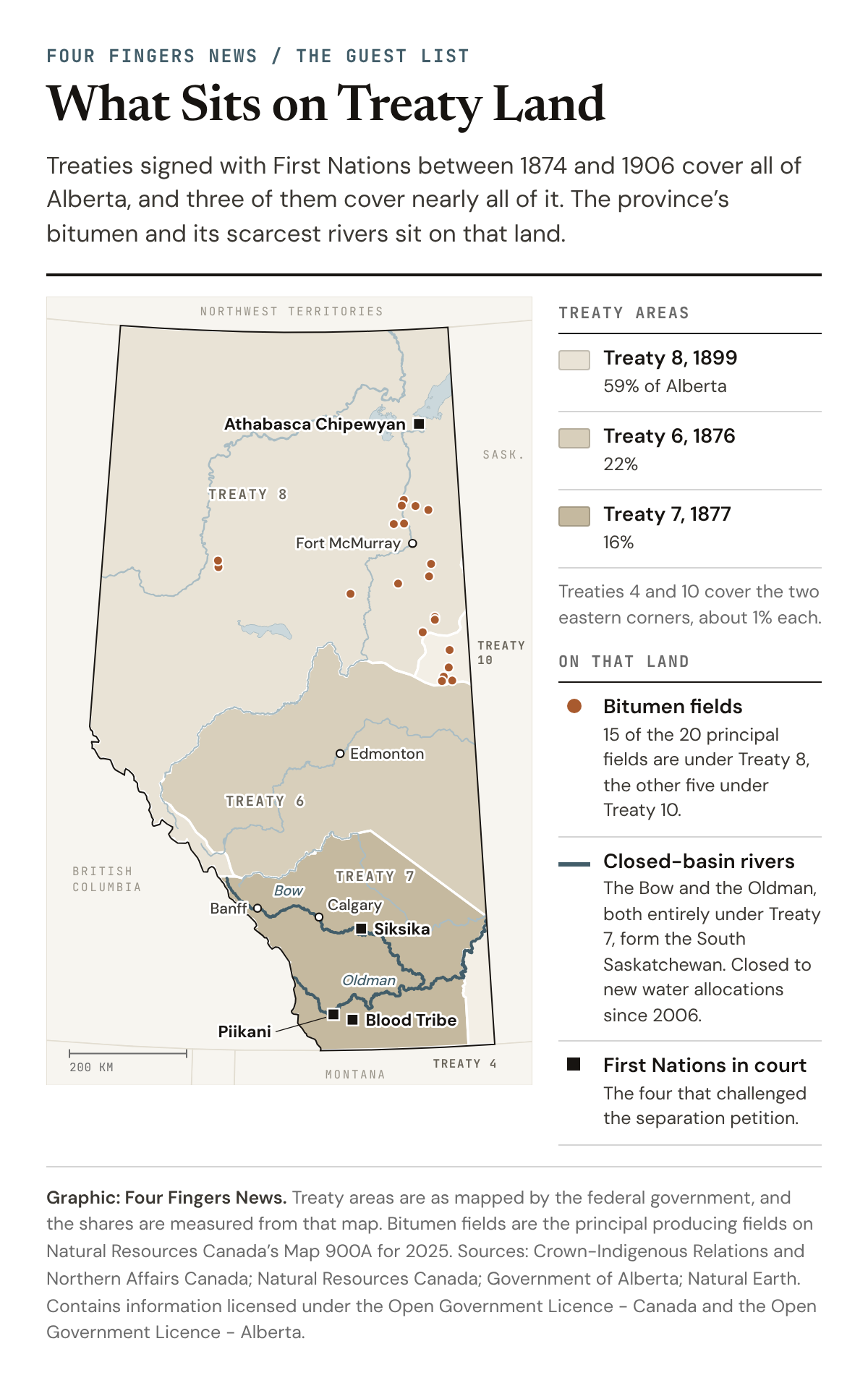
The people at those State Department meetings were separatist leaders and American officials, and the Indigenous nations that signed those treaties, known in Canada as First Nations, have spent the past year in Alberta’s courts instead. In December, a judge reviewing the separatists’ first proposed referendum question ruled that it would violate treaty rights, writing that First Nations were founding partners in Alberta and “cannot be ignored or bypassed” as the province weighs its future. After the legislature changed the petition law and elections officials approved a reworded question, the Athabasca Chipewyan First Nation from the north and the Piikani, Siksika and Blood Tribe of the Blackfoot Confederacy from the south went to court, and in May a second judge threw the approval out because the province hadn’t consulted them. Premier Danielle Smith called that ruling “anti-democratic,” and her government then wrote its own question for the Oct 19 ballot, one she said the ruling wouldn’t apply to. The province and the separatists are both appealing, and First Nations leaders say the litigation has put growing financial and legal burdens on the nations defending their treaties. (Global News · December ruling; Alberta Court of Appeal · June 29 decision; Global News · Smith on the May ruling; Government of Alberta · Premier’s address, May 21; Alberta Native News · Treaty 6 statement)
The ballot on Oct 19 can’t take Alberta out of Canada, because the most it can do is start the legal work toward a second, binding vote, and advance voting opens Tuesday. The people who want out have real complaints, since Alberta is landlocked, produces most of Canada’s oil, and has argued for decades that Canada’s federal government manages that wealth over its head. The group’s own chief executive says the goal is “sovereignty independent of the U.S.” (Alberta Court of Appeal · June 29 decision; Elections Alberta · Voting dates; Canada Energy Regulator · 2025 production; DisinfoWatch · Alberta report, May 6; CP24 · Sylvestre on sovereignty, Jan 24)
The United States hosted the group’s three meetings, which means American officials sat down three times with people working to take a province out of an allied country. The White House says they conveyed no support, but President Trump has pushed to make Canada the 51st state, and since Sep 29 the US has been turning back Canadian alcohol, dairy products and motorcycles at the border. Canadians had already cut back on trips across that border, and Statistics Canada counted about a quarter fewer return trips from the United States this August than in August 2024. (NBC News · White House and State Department statements; AP via Fox 35 · Import bans, Sep 29; Travelweek · Statistics Canada’s August count)
On Jan 22, 2026, a mere 37 days before the US went to war with Iran, the US Treasury Secretary, Scott Bessent, went on television, said Canada wouldn’t let Alberta build a pipeline to the Pacific, and added “I think we should let them come down into the U.S.” before giving his view of the province:
“They have great resources.”