
Check with Your Airline
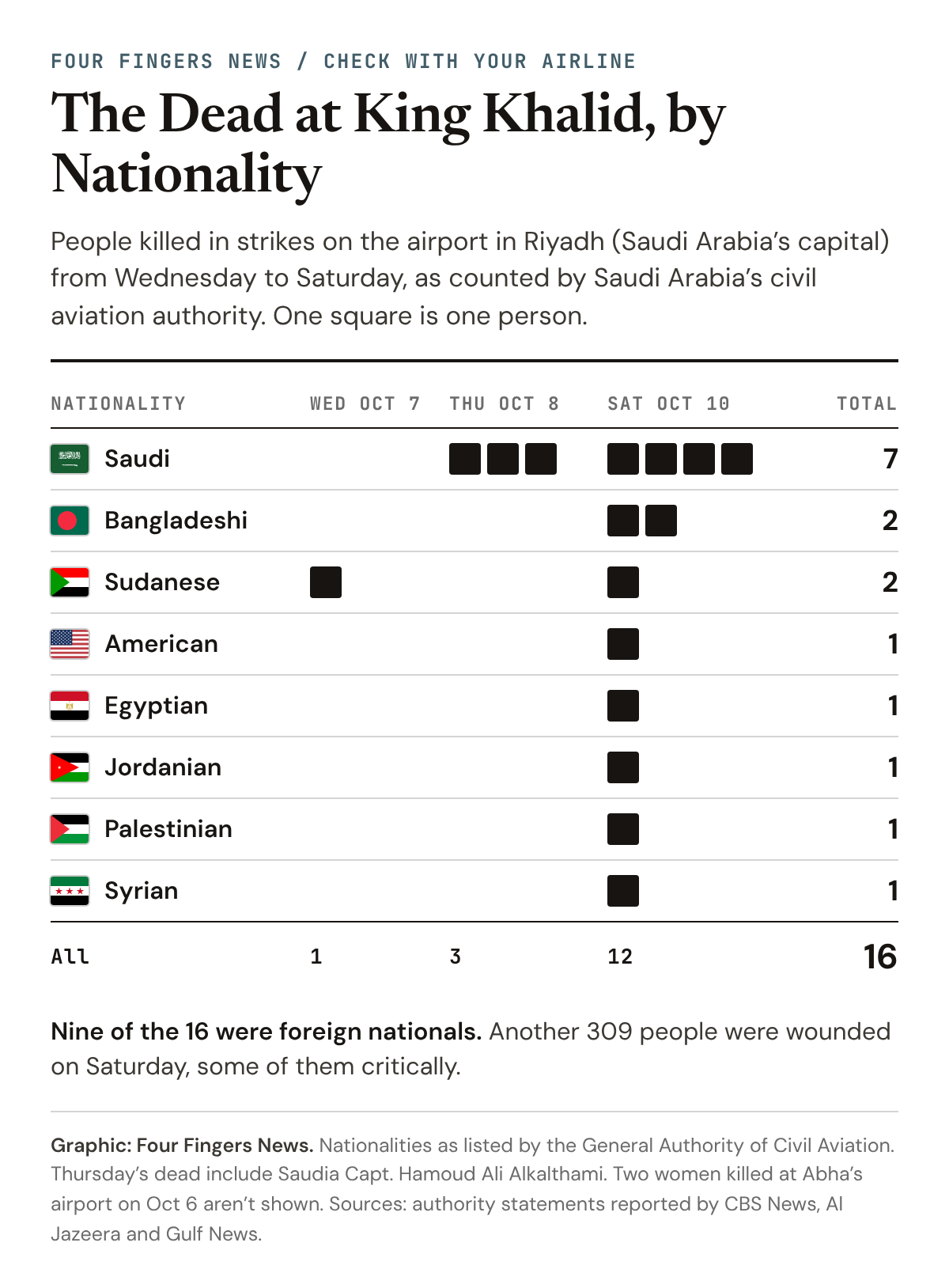
Day 225. A strike on King Khalid International, the main airport in Riyadh (Saudi Arabia’s capital), killed 12 people and wounded 309 on Saturday, after strikes there on Wednesday and Thursday had already killed four. An injured traveler told Reuters that part of the ceiling near a departure gate came down. Ansarallah, the movement that governs most of northwest Yemen from Sanaa (Yemen’s capital), claimed the week’s earlier strikes, and after this one the head of its media office posted that the group had “shut down Riyadh international airport,” which Reuters reports as a claim of responsibility. (CBS News · Aviation authority toll, Oct 10; AFP via Malay Mail · Oct 7; CBS News · Live file, Oct 9 and 10; Reuters via Jerusalem Post · Airport strike, Oct 10)
Who gets on a plane at an airport that took a ballistic missile two days earlier?
Here’s the week behind that question. On Monday, Ansarallah told every airline flying over Saudi Arabia that the country’s skies were now part of the war, and that night it said it had fired on King Khalid. On Wednesday, a strike there killed a man, and flights stopped for a little over an hour and then started again. On Thursday morning, Ansarallah repeated the warning “for the last time” while the departure board showed 58 flights delayed and 11 cancelled, and later that day a strike killed a captain with Saudia, the national airline, and two other people and heavily damaged a parked airliner. By Friday, Saudi media were reporting that air traffic was back to normal, and Ansarallah had said the only flights allowed into Riyadh were humanitarian ones carrying its permit. None of this was hidden, since the warnings were posted in public and Saudi Arabia’s own aviation authority announced the dead, and on Saturday there were travelers at the departure gates again when the next strike came. I wouldn’t have gone near that airport after Wednesday. Boarding there on Saturday was Russian roulette played after the gun had already gone off twice, and I went looking for who was playing and what they’d been told. (dpa via GNA · Oct 5 notice; AeroCorner · Monday’s claimed strike; The National · Thursday’s board, Oct 8; AP via News4Jax · Final warning, Oct 8; CBS News · Live file, Oct 9 and 10; Reuters via Jerusalem Post · Airport strike, Oct 10; Al Jazeera · Flights resume, Oct 9)
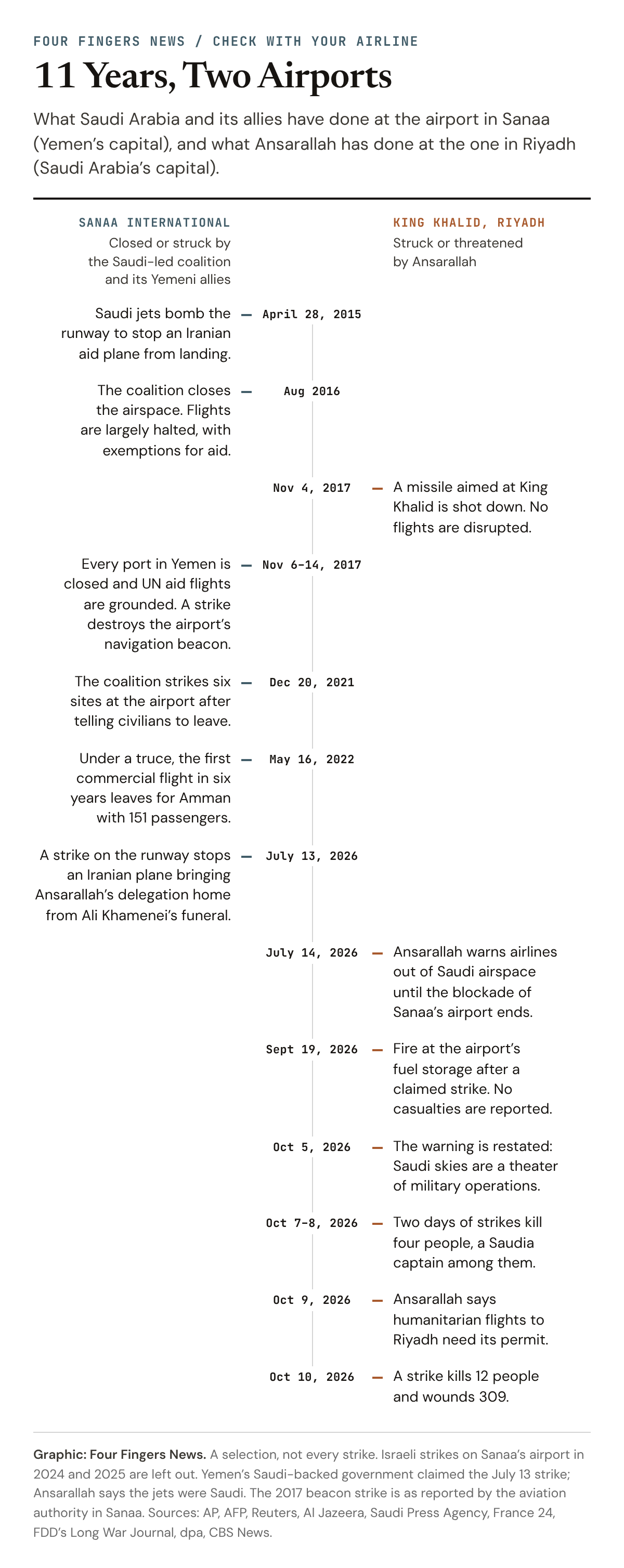
The warning is older than this week. On July 14, the day after a strike hit the runway at Sanaa’s airport, Ansarallah warned every airline to stay out of Saudi airspace until the Saudi-led blockade of that airport was lifted. Monday’s notice, from its coordination center in Sanaa, called the kingdom’s skies a theater of military operations, exempted Mecca and Medina (the two holiest sites in Islam) for the sake of pilgrims, and said it wouldn’t answer for what followed. The reason it gave was Saudi airstrikes on Yemen, where 100 jets from the Saudi-led coalition had flown that morning and where, a day later, the health ministry in Sanaa said one strike killed six members of a family in Hajjah, four of them children. (FDD’s Long War Journal · July 14 warning; dpa via GNA · Oct 5 notice; AFP via Hürriyet Daily News · Coalition jets, Oct 5; AFP via Malay Mail · Oct 7)
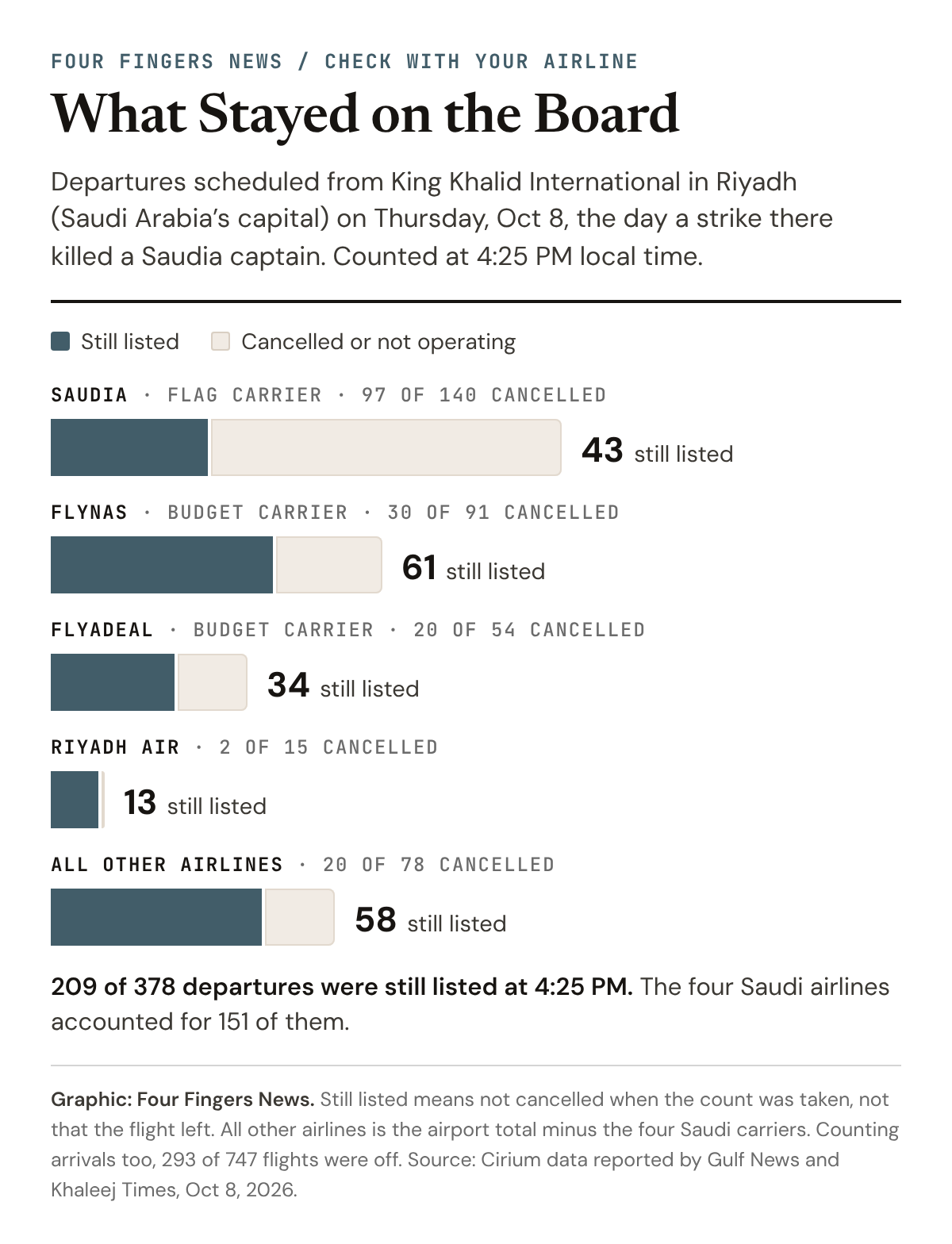
Airlines with somewhere else to fly acted on it. By Friday, Lufthansa, Air India, Emirates, Etihad, flydubai, Air Arabia and Pakistan International had suspended flights to Riyadh, and Europe’s aviation regulator had advised against parts of Saudi airspace. The airlines based in the kingdom cut their schedules and kept flying. On Thursday, the day Capt. Hamoud Ali Alkalthami and two other Saudis were killed, Saudia had cancelled 97 of its 140 departures by late afternoon, and across the airport 293 of the day’s 747 flights were off while the rest were still listed. (CBS News · Live file, Oct 9 and 10; Khaleej Times · Cirium count, Oct 8; Gulf News · Cirium count, Oct 8)
The casualty lists say who was there, and on Saturday that was four Saudis, two Bangladeshis, an American, an Egyptian, a Jordanian, a Palestinian, a Sudanese and a Syrian. Wednesday’s dead was a Sudanese resident, and Thursday’s delay board included a Yemenia flight to Aden, the city in southern Yemen where the Saudi-backed government sits, running more than three hours late. The list reads like the region’s workforce and its neighbors, and it can’t tell you why any one of them was traveling or how much they knew about the risk. (CBS News · Aviation authority toll, Oct 10; CBS News · Live file, Oct 9 and 10; The National · Thursday’s board, Oct 8)
What Ansarallah announced and what passengers were told inside Saudi Arabia aren’t the same thing. AFP reports that Saudi Arabia has kept tight control of information about the strikes on its soil, leaving residents unclear about the danger. The kingdom has a way to alert people on the ground, and on Sept 19 it used it, sending phone alerts across Riyadh hours before a fire broke out at the airport’s fuel storage. Reuters reports that Saturday’s strike came with no alert from the kingdom’s threat warning system. What passengers had was the airport’s advice, given on Thursday and again on Saturday, to check their flight’s status with their airline. (CBS News · Live file, Oct 9 and 10; Reuters via South China Morning Post · Sept 19 alerts; Reuters via Jerusalem Post · Airport strike, Oct 10; Gulf News · Airport advisory, Oct 8; Arab News · Airport advisory, Oct 10)
As for why the airport stays open, part of the answer is that King Khalid moved 37 million people in 2024, and part, I think, is that closing it would concede what Ansarallah claimed on Friday, which is that it now decides what lands in Riyadh. Saudi Arabia has made that same claim over Sanaa’s airport for 11 years. In April 2015, Saudi jets bombed Sanaa’s runway to keep an Iranian plane carrying aid from landing, and from Aug 2016 until a truce in 2022, the Saudi-led coalition kept the airport shut to most flights. Then on July 13 of this year, a strike claimed by Yemen’s Saudi-backed government hit the runway again to keep another Iranian plane from landing, this one carrying Ansarallah’s delegation home from the funeral of Ali Khamenei, Iran’s supreme leader. The plane diverted to Hodeidah, on Yemen’s Red Sea coast, and the warning to airlines came the next day. (Khaleej Times · Cirium count, Oct 8; AP via Fox · Runway, April 2015; AFP via Jordan Times · Airport blockade; Xinhua · Runway, July 13; FDD’s Long War Journal · July 14 warning)
It’s Russian roulette, and the passenger picks up the gun by boarding. The record says who loaded it, because Ansarallah has announced as much since July, and who keeps the game going, because Saudi Arabia holds the airport open, controls the news about the strikes and sent no alert on Saturday. It doesn’t say why anyone still plays after a warning that plain and four deaths at the same airport in the same week. The only thing I can offer is that a flight still on the schedule tells you what the people who run the airport have decided, which isn’t the same as telling you it’s safe. (CBS News · Live file, Oct 9 and 10; Reuters via Jerusalem Post · Airport strike, Oct 10)