
Eritrea, of All Places
I remember Eritrea from church.
Growing up at Sammamish Hills Lutheran, I remember collections and fundraisers for people in a country I knew almost nothing about. The details faded. The name stayed.
This week, seeing Eritrea in the news again, I finally asked the question that never occurred to me as a kid: why did a Lutheran church outside Seattle care about Eritrea?
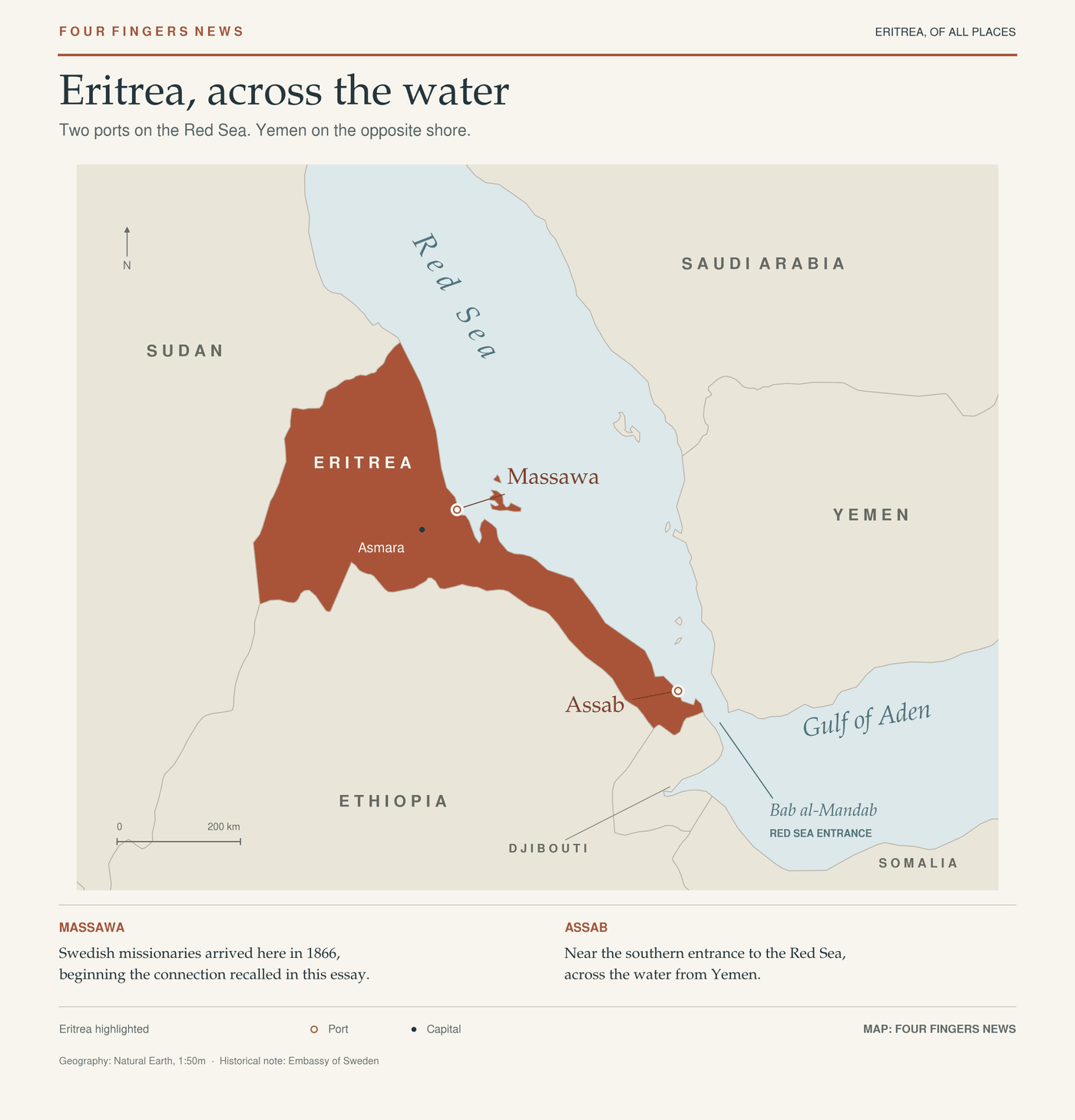
The answer goes back to 1866, when Swedish Lutheran missionaries landed at Massawa on the Red Sea. They meant to push on into Ethiopia. Unrest changed their plans, so they stayed and built missions in what’s now Eritrea. Over generations, those connections grew into congregations, schools, clinics and relationships that later helped carry humanitarian relief.
My family has Swedish roots. So a childhood memory from a church near Seattle turns out to have a history stretching across continents and back more than a century. I still haven’t found the particular fundraiser I remember. But the connection makes sense.
Now Washington’s got its own renewed interest in Eritrea, and the timing deserves attention.
For months, we’ve watched attacks on American bases in the Gulf expose the vulnerability of a military presence built over decades. Buildings damaged or destroyed. Personnel evacuated. Questions about what can be rebuilt, what can be defended, and where forces might have to operate instead. The geography that once helped the United States project power has become a source of exposure.
Against that backdrop, look at the opening toward Eritrea. The United States has lifted sanctions on the country’s military and ruling party. Officials have been discussing closer relations, including security cooperation. A government Washington sanctioned is now a government Washington’s courting.
Eritrea’s coastline faces Saudi Arabia and Yemen across the Red Sea. Its ports sit beside some of the most consequential shipping lanes in the world. The UAE previously used Assab to move troops and heavy equipment into Yemen.
There’s no confirmed American basing agreement in the reporting I’ve found. But you don’t need a signed lease to recognize why Washington’s interested.
Meanwhile, Britain’s agreed to provide aerial refuelling for Saudi aircraft responding to Houthi attacks. The problems around these waterways keep drawing in more countries, more resources and more commitments.
As existing positions become harder to defend, the search for alternatives can pull more places into the war. Moving the footprint doesn’t necessarily reduce the conflict. It can spread the commitments needed to sustain it.
Put these developments together and the question gets bigger than Eritrea: what’s the plan for making all of this smaller?
Every new commitment arrives with its own explanation. Protect the shipping. Support the partner. Keep the route open. Answer the latest attack. Find somewhere safer to operate. Each move has an immediate justification. Together, they deserve an explanation of where they lead.
A government should be able to say how its next military commitment brings the end of a war closer. It should tell the public what success requires, what obligations it’s taking on, and what happens if the next move produces another crisis that needs another response. We’re entitled to ask while the decisions are still being made.
Eritrea caught my eye because I’d heard the name in a very different setting, decades ago. What started as a childhood memory led me through Swedish missionary history and back to a country that powerful governments are once again weighing for its location.
A coastline that looks useful from Washington is somebody’s home. Any bargain over access, security or influence carries consequences for people who may have very little say in it.
The map keeps growing. Where’s the plan to bring the war to an end?